Key Takeaways
- For stainless steel flask orders, practical MOQ usually starts at 1,000-3,000 pcs per color and capacity
- 304 stainless steel is standard for food-contact interiors; 316 is used when corrosion resistance matters more than price
- Powder coating often costs USD 0.25-0.60 more per unit than basic spray paint but resists scratches better
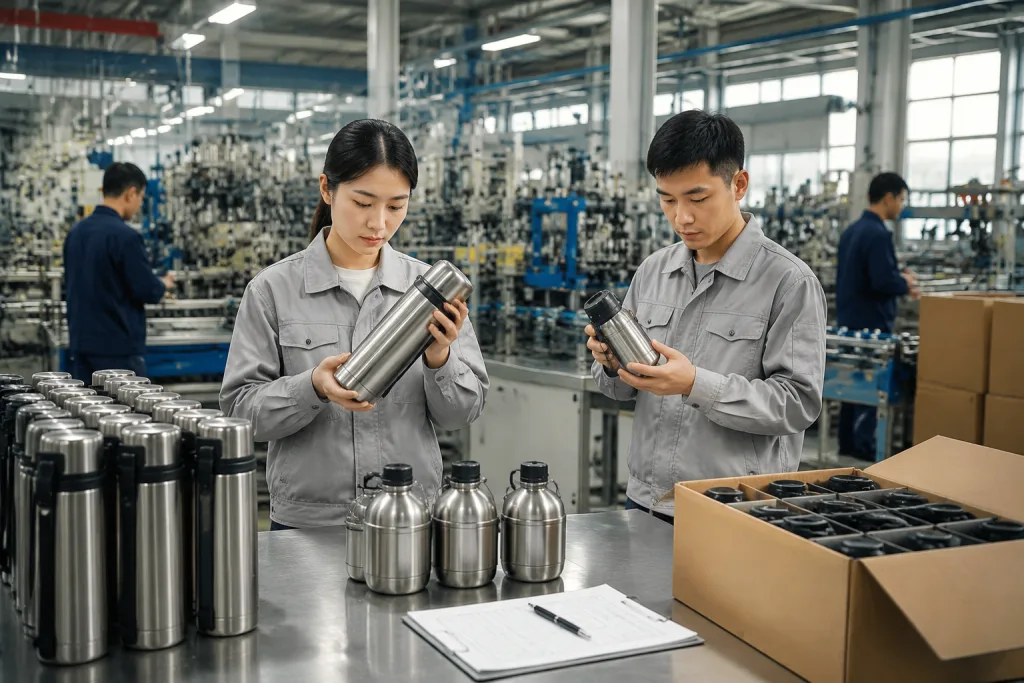
- AQL 2.5/4.0 inspection before shipment is cheaper than replacing leaking stock after distribution
If you are searching for vendors stainless steel flask, you are not just comparing one bottle with another. You are deciding how much trouble your next custom drinkware order can absorb: a 500 ml cup measuring 472 ml in QC, powder coating that chips on the cross-hatch tape test, lids leaking after 3 minutes upside down, 12 days promised vs 18 days shipped, or a color box that the retail buyer rejects because the barcode sits 4 mm too low.
At BottleForge Industrial in Hangzhou, Zhejiang, we’ve watched buyers fight for USD 0.10 off the unit price while skipping the checks that decide whether the program sells cleanly. Wrong question. The line runs smoother when the buyer locks the structure, compliance file, decoration process, and vendor control points before pushing FOB China pricing; last month QC pulled 32 samples from a 3,000 pcs trial order and the only real issue was a PO typo calling for matte black while the artwork said gloss black.
Start With The Real Buying Decision
The first decision is not “which canteen supplier is cheapest?” The better question is “what job does this flask need to do?” A canteen giveaway for a 10,000 pcs sports event can live with a simpler body and one-color logo, while a distributor canteen line for outdoor shops needs retail packaging, barcode control, and fewer dent complaints at AQL 2.5. A premium customized growler for craft beverage retail is another spec altogether. We have seen this go sideways when a buyer sent one photo and expected three price levels from the same flask.
For a basic custom canteen, 201 stainless steel single-wall, 0.5 mm wall thickness, and a screw cap with silicone ring can be fine. It keeps landed cost low, often around USD 2.20-3.20 FOB China for 500-750 ml depending on finish and packaging. QC still checks the thread with a go/no-go gauge because a 0.3 mm mismatch on the cap will become a leak complaint. For a vacuum insulated flask, move to 304 stainless steel inside, 201 or 304 outside, 0.4-0.5 mm shell thickness, copper plating if heat retention matters, and a cap that passes a 24-hour upside-down leak test.
The trade-off is plain. Single-wall products are cheaper and lighter. The line can run them faster, often 18,000-22,000 pcs per day on a stable shape. Vacuum flasks cost more because welding, vacuum testing, and lid control all need tighter handling. If your buyer expects 12 hours hot and 24 hours cold, a single-wall bottle is the wrong quote even if the photo looks close. The math doesn't work, and the buyer will flag it after the first sample test with boiling water and a digital probe.
At our Zhejiang facility, normal monthly output is about 450,000 stainless steel drinkware units, with standard production lead time of 30-40 days after artwork and deposit approval. For new molds, special lids, or a custom growler handle, add 15-25 days. Put that timing on the PO before release. Last month, QC pulled the sample on a custom handle order because the buyer’s PO said matte black, while the artwork file said PMS 426C gloss; that kind of small mismatch can burn 3 days before the order even reaches polishing.
Choose Material Before Decoration
About 7 out of 10 buyers ask for logo options before we even confirm the steel grade. This is the wrong question to ask. Decoration sits on top of the product, and QC pulled samples from one 3,000 pcs run where the laser mark looked clean but the body failed the 1.2 m drop test. Wrong base material kills the order.
For most vendors stainless steel flask projects, we run food-grade 304 stainless steel on the inside wall. It is accepted for EU and North American custom drinkware programs, handles acidic drinks better than 201, and supports LFGB, FDA food-contact, and REACH-related chemical checks when the full construction is tested. 316 stainless steel gives stronger corrosion resistance, but it adds 8-15% to raw material cost on our coil quotes. Use it only when the retail price can carry it; for a USD 6.20 promo flask, the math doesn't work.
Wall thickness matters on the line and in the carton. A 0.35 mm outer shell can look fine on a quotation, but our caliper check at incoming material shows those shells dent faster during ISTA-style drop handling. For mid-market distributor drinkware, we usually recommend 0.4-0.5 mm outer thickness. For large 1.9 L or 2 L customized growler designs, 0.5-0.6 mm gives better structural confidence around the base and shoulder, where dents show first on retail shelves.
Do not ignore lids. A canteen manufacturer may show a beautiful body sample and then attach a cheap PP lid with thin silicone; we have seen this go sideways when the buyer flagged leakage after 18 days of transit instead of the planned 12 days. Ask the canteen vendor for lid material, silicone hardness, thread tolerance, and test records after 500 open-close cycles. Tritan and PP lids do not age the same under hot-fill checks. Bamboo looks good for sustainable positioning, but it needs tighter moisture control and 5-ply carton packing during humid China export seasons.
Your material decision sets the quality ceiling. Decoration can lift perceived value, but material and lid design decide return rate; on one PO the buyer even typed “304 body” while the approved sample label said “201 outer,” and QC stopped it before mass production.
Match Branding To The Finish
I’ve got the rewrite shape. Next I’m tightening the wording so it sounds like a factory-side sales engineer, not marketing copy, while keeping the HTML exactly as-is.A canteen customization program usually fails in two spots: the logo wears off after normal use, or the finish makes a good flask look cheap. We had one buyer flag a PO that called for matte black on a gloss body, and the first sample was already off before QC signed it. The right method depends on coating, order volume, and how fine the artwork is.
Silkscreen printing works well for simple one- or two-color logos on flat or slightly curved surfaces. On our line, it usually runs USD 0.06-0.18 per print position and makes sense for MOQ of 1,000 pcs. Pad printing can handle smaller curved areas, but for a large stainless flask body it is rarely the best fit. Laser engraving is cleaner for powder-coated stainless steel; a CO2 laser burns through the coating and leaves the metal showing, and it usually adds USD 0.12-0.35 per unit depending on logo size and machine time.
For a canteen promotional order where price leads, spray paint plus silkscreen may be enough. For a premium customized drinkware retail line, powder coating plus laser engraving is the safer call. We have seen the math go sideways when a buyer chases a low unit price and then pays for rework after a poor abrasion result. When the coating is set up right, ask for a tape test, an alcohol rub test, and a 3M scratch sample before mass production.
Full-wrap heat transfer or water transfer can make a customizable canteen stand out, especially for outdoor, campus, or corporate programs. The weak point is the seam and the neck curve, where registration slips first; our QC has pulled samples there more than once on a 360-degree wrap. If your design needs full coverage, approve a production-line sample, not just a digital mockup. A mockup shows layout. A sample shows whether your canteen manufacturers can hold color, registration, and edge alignment on the line.
Price Quotes Need The Same Specification
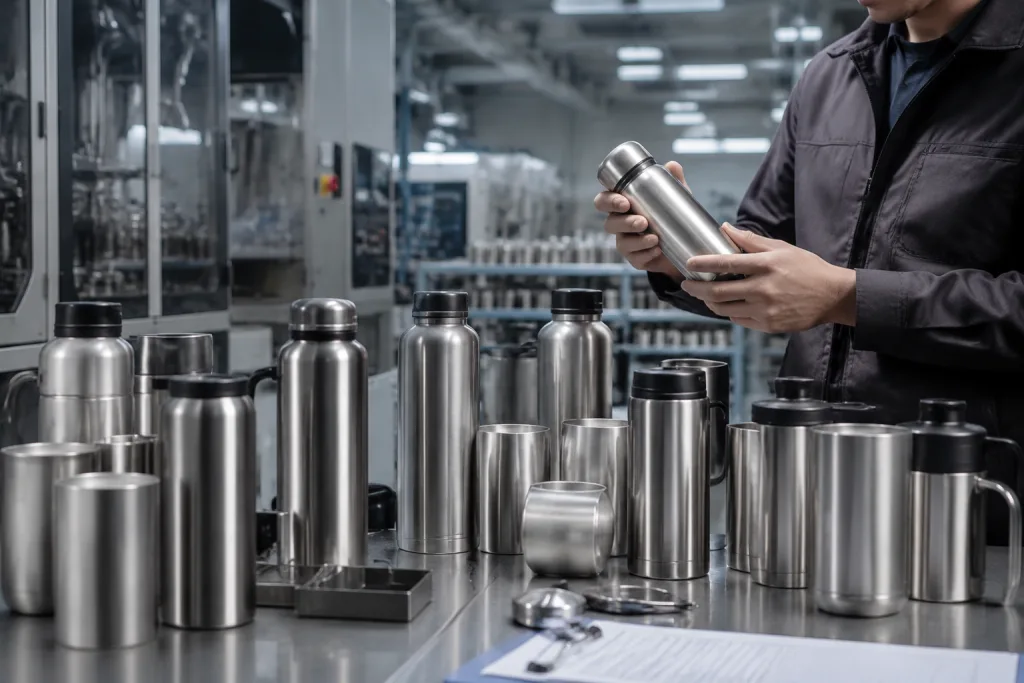
You cannot compare canteen suppliers fairly unless every quote uses the same spec sheet. “750 ml stainless flask with logo” is not a spec. It is a fast way to get five prices for five different builds. On our line, we check wall thickness with a caliper before we even talk price.
A usable RFQ should spell out capacity, single-wall or vacuum insulated structure, inner and outer stainless grade, wall thickness, lid material, coating type, decoration method, packaging, test requirements, Incoterm, and target delivery date. If you need Amazon or marketplace handling, add FNSKU labeling, carton weight limits, drop-test expectations, and whether the canteen distributor needs individual polybag-free packaging. The buyer who leaves out carton limits usually comes back after QC flags the pack-out.
Here is a realistic example. A 750 ml vacuum insulated custom canteen with 304 inner, 201 outer, powder coating, laser logo, standard lid, color box, and 1,500 pcs MOQ may quote around USD 5.20-6.80 FOB Ningbo or Shanghai, depending on steel price and coating color. Change to 304 outer shell, custom lid tooling, Pantone-matched coating, and retail gift box, and the price can move above USD 7.50. On the bench, QC pulled the sample and checked the lid torque twice; that is where the extra cost sits.
For a custom growler at 1.9 L, expect more steel, larger cartons, and freight that bites harder. A distributor growler line can look fine at FOB level and still lose money once ocean freight, duties, warehouse handling, and replacement stock are in the math. Ask your canteen factory for master carton dimensions early. A 5% shift in carton cube can matter more than a USD 0.08 product discount, and we have seen buyers push back on that only after the booking is already in.
Good vendors will push back on vague specs. Weak vendors will fire off a quote and fix the mess later with excuses. We ship faster when the PO says the right thing the first time; a typo like “304 outside” instead of “201 outer” has burned a week on the schedule before.
Check Compliance Like A Buyer
Check compliance before the 30% deposit, not after 12,000 flasks are boxed in a Ningbo warehouse. For Europe, we ask which rule drives the order: LFGB for food contact on the inner 304 stainless, REACH for restricted chemicals in coating and straps, and packaging rules for labels, recycling marks, and polybag warnings. For North America, FDA food-contact expectations and California Proposition 65 depend on the sales channel; one U.S. buyer flagged us over a missing Prop 65 warning sticker on the master carton. Kids items need a tighter read, with ASTM or CPSIA checks on paint adhesion, cap parts, and anything a 3-year-old can twist off.
Factory audit requirements sit in a different bucket from product compliance. BSCI, Sedex, ISO 9001, and similar systems do not prove a flask is food-safe. They show how the factory manages labor records, corrective actions, or process control; they do not tell you whether black powder coating passes migration testing. Both matter. Do not mix them up. If a canteen manufacturer sends only a 2022 audit PDF and no current 304 stainless material test report, keep asking until QC can match the report to the heat number on the steel coil.
For customized canteen orders, test the final decorated product when the budget allows. The coating and ink usually create the risk; the silicone gasket, PP lid, and stainless body still need to be named on the report. A plain stainless test report from 18 months ago does not cover your matte red coating and printed logo ink, and we have seen this go sideways when a buyer changed Pantone color after sample approval. QC pulled the sample, did a 3M tape cross-hatch check on the logo, then the lab still asked for the finished bottle, not loose parts. National retail programs and distributor drinkware catalogs will not accept guesswork here.
At BottleForge Industrial in Zhejiang, China, we run material declarations, production batch records, and inspection files against PO numbers, including carton marks and the final approved sample photo. For repeat orders, that history lets you avoid retesting every component while keeping traceability back to the PO; last month it saved a buyer 9 days because the lab accepted the same lid material file. For new canteen distributors, set the compliance checklist before sample approval: target market and standard first, then lab name, test scope, who pays, and the cutoff date. Boring work. It prevents expensive arguments, especially when someone spots a typo on the PO after mass production starts.
Audit The Vendor Control Points
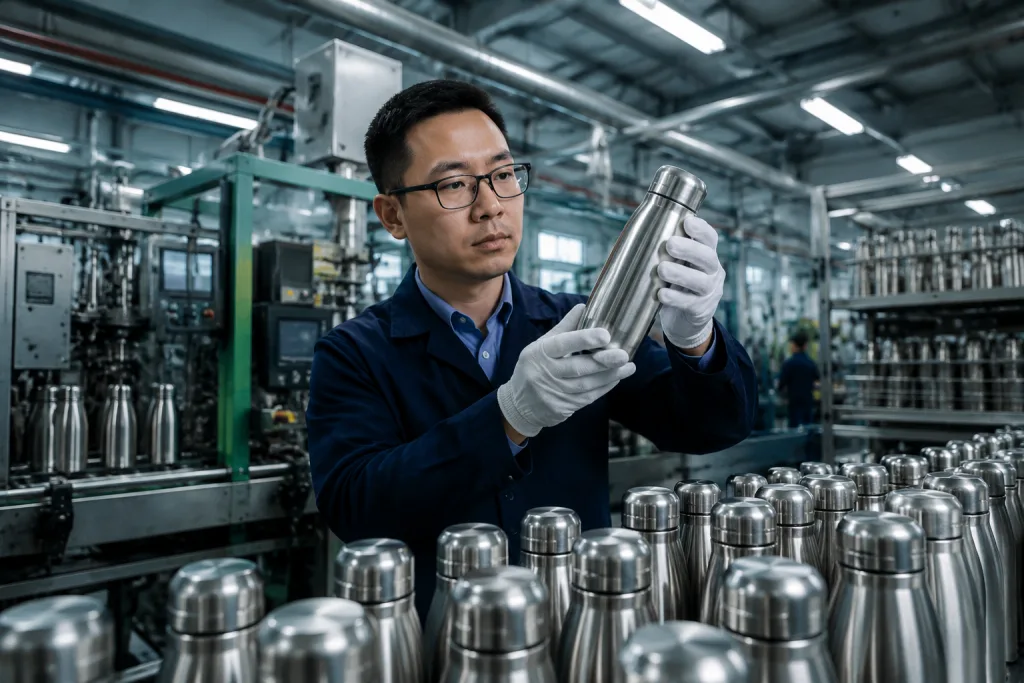
A canteen vendor is not just a price source. The vendor controls 304 stainless coil buying, drawing, seam welding, vacuum pumping, polishing, powder coating, assembly, inner bag packing, and vessel booking. One weak station is enough. We have seen cartons pass a quick outer check while 37 pieces inside had rattling lids because the line changed a silicone gasket without updating the BOM.
For vacuum stainless steel flask production, ask exactly where vacuum testing sits on the route card and what gets rejected. A practical factory should run vacuum performance checks after vacuuming and again after assembly on sampled units. For leak testing, we run water fill, cap torque check with a 0.6 N·m torque driver, and 30 minutes inverted on a white tray. For heat retention, a common internal method is filling at 95°C and checking temperature after 6, 12, or 24 hours depending on the product claim. QC pulled the sample last month because 2 out of 80 dropped 9°C faster than the approved sample.
Inspection should be written into the order, not discussed after the goods are packed. Standard consumer drinkware orders often use AQL 2.5 for major defects and AQL 4.0 for minor defects, with critical defects set at 0. Critical defects include sharp edges, contamination, broken insulation, severe leakage, and unsafe packaging staples. Major defects include wrong logo position, obvious coating chips, poor lid fit, and capacity outside tolerance. Minor defects include small cosmetic marks within an agreed limit, such as one black dot under 0.5 mm outside the logo viewing area. Put it on the PO. We once had a buyer flag “mat finish” as a typo, and the supplier read it as matte coating for the full 3,000 pcs run.
If you are working with multiple canteen manufacturers, demand pre-production samples, sealed color standards, and carton marking approval before deposit balance. A canteen factory may read “navy blue” differently from your brand book. Pantone references help, but powder coating still needs physical approval under D65 light, not just a phone photo from the coating room. For repeat distributor canteen orders, keep a golden sample at the factory and one in your office. This is the wrong place to save 2 days. The fastest dispute settlement is still putting the new sample beside the signed golden sample on the QC table.
Plan MOQ, Lead Time, And Reorders
MOQ is not just a factory rule. It is tied to 304 stainless coil buying, powder coating line changeover, laser logo fixture setup, packaging print plates, and export carton runs. For standard stainless flasks from China, a sensible MOQ is 1,000 pcs for stock shape with one color and one logo. For Pantone coating, custom packaging, or a canteen customized lid, 2,000-3,000 pcs is more realistic because the coating booth needs about 18 kg of powder to run clean without shade drift. For new mold development, you may need 5,000 pcs or a tooling charge. We had one buyer push back on 800 pcs with three colors; the math didn't work once the line counted washout time.
If you are a new canteen distributor testing a market, do not over-customize the first order. Use an existing body shape, standard lid, and one finish that already passed our drop test jig. Spend the budget on stronger color box paper, a clean barcode label, and AQL 2.5 inspection before shipment. Simple sells first. Once sales data proves the SKU, move to a canteen customizable platform with special lid, molded grip, or exclusive color series. We have seen this go sideways when a first PO had a typo in the Pantone code and the buyer only caught it after QC pulled the pre-production sample.
Lead time should be planned backwards from the shelf date. A normal timeline is 7-10 days for sample, 3-5 days for artwork confirmation, 30-40 days for mass production, 3-7 days for inspection and export paperwork, then freight. Ocean shipment to Europe or North America can add 25-45 days port-to-port, or 38-60 days if inland trucking and warehouse appointment are included. Air freight fixes the calendar but can kill margin on heavy stainless goods; one 18 oz flask carton at 12.6 kg chargeable weight is not friendly. On the line, one late logo approval can hold 6,000 pcs in semi-finished racks.
Reorders are where good vendor relationships pay off. Keep the same steel grade, coating code, logo file, carton layout, and inspection checklist. Ask your canteen suppliers to keep coating powder details, logo fixture photos, and tooling records in the order file. If your custom drinkware line becomes a quarterly program, forecast by quarter instead of issuing emergency POs. China factories can move fast, but stable planning gets you better capacity, fewer substitutions, and cleaner delivery performance. We ship smoother when the repeat PO says “same as PO 24-117, carton mark rev B” instead of sending 11 mixed attachments on Friday night.
Send Your Flask Specification For A Practical Quote
Share capacity, material, logo method, packaging, and target market. We will review feasibility, MOQ, lead time, and FOB China pricing.
Frequently asked questions
What MOQ should I expect from vendors stainless steel flask suppliers?
For a standard stainless steel flask using an existing mold, expect 1,000 pcs MOQ per color and capacity if the logo is simple. If you need Pantone powder coating, custom color box, or a customized canteen lid, 2,000-3,000 pcs is more realistic. New mold projects, such as an exclusive custom growler body, often require 5,000 pcs or a separate tooling charge of USD 800-3,500 depending on complexity. Be careful with very low MOQ offers. They may use stock colors, mixed production batches, or limited QC control, which can be fine for samples but risky for distributor drinkware programs.
Is 304 stainless steel always necessary for custom canteen orders?
For the interior food-contact surface, 304 stainless steel is the safest default for most custom canteen and customized drinkware orders. It gives better corrosion resistance than 201 and is widely accepted for EU and North American testing. The outer wall can be 201 or 304 depending on positioning and budget. For premium products, coastal markets, or acidic beverage use, 304 outer or even 316 inner can make sense, but expect an 8-15% material cost increase. If a canteen supplier quotes much lower than others, ask whether both inner and outer walls are 304 or only the inner wall.
Which logo method is best for a promotional stainless flask?
For a basic canteen promotional project, silkscreen printing is usually the most economical choice at roughly USD 0.06-0.18 per print position. It works best for simple logos with one or two solid colors. For powder-coated stainless flasks, laser engraving is more durable and usually adds USD 0.12-0.35 per unit depending on logo size. Full-wrap graphics look attractive but need higher setup control and should be approved with a production sample. If your order will be used daily or sold at retail, I would choose powder coating plus laser before choosing cheap spray paint plus print.
How do I compare prices from different canteen manufacturers fairly?
Send every canteen manufacturer the same RFQ sheet. Include capacity, vacuum or single-wall construction, stainless grade, wall thickness, lid material, coating, logo method, packaging, compliance tests, MOQ, Incoterm, and required delivery date. Without those details, one canteen vendor may quote 201 stainless, thin shell, spray paint, and bulk pack while another quotes 304 inner, powder coating, laser logo, and color box. The cheaper price may not be a better offer. For a 750 ml vacuum flask, a realistic FOB China range can be USD 5.20-6.80 with decent retail packaging.
What inspection standard should I use before shipment?
For B2B stainless flask and custom drinkware orders, AQL 2.5 for major defects and AQL 4.0 for minor defects is a practical baseline. Critical defects should be 0 accepted. Your inspection checklist should cover leakage, insulation performance, sharp edges, odor, coating adhesion, logo position, color matching, carton strength, barcode or FNSKU labels, and quantity. For vacuum flasks, add a heat retention sample test, such as filling with 95°C water and checking temperature after 6 or 12 hours. Third-party inspection in China usually costs far less than handling returns after stock reaches Europe or North America.