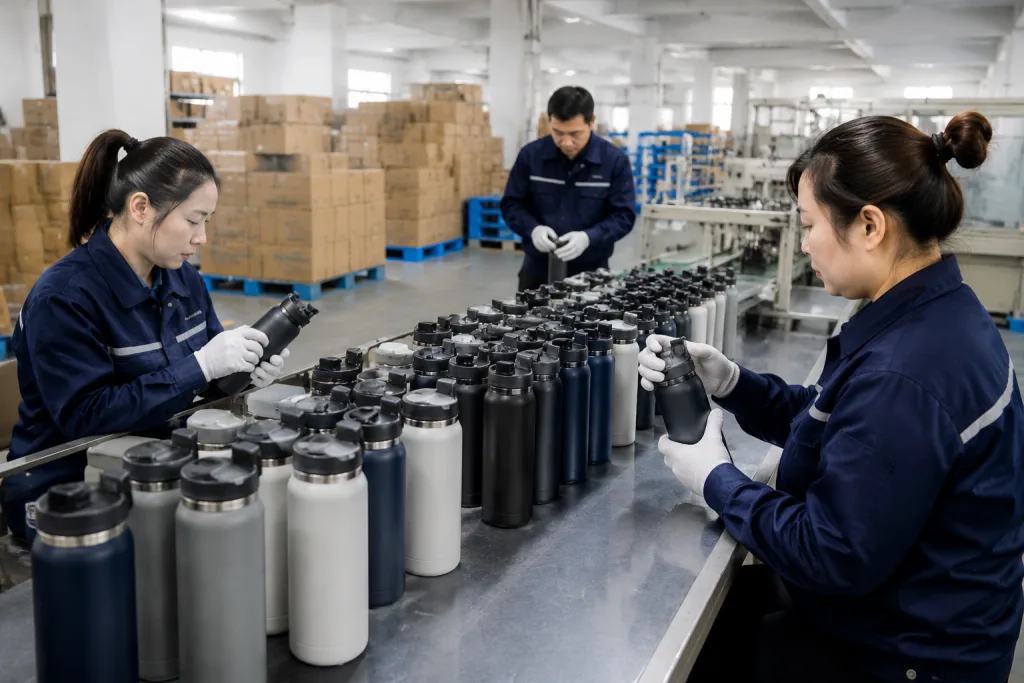
Key Takeaways
- For most custom sports water bottle orders, plan MOQ at 3,000 units per color and 25-35 production days
- AQL 2.5 for major defects and AQL 4.0 for minor defects is a realistic inspection setup
- Logo method changes cost by USD 0.08-0.65 per unit depending on print area and durability
- Shaker bottles need tighter checks on lid thread, ball fit, odor, and dishwasher claims
Your gym chain needs 8,000 bottles for a spring member campaign. Marketing asks for a sharp logo with no ink bleed at the curve. Ops wants cartons that do not split after 2 drops from 80 cm. Finance wants the unit cost frozen before artwork approval. Fair enough. This is where 7 out of 10 buyers start searching for vendors sports water bottle suppliers and end up comparing quotes that hide carton spec, logo setup, and spare-parts cost.
Here is a real sourcing path, from spec sheet to shipment. We run these orders with China factory numbers: MOQ 3,000 units per color, 25-35 day production after sample approval, and FOB Ningbo or Shanghai pricing. BottleForge Industrial is in Hangzhou, Zhejiang, and QC pulled the same issue last month on a gym-chain sample: the lid passed a hand leak test, then failed after 6 hours upside down on the test rack. Ask for the leak test method first; chasing the lowest quote is the wrong question to ask.
Start with the gym use case
The wrong move is asking a vendor for catalog pricing before you lock the use case. A bottle sold at reception faces a different brief than one handed out with a 12-month membership. Retail needs better carton work and a cleaner shelf read. A giveaway bottle can be plain, but if the cap leaks in a gym bag, the buyer will flag it on day one.
For a fitness brand or gym chain, we run four buying lanes. First, a bulk sports water bottle for general member giveaways, usually 600-750 ml, single-wall Tritan or PP, one-color print. Second, a bulk gym water bottle for retail shelves, often 750-1,000 ml, with a better lid, carry loop, and individual color box. Third, a bulk shaker bottle for protein programs, normally 500-700 ml, with a mixing ball or grid. Fourth, a custom fitness water bottle for branded merchandise, where color match and surface finish matter more than shaving USD 0.05 off the price. On the line, we check cap torque at 0.8-1.2 N·m. The math does not work if you squeeze all four into one spec.
Here is a workable scenario: you need 8,000 units for 22 gyms across Germany, France, and the Netherlands. You choose a 750 ml Tritan flip-top bottle, custom PMS 432C body tint, black lid, white logo, and individual polybag plus master carton. That brief is tight enough for a vendor to quote cleanly. Without it, you get a low number that jumps after sampling. QC pulled the first sample and checked logo position at 2 mm from the shoulder, because a PO with “blue-ish” or a wrong PMS code turns into a week of back-and-forth.
At our Zhejiang factory network, a standard sports bottle line can run about 450,000-600,000 plastic bottles per month, depending on mold allocation. That sounds like plenty, but caps, silicone seals, and color matching still slow the line. The 32-cavity mold may be ready, then the lid insert or seal gasket holds everything up. Give the supplier the launch date first, then build backward from the actual production calendar.
Lock the bottle specification early
A custom sports water bottle spec should fit on one page. If it takes ten emails to explain the bottle, our QC team on the line will read it three different ways. Start with resin grade and capacity, then lock the drawing size in mm, lid structure, logo process, export carton, and target market compliance. We run this off a signed spec sheet, not a WhatsApp screenshot.
For Europe and North America, common material choices are Tritan, PP, PE, AS, stainless steel, and glass. Tritan works well for a customizable sports water bottle because it stays clear, takes drop testing better than AS, and does not feel like thin PP from a giveaway order. For shaker programs, PP still wins when the buyer needs a lower unit cost and repeat gym use. If you are ordering a custom shaker bottle or custom made shaker bottle, write down food-grade PP body, silicone seal on the lid, and 304 stainless steel mixing ball. QC pulled one sample last month where the PO said “steel ball,” and the supplier tried to quote a cheaper chrome-plated part. Bad shortcut.
Wall thickness matters. A light promotional PP bottle may be 1.2-1.5 mm. A better Tritan gym bottle is often 1.8-2.2 mm in the body, with extra resin near the shoulder and thread where bottles crack first. Ask for the resin weight target in grams. If you push the price too low, the factory may cut resin weight by 8-12%. You may not catch it on one golden sample, but end users will see stress whitening after 14 days of drops, dishwasher heat, and locker-room abuse. We have seen this go sideways.
For our buyer scenario, the agreed spec is 750 ml Tritan, 2.0 mm average body wall, flip-top lid with silicone gasket, 55 mm mouth opening, one-hand push button, carry loop, and temperature range from -10°C to 90°C. That is a customized sports water bottle, not a science project. The math works because the vendor can hold tolerances on a proven mold; a rushed decorative mold usually gives you flash on the thread, lid wobble, or a gasket gap over 0.3 mm.
Ask for a signed product specification sheet before paying the deposit. It should include net weight target, carton quantity, carton dimensions, gross weight, HS code estimate, and compliance standards such as LFGB, FDA, REACH, or California Proposition 65 if applicable. We also ask the buyer to stamp the artwork page and carton mark page, because one typo on a PO can turn “750 ml” into “700 ml” on 3,000 color boxes.
Price the order without guessing
Most vendor quotes are hard to compare because one line includes the polybag, another drops the logo, and a third quietly swaps in a thinner lid. On an 8,000-unit custom gym water bottle order, we break the math into five lines: bottle body, lid assembly, logo decoration, packaging, and export handling. Tooling stays separate if you need a private mold. Last week QC pulled a sample with a 0.2 mm lid gap, and that kind of detail is what changes the quote.
For reference, a 750 ml Tritan sports bottle with a flip lid usually lands around USD 1.65-2.35 FOB China at 5,000-10,000 units, depending on resin grade, lid structure, and pack style. A simple PP bulk fitness water bottle can sit at USD 0.65-1.10. A better customizable gym water bottle with matte finish, wider mouth, and an individual retail box can move to USD 2.20-3.20. A bulk shaker bottle may start near USD 0.85 for a basic PP version and reach USD 1.60-2.40 for a heavier custom logo shaker bottle with a stainless mixing ball and embossed measurement scale. We run these numbers against the line every week, and the math does not work if someone quotes retail-box quality at bulk-bottle pricing.
Logo pricing is where buyers get caught. One-color silk screen may add USD 0.08-0.15 per unit. Multi-color printing can add USD 0.18-0.45. Laser engraving on stainless steel is usually USD 0.12-0.30. Heat transfer or full-wrap decoration can add USD 0.35-0.65 and needs tougher abrasion testing. If you need a customized shaker bottle with both front logo and side measurement markings, price both operations separately. The buyer flagged this on a PO before; the logo was fine, but the scale print had its own setup charge.
For a new China supplier, the usual term is 30% deposit and 70% before shipment after inspection. FOB Ningbo or FOB Shanghai is standard for Zhejiang suppliers. If you ask for DDP to your gym warehouse, you can get a landed estimate, but still ask for the FOB unit price first. That keeps the bottle cost and freight cost clean. On one shipment, a PO typo moved the carton count from 12 to 120, and the only way to catch it was the FOB breakdown. For the scenario order, I would expect a fair FOB range of USD 1.95-2.25 for 8,000 units, assuming one-color logo, custom body color, standard lid mold, and individual polybag. If a quote is USD 1.35, something is missing.
Approve samples like an inspector
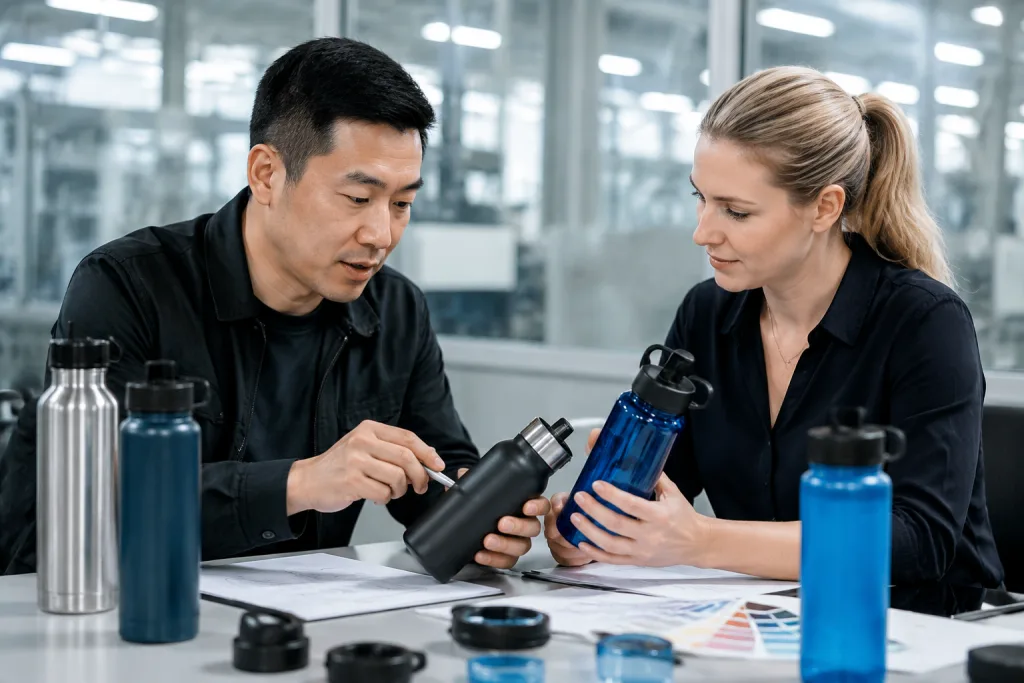
Sampling is not photo approval. You need a pre-production sample made with the same resin grade, same color masterbatch, same logo process, and the same lid seal planned for bulk. If a supplier sends a random clear bottle from stock and says the final color will change later, treat it as a reference sample, not an approval sample. QC pulled one like this last month: the stock lid passed, but the bulk lid gasket was 0.4 mm thinner and leaked on the tilt rack.
For a customizable fitness water bottle, approve the bottle, artwork, and packaging as separate checkpoints. On the bottle, check capacity, lid swing, seal compression, weight in grams, hand feel, and drop result. On the artwork, measure logo size with a caliper, confirm placement from the seam line, check PMS tone, and look for fuzzy print edges under a 10x loupe. On packaging, scan the barcode, read the warning text, confirm carton marks, and check any FNSKU or warehouse label if the bottles will move through ecommerce channels. We’ve seen this go sideways because a PO had “FNSKU” typed as “FNSK,” and the buyer flagged it only after cartons were packed.
Our buyer scenario needs a dark grey translucent body. PMS color matching on plastic is not the same as printing on paper. Resin wall thickness changes the tone; a 2.2 mm side wall and a 3.0 mm base will not read the same under gym lighting. Ask the supplier for a color chip or injected color plaque before mass production. A Delta E tolerance of under 2.0 is difficult on translucent plastic; under 3.0 is more realistic for 8 out of 10 production runs we run. The wrong question is “Can you match this exactly?” The better question is “What tolerance can your injection line hold on this resin?”
Do basic abuse checks before approving. Fill the bottle with water, close the lid, lay it sideways for 8 hours, then invert it for 30 minutes. Drop a filled bottle from 1.0 meter onto a rubber mat, then onto a hard surface if that matches your use case. Run the lid open-close cycle at least 50 times by hand. For a custom shaker bottle, shake it hard for 60 seconds with water and protein powder, then check the gasket, thread, and odor after washing. Simple test. On our line, QC marks leakage with a red paint pen on the sample card, because photos hide small beads around the thread.
Sampling normally takes 7-10 days for existing molds and 15-25 days when custom color matching and print trials are involved. In Zhejiang, we tell buyers not to book promotion dates until the approved sample is physically in their office. We ship samples by DHL when the buyer needs speed, but the math does not work if a launch date assumes 7 days while the logo still needs a second silk-screen trial and one alcohol-rub test.
Control production before cartons close
After the deposit lands, the order is no longer “just make bottles.” It becomes a control job. A solid vendor locks resin buying, injection molding, logo decoration, lid assembly, packing, and QC timing on one sheet. We run this with a production board beside the injection line, not with WeChat voice notes. For distributors sports water bottle buyers, friendly updates are not enough; ask for written checkpoints before the cartons get taped.
For an 8,000-unit run, a workable schedule is 3-5 days for material preparation, 5-8 days for injection molding, 4-7 days for logo printing and curing, 3-5 days for assembly and packing, then 1-2 days for final inspection and loading. Total lead time is usually 25-35 days after sample approval. If a supplier promises 12 days in China’s peak season, this is the wrong question to ask: do not ask “Can you do it?” Ask which step gets squeezed. Last April, QC pulled samples from a rushed line and found 6 lids with weak hinge pins before packing even started.
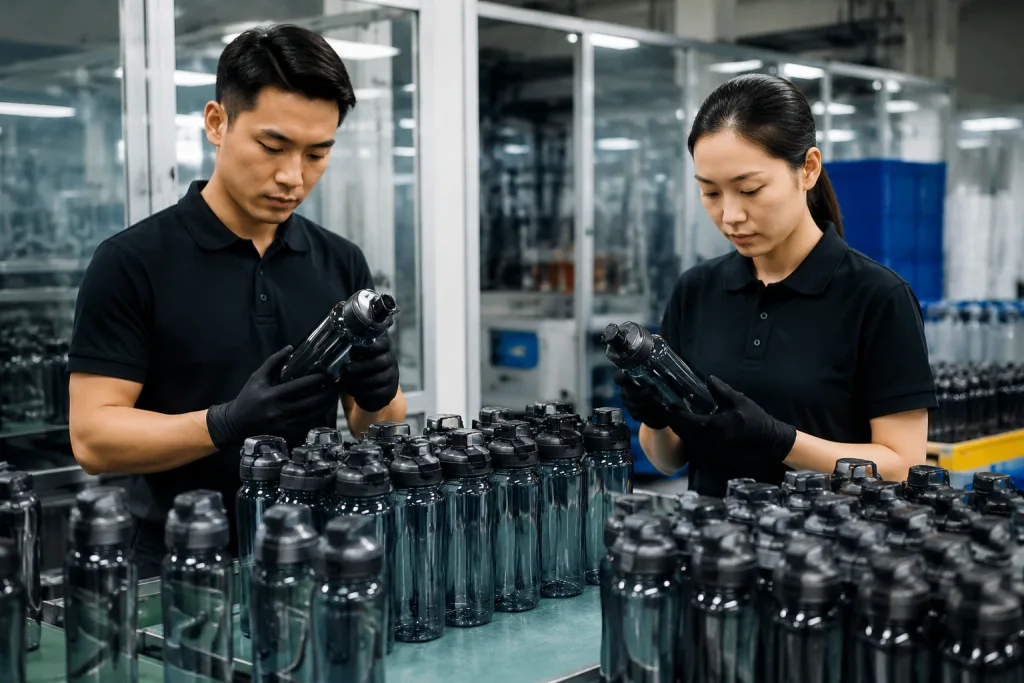
Set an in-line inspection when 20-30% of the order is complete if the project is new, the color is difficult, or the bottle has a complicated lid. This catches print alignment, color drift, lid fit, and packaging mistakes before the full order is sealed. We check logo position with a 0.5 mm steel ruler and compare body color against the approved sample under a D65 light box. A final random inspection should follow ANSI/ASQ Z1.4 or ISO 2859-1 sampling. For drinkware, many buyers use AQL 2.5 for major defects and AQL 4.0 for minor defects. Critical defects, such as contamination, sharp edges, or leaking seals, should be zero tolerance.
Define defects in plain language. Major defects include leakage, cracked body, broken lid hinge, wrong material, wrong logo, and barcode that cannot scan. Minor defects include small print dust, slight flow mark, minor carton scuff, or acceptable color variation within the approved tolerance. For a distributor gym water bottle order, carton strength also matters. A common export carton is 5-ply corrugated, 42-48 bottles per carton, with gross weight kept under 15-18 kg so warehouse staff can handle it without damage. We have seen this go sideways when a PO had “48 pcs/ctn” typed as “84 pcs/ctn”; the buyer flagged crushed bottles after the first pallet stack.
Ask for inspection photos of filled leak tests, logo rub tests, carton drop tests, and packed pallet condition. We ship only after the line sends clear photos of upside-down bottles filled for 30 minutes, a 3M tape pull on the logo, and a 76 cm carton drop test. If the supplier refuses inspection before balance payment, choose another vendor. The math does not work if you save two days and receive leaking stock.
Plan compliance and documentation
Fitness brands often push compliance to the week before shipment. Bad habit. A customized fitness water bottle touches the mouth, sits with lemon water at pH 3-4, and goes through 500 dishwasher cycles in some buyer test plans. Line it up before we run mass production, not after 312 cartons are taped and sitting by the dock.
For Europe, ask about LFGB food contact testing, EU 10/2011 for plastic materials where relevant, REACH SVHC screening, and packaging waste markings if required by your market. For the United States, FDA food contact compliance and California Proposition 65 risk review may matter. For kids or youth gym programs, ASTM and CPSIA questions can appear depending on the bottle design and age grading. If your gym chain sells in Canada, bilingual packaging may also be required; we once had QC pull 2,000 color boxes because the French warning line was missing on the side panel.
Do not accept a five-year-old test report for a different bottle and assume it covers your order. The math doesn't work. A report only has value when the material, colorant, supplier, and tested item match your production goods closely enough for a lab to defend it. Dark pigments, soft-touch coatings, silicone seals, and printed inks can shift compliance risk; on one 750 ml shaker, the buyer flagged the ml/oz measurement ink after the cup body had already passed. For a custom logo shaker bottle, include the measurement ink and lid gasket in the compliance check, not just the cup body.
Factory audits are a separate issue. BSCI, Sedex, ISO 9001, and other documents do not prove the bottle is food safe, but they show how the factory controls records, training, and corrective actions. If you are a larger gym chain, ask your vendors sports water bottle shortlist for audit status before sampling; we usually need 1-2 working days to pull the latest audit PDF and CAP from the document clerk. It saves time.
For export documentation, expect commercial invoice, packing list, bill of lading, certificate of origin if needed, and test reports. If you are buying FOB from China, your forwarder handles ocean booking. If you are buying DDP, still request carton dimensions and gross weights early; a 63 x 42 x 38 cm carton at 14.8 kg prices differently from a guessed carton, and freight quotes can swing 15-30% when carton data changes. We ship cleaner when the PO, carton mark, and packing list all use the same SKU code.
Ship and learn from the first run
Treat the first shipment like a controlled launch, not a PO we throw over the wall. For the 8,000-unit customized gym water bottle run, we would palletize export cartons at the Hangzhou line, check pallet height against the container plan, truck to Ningbo, then move by sea to Rotterdam or Hamburg. For North America, we ship Ningbo to Los Angeles, Long Beach, Vancouver, or New York based on where the stock breaks down after customs. One buyer once pushed for loose cartons to save USD 0.06 per bottle; the math did not work after 17 crushed master cartons showed up in the receiving photos.
If bottles go straight to gyms, mark each carton by location or campaign batch. Simple works. For a central warehouse, print item number, color, quantity, gross weight, carton size, made in China, and purchase order number on two adjacent panels, with 40 mm minimum barcode quiet space if a scan label is used. For ecommerce or marketplace use, we apply FNSKU or SKU stickers at the factory only after you approve label placement on a packed sample. QC pulled the sample last month because a sticker covered the recycling mark; that kind of mistake turns into warehouse rework fast.
After delivery, collect feedback from 5-10 gym locations within 30 days. Ask the front desk to log leakage with photos, lid breakage by part, odor after first wash, member comments, and packaging damage by carton number. If returns exceed 1.0-1.5%, send defect photos and the inner carton label to the supplier, because we need to trace the shift, cavity, or packing table. If returns stay below 0.5% and member feedback is good, larger volume or color extensions make sense. A private mold is the wrong question to ask until the second order proves repeat demand.
This is also where you decide whether you need a distributor sports water bottle range or a deeper merchandise program. A basic bottle is enough for a 60-day membership campaign. Retail shelves need a tighter set with shared colors and caps: distributor fitness water bottle for training zones, distributor gym water bottle for reception sales, distributor shaker bottle for protein users, and maybe a stainless travel tumbler if your average ticket supports it. For repeat orders, lock the approved sample, resin grade, logo file, gasket material, carton spec, and AQL plan under one item code; we usually tape a signed golden sample box with the PO number, because slow drift on gaskets or logo size is how reorders go sideways.
A reliable China vendor will accept that discipline. It makes the line easier to run, cuts arguments during inspection, and gives you a bottle program that scales past one campaign. We ship better when the approved sample, packing photo, and PO details match down to the mm.
Send your sports bottle brief for a practical quote
Share capacity, material, logo, quantity, and target market. We will return MOQ, FOB pricing, lead time, and QC suggestions.
Frequently asked questions
What MOQ should we expect for custom sports water bottles?
For most existing mold plastic bottles, expect MOQ around 3,000 units per color. Some vendors will accept 1,000-2,000 units for stock colors with simple logo printing, but the unit price is usually higher by USD 0.15-0.40. For custom body color, custom lid color, or a customized shaker bottle with special measurement markings, 3,000-5,000 units is more realistic. Stainless steel bottles often start at 1,000-3,000 units depending on finish. If you need a private mold, the economic starting point is usually 10,000 units or more, plus tooling cost.
How long does a custom gym water bottle order take?
For an existing mold order, plan 7-10 days for sampling and 25-35 days for mass production after sample approval and deposit. Add 3-7 days if PMS color matching is difficult or if you need a custom retail box. Sea freight from China to Europe often takes 30-40 days port to port, while China to the US West Coast can be 18-28 days depending on routing and season. For a launch date, work backward at least 90 days. Faster is possible, but rushing usually increases QC risk.
Which logo method is best for a custom logo shaker bottle?
For a custom logo shaker bottle, silk screen is usually the best balance of cost and durability. One-color printing may add USD 0.08-0.15 per unit at 3,000-5,000 units. If your design needs gradients or a large wrap, heat transfer gives better coverage but may add USD 0.35-0.65 and needs abrasion testing. Embossed logos look durable but require mold changes, so tooling can run from USD 800 to several thousand dollars. For shaker bottles, also check that measurement scale printing survives 3M tape testing and repeated washing.
Can one vendor supply bottles for all gym locations?
Yes, but you need to specify packing and labeling by destination early. A vendor can produce one bulk gym water bottle order and split cartons by gym location, region, or campaign code. This adds handling time and sometimes USD 0.03-0.10 per unit depending on labeling work. For 20 or more locations, provide a carton allocation sheet before packing begins. If you change allocations after cartons are sealed, the factory may need 1-2 extra days for rework. For DDP shipments, confirm whether delivery is to one warehouse or multiple gyms.
What should we inspect before paying the balance?
Inspect leakage, lid function, logo accuracy, capacity, odor, sharp edges, carton strength, barcode scanning, and packing quantity. Use ANSI/ASQ Z1.4 or ISO 2859-1 sampling, with AQL 2.5 for major defects and AQL 4.0 for minor defects. Critical defects should be zero tolerance. For a 8,000-unit order, the inspector may check 200-315 units depending on inspection level. Ask for filled leak tests, logo rub tests, and carton drop checks. Do not rely only on factory photos, especially for a first order from a new vendor in China.