Key Takeaways
- For school programs, 12 oz to 18 oz covers most age groups, and 3,000 pcs is a realistic MOQ for a custom kids water bottle run
- PP bottles usually land around USD 1.10-1.60 FOB, Tritan around USD 2.20-3.80, and stainless around USD 3.20-5.90 depending on build
- Ask for FDA, LFGB, REACH, CPSIA, or EN71 where relevant, plus AQL 2.5 major and 4.0 minor on shipment inspection
- A real children water bottle manufacturer will show you samples, test reports, and a 25-35 day lead time, not just a catalog
School buyers rarely lose money on the bottle body. The losses come from 3 repeat problems we see on vendor orders: silicone seals that leak in backpacks, flip lids that crack after drop tests, and carton labels that do not match the district brief. If you are comparing vendors school water bottle offers, ask whether the supplier can hold the same capacity, Pantone color, and print position across 5,000 or 50,000 pcs. A nice sample is not enough. We have seen this go sideways when QC pulled the sample and the logo had shifted 4 mm after the first heat-transfer run.
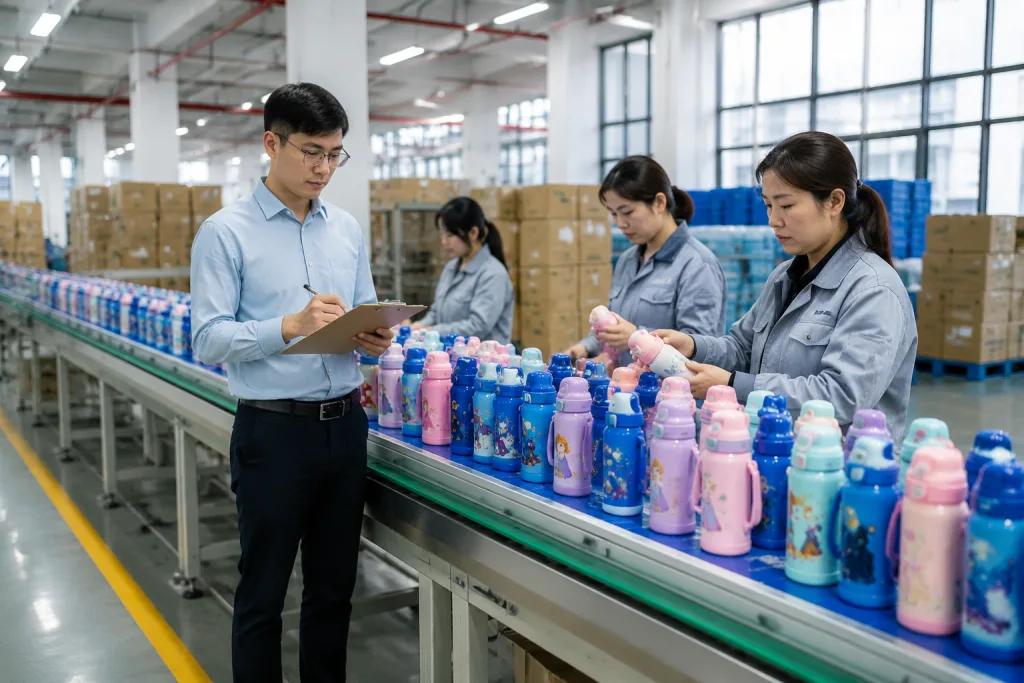
In Zhejiang, a serious children water bottle factory should talk about resin traceability, AQL, and lead time before showing cute artwork. Our China lines in Hangzhou run about 280,000 units/month, with a 3,000 pcs MOQ and 25-35 day production on normal custom kids bottle jobs. We run pre-production checks with a digital caliper, gram scale, and torque test on the lid before the line opens. That is the level of detail you should ask from any children water bottle supplier.
What schools actually buy
A district buyer asking for a bulk school water bottle program is usually not buying “style.” They are buying fewer parent complaints after 3,000 bottles hit lockers, lunchrooms, bus floors, and the dishwasher room. For a vendors school water bottle order, the right spec is the one that passes a 1.2 m drop test and still seals after QC pulls the sample from the wash rack.
We run the selection by age group first, then by how the bottle gets used during the school day:
- Preschool and early primary: 12-14 oz, body weight under 120 g where possible, wide mouth, soft carry loop that does not pinch small fingers.
- Elementary: 14-16 oz, one-hand open if the school allows it, gasket channel wide enough for a cleaning brush, not a toothpick job.
- Older kids: 16-18 oz, thicker base, textured grip, stronger hinge or cap thread; we check the cap on a torque tester before mass packing.
For school procurement, bulk children water bottle programs fail when the design gets too clever. We have seen this go sideways. Odd lids slow cleaning. Thin handles crack after 7-10 bend cycles. Cute animal shapes add mold cost, often USD 1,800-3,500 per set, but they do not help a teacher manage 28 bottles on one shelf. If you need children water bottle wholesale pricing, stay near standard cylindrical forms with a clean printable panel. The math works better, and replacement stock is easier to reorder when the buyer comes back with a PO typo on the color code.
A practical custom school water bottle also needs a clear labeling plan for class, color group, or house system. If the district wants names, barcodes, or a custom kids bottle with logo, lock the print area and carton mark before sampling. Once the layout is fixed, changing a 45 mm logo panel to 60 mm after cartons are printed costs days, not minutes, and the line will not wait for artwork revisions.
Pick the material by age
Material choice drives cost, weight, odor control, and how annoyed a facilities team gets after 300 bottles go through the dishwasher. On our line, QC pulled the sample after a 24-hour smell check, and that is why I usually narrow children water bottle customized programs to PP, Tritan, or stainless steel.
- PP: Lowest cost, fine for big school issue orders, usually USD 1.10-1.60 FOB for simple molds. We run this when the buyer wants 5,000 pcs and cares more about unit price than a premium hand feel.
- Tritan: Clear, tougher, and more premium, often USD 2.20-3.80 FOB. Wall thickness usually sits around 2.0-2.5 mm, and that extra 0.3 mm on the body makes a real difference when kids drop it on the floor.
- Stainless steel: Best for insulated or high-durability builds, commonly USD 3.20-5.90 FOB. A 304 body around 0.4-0.5 mm is common here, and the buyer will feel the weight as soon as they pick up the sample.
If you want a children water bottle custom program for younger users, PP and Tritan are easier to keep light. We had one school buyer flag a lid that needed two hands to open, and that ended the stainless option fast. If you need hot-and-cold performance, stainless makes sense, but the lid system gets more complex and the price jumps fast. For a custom made kids bottle, ask for food-contact declarations, BPA-free confirmation, and migration testing where required by the market.
Do not buy on material alone. A cheap PP bottle with a bad cap leaks in the first week, and we've seen that go sideways in school bags. A children water bottle supplier should explain why one material fits the school environment better than another, not just push the highest-margin option.
Lock the spec before samples
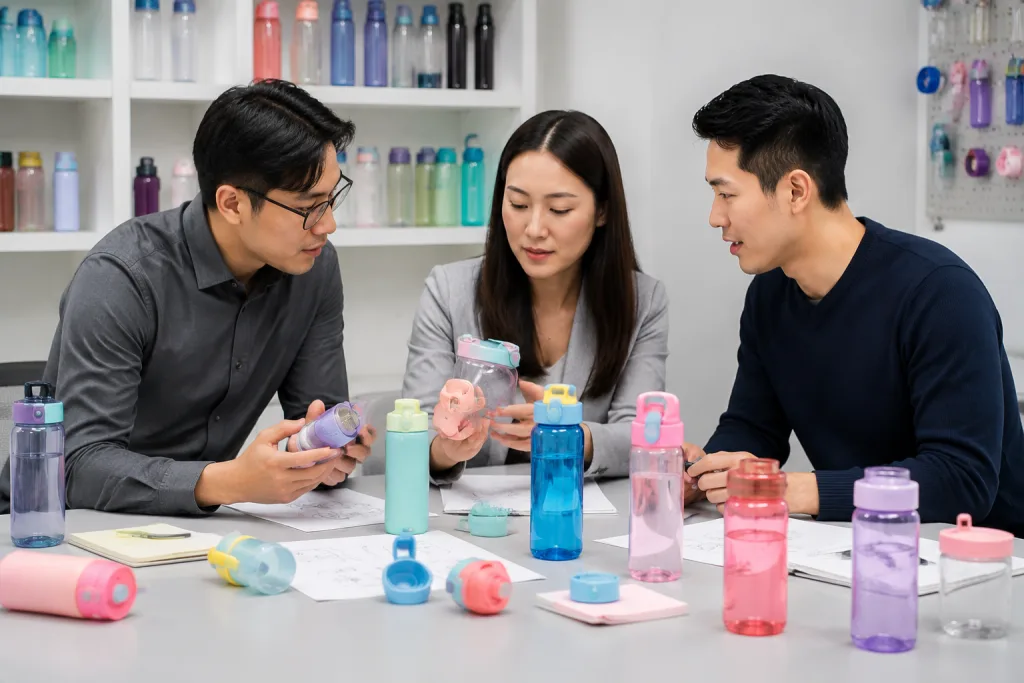
A vendor should quote from a drawing, not a mood board. We see projects go off track when a buyer signs a sample and the spec sheet is still loose. On the line, a 1 mm wall shift or a different lid insert can move the quote, and the lead time, fast.
Use a checklist like this before sample sign-off. QC pulled one sample yesterday with a 0.6 mm gasket mismatch, and that kind of miss turns into a chargeback later:
- Capacity in ml and oz, plus full dimensions
- Body material, lid material, and gasket material
- Mouth diameter, usually 38-55 mm for school use
- Leak test target, ideally 24 hours inverted
- Drop test, often 1.2 m for 6 drops on key corners
- Logo method, print area, and PMS or Pantone target
- Carton count, master carton strength, and barcode placement
For custom logo kids bottle programs, lock the decoration early. Silk screen is fine for 1 to 3 colors. Laser engraving suits stainless. Wrap print looks sharp, but the art file needs tighter control. If you want children water bottle custom naming or class numbers, fix the print position before we run the pad printer, or it will clash with the grip zone.
Do not approve a sample until the vendor can repeat it twice. One good sample is luck. Two matching samples are process.
This is where a children water bottle manufacturer earns your trust. They should mark which dimensions are fixed, which ones can move, and how each change hits unit cost. We had a buyer flag a typo on the PO last season, and that 320 ml versus 350 ml gap changed the carton count overnight.
Judge the factory, not the brochure
If you are buying from children water bottle vendors in China, especially from Zhejiang, judge the audit file before the sales deck. Ask for BSCI or another social compliance record, ISO 9001 if they talk about process control, and current food-contact test reports from a recognized lab. Ask for the test date and report number, not just the logo. We have seen buyers accept a pretty PDF, then QC pulled the sample and found the report was 19 months old.
A competent children water bottle factory should be able to answer these points without calling three managers into the room:
- Incoming raw material checks by lot number, including 304 stainless coil tags or PP resin batch labels
- In-line inspection frequency during assembly, such as cap torque checks every 2 hours with a torque meter
- AQL sampling plan, usually 2.5 major and 4.0 minor
- Packaging damage rate by carton type, plus a clear spare-parts policy for lids, straws, and silicone seals
At our Hangzhou site in Zhejiang, we run about 280,000 units per month on drinkware lines, and that volume lets us handle repeat school programs without reshuffling the line every week. Our normal MOQ is 3,000 pcs per SKU, with 25-35 days for standard custom jobs after sample approval. Short runs look easy on a PO. The math often does not work once the buyer adds 4-color logo printing, barcode labels, and a 9 kg drop-test carton requirement. A smaller children water bottle distributor can sell stock, but repeatable branding needs a real manufacturer or supplier with process control.
Do not be distracted by a giant showroom. Ask for a walkthrough of molding, printing, and packing. Watch one carton being sealed. In China, the factories that answer clearly on mold cavity count, pad-printing jig setup, and final carton inspection are usually the ones that ship on time.
Work out landed cost honestly
FOB is just the first line on the sheet. We’ve seen buyers compare children water bottle wholesale quotes at USD 1.28 and USD 1.35, then lose the difference on 5-ply export cartons and replacement caps. The math doesn’t work if the quote is missing carton size, packing method, or Incoterm. Ask every children water bottle supplier to price the same bottle, the same 52x38x44 cm carton plan, and the same shipping term. Last month a buyer flagged a PO that said “FOB Ningbo” while the quote was “EXW Hangzhou.” Small typo. Big bill.
A realistic landed-cost worksheet for a 5,000 pcs order might look like this. We run this on a simple packing table before sales confirms the proforma invoice:
- Base bottle FOB: USD 1.35 each
- 1-color logo: +USD 0.12
- Color lid adjustment: +USD 0.08
- Gift or retail box: +USD 0.22
- Ocean freight and origin charges: +USD 0.12-0.30 depending volume
Tooling, if needed, can run USD 300-1,200 for a new part or handle. For a children water bottle promotional giveaway, use one standard mold and one print color, then pack 24 pcs per master carton instead of paying for a fancy retail box. If it is a school district purchase, put the money into the seal and hinge. QC pulled a sample last week where the hinge pin was 0.4 mm loose after drop testing. The glitter sleeve looked nice; the lid failed.
For importers, the gap between a bulk children water bottle quote and the landed bill often sits in packaging and duty classification. Ask the vendor to split product cost, printing, packaging, and freight on the PI, line by line. That is the fastest way to compare a children water bottle manufacturer with a children water bottle vendor selling loose stock. We’ve seen this go sideways when a buyer approved USD 0.18 packaging in email, then their forwarder calculated duty on the packed retail value instead of the bare bottle price.
Use this order checklist
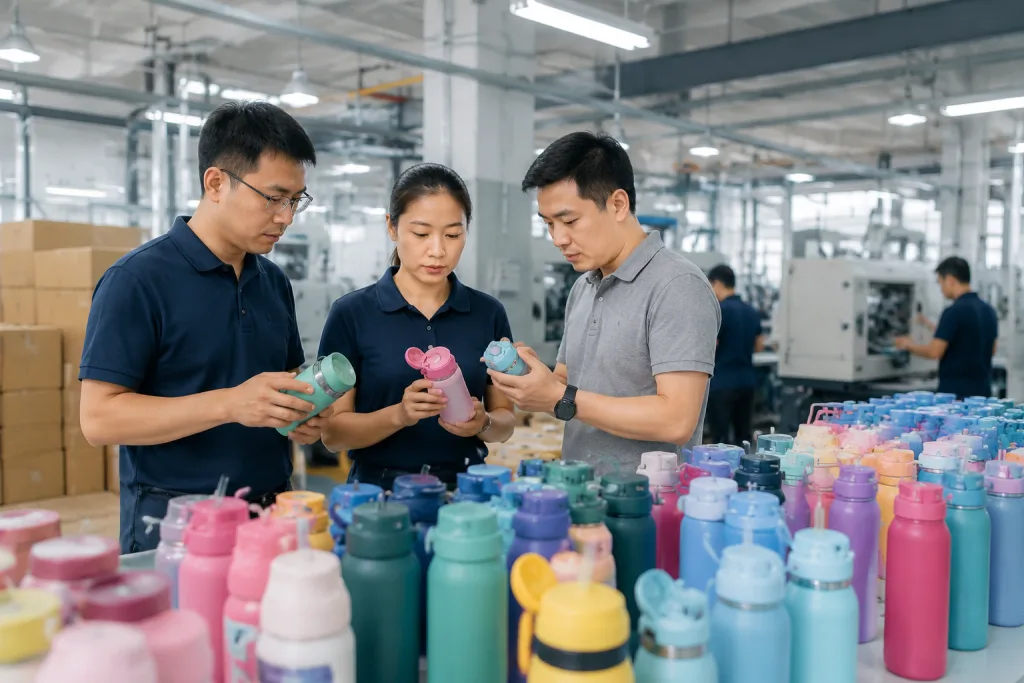
Before you release a PO, get the vendor to answer these points in writing. We check every carton mark against the PO line by line at pack-out, and one missing digit is enough to wreck a school order and start a claims file.
- Confirm capacity, color, logo method, and carton spec
- Approve one golden sample and keep a signed copy
- Request material declarations and test reports for the destination market
- Agree on AQL 2.5, spare lids, and replacement policy
- Ask for production photos at molding, printing, and packing
- Set a ship date window, not just a vague month
For a custom kids bottle order, I would ask for 2% extra lids and 1% extra bottles in the carton plan. That buffer saves days when schools open boxes and find a missing cap or a cracked base. On one district launch, QC pulled the sample off the line at 14:00 and the buyer still flagged the barcode panel on the pre-shipment photo set. If it is a bulk kids bottle for resale, make sure the outer carton and inner pack match your warehouse flow or Amazon carton rules, not the supplier’s default.
One hard rule: if the supplier cannot explain the defect limit, the test method, and the lead time in plain language, keep looking. This is the wrong question to skip. A solid children water bottle custom program should feel dull by the end because the process is locked down, and the gauge on the line matches the signed sample. That is what you want when 10,000 kids are waiting for the same bottle.
Get a quote that matches your school brief
Send your target age group, capacity, logo file, and annual volume. We will turn it into a clean children water bottle specification and pricing.
Frequently asked questions
What is the usual MOQ for a custom kids water bottle?
For a standard custom kids water bottle, 3,000 pcs per SKU is a normal factory MOQ in China. If you choose stock colors and simple one-color printing, some children water bottle manufacturers can work from 1,000 pcs, but pricing will rise by 10-25%. For a fully custom mold or special lid, expect higher tooling and a firmer MOQ. Sample lead time is usually 7-10 days, then mass production takes 25-35 days after sample approval and deposit.
Which material is best for a school water bottle order?
For most school use, PP or Tritan is the practical choice. PP keeps the unit price around USD 1.10-1.60 FOB and works well for bulk school water bottle programs where weight matters. Tritan is better if you want clearer plastic, stronger impact resistance, and a more premium look, usually USD 2.20-3.80 FOB. If you need insulation, choose 304 stainless steel, but expect more cost, more parts, and a heavier bottle. For younger children, lighter is usually better.
Can you add a logo or student name to the bottle?
Yes. Most children water bottle custom projects can take silk screen printing, pad printing, laser engraving on stainless, or wrap decoration. A one-color logo is the cheapest and most durable for school use. Add about USD 0.10-0.20 per piece for basic printing, depending on size and quantity. Personalization by name or class number is possible too, but it needs art files and tighter packing control. For custom logo kids bottle orders, confirm the print area before you approve the sample.
What certifications should I ask a vendor for?
Ask for the standards that match your market. For the US, food-contact declarations and CPSIA-related documentation may be needed for kids products. For Europe, REACH and LFGB or food-contact compliance are the common asks. EN71 can matter for certain children’s products. For the factory itself, BSCI or another social compliance report, plus ISO 9001 if available, gives you more confidence. Do not accept a certificate without checking the issue date, product scope, and lab name.
How long does a bulk children water bottle order take?
A normal bulk children water bottle order usually takes 25-35 days for production after sample sign-off and deposit. If the artwork is simple and the factory has material in stock, the faster end is realistic. Peak season, complex lids, or special packaging can stretch that to 40-45 days. Ocean freight then adds another 18-32 days depending destination. If you are buying from a China supplier for a school season launch, build in buffer time for artwork approval and pre-shipment inspection.