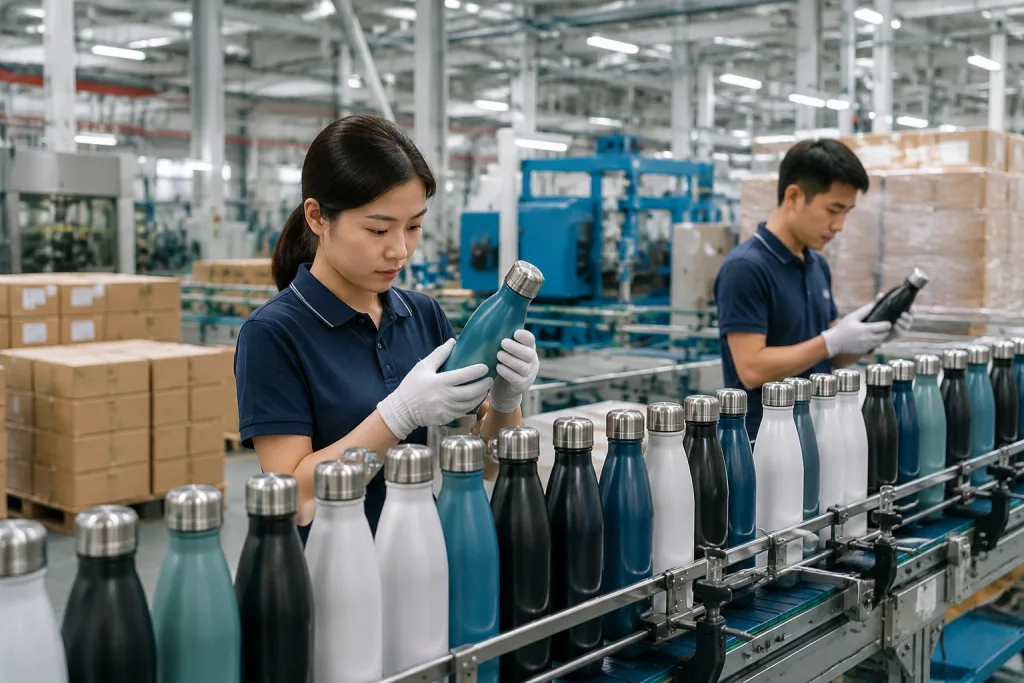
Key Takeaways
- Start with channel: retail, promotional, FBA, and distributor orders need different specs, cartons, and AQL levels
- Typical custom drinkware MOQ is 1,000-3,000 pcs per SKU, with 25-40 day production after artwork approval
- Laser engraving is durable, but screen printing often costs USD 0.08-0.18 less per unit on simple logos
- Ask vendors reusable water bottle suppliers for REACH, LFGB/FDA, BSCI, and pre-shipment inspection records before paying balance
If you are searching for vendors reusable water bottle, you probably do not need another catalog page. You need a buying path that protects margin after ocean freight, duties, 2%–4% defect claims, and artwork approvals that arrive 9 days late. We have seen a USD 0.20 “saving” go sideways into a 6-week delay when the buyer picked a cheaper lid mold before checking carton CBM.
From our Hangzhou, Zhejiang line, we see the same mistakes every season: buyers pick the shape before the sales channel, approve the logo before the powder coating cross-hatch test, and push unit price before anyone checks whether 24 pcs fit the export carton. Wrong order. QC pulled a sample last month where the laser logo was 3 mm off-center, and the buyer flagged it only after the PO typo had already locked the black finish as “blcak.” China is still a solid source for custom drinkware, but the math does not work if product decisions come before packing, coating, and inspection details.
Choose The Channel Before The Bottle
The first decision is not stainless steel versus plastic. It is the sales channel. A vendors reusable water bottle order for a European retail chain does not run like a 3,000 pc conference giveaway or a North American distributor replenishment program. We learned this the hard way when a buyer’s PO said “retail pack,” but the artwork file only showed a loose polybag layout.
For retail, shelf impact and repeatable supply carry more weight than one fancy feature. Barcode position must stay scannable, the powder coat needs to match the approved Pantone under the light box, and the gift box cannot crush in transit. A matte powder-coated 18/8 stainless bottle with a 0.5 mm inner wall and 0.6 mm outer wall may look strong enough for retail, but QC still runs the 76 cm drop test and checks master carton marks against the packing list. Online sales add another trap: carton dimensions can move your FBA fee by USD 0.40 to USD 0.90 per unit, which hurts more than most buyers expect.
For promotional orders, the math changes. You may accept a lighter single-wall body, a basic PP lid, or a 500 ml capacity if the landed cost has to stay under a campaign budget. This is the wrong question to ask: “Can we make it feel premium?” Ask whether the logo can print cleanly in one pass on the pad-printing jig and whether approval can be finished in 48 hours. For event canteen custom projects, a clean imprint area often beats premium insulation. We’ve seen this go sideways when a canteen vendor pushed vacuum bottles for a one-time activation and missed the delivery window by 9 days.
For distributors, consistency matters most. A canteen distributor or distributor canteen buyer should not open with 6 lid molds and 10 colors; the line will spend too much time changing fixtures, and the warehouse will split cartons all week. Every extra color adds QC checks, spare lid confusion, and inventory risk. QC pulled the sample last month because 2 blue batches were 1 shade apart under D65 lighting. At BottleForge Industrial in Zhejiang, we usually recommend starting with 2 capacities, 3 colors, and 1 shared lid family before expanding the range.
Decide Material And Performance Level
Material is where buyers lose money fast. We see 7 out of 10 new inquiries start with the wrong question: “Is stainless steel better?” That is the wrong question to ask. The right spec depends on heat retention, bottle weight, food-contact documents, target FOB, and whether the user throws it in a school bag or leaves it in a car cup holder. Last month QC pulled a 620 g sample that looked premium on the photo, but the buyer flagged it as too heavy before we even ran the leak test.
For reusable water bottles, 18/8 stainless steel is the usual choice for mid-range and premium custom drinkware. A typical 500-750 ml double-wall vacuum bottle uses 304 stainless steel inside and outside, with copper coating optional when the buyer wants stronger thermal performance. On our line, realistic performance is 6-12 hours hot and 12-24 hours cold, depending on lid design, neck diameter, and wall structure. Claims need a lab sheet, not sales talk. A wide-mouth bottle with a straw lid will not perform like a narrow-mouth screw cap thermos; we measured one 58 mm mouth sample at 8 hours cold where the buyer expected 18.
Tritan works when buyers need transparency, lower weight, and a sporty look. It fits a canteen customizable school or fitness line, but we still run odor checks after 24 hours, upside-down lid leakage tests, and 1.2 m drop impact on the corner and base. Aluminum can work for low-cost canteen promotional programs, usually with an inner coating, but the math does not work if the buyer wants a premium long-life product at a giveaway price. We have seen this go sideways when a PO says “matte black aluminum” and the artwork file says “dishwasher safe.”
Growlers need their own spec sheet. A custom growler or customizable growler for breweries usually needs 1.9 L or 2 L capacity, thicker stainless steel, a pressure-conscious cap design, and stronger carton protection. For a distributor growler program, confirm beer-use claims, food-contact documents, and country-specific labeling before sampling. A customized growler is heavier to ship; we packed one 2 L model at 12 pcs per master carton, and the carton cube killed the FOB saving by the time the forwarder quoted ocean freight.
Our practical advice: set the performance target first. For example, 750 ml, under 390 g, leak-proof at 45 degrees for 30 minutes, powder coating adhesion at 3M tape test grade 4B or better, and AQL 2.5 for major defects. Then ask canteen manufacturers to quote against that spec, not against a photo. We run the first sample with calipers, a digital scale, hot-water test, and tape test on the coating; if the sample fails there, a cheaper quote is just a cheaper problem.
Match Branding To Wear Conditions
Branding is part of the spec, not artwork pasted on at the end. It changes cost, lead time, defect risk, and what the customer thinks when the bottle comes out of the carton. We run different marking plans for a 10,000 pcs retail customized drinkware program, a 1,200 pcs canteen customized order for staff onboarding, and a distributor drinkware catalog item that needs repeat batches. QC pulled one sample last month where the logo sat 4 mm too high because the PO said “front center” but the PDF showed it under the shoulder.
Laser engraving is our safest choice on stainless steel when the buyer cares about wear. It will not peel. It also looks clean on powder coating if the color contrast is strong enough. The trade-off is cost and logo size. A typical logo engraving may add USD 0.18-0.45 per unit, depending on logo area and fixture time. On our 30W fiber laser, a large vertical logo slows the line because each bottle needs tighter positioning in the rotary jig. Light beige, pale pink, and white coating can make engraving look weak unless the buyer accepts a subtle tone-on-tone mark.
Silkscreen printing costs less for simple one-color logos. On a straight-wall bottle, a normal logo print may add USD 0.08-0.18 per unit. On a tapered body, artwork distortion and registration become harder, and the buyer flagged this on a 750 ml sample because the circle logo turned slightly oval. Heat transfer works for gradients and larger wrap designs, but test abrasion, dishwasher claims, and edge lifting before signing the PP sample. UV printing looks sharp on day one. For bottles thrown into backpacks every day, the math does not always work.
For a custom canteen or customizable canteen used outdoors, we prefer laser or a conservative one-color print with a tested coating system. For a canteen promotional campaign with a 3-month useful life expectation, screen printing may be perfectly sensible. We have seen this go sideways when a buyer asked for full-wrap UV on a rough powder coat, then found tiny chips near the bottom radius after 300 rubs on the abrasion tester. The honest question is not which logo method is best. Ask how long the logo must look good after real handling.
Ask for pre-production samples using final artwork, final coating, and final packaging. Do not approve branding from a flat digital mockup alone. A factory in China can make a clean rendering in 20 minutes; that does not prove curved-surface registration, coating adhesion, or color match under daylight. We check samples under a D65 light box and measure logo position with a caliper, because 2 mm off center looks cheap once 24 bottles sit together in a retail tray.
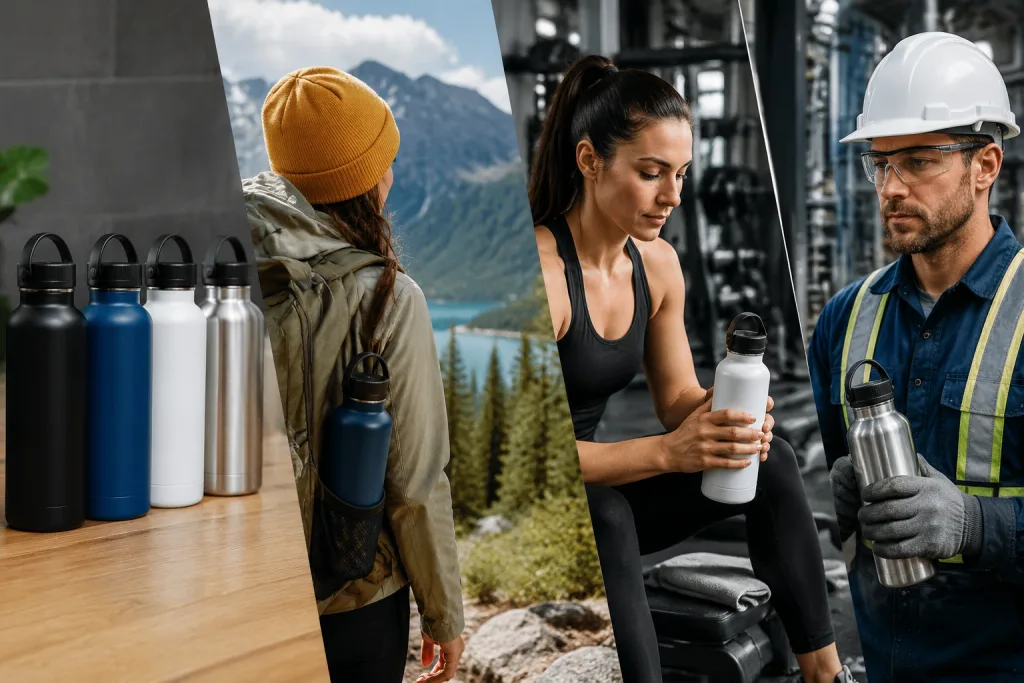
Read MOQ And Price Together
MOQ is not a trick number. It comes from steel sheet buying, powder coating line setup, logo jigs, printed cartons, and how many workers we put on the line. If a canteen supplier quotes 500 pcs for a fully custom color, ask what changed: stock powder, shared brown carton, USD 0.18 higher unit price, or 12 days in queue versus 18 days. Ask it early. We once had QC pull a pre-production sample because the buyer’s PO said “matte sand” while the Pantone file was closer to 7502C.
For most stainless steel vendors reusable water bottle orders from China, a realistic MOQ is 1,000 pcs per model for stock colors with logo, 3,000 pcs for custom Pantone powder coating, and 5,000-10,000 pcs for a private lid mold or body tooling. At BottleForge Industrial in Hangzhou, Zhejiang, our monthly capacity is about 420,000 stainless drinkware units, but small orders still need scheduling discipline. The line does not like stop-start work. A 1,000 pc order cannot cut into a coating oven set for 8,400 black bottles every afternoon without adding labor and scrap.
FOB pricing should be compared only after the spec is locked. A 750 ml double-wall stainless bottle may range from USD 3.20-5.80 FOB Ningbo or Shanghai depending on steel thickness, lid type, coating, packaging, and inspection requirements. A cheaper quote may use a 201 stainless outer wall at 0.38 mm instead of 0.45 mm, a lighter PP lid, no copper coating, a 5-layer carton instead of a stronger export carton, or looser QC. Sometimes that spec is fine. Sometimes it is how leakage claims start, and we have seen this go sideways after the buyer flagged 27 wet cartons at unpacking.
Payment terms also matter. A common structure is 30% deposit and 70% balance before shipment after inspection. For repeat canteen distributors, staged shipments or credit terms can be discussed after 3 clean orders with no AQL 2.5 failures and no payment delay. New buyers should avoid paying 100% upfront unless the order is small and the supplier history is clear. The math does not work if you save USD 80 on bank fees and lose control of a USD 6,000 shipment.
When comparing canteen suppliers, build a landed cost sheet: FOB price, inland freight, sea freight, duty, customs broker, inspection, Amazon prep if needed, warehousing, damage allowance, and replacement policy. A quote that is USD 0.25 higher but saves 8% carton cube can land cheaper by the time it reaches your warehouse. We run carton checks with a tape measure and gross-weight scale because a 2 mm carton change across 1,000 pcs can push one more CBM into the booking.
Check Compliance Before Artwork Approval
Do not wait until the cartons are packed. If you ship to Europe or North America, we ask for the file pack before artwork sign-off, because the line cannot fix a bad compliance call after we print 5,000 units. The exact documents change by material and market, but food-contact and social compliance sit at the front of the file, not at the end.
For stainless steel and plastic custom drinkware, European buyers usually ask for LFGB or EU 1935/2004 food-contact testing, REACH on restricted substances, and sometimes heavy metal declarations tied to the packaging. North American buyers may want FDA food-contact suitability, California Proposition 65 review, CPSIA when kids are involved, and ASTM checks for children’s products. A kids bottle is not just a smaller adult bottle; we have seen the straw, lid, coating, and tiny parts fail the first review on a 12 mm detail the buyer missed.
Factory audits matter too. BSCI, Sedex, ISO 9001, or a customer audit tells you whether the factory has basic process control and labor compliance. They do not promise perfect goods. If a canteen factory cannot show the current audit scope, the exact address, and a product category that matches your bottle, that is a red flag. We have had buyers push back on this, and the math does not work if the audit is from another site.
Put inspection criteria in the PO. For standard reusable bottles, many buyers run AQL 2.5 for major defects and AQL 4.0 for minor defects, but sharp edges, contamination, bad odor, broken lids, and serious leakage should stay at zero tolerance. Write the leak test in plain terms: water-filled, cap torqued, inverted or tilted, duration, and sample size. QC pulled a sample once and found a 3-second seep because the PO only said “no leaks,” which is too vague for the line.
Artwork approval needs legal labeling too. Country of origin, capacity mark, recycling marks, FNSKU or barcode placement, warning text, and importer details can all block receiving if they are wrong. This is boring work, but relabeling 3,000 cartons in a 3PL costs more than fixing a typo on the PO, and we have seen both. Get the label proof checked before you release it.
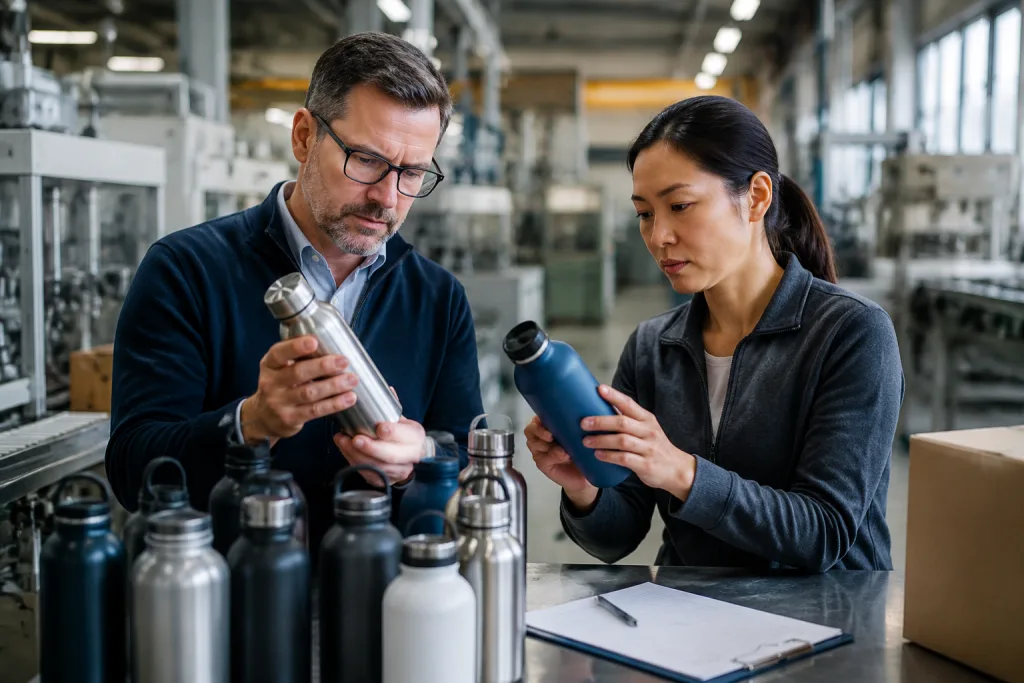
Control Samples, Production, And Shipping
The production timeline is where 7 out of 10 first-time buyers lose control. A customized canteen order is not 30 days from your first email. We usually count 25-40 days after deposit, final artwork, approved sample, and packaging files are all in hand. If the job needs Pantone powder coating, new mold work, or SGS/LFGB testing, add 7-20 days. On our line, a 0.5 mm logo shift caught under the logo positioning jig can stop printing for half a day, so the calendar starts after the files are clean, not after the inquiry.
Use three sample stages when the order value justifies the extra courier cost. First, a reference sample to confirm shape, capacity, and lid feel with the actual gasket hardness. Second, a pre-production sample with final logo, coating color, and packaging. Third, a sealed approval sample kept by both buyer and factory. For a customized drinkware order above USD 15,000, skipping the sealed sample is the wrong question to ask; we have seen one PO typo turn “matte black” into “gloss black,” and QC pulled the sample only because the sealed unit was on the shelf.
During production, ask for photos or short videos at key points: raw material, body forming, polishing, vacuum testing, coating, logo application, assembly, and packing. A solid canteen vendors team should not be offended by this. You are not trying to run their workshop. You are asking for proof that the order exists and is moving correctly. We ship better when the buyer asks for a 15-second vacuum-test clip, a carton-line photo, and one close-up of the laser logo before the full batch goes through the rotary fixture.
Pre-shipment inspection should happen when goods are 100% produced and at least 80% packed. The inspection should check quantity, workmanship, leakage, coating, logo position, barcode scan, carton drop condition, and carton marks. For online retail, also check FNSKU scannability and polybag suffocation warning if applicable. For distributor canteen orders, spare lids and replacement parts should be counted separately. One buyer flagged this after finding 48 spare lids mixed into master cartons instead of the accessory carton; the AQL 2.5 report looked fine, but warehouse receiving still went sideways.
Shipping choice depends on urgency and volume. Air freight hurts on stainless steel bottles because the cartons are bulky and the value per cubic meter is not strong enough. Sea freight is usually the sensible choice for 1,000 pcs and above. From Zhejiang or nearby ports in China, FOB Ningbo and FOB Shanghai are common. Confirm carton dimensions early. Freight surprises are carton-cube surprises: a 7 kg carton that grows from 56×38×32 cm to 60×42×36 cm can push the quote up even when the unit price stays unchanged.
Score Vendors With A Simple Matrix
You do not need a heavy procurement system to compare canteen manufacturers. You need a short scorecard, used before the buyer starts squeezing the last USD 0.10. We run into this often: the price sheet looks clean, then QC pulls a pre-production sample and the wall thickness reads 0.38 mm on the micrometer instead of the quoted 0.45 mm. Score the vendor on product fit, honest engineering answers, compliance files, reply speed, line capacity, and how they handle claims after shipment.
Give each supplier a 1-5 score in six areas. First, spec clarity: do they answer wall thickness, 304 stainless grade, lid material, silicone hardness, carton size, and packing method without hiding behind “standard”? Second, sample quality: does the sample match the quote, or did they polish a better version just to win the PO? We have seen a 750 ml sample pass, then the mass-production cup came back 6 g lighter. Third, document readiness: can they send REACH, LFGB/FDA, audit documents, and a previous inspection format within 24 hours? Fourth, production control: do they explain vacuum testing pressure, coating cross-hatch checks, and AQL inspection steps? Fifth, commercial fit: are MOQ, lead time, payment terms, and FOB Ningbo or Shanghai workable for your channel? Sixth, problem handling: do they talk about spare lids, defect allowance, and claim timing before anything breaks?
This scoring method works whether you buy from a canteen manufacturer, canteen supplier, canteen distributors network, or a direct canteen factory in Zhejiang. Direct factories usually give cleaner engineering feedback and tighter cost control because the line leader can check the drawing while the buyer is still on WeChat. Trading companies can make sense when you need 6 mixed items under one shipment and the MOQ math at one factory does not work. Neither model wins by default. We have seen this go sideways with a direct factory that refused to adjust a 2 mm logo position, and we have seen a sourcing partner save 12 days versus an 18-day factory sample cycle. Ask who owns the mistake when QC flags it.
For most B2B buyers, the best first order is not the biggest order the vendor will accept. This is the wrong question to ask. Start with a controlled order: 1-2 SKUs, written inspection rules, and enough quantity to test sell-through without filling the warehouse. For a reusable water bottle program, 1,000-3,000 pcs per SKU usually gives the factory a fair line run and gives your sales team real feedback. Once the vendor proves stable quality and fast communication, expand into canteen customizable lines, customizable drinkware bundles, or a private distributor growler range with stronger confidence.
Send Your Bottle Brief For A Practical Quote
Share capacity, material, logo method, target MOQ, and market. We will return a factory-level quote with lead time and packaging notes.
Frequently asked questions
What MOQ should I expect for vendors reusable water bottle orders?
For stainless steel bottles from China, expect 1,000 pcs per SKU for stock colors with logo printing or laser engraving. Custom Pantone powder coating usually starts around 3,000 pcs, because the coating line setup and color loss must be absorbed. Private molds, special lids, or a custom growler body can require 5,000-10,000 pcs depending on tooling. Some canteen suppliers offer 300-500 pcs, but the unit price is higher and options are usually limited to existing colors and packaging.
How long does a customized canteen order take from deposit to shipment?
A normal customized canteen or customized drinkware order takes 25-40 days after deposit, final artwork, and sample approval. Add 5-7 days for pre-production sample making, and 7-20 days if you need new mold work, special Pantone coating, or third-party compliance testing. Sea freight to Europe or North America is separate and often takes 25-45 days port to port. If a canteen factory promises 15 days for a fully custom order, ask which steps are being skipped.
Should I buy from a canteen manufacturer or a trading company?
A direct canteen manufacturer is usually better when you need stable repeat production, engineering changes, cost control, and clear QC ownership. A trading company can be useful when you need mixed products, very low MOQ, or several materials in one shipment. For distributor drinkware programs above 3,000 pcs per SKU, direct factory communication often saves time. For a mixed promotional order of 300 bottles, 500 mugs, and 200 bags, a trader may be simpler. Judge by transparency, not by the label.
Which logo method is best for canteen promotional projects?
For canteen promotional orders, one-color silkscreen printing is usually the most cost-effective, often adding USD 0.08-0.18 per unit on a simple straight-wall bottle. Laser engraving is better for long-term durability and premium stainless products, but it may add USD 0.18-0.45 depending on logo size. Heat transfer is useful for full-color artwork, but test abrasion and edge lifting. If the bottle must survive daily backpack use for 12 months, choose durability over the cheapest logo quote.
What quality checks should I require before paying the balance?
Require a pre-shipment inspection when goods are 100% produced and at least 80% packed. Use AQL 2.5 for major defects and AQL 4.0 for minor defects, with zero tolerance for unsafe contamination, sharp edges, serious leakage, or broken caps. The checklist should include capacity, weight, coating adhesion, logo position, barcode scan, carton marks, leakage testing, and packaging drop condition. For Amazon or distributor orders, also verify FNSKU labels, carton dimensions, and spare part counts before balance payment.