Key Takeaways
- Set AQL at 2.5 major / 4.0 minor before production, not after defects appear
- For stainless bottles, confirm 0.45-0.55 mm inner wall thickness and vacuum test method
- Typical custom drinkware MOQ is 1,000-3,000 units per SKU depending on decoration
- Plan 25-35 days for production after artwork and pre-production sample approval
A refillable bottle order often fails before the line runs the first trial batch. We see it at sample stage: the 2D drawing misses the mouth ID by 0.4 mm, the buyer picks laser engraving because it saves USD 0.08, the carton spec is copied from a 500 ml SKU, and no one writes down what “acceptable finish” means. Then 3,000 pieces arrive with a squeaky lid, powder coat chipped at the rim, or a barcode label that fails on a Zebra scanner in your warehouse.
If you are comparing vendors refillable water bottle options in China, buy the process, not only the unit price. This is the wrong question to ask first. Our Hangzhou, Zhejiang team sees the same 6 problems every peak season: custom drinkware samples approved after one photo, canteen supplier claims accepted without a salt spray report, and AQL 2.5 inspection rules written only after QC pulled the sample and found lid wobble over 1.2 mm. Here is how we spec the order before it goes sideways.
The Quote Hides the Real Risk
The lowest quote from a canteen vendor usually cuts something the spreadsheet does not show. We see it on the line: 0.38 mm wall stock sold as “standard,” 201 stainless pushed into the inner wall instead of 304 food-grade steel, a soft cap gasket that fails after 6 leak tests, one-pass powder coating, or no drop test after assembly. For a vendors refillable water bottle program, those shortcuts come back as returns, retailer chargebacks, and pallets that sit for 90 days.
Start every RFQ with a controlled spec sheet. Do not ask a canteen factory for “500 ml stainless bottle with logo.” That is the wrong question to ask. Ask for 500 ml capacity, 304 inner wall, 201 or 304 outer wall, 0.45-0.55 mm wall thickness, double-wall vacuum construction, leakproof screw lid, BPA-free PP cap, silicone gasket, and LFGB or FDA food-contact compliance depending on your market. If the product is for Europe, add REACH for coating and packaging inks where relevant. QC pulled one sample last month where the PO said “304 inside,” but the XRF gun showed 201 on the liner.
FOB Ningbo or Shanghai pricing should use the same assumptions across every canteen supplier you compare. Break out decoration, insert card, carton strength, individual polybag or tissue wrap, barcode label, and inspection support line by line, with carton burst strength in kg if your retailer specifies it. A canteen manufacturer in Zhejiang may quote USD 3.20 for a simple 500 ml powder-coated bottle at 3,000 units, while another China supplier quotes USD 2.85 but excludes logo setup, inner carton, or vacuum loss sorting. That USD 0.35 gap is not always savings. We have seen this go sideways when the buyer flagged a missing EAN label after packing, and the rework added 2 days at the warehouse.
Good sourcing is not finding the lowest number. It is making sure every vendor is pricing the same bottle, the same packaging, and the same inspection workload.
Vacuum Failure Is Not Cosmetic
For insulated bottles, vacuum failure is the defect buyers still under-price. A scratch gets caught at IQC. A weak vacuum hides until someone fills the bottle with ice water and sees sweat on the outer wall after 20 minutes. Too late. By then, 3,000 pcs are already sitting in your distributor drinkware channel, and the buyer flags it with photos from a retail store, not from our line.
Vacuum performance comes down to weld bead consistency, air extraction time, base plug sealing, and how the bodies are handled after vacuuming. A proper canteen manufacturer should run a vacuum retention check with hot water or temperature decay testing. For our Zhejiang production partners, a common internal test is 95°C water filled for 4-6 hours, with the outer surface checked by hand and the temperature drop checked against the approved sample using a probe thermometer. Exact criteria belong in the purchase order. We once saw a PO say “no leaking vacuum,” which sounds harmless, but QC had no pass/fail number to hold the line.
If you are buying a custom canteen, customized growler, or travel bottle, write the temperature claim with some discipline. “Keeps hot 12 hours and cold 24 hours” looks neat on packaging, but the math does not work for every body. A large-mouth 1,900 ml custom growler will not behave like a narrow 500 ml bottle. Lid stack height, air volume, and a 58 mm opening change performance. If you print aggressive claims and skip testing, you own the complaint.
- Spec around it: require vacuum testing on 100% of insulated units before packing, and ask for the machine log by carton range.
- Check at inspection: pull samples from sealed finished goods, then run hot-water testing instead of checking loose bodies from a side table.
- Write tolerance: define the allowed temperature drop in °C and what counts as condensation, including water beads around the bottom seam.
A serious canteen factory will not object to this. If a canteen vendor says vacuum testing is unnecessary, we would push back hard; we have seen this go sideways on 5,000 pcs after the buyer’s warehouse opened only 8 cartons.
Lids Leak When Specs Are Lazy
Most refillable water bottle complaints start at the lid, not the bottle body. The cap looks simple, but it carries thread fit, gasket hardness, venting, hinge strength, straw tolerance, and the feel of the closing torque. On a canteen customizable run, one lid change can turn a decent bottle into a refund problem overnight.
Buyers often sign off a golden sample, then let the factory swap in “equivalent” lid parts for mass production. That is where leaks start. We have seen a gasket move from food-grade silicone to cheaper TPR, thread tolerance open up after 3,000 cycles on the tool, and a flip spring pass 100 openings but fail at 500. The wrong question is whether it “looks the same”; the math does not work if the sports bottle or kids bottle gets shaken, dropped, and tossed into a school bag.
Your purchase order should lock the lid material and the test method. We run a plain leak check: fill with room-temperature water, tighten to normal hand torque, invert for 30 minutes, shake 20 times, then look for seepage around the seal. For a straw lid, add suction and air-vent checks. For hot-fill bottles, confirm the lid rating before you release the PO; a lot of promo lids are cold-water only. QC pulled one sample last month with a 0.4 mm gap at the gasket seat, and that tiny miss would have become a big complaint.
For a distributor canteen or canteen promotional order, ask for 5-10 finished pre-production samples built with mass-production parts. Test them in your office, not only under factory lights in Hangzhou. Put them in a backpack, wash them 10 cycles, and check smell, gasket seating, and lid noise. We ship plenty of orders that pass paper approval and fail in real use; I would rather spend one extra day on samples than eat 800 complaints from a weak cap design.
Decoration Fails at the Rim
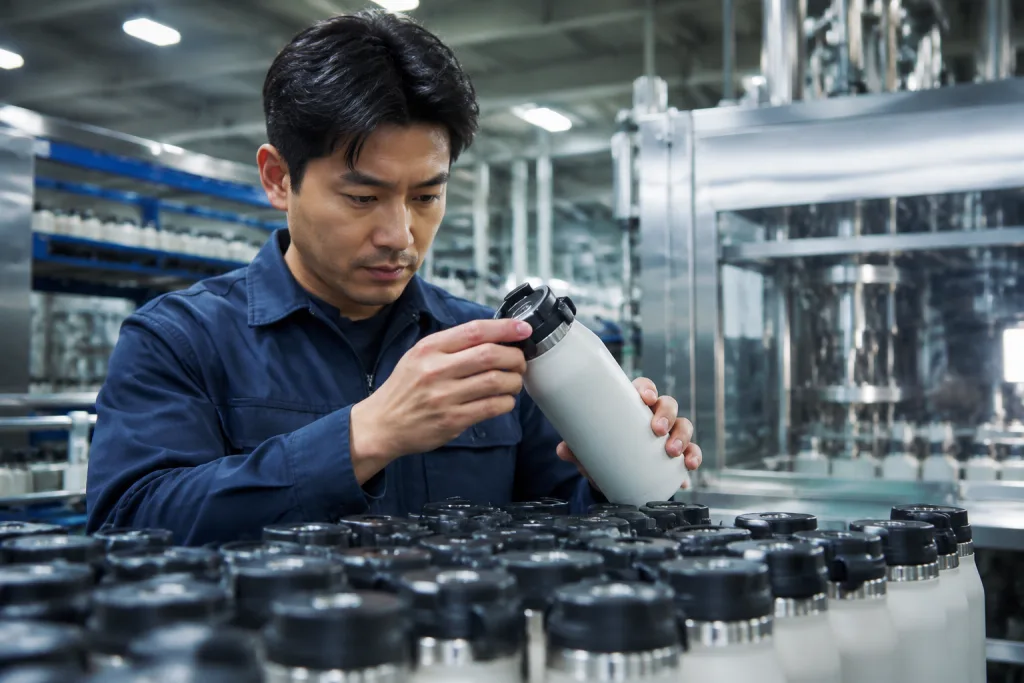
Logo decoration is where custom drinkware turns into sellable brand stock, so the buyer stares at the logo while the factory watches the line speed. That gap causes the failures. We have seen powder coat chip within 3 mm of the rim after lid torque testing, laser marks come out pale on brushed 304 stainless, silkscreen ink scratch off under a fingernail, and full-wrap artwork drift 2-3 mm at the seam. QC pulled 12 samples from a 500-piece pilot run last month; 4 had rim chips before packing.
Each decoration method has a proper job. Laser engraving lasts on stainless steel, but it will not give your Pantone 186C red. Silkscreen is right for a one- or two-color logo, if the cup wall is smooth and the ink passes adhesion testing on the actual coating. Heat transfer gives more artwork area, but dishwasher cycles and bag abrasion can make the math ugly. UV printing looks crisp on the sample table; do not call it dishwasher safe until we run the test. We use a Mitsubishi pencil set and 3M 600 tape on the same finish planned for mass production.
For customized drinkware, define logo width in millimeters, distance from base or rim, Pantone color, position tolerance, and surface finish. “Logo centered” is not a spec. It is the wrong question to ask. Write it like this: logo 45 mm wide, front centerline opposite lid hinge, bottom edge 80 mm above base, position tolerance ±1.5 mm. For a canteen customized with full-wrap artwork, ask for a printed layout proof and a seam placement photo before mass production. We once had a PO say “opposite handle,” but the sample had no handle; the buyer flagged it only after the pre-production photo.
Adhesion testing should be simple and written into the order. A cross-hatch tape test, alcohol rub test, and 3M tape pull after 24 hours catch bad ink or weak curing before cartons hit the pallet. On powder coating, ask for coating thickness; 60-80 microns is common for many bottles. Too thin chips fast. Too thick can tighten thread fit or stop the lid from seating cleanly near the neck. Our coating gauge has caught 105-micron necks that looked fine by eye but failed after 20 open-close cycles.
If your product is a customizable growler or customized canteen sold at retail price points above USD 15, do not treat decoration as packing-room artwork. The customer sees the logo before they test the vacuum. We ship plenty of bottles where the insulation is right and the complaint still comes back as “logo peeling near lip.” That is avoidable if the rim area, cure time, and inspection photos are locked before the line starts.
Compliance Paperwork Can Be Hollow
Many canteen suppliers will send a PDF certificate in 10 minutes. That proves they have a file, not that your bottle passes. We have seen reports tied to a different SKU, an old resin lot, or only the 304 sheet before coating and cap assembly. For Europe and North America, the real question is whether the paperwork matches the exact build on your PO.
For food-contact stainless drinkware, buyers usually ask for FDA or LFGB testing, BPA-free cap material confirmation, and California Proposition 65 screening if the channel needs it. For children’s bottles, CPSIA, ASTM F963, and small-parts checks come up fast. For EU sales, REACH matters for coatings, inks, and some packaging parts. If you run a line with 3 colors and 2 lid styles, keep a separate compliance file for each SKU mix.
Factory audits matter, but they do not clear the order by themselves. BSCI, Sedex, and ISO 9001 show a system on paper; they do not stop a mixed-cap shipment. A factory can pass ISO 9001 and still miss a cap insert if the BOM is loose. We have seen that go sideways when the buyer flagged a 0.3 mm gasket change and nobody updated the control sheet.
Ask for documents that match the exact order: material declaration, test reports for the same material family, artwork ink statement when needed, and packaging compliance if recycled paper or special ink is used. For large distributor orders, budget third-party lab testing before shipment. A basic food-contact test takes 5-10 working days. That is the math. Do not ask the factory to ship first and send papers later.
Packaging Breaks Margins Quietly
Packaging failure does not look as bad as a leaking bottle, but it kills margin line by line. We have seen 380 color boxes come off a pallet with corner dents after a 9-hour truck ride to the FBA forwarder. Dented gift boxes, rubbed powder coating, crushed cartons, wrong FNSKU labels, and mixed-color cartons all turn into warehouse rework that was never in the landed-cost sheet. If you sell through Amazon FBA, retail chains, or regional distributors, packaging is part of the product. Treat it that way.
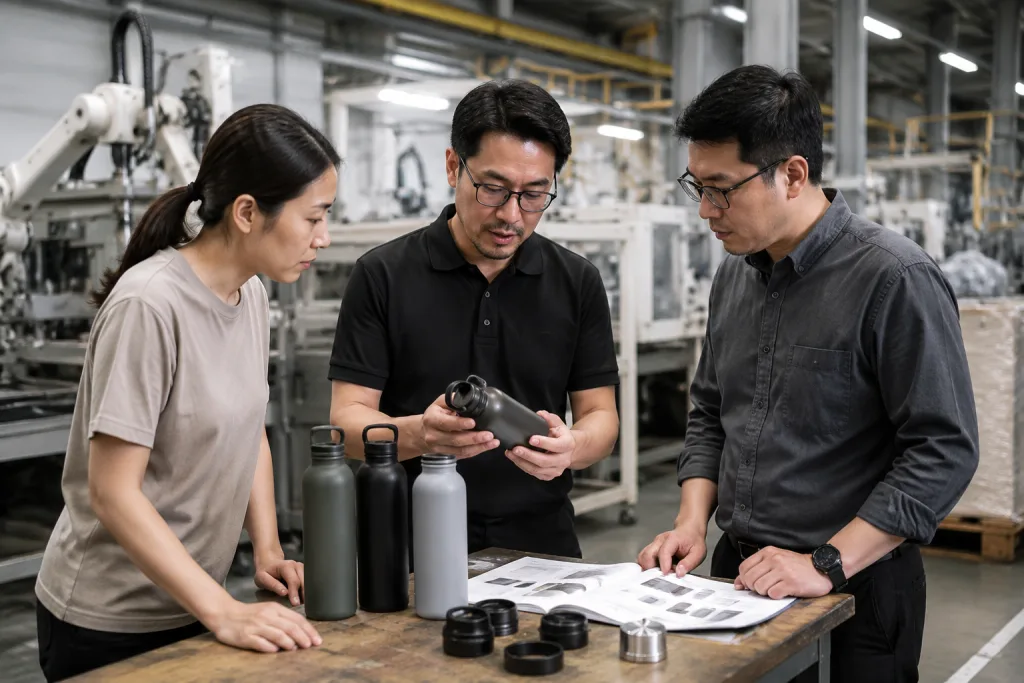
For a vendors refillable water bottle order, lock the packing method before the PP sample. We run a common setup as one bottle in a polybag or tissue wrap, then a white box or color box, then 24 units per export carton. For heavier custom growler products, 12 units per carton may be safer because the math does not work once a carton hits 18 kg and handlers start dropping instead of lifting. Specify 5-ply export carton, carton bursting strength or edge crush test if required, gross weight limit, drop-test height, and barcode placement. For drinkware cartons in the 500 ml to 1,000 ml range, keeping gross weight under 15 kg cuts a lot of corner crush and tape split on the line.
If you need retail-ready packaging, send dielines and barcode rules before sample approval. Do not wait until production is finished to ask a canteen supplier for individual labels. Labeling after packing increases errors; QC pulled one sample lot last year where the FNSKU was correct, but the PO had “matte balck” and the warehouse matched it to the wrong black lid. FNSKU, UPC, country of origin, suffocation warning, carton marks, and inner carton labels should be written into the packing instruction, with label size in mm and placement shown on a photo.
Our Hangzhou, Zhejiang office usually recommends a pre-shipment carton drop test on packed goods: one corner, three edges, and six faces from a height matched to carton weight. It is not a perfect simulation, but it catches weak cartons, thin dividers, and bottles that move inside the box when we shake the carton by hand. We have seen this go sideways when the buyer approved the bottle only, then flagged carton deformation after arrival. A canteen vendors list is useful only if the vendor can pack consistently, not just make a good-looking bottle.
Inspection Must Match the Failure
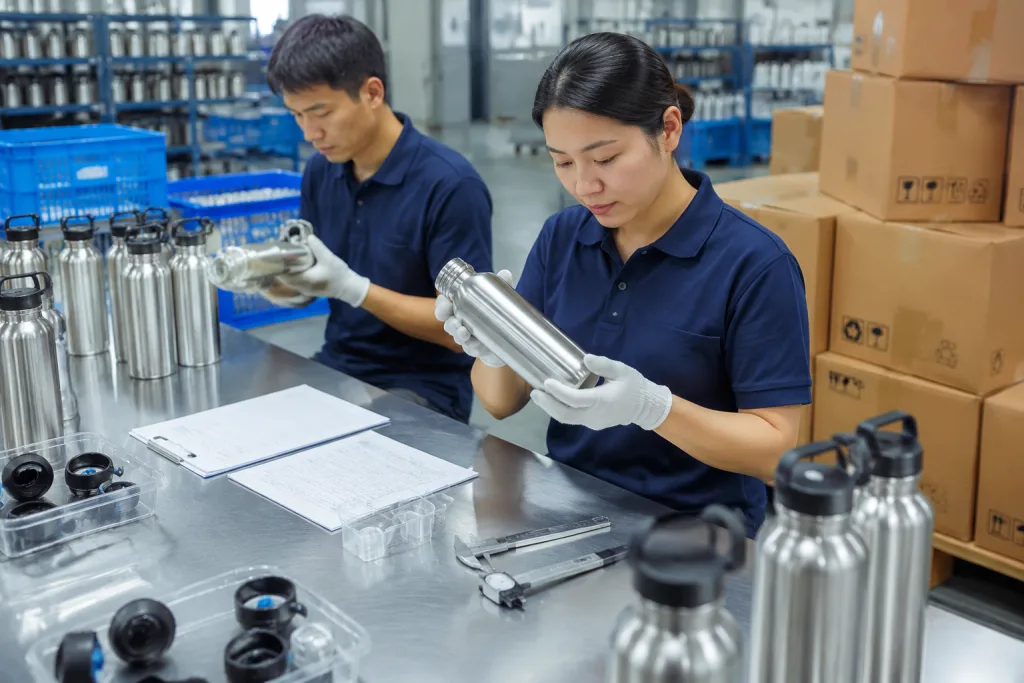
Generic inspection catches generic problems. On the line, QC pulled the sample and a 28 mm cap still passed hand check while the gasket smelled off. If your inspector only checks quantity, color, and logo, they will miss vacuum loss, gasket smell, loose handles, bad thread engagement, and barcode scan failure. Those are the problems that hit B2B buyers after the truck leaves.
Use AQL sampling, but tie it to failure points. A common setup is AQL 2.5 for major defects and 4.0 for minor defects, with critical defects at 0. For a 3,000-unit order, the sample size may be 125 or 200 units depending on inspection level. In that sample, set leak tests, coating rub tests, barcode scans, carton checks, and assembly checks by count. Asking for "full inspection" without a checklist is the wrong question.
At BottleForge Industrial, our China supply network can support around 300,000 stainless drinkware units per month across standard bottle, tumbler, and growler lines, with typical MOQ from 1,000 units for simple logo work and 3,000 units for custom colors or molded lids. Normal lead time is 25-35 days after deposit and approved pre-production sample. On one recent order, the buyer flagged a PO typo on the lid color code, and we caught it before the pre-production sample freeze. Those numbers only matter if the inspection plan is ready before the line starts.
For a canteen distributors program, create a defect classification sheet. Major defects include leakage, failed vacuum, sharp edges, wrong material, wrong logo, non-scanning barcode, and carton shortage. Minor defects include tiny coating specks outside the main logo area or slight color variation within approved tolerance. Critical defects include contamination, unsafe sharp metal, or banned material findings. When the canteen supplier knows the standard before production, the inspection call goes cleaner.
Send Your Bottle Spec Before You Source
Share capacity, material, logo, packaging, MOQ, and market. We will review the risk points and quote a production-ready custom drinkware program.
Frequently asked questions
What MOQ should I expect for vendors refillable water bottle orders?
For most stainless steel refillable water bottles in China, a realistic MOQ is 1,000 units per SKU for laser engraving or one-color silkscreen on stock colors. If you need a custom powder-coated Pantone color, full-wrap print, molded lid, or retail box, expect 3,000 units or more. A custom canteen with a new shape or private mold can require 5,000-10,000 units plus tooling. Be careful with very low MOQ offers such as 100-300 units for fully customized drinkware; they are often trading-stock decoration jobs, not controlled factory production.
How long does a canteen factory need for custom production?
A normal timeline is 7-10 days for artwork proof and pre-production sample, then 25-35 days for mass production after approval and deposit. Add 5-10 working days if you need third-party lab testing for LFGB, FDA, REACH, or Prop 65 screening. Peak season in China, usually August to November for holiday and Q1 retail programs, can add another 7-14 days. If a canteen supplier promises 10-day production for 5,000 customized canteen units with color coating and retail packaging, ask what testing or curing steps are being skipped.
Which is better for my logo: laser engraving, silkscreen, or UV print?
Laser engraving is the safest durability choice for stainless steel and powder-coated bottles, especially for distributor drinkware that will be handled heavily. Silkscreen is cost-effective for simple logos, usually one to three colors, but it needs adhesion testing on textured surfaces. UV print gives sharper color graphics and gradients, but you should confirm abrasion and wash resistance before claiming dishwasher safety. For canteen promotional programs under tight budgets, laser or single-color silkscreen is usually cleaner. For premium customizable drinkware, pay for pre-production decoration samples and test them before approving mass production.
Can I use one canteen manufacturer for bottles, tumblers, and growlers?
Yes, but only if the factory has the right lines and QC controls for each format. A 500 ml bottle, 900 ml tumbler, and 1,900 ml customized growler have different welding, polishing, vacuum, lid, and packing risks. Some canteen manufacturers are strong on bottles but outsource growlers or special lids. Ask directly which processes are in-house: tube forming, welding, vacuuming, powder coating, printing, and final packing. If your program includes a distributor growler and a custom canteen, request factory photos, production flow, and separate pre-production samples for each item.
What should I check before paying the balance?
Do a pre-shipment inspection when goods are 100% produced and at least 80% packed. Check quantity, color, logo position, coating defects, lid fit, leakage, vacuum performance, barcode scanning, carton marks, and packaging strength. Use AQL 2.5 major / 4.0 minor as a practical baseline, with critical defects set at 0. For a 3,000-unit order, do not rely on 5 photos from the canteen vendor. Either send your own inspector, use a third-party QC company, or work with a China supplier that provides a written inspection report before final payment.