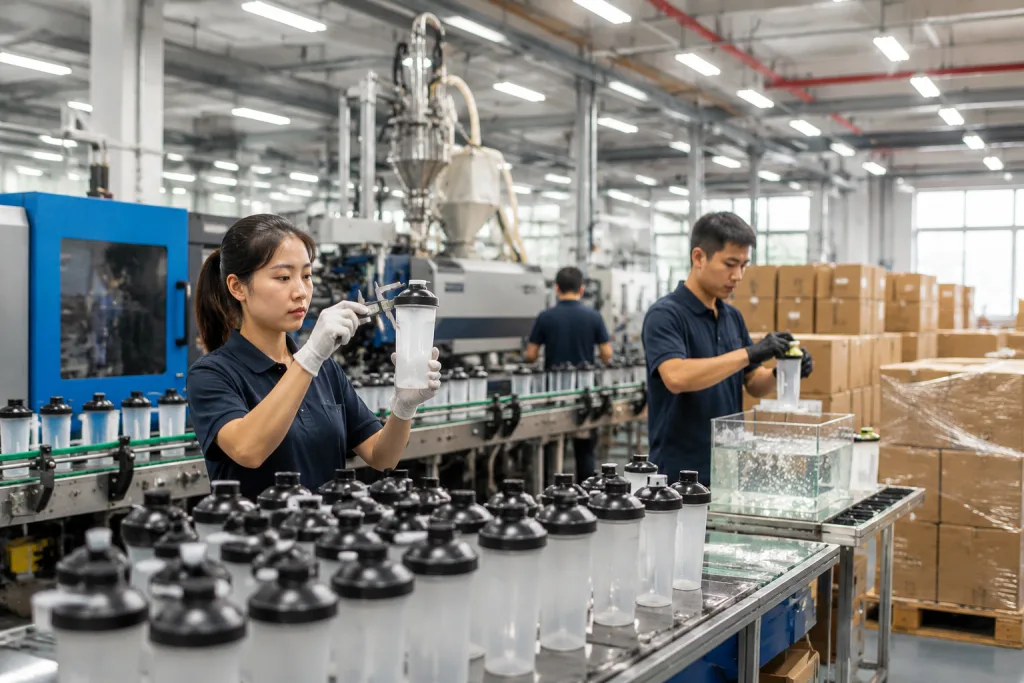
Key Takeaways
- A standard shaker order in Zhejiang often starts at 3,000 pcs per color, with 30-45 day production after approval.
- PP shakers usually cost USD 0.72-1.35 FOB China, while Tritan versions often land at USD 1.40-2.20.
- A 1.5-2.0 mm silicone gasket and 24-hour inversion test reduce leak claims more than fancy lid shapes.
- Use AQL 2.5 for major defects and ask for REACH, LFGB, FDA, and batch traceability before release.
If you are buying vendors protein shaker stock for retail shelves, gym chains, or a distributor drinkware program, don’t start with the artwork. Start with the numbers. We run first samples through a 1.2 m drop test, lid torque check, and 24-hour inverted leak test before the sales photo means anything. A shaker can look clean online and still leak in a carton, crack at the flip cap, or lose print after 20 washes. That is where your margin disappears.
In Zhejiang and across China, the better programs are won on spec sheets, not promises. A serious canteen manufacturer should give you wall thickness in mm, gasket size, material grade, and the test method before asking which Pantone color you like. We’ve seen this go sideways when a buyer approved a smooth 600 ml body but skipped the lid gasket drawing; QC pulled the sample later for a 0.4 mm mismatch. Same rule for custom drinkware, canteen custom runs, or a custom growler line. You are not buying one bottle. You are buying repeatability across 3,000 pieces.
Start With the Spec Sheet
For vendors protein shaker quotes, asking price before the build spec is the first way we see orders go loose. Price comes later. Write the line the way our tooling engineer marks the sample card: nominal volume, safe fill line, wall thickness, lid type, print area, carton pack, test standard. A 700 ml shaker should carry a 650 ml working fill, since powder and ice need headroom; last month QC pulled a cup filled to the rim and the buyer flagged foam leakage after 20 shakes. If the supplier quotes only the marketing volume, the math does not work.
Ask for dimensional tolerance in millimeters, not soft words like “standard” or “normal.” A body tolerance of ±5 ml and a weight tolerance of ±3 g tells you whether the molding is stable; we check this on the line with a digital scale and a 0.02 mm vernier caliper. The same discipline applies when you source a customized canteen, a canteen promotional line, or a custom growler. Different bottle, same sourcing logic.
- Nominal volume: 600 ml, 700 ml, or 800 ml, marked the same way on the drawing and carton label
- Safe fill line: 90-95% of nominal volume, confirmed with water fill during pre-production
- Wall thickness: 0.8-1.0 mm for PP, 0.9-1.2 mm for Tritan, measured at body shoulder and base
- Carton count: 24 or 48 pcs, based on lid height and whether the shaker ball ships inside
- Print area: define width and height in millimeters, not just “logo on front”
If a canteen supplier cannot state those numbers clearly, you are not looking at a factory-ready program. You are looking at a sample room pitch. We have seen this go sideways when the PO says 700 ml, the artwork says 650 ml, and the carton mark gets approved anyway.
Body Material and Wall Build
For shaker bottles, the body resin sets the complaint rate and the landed cost. PP is the low-cost pick: light, cheap, good for a 3,000-10,000 pcs gym promo where the buyer will not pay for crystal-clear plastic. It works when we run a straight body, no deep waist groove, and keep the wall at 0.8-1.0 mm; our caliper checks at the shoulder because that is where thin spots show first. Tritan copolyester costs more, often by USD 0.25-0.60 per piece in China, but the clarity and drop strength are easier to sell at retail. For a custom drinkware line on a shelf, the buyer sees that difference in 5 seconds.
Do not accept “food grade” as the full answer. That is the wrong question to ask. A proper canteen manufacturer or canteen factory should state whether the resin is FDA compliant, LFGB suitable, and tested for REACH where needed, with the report matching the resin code on the BOM, not a random PDF from 2021. For cold-fill protein shakers, heat resistance above 80°C is usually enough; QC pulled one sample last month that warped at 78°C after the supplier claimed 100°C. If your use case needs boiling water or thermal retention for 12 hours, it is no longer a shaker job. Move it into insulated canteen or customized drinkware structure, with double-wall stainless and a different lid seal stack.
Sample checks that matter
- Look through the body against light and mark any thin shoulder area over 15 mm wide
- Open and close the lid 20 times, then check thread dust and uneven bite
- Run a smell test after a 24-hour water soak in a sealed sample bag
- Drop test from 1 m onto wood or tile, then inspect the base ring and lid hinge
If the bottle turns soft after warm water, stop. The resin mix or wall profile needs revision before you place a full PO; we have seen this go sideways when a buyer approved color first and checked heat only after 12,000 pcs were molded.
Lid, Gasket, and Leak Control
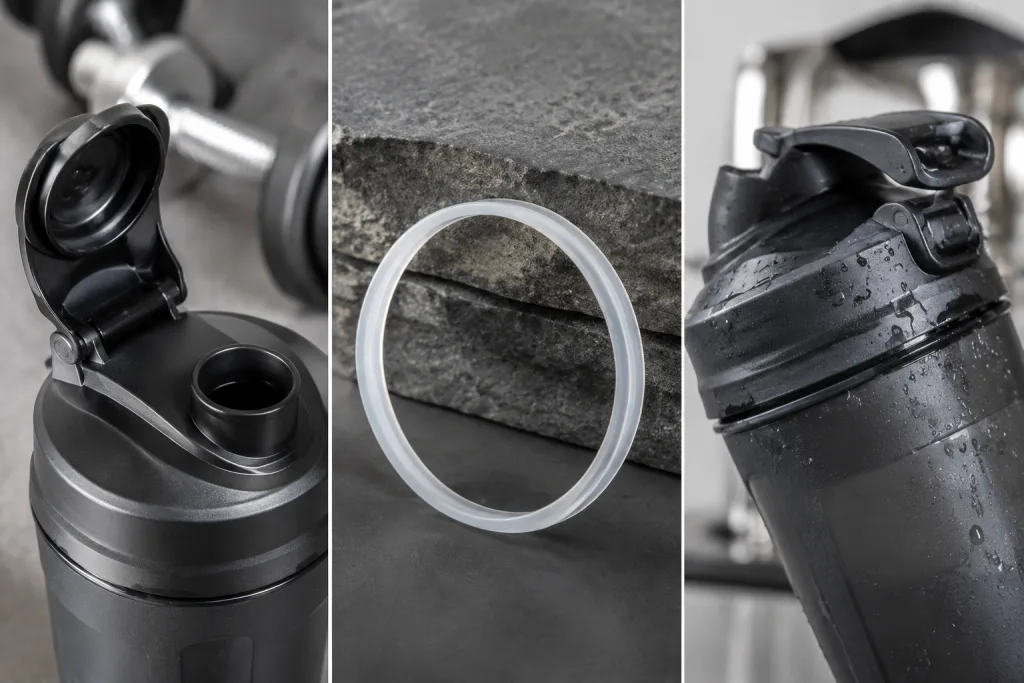
The lid is where a shaker either works on shelf or comes back as a refund. Most leaks start at the seal, not the bottle wall. Ask for gasket thickness, usually 1.5-2.0 mm silicone, and ask whether the gasket is removable. We check it with a digital caliper at 4 points, because a 0.2 mm thin spot is enough to fail an inversion test. Hard PP-to-PP sealing looks clean in a catalog photo, but after 30 dishwasher cycles the math doesn't work. A soft silicone ring gives cleaner compression and more stable results when we run 5,000 pcs on the line.
Flip tops and screw lids need separate checks. On a flip top, inspect hinge life and latch tension with a simple push-pull gauge; last month QC pulled the sample at 18 N because the buyer flagged it as too stiff for gym users. On a screw lid, check thread count, closure torque, and whether the cap bottoms out before the seal compresses. We normally test with 24-hour inversion, a 1 m drop, and 50 open-close cycles before packing approval. For retail or gym channel orders, this is not paperwork. It decides whether the carton ships or sits beside the leak-test tank for rework.
Practical rule: if the lid takes too much force to close, buyers will overtighten it, and overtightening creates leaks. We have seen this go sideways after a PO typo changed “soft gasket” to “hard seal.”
Experienced canteen distributors ask for gasket photos, thread drawings, and a written leak test method before they release production. Good request. We send close-up photos from the assembly bench, a thread section drawing in mm, and the actual AQL 2.5 leak-test record instead of a nice promise.
Branding That Survives Washing
Branding on a shaker looks simple until the wash test starts. Curved PP walls, sweat from cold drinks, alkaline detergent, and hand rubbing all attack weak ink. We run PP bodies through a 3M tape pull after curing, then QC rubs the logo with a damp white cloth for 30 strokes. For PP bodies, silk screen gives the best cost on one or two colors. For premium custom drinkware, laser engraving is clean on stainless lids or trim rings, but it is the wrong question to ask for a translucent shaker shell. The beam does not give the retail look buyers expect. Pad print handles small logos and measurement marks, but adhesion still has to pass the dishwasher check.
Keep the logo out of the grip zone. Simple rule. A 40-60 mm wide print area survives better than a tall vertical mark near the neck, where fingers and bottle brushes hit first. Last season, QC pulled the sample after 18 wash cycles because the buyer’s vertical logo lost ink at the top shoulder. If you source custom canteen, canteen customizable, or customized growler programs from the same line, do not copy the decoration spec blindly. A print method that passes on a canteen custom project can fail on a shaker because the wall radius is tighter and the wash cycle is tougher.
- Minimum line width: 0.3 mm for clean silk screen, checked on the film before plate making
- Registration tolerance: ±0.5 mm for multi-color logos, measured at first-article inspection
- Dishwasher target: 50 cycles at 60°C, with tape pull after cooling
- Packaging needs: barcode, FNSKU, and carton marks aligned with the buyer’s PO file
If you sell through Amazon or other barcode-driven channels, label placement matters almost as much as the logo. We have seen this go sideways from one PO typo: FNSKU on the inner bag, barcode on the color box, and the carton mark approved from an old artwork file.
MOQ, Price, and Lead Time
MOQ tells you whether this is a real order or a sample round. At our Zhejiang line, a standard shaker starts at 3,000 pcs per color. We run first samples in 7 days, then mass production in 30-45 days after artwork approval and deposit. On the floor, QC checks lid torque with a hand gauge before we release carton pack. Monthly output sits near 900,000 units, so repeat distributor programs move cleanly. Smaller runs still ship, but the unit price climbs fast because setup, packing, and carton labor do not shrink with the order. If a buyer wants 500 pcs at this spec, the math does not work.
For price, a basic PP shaker usually lands at USD 0.72-1.35 FOB China. Tritan models sit around USD 1.40-2.20, depending on lid count, print colors, and whether you need a measuring scale or insert. Special packaging adds another USD 0.10-0.25. Last month QC rejected a sleeve because the barcode sat 2 mm off center; that is the kind of thing a cheap quote hides. In Zhejiang, the lowest price often turns into the most expensive order once rework, reprint, or leakage claims show up. Compare landed cost, not just unit price.
If you already buy a custom growler or a canteen promo line, use the same cost model. Thicker walls, metal parts, and insulated builds should cost more. That is normal. We once saw a PO call for a 500 ml shaker but list a 28 oz insert, and the buyer flagged it after we sent the dieline. The wrong question is why a shaker does not match a plain bottle price. The line runs different. The margin should too.
Compliance and Supplier Discipline
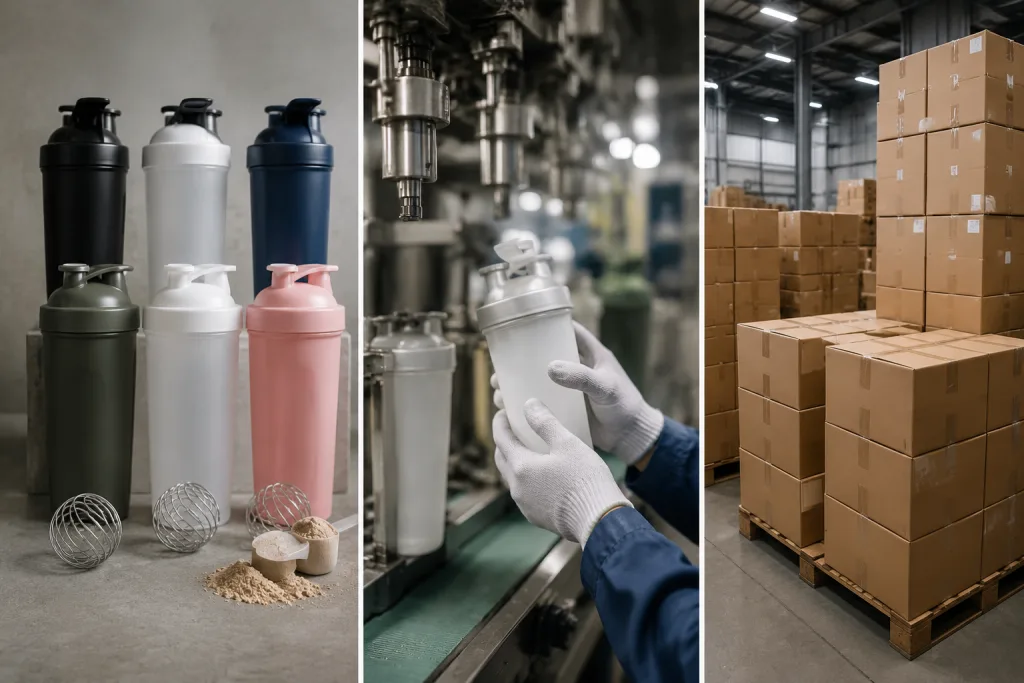
The supplier you want can show process control on paper and on the line. Ask for BSCI or a similar social audit, ISO 9001 if they have it, plus REACH and LFGB test reports for your market; for the US, FDA food-contact suitability is usually the first gate. A real protein shaker factory answers with report numbers, issue dates, and batch codes, not vague promises.
QC has to be written down. Start with AQL 2.5 for major defects and 4.0 for minor defects, then define the misses that actually hurt sales: leak, cracked lid, wrong logo, missing part, poor fit. We run a torque check on lid threads and keep resin batch, gasket lot, print color, and carton count tied to the PO; if they cannot trace that back, they are trading, not manufacturing.
That difference shows up fast on repeat orders, retail replacement runs, and distributor reorders. The same rule holds for customized drinkware: steady output beats a clever pitch. Ask for a 300-500 pcs pilot run, then check carton drop, logo rub, and leak rate before you green-light the full shipment.
Request a shaker spec quote today
Send your target volume, artwork, and compliance market. We will return a line-by-line quote with MOQ, lead time, and print options.
Frequently asked questions
What MOQ should I expect for vendors protein shaker orders?
For a standard shaker with one body color and one logo, 3,000 pcs per color is a normal factory MOQ in Zhejiang. Some canteen manufacturers will quote 1,000-2,000 pcs for repeat buyers, but the unit price usually climbs because setup cost stays the same. Samples are often 1-2 pcs, and lead time is typically 30-45 days after artwork approval and deposit. If you need multiple lid colors, custom packaging, or a measurement scale, expect the MOQ to rise. If a canteen supplier promises tiny volume with a very low price, ask how they are handling tooling, carton packing, and print setup. That is where the real cost hides.
Is Tritan better than PP for a shaker bottle?
Usually yes, if you want a clearer and more premium product. Tritan gives better impact resistance and better transparency, which helps when the bottle sits beside other custom drinkware on retail shelves. The tradeoff is cost. In China, Tritan often adds USD 0.25-0.60 per piece versus PP, depending on wall thickness and color. PP is still a sensible choice for canteen promotional campaigns, distributor drinkware programs, and price-sensitive gym sets. If the buyer wants a more upscale canteen customizable line, Tritan is often worth it. If the buyer wants volume and margin, PP can be the smarter move.
What compliance documents should I request from a supplier?
Ask for the documents that match your market. For the EU, request REACH and LFGB-related material or migration reports. For the US, ask for FDA contact suitability or a compliance statement tied to the resin and ink system. If you are buying from a canteen factory in China, also ask for ISO 9001 and BSCI or a similar social audit if you need retailer approval. Good suppliers can provide batch traceability, COA for resin, and test reports for the gasket material. Do not accept the phrase food grade by itself. It is too vague to protect your PO, especially for customized drinkware that goes through retail or marketplace review.
Can the logo survive repeated washing and dishwashers?
Yes, but only if you choose the right decoration method and keep the art simple. On PP shakers, silk screen is usually the safest option for one or two colors. A good target is 0.3 mm minimum line width and 50 dishwasher cycles at 60°C. On stainless custom growler or insulated canteen projects, laser engraving can last longer, but it is not a universal answer. Ask the canteen supplier for adhesion testing, dishwasher testing, and a clear print location map. If your logo sits on a heavy curve or near the grip zone, wear will rise. Good art placement matters as much as ink quality.
How do I judge a shaker supplier if I also buy canteens or growlers?
Use the same scoring system across every SKU. A real canteen manufacturer should be able to quote wall thickness, gasket type, print method, carton pack, MOQ, and lead time without hesitation. If they also supply custom canteen, customized canteen, or custom growler lines, check whether they own the tooling and packing process or only resell from another plant. A strong factory in Zhejiang will show consistent samples, stable AQL results, and repeatable delivery windows. A trader may still get you a product, but the variation is usually higher. For distributor canteen or distributor growler programs, that variation becomes a margin problem very quickly.