Key Takeaways
- Specify food-grade PP, wall thickness 1.8-2.3 mm, and cap torque range before price comparison
- Budget USD 0.85-2.40 FOB China for most polypropylene canteen programs, depending on size and decoration
- Use AQL 2.5 for major defects and AQL 4.0 for minor defects on pre-shipment inspection
- Plan 7-10 days for custom sample approval and 25-35 days for mass production after deposit
A polypropylene bottle looks simple until the container arrives with caps oval by 0.4 mm, cloudy bodies, weak logo adhesion, or 5-ply cartons failing a 1.2 m drop test. We see it on quote sheets for vendors polypropylene bottle projects: the buyer chases the lowest canteen custom price, then pays for the missing details. Resin grade not locked. Cap tolerance too loose. No signed pre-production sample on the bench.
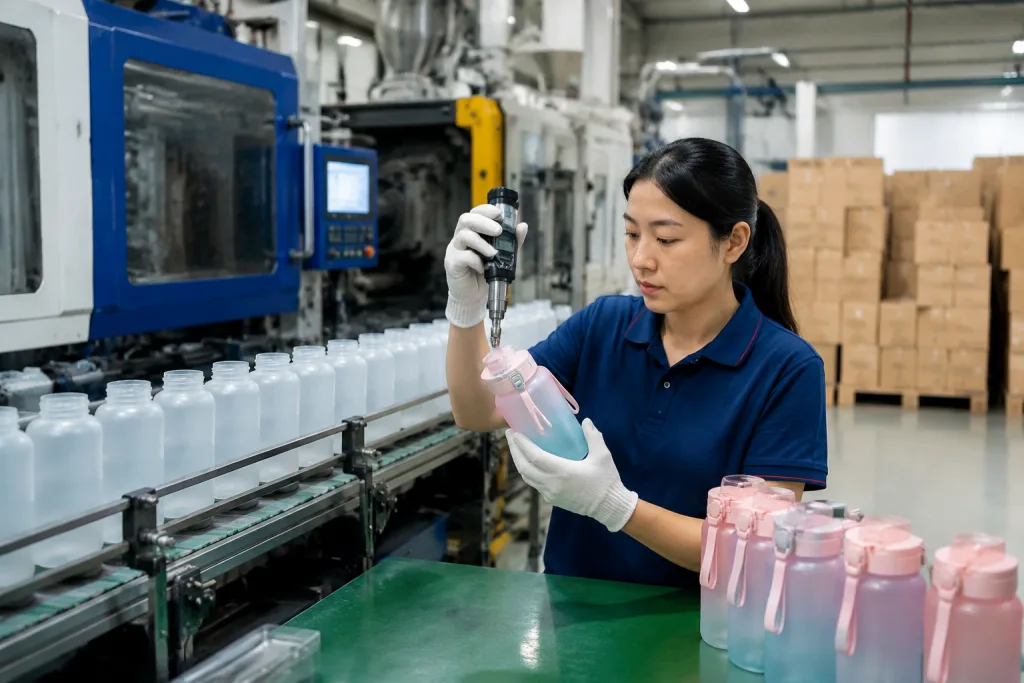
We manufacture custom drinkware in Hangzhou, Zhejiang, and QC pulled the same mistakes from 17 Europe and North America projects last quarter. China can make solid PP canteens, but the spec must give the canteen factory something measurable to run against: resin code, cap torque, logo test method, carton weight. Our Zhejiang line handles about 450,000 plastic bottle units/month, with typical MOQ from 3,000 pieces per color and 25-35 days mass production after sample approval.
Resin choice is the first leak
The first leak usually starts before the cap is even tested. QC pulled one PP sample last month that looked fine under the light box, but the body had a light oily smell after 24 hours in a sealed PE bag, and the scratch mark from a 2H pencil stayed white. Polypropylene works for lightweight canteen promotional orders, especially 3,000-10,000 pcs runs, but the resin grade has to be written on the PO. “PP food grade” is not enough. We ask for virgin PP, FDA food-contact conformity for the U.S. market, and EU 10/2011 plus LFGB or REACH screening where relevant for Europe.
For a 500-750 ml custom canteen, we normally run body wall thickness around 1.8-2.3 mm. Below 1.6 mm, you may save USD 0.05-0.09 per unit, but the bottle feels cheap and the shoulder can sink after cooling; we measure this with a digital caliper at the shoulder radius, not by hand feel. Above 2.5 mm, cycle time stretches and the quotation rises without much retail gain. The math doesn’t work. If your canteen distributor channel sells to outdoor clubs or schools, impact resistance beats chasing the last few cents.
Ask your canteen supplier to state whether the body is injection molded, extrusion blow molded, or injection stretch blow molded. Each process leaves different parting lines and tolerance behavior, and mold cost can move from about USD 2,800 to over USD 8,000 depending on cavity count and structure. A serious canteen manufacturer in China should explain this before quoting tooling. We’ve seen this go sideways: the buyer flagged a 1.5 mm mismatch at the cap thread after approval because the vendor quoted from a photo and never locked the process. If a canteen vendor gives only a photo and a unit price, you are not buying a controlled product; you are buying whatever the factory happens to run that week.
Cap tolerance causes real returns
In our return logs, about 7 out of 10 polypropylene bottle complaints start at the cap. If a bottle leaks inside a school bag or gym backpack, the buyer calls it a refund case, not a “minor defect.” The usual causes are thread tolerance over 0.25 mm, gasket compression that is too soft, a hinge pin that walks out after cycling, or caps and bodies pulled from two subcontracted lines. We have seen this go sideways when a canteen vendor bought bodies from Ningbo and caps from Yiwu, then asked us why our go/no-go thread gauge would not pass the assembly.
Your purchase order should lock the closure system with numbers, not adjectives. For screw caps, require a cap torque test, typically 0.8-1.2 N·m for small PP bottles and 1.0-1.5 N·m for larger 1 L canteens, depending on thread design. For flip lids, specify hinge cycle testing at 3,000-5,000 open-close cycles, and ask whether the test is run dry or after 60°C hot-water loading. Silicone gaskets should be removable only if your retail market expects cleaning access; otherwise the math does not work, because one missing 3 g gasket can turn a full carton into a complaint ticket.
For a canteen customizable project, approve a golden sample with the exact cap color, gasket hardness, thread fit, and pull strap. Do not approve the bottle body alone. We keep one signed sample in our Hangzhou QC room and send one to the buyer, with the sample tag tied through the handle using a numbered seal. During production, line inspectors compare every 2 hours against that sample. Simple check. It prevents the classic problem where a canteen manufacturer changes the cap mold because “the function is the same.” It is not the same if QC pulled the sample at 10:30 and the buyer flagged wet cartons at destination.
Decoration fails when PP is ignored
Polypropylene is a weak surface for branding. Its low surface energy makes ink and labels slide if you treat it like stainless steel, Tritan, or glass. We see this on the line: a logo can pass first-day inspection, then start lifting after one dishwasher run, a carton rub, or 7 days in a hot warehouse.
For canteen orders, screen printing works when the bottle goes through flame treatment or corona treatment before print. We ask for a dyne reading of 38 dynes/cm or higher, checked with a dyne pen before ink hits the part. Heat transfer labels need a curve test near ribs and grip panels; QC pulled the sample and the edge lifted on a 65 mm radius. Pad printing fits small cap logos. A full wrap? Wrong spec. If the buyer wants a premium retail finish, in-mold labeling is the cleaner path, but tooling control has to be tight and sample lead time is longer by 12 days versus a standard print sample.
A custom canteen logo should clear three checks: 3M tape pull after 24 hours, 500-cycle dry rub, and a 60°C warm-water soak for 2 hours when the bottle is sold for warm drinks. For dishwasher-safe claims, the math does not work if the artwork is weak. We have seen a distributor push back on this and then the buyer flagged the claim on the PO. Many PP bottles survive top-rack cycles; the decoration is what fails. If a customer wants “dishwasher safe” on packaging, put the test method and cycle count in writing. Loose wording turns into chargebacks fast.

Color matching drifts by batch
Brand owners usually catch color drift too late. PP resin base tone, masterbatch percentage, barrel temperature on the injection machine, cooling time, and wall thickness all push the final shade around. A Pantone number on the PO is the wrong control point by itself, because Pantone is ink on paper and the bottle is molded PP. We’ve had QC pull a navy sample from the line under a D65 light box and the buyer flagged it as royal blue in the approval photo. For canteen promotional orders, that shade gap can turn a clean shipment into a rejected 8,000 pcs lot.
Use a physical color chip or a sealed previous production sample as the reference. Better still, keep 2 signed samples: one with the factory and one with the buyer. For higher-volume distributor canteen programs, ask for spectrophotometer readings and set a Delta E tolerance before mass production. We run Delta E ≤ 1.5 for strict brand colors and ≤ 2.5 for normal promotional work. Metallic and translucent PP colors are harder to hold, especially in 1,000 ml bottles where the shoulder and base can look darker because the wall builds up by 0.4–0.8 mm.
If you are ordering from 2 canteen suppliers, their “same Pantone” will not automatically match. Masterbatch suppliers vary across China, and even within Zhejiang we see different base resin tones from Ningbo and Taizhou material dealers. For one retail launch, keep the body, lid, strap, and printed logo under one responsible canteen supplier, with the signed color chip taped to the production traveler. Splitting components across 2 canteen manufacturers may cut unit cost by USD 0.03, but we’ve seen this go sideways: lids pass, straps look warm, cartons show a third shade in the product photo. If your channel includes canteen distributors serving corporate clients, consistent color is not cosmetic; it is brand compliance.
Packaging breaks before the bottle does
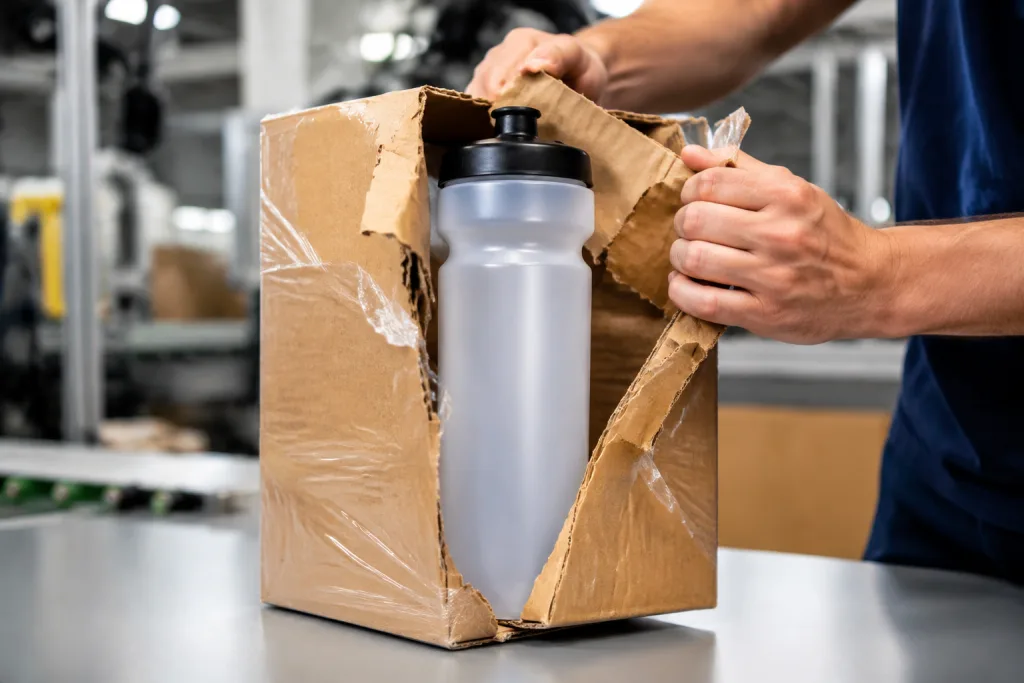
A polypropylene bottle is light, and this is where buyers under-spec the carton. We see it on about 3 out of 10 first orders: outer cartons arrive crushed, hang tags curl at the hole punch, or retail boxes show rubbed corners after one ocean leg plus truck transfer. The bottle survives. The shipment still gets flagged. Last June, QC pulled the sample carton after a 12 kg stack test and found two corner seams split by 8 mm, which means your warehouse or FBA prep team starts counting exceptions instead of receiving stock. Packaging is where customizable drinkware projects lose margin after the factory gate.
Start with the sales channel, not the bottle price. Bulk-packed promotional canteens can run in 5-ply export cartons with polybag or paper wrap, usually 50-100 pieces per carton depending on size; on a 650 ml PP bottle, we normally cap the carton at 18-20 kg gross weight so the line can palletize cleanly. Retail customized canteen orders need inner boxes, barcode placement, warnings, and carton marks checked against the PO, including small things like a missing hyphen in “BPA-free” that one buyer flagged at final inspection. If you sell online, define the drop test: ISTA 1A for basic parcel simulation or a 76 cm carton drop test on one corner, three edges, and six faces. For Amazon-style prep, confirm FNSKU label size, scannability, and carton weight under 22.5 kg unless your warehouse accepts heavier cartons.
Ask for a carton packing photo before mass packing starts. It should show carton dimensions, bottle orientation, divider use, barcode position, and gross weight on a floor scale, not just a neat top-view photo. For FOB China shipments, weak cartons become your problem once goods are loaded; this is the wrong place to save USD 0.03. We run stronger B=C cartons or add dividers when the math makes sense, and a good canteen factory will not object if you accept the cost impact, often USD 0.04-0.12 per unit. That is cheaper than repacking 8,000 units in a U.S. 3PL warehouse, especially when repack takes 12 days vs 18 days during Q4 backlog.
Inspection must match the defect risk
Generic checklists miss the way PP canteens actually fail. AQL works only if the defect buckets match the part. For vendors polypropylene bottle sourcing, put leakage, sharp flash, wrong resin, odor, cracked caps, and unreadable barcodes in major. A 0.8 mm print shift, tiny color specks, or carton rub marks can stay minor if retail acceptance is still fine.
For most B2B custom drinkware orders, we run general inspection level II with AQL 2.5 for major and AQL 4.0 for minor. If the order is for children, schools, or a chain with tighter shelves, tighten the plan and add material compliance review. Kids’ drinkware may need CPSIA, ASTM F963 checks on accessible parts, and phthalate or heavy metal screening, depending on the design and market. An old report for a different bottle shape is the wrong question to ask.
Check first-piece samples, mid-line random samples, and final packed goods. At BottleForge Industrial in Zhejiang, our QC logs injection temperature, cap torque, leakage test results, and print adhesion by batch, and we keep the torque wrench on the line for spot checks. If the vendor cannot send inspection photos with the production date and carton numbers, traceability is thin. One bad carton is enough to turn 200 units into a headache, and 20,000 is where the math stops working.
Price gaps need a teardown
If three canteen suppliers quote USD 0.92, USD 1.18, and USD 1.55 FOB for a 750 ml PP bottle, do not treat the USD 0.92 offer as fake right away. Check the build. We run teardown checks with a digital scale and caliper: resin grade, body weight in grams, wall thickness around the shoulder, cap thread fit, silicone or TPE gasket, print method, carton burst strength, and whether FDA or LFGB testing is in the price. Ask each canteen manufacturer for bottle weight, mold ownership, sample charge, packing method, and production lead time. If one quote shows a 72 g body and another shows 94 g, the price gap already has a name.
For a standard 600-800 ml customized growler-style PP canteen, realistic FOB China pricing usually lands at USD 0.85-2.40 based on mold, lid complexity, and order volume. A custom growler or customizable growler with a wider mouth, molded handle, and heavier cap will price near the top of that band. The math does not work if a buyer wants a 90 mm mouth, two-shot lid, and retail gift box at the bottom price. New mold tooling may range from USD 1,200 for a simple cap insert to USD 8,000-18,000 for a full custom body and lid set. Last quarter QC pulled a sample where the cap insert was 0.35 mm short, and that tiny miss caused slow leakage after the carton drop test.
MOQ matters because color change, machine setup, and printing setup cost real money on the line. We usually quote from 3,000 pieces per color for existing molds and 10,000 pieces for some new custom body projects. A canteen distributor asking for 12 colors at 500 units each will pay more per unit and face more color variation; we have seen Pantone 326C drift after the third hopper cleanout. Better approach: start with 2 colors or 3 colors, confirm sell-through, then reorder with cleaner forecasts. A good canteen vendor should push back when your assortment plan is too fragmented. That is not bad service. It is manufacturing reality.
Send us your polypropylene canteen spec for review
We will check resin, cap, logo, packaging, MOQ, and lead time before you commit to tooling or a production deposit.
Frequently asked questions
What MOQ should I expect from vendors polypropylene bottle factories?
For existing polypropylene bottle molds, a practical MOQ is usually 3,000 pieces per color, although some canteen vendors may accept 1,000-2,000 pieces with a higher unit price and limited decoration options. For a new custom canteen body, expect 10,000 pieces or more because tooling, color matching, and line setup need volume to make sense. If you need several colors, do not split 3,000 units into six colors unless you accept higher cost and more QC risk. At our Hangzhou, Zhejiang factory, normal mass production lead time is 25-35 days after deposit and approved sample, with another 7-10 days for custom sample work.
How do I know if a canteen supplier is using safe PP material?
Ask for a material declaration stating virgin food-grade polypropylene, not just “safe plastic.” For U.S. buyers, request FDA food-contact conformity documentation. For Europe, ask for EU 10/2011 migration testing and REACH screening where relevant. If the bottle is for children, check CPSIA and ASTM F963 requirements for coatings, inks, and small parts. You should also ask the canteen supplier to identify masterbatch and gasket materials, because safety risk is not only in the bottle body. A current test report should match the product structure, color, and decoration, not a different bottle made two years ago.
Is polypropylene suitable for a customized growler or sports canteen?
Polypropylene works well for lightweight sports canteens, school bottles, and promotional drinkware, especially in 500 ml to 1 L sizes. It is not the right material if you need vacuum insulation, premium metallic finish, or long hot beverage retention. For a customized growler look, PP can create a wide-mouth, handled bottle at a lower weight than stainless steel, often around USD 1.40-2.40 FOB China depending on cap and decoration. Be careful with hot-fill claims. Many PP bottles tolerate warm liquids, but the exact temperature limit depends on wall thickness, cap design, and deformation testing.
Which logo method is best for canteen promotional orders?
For simple one- or two-color logos, screen printing is usually the most economical choice on PP, provided the surface is flame or corona treated before printing. For cap logos, pad printing is common. Heat transfer can handle more complex graphics but needs curved-surface testing and stronger process control. In-mold labeling gives a cleaner retail look, but it requires higher volume and tighter tooling setup. For a canteen promotional order, require a 3M tape test, 500-cycle rub test, and visual inspection after warm water exposure. Do not approve mass production based only on a fresh printed sample.
What inspection standard should I put on my purchase order?
For most distributor drinkware orders, use AQL general inspection level II, with AQL 2.5 for major defects and AQL 4.0 for minor defects. Define leakage, cracked cap, sharp flash, wrong material, strong odor, missing gasket, unreadable barcode, and incorrect logo as major defects. Minor defects can include small specks, slight print offset under 1 mm, or light carton marks if retail acceptance is not affected. Add functional tests: 100% visual checks on line, random leak testing, cap torque measurement, logo adhesion testing, and carton drop checks. The inspection checklist should be agreed before production, not argued after goods are packed.