Key Takeaways
- Confirm capacity, steel grade, and insulation target before requesting samples; 304 stainless and 6-12 hour heat retention are common starting points
- For canteen custom projects, MOQ normally starts at 1,000-3,000 pcs depending on color, cap, and logo process
- Laser engraving is durable but slower; one-color silk screen is cheaper below 5,000 pcs when artwork is simple
- Use AQL 2.5/4.0 inspections, REACH/LFGB/FDA checks, and 30-45 day production lead times for realistic planning
If you are sourcing vendors outdoor canteen products, the hard part is not finding a supplier. The hard part is fixing the spec before three quotes land on your desk for what looks like the same bottle. Shape, 304 stainless vs 316 stainless, cap type, powder coat, logo method, carton count, and test plan all move the landed cost. We run this every week, and the buyer who skips the drawing stage usually pays for it later. A simple typo on the PO, like `500ml` instead of `550ml`, can force a new sample and a fresh round of QC on the line.
From our Zhejiang factory in Hangzhou, we see buyers lose a week because they ask for a custom canteen before they lock the use case. Retail outdoor gear, staff gifts, military-style promo runs, and distributor programs do not share one spec. That is the wrong question to ask. If you define the job first, sampling usually stays around 12 days instead of 18 days, and the MOQ debate gets easier to handle. We have seen this go sideways when a buyer wants one bottle for a hiking brand and a different one for a camp supply catalog, but expects the same tooling and price.
Start With The Buying Decision
A vendors outdoor canteen buy starts with four calls: end user, sales channel, branding level, and target compliance market. Skip one, and every canteen factory will quote a different build. We see that on the line all the time.
Retail buyers need cleaner surface finish, a cap that survives carton friction, barcode labels, and shelf-ready cartons that stack at 6 pcs per inner. For a canteen promotional campaign, a simple cap and one-color logo often work if the landed price stays at USD 3.20-4.80 FOB China. Distributor orders play by another rule: the SKU has to stay steady for 12-24 months, or the buyer flags it on the next reorder sheet.
Next is insulation. Single-wall stainless canteens are lighter and cheaper, usually 0.45-0.55 mm wall thickness, and they fit cold water, hiking clubs, and low-budget gifts. Double-wall vacuum canteens use inner and outer shells, usually 0.4-0.5 mm 304 stainless, and each batch needs vacuum testing on the gauge. They cost more, but the retail story is stronger and QC pulls fewer samples for complaint checks.
Then decide how far you want to go on customization. Logo-only jobs are straightforward: stock mold, standard lid, standard powder coat, then silk screen or laser. A fully canteen customized project with a new body profile, special cap, silicone bumper, or custom growler-style handle needs engineering review and a 2D drawing sign-off. Tooling can run USD 1,200-8,000 depending on parts. That is normal. The math only works if the buyer can show repeat volume, not a one-off PO with a typo on carton count.
Do not ask ten canteen vendors for “best price” until you can state capacity, material, finish, logo method, packing, destination market, and target delivery date.
Choose The Canteen Body First
The body carries most of the cost and most of the complaints. For outdoor canteen programs, we usually quote 500 ml, 750 ml, 1,000 ml, and 1.9 L. A 750 ml customized canteen is the safe retail size; it fits most shelf trays and keeps carton weight around 12-14 kg when we run 48 pcs per master carton. A 1.9 L custom growler or customizable growler suits camping, breweries, and picnic channels, but the freight math changes fast. The cartons cube out first. One US buyer pushed back on a 1.9 L quote last May because the sea freight added USD 0.42 per unit versus the 1,000 ml body.
Write the material on the PO clearly. Food-contact stainless should be 304 stainless steel for the inner wall, no guessing from the supplier side. Some buyers accept 201 stainless for the outer wall on price-sensitive jobs, but we do not recommend it for humid coastal markets because the math doesn't work: saving USD 0.10-0.20 is not worth 3 pallets of rust complaints. QC pulled a sample from a Ningbo-bound batch where the magnet test showed the outer shell was not what the buyer approved. Aluminum canteens still exist, but coating control and dents make them hard for premium distributor canteen programs.
Wall thickness changes the hand feel and the dent rate. A cheap single-wall canteen may use 0.35 mm material. Looks fine online. Drops badly. We have seen 0.35 mm bodies crease after a 90 cm warehouse drop onto a concrete corner during incoming inspection. For most B2B custom canteen projects, 0.45 mm is the better minimum. For larger growler bodies, 0.5 mm or above feels steadier, especially when the line welds on a wide carry handle and the buyer wants a heavier outdoor look.
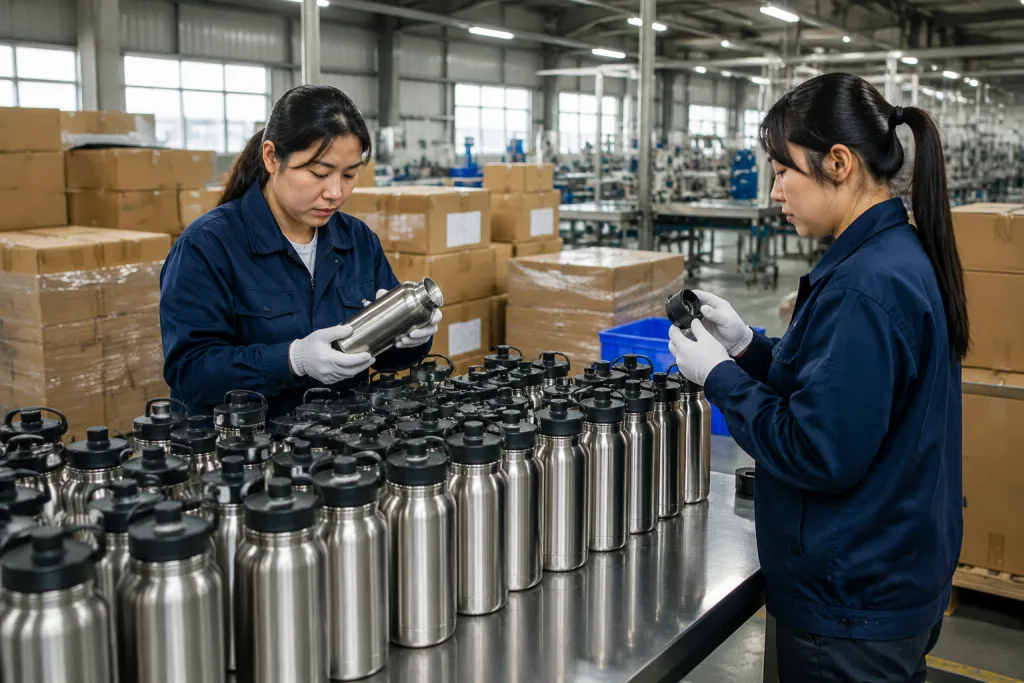
Cap design is not a small detail. A PP screw cap is cheaper and light, while a stainless cap with silicone gasket feels better in the hand and shoots better for catalog photos. A tethered cap prevents lost caps in outdoor use, but it adds 6-8 seconds of assembly time per unit and gives QC one more point to check. Ask your canteen factory for the leak testing method. We run 100% air pressure or water inversion checks on sealed bottles before final packing, plus random drop tests by batch; last quarter, QC flagged 27 caps with uneven gasket seating before they reached the carton line.
Branding Changes The Cost Curve
Branding is where 7 out of 10 canteen supplier quotes start to get slippery. “Logo included” tells you almost nothing unless the quotation fixes the process, logo size in mm, color count, and print position. For canteen promotional orders, we usually run one-color silk screen on one side as the lowest-cost route; a 55 mm wide logo on the front panel is a normal case. It can add roughly USD 0.08-0.18 per unit depending on artwork size and quantity. Ask for the print area drawing. QC pulled one sample last month where the buyer’s PO said “left side,” but the artwork file marked “front,” and that small mismatch held the line for 6 hours.
Laser engraving costs more on some finishes, but it survives abrasion better. For outdoor retail and employee gift programs, this is often the safer call when the buyer wants a premium look without the logo rubbing off after 30 wash cycles. For powder-coated bottles, laser exposes the stainless layer underneath. For polished stainless, the mark is soft; we’ve seen buyers reject it because the logo looked too quiet under store lighting. A canteen vendor should show real production photos taken on the packing table, not a clean digital mockup. The wrong question is “Can you laser it?” The right question is “How visible is a 40 mm logo on this exact finish?”
Full-wrap printing, heat transfer, and water transfer work for high-impact customized drinkware, but the math changes fast: higher setup cost, slower approval, tighter color control on the line. If your order is 1,000 pcs, keep the artwork simple. We run this with a Pantone chip beside the sample, and even then QC may flag a 5% shade drift between the first 50 pcs and the middle cartons. If your order is 10,000 pcs, a more complex canteen customizable design can make sense because setup cost spreads out across the run. Small orders with full-wrap artwork go sideways more often than buyers expect.
Packaging also carries your brand. A plain white box may cost USD 0.12-0.25. A printed color box can be USD 0.25-0.60 depending on size and paper grade. For Amazon or marketplace shipments, you may need FNSKU labels, suffocation warnings for polybags, and carton drop-test awareness. We ship marketplace orders with the label position checked by a handheld scanner before sealing the master carton. Distributor growler and distributor drinkware orders often need neutral cartons so the same stock can serve several downstream accounts; one buyer flagged us for printing the end customer name on a carton flap, and they were right to push back.
- Lowest cost: stock color with one-color silk screen, usually one side and one fixed logo size.
- Best durability: powder coat with laser engraving, after checking logo contrast on a real sample.
- Best shelf impact: custom color with printed box, scannable barcode, hang tag artwork, and carton labeling checked before packing.
Audit Capacity Before You Trust Quotes
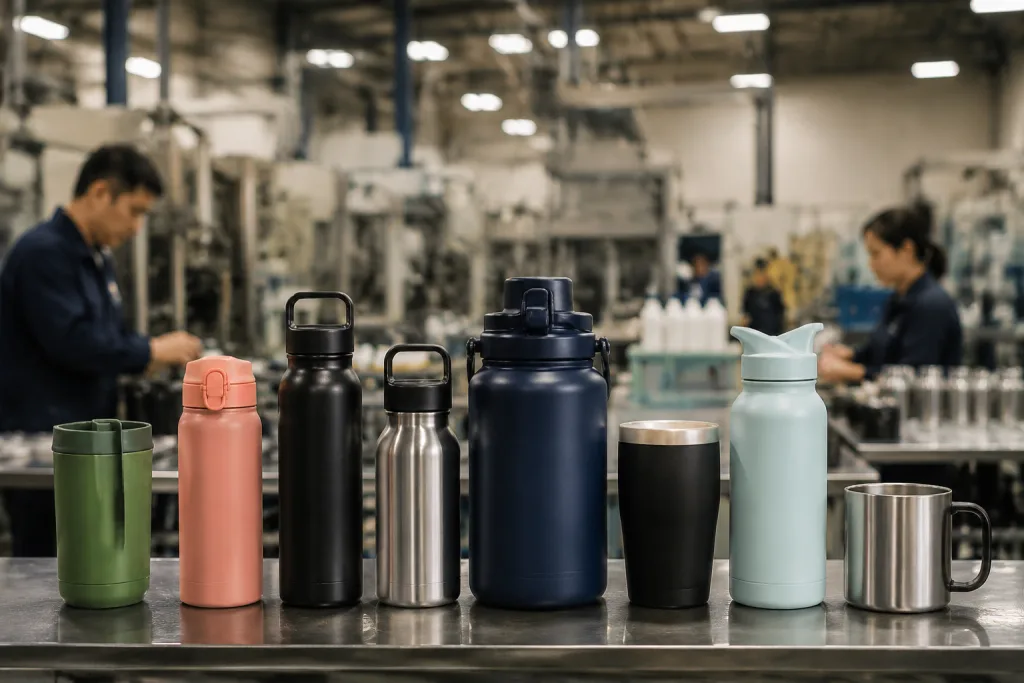
A serious canteen factory should quote more than a unit price. Ask for monthly capacity, normal MOQ, sample time, production lead time, inspection steps, and export track record. At BottleForge Industrial in Hangzhou, Zhejiang, we run about 650,000 stainless units a month across bottles, tumblers, thermos, and canteen-style products. Typical MOQ is 1,000 pcs for logo-only stock molds and 3,000 pcs for custom color or special accessories. QC pulled the sample on a torque tester and checked the lid thread gap at 0.2 mm before release.
Lead time lives or dies on the bottleneck. A simple custom canteen built on an existing body may sample in 7-10 days and ship in 30-35 days after deposit and artwork approval. A new cap mold or a custom growler handle can add 20-30 days before mass production starts. If a canteen factory says 15-day production in peak season without checking color, lid stock, and carton supply, that quote is a red flag. We have seen that go sideways when the buyer flagged a PO typo on lid quantity and the whole line stalled for a day.
For Europe and North America, compliance belongs in the plan from day one. Common asks include LFGB or EU food-contact testing, REACH for coatings and components, FDA food-contact expectations for the US, and California Proposition 65 review where relevant. If the product is for kids, ASTM and CPSIA questions may come up even when the shape looks like adult outdoor gear. The buyer pushback is usually the same: “Do we need all of this?” Yes, if you want the shipment to clear. Our lab keeps an XRF checker on the bench for coating checks, and that saves time when a metal part looks off.
Factory audits still matter. BSCI, ISO 9001, Sedex, or customer-specific audits do not fix a bad product, but they do show whether the shop can keep basic discipline. Ask canteen manufacturers for the latest audit scope and confirm it covers the real production site in China, not just a trading office. If you buy through an agent, ask who owns inspection and corrective action. On one audit, the buyer found the carton count on the packing list was off by 200 pcs; that is the kind of mistake that tells you whether the line is tight or loose.
Build The Quote Like A Spec Sheet
The quickest way to compare canteen vendors is to make every quote follow one spec-sheet format. A usable quotation should show model number, capacity, material, finish, logo process, packaging, MOQ, sample cost, production lead time, payment term, trade term, carton size, gross weight, and validity period. We run this in a 16-column RFQ sheet; if one canteen vendor quotes FOB Ningbo and another quotes EXW Zhejiang, the “cheaper” line often loses once you add RMB 1,800-2,600 trucking, customs handling, and export paperwork.
For most buyers, FOB Ningbo or FOB Shanghai is cleaner than EXW because the China factory takes care of the local export steps. CIF works for a first trial order, but ask what is excluded at destination. Ocean freight looks cheap on the PI, then the buyer gets hit with local port fees, handling, customs broker charges, and final delivery. For North America, ask for carton dimensions before price approval; our shipping clerk measures with a tape on the packing table, because a 2 cm carton change can push the order from 18 pallets to 20 pallets.
Price breaks need to pass the smell test. A 1,000 pc order still carries coating changeover, pad-print plate setup, and first-article QC time. At 3,000 pcs, the unit price usually improves because the line is not stopping after one short run. At 5,000-10,000 pcs, stainless coil purchasing, powder coating, caps, cartons, labor, and inspection spread out better. The wrong question is “how much discount if I double volume?” We have seen this go sideways when a buyer expected a 30% drop; the math does not work when 304 stainless, coating powder, leak-test labor, and AQL 2.5 inspection all have hard cost floors.
Payment terms tell you a lot. For new buyers, standard terms are usually 30% deposit and 70% balance before shipment. Larger distributor canteen accounts may negotiate after 6-8 stable orders and clean payment records. If a supplier offers loose terms on a heavily customized canteen, slow down and check whether they own the line; QC once pulled a pre-shipment sample where the PO said “matte army green” but the factory sprayed glossy green, and the reseller had no control over rework timing.
Control Samples And Inspections
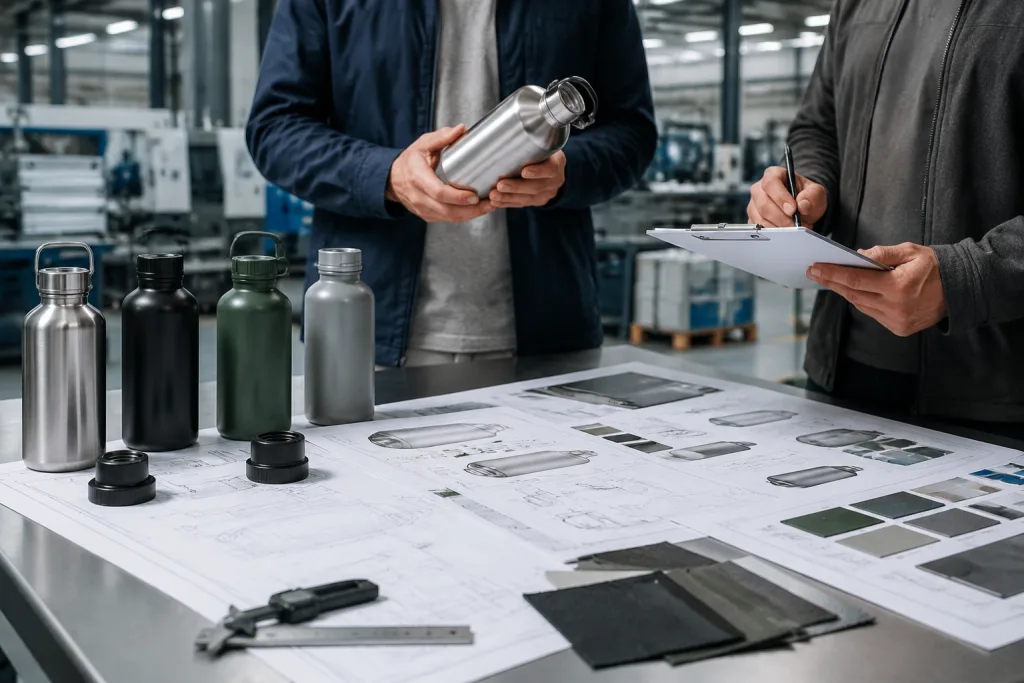
Samples are not souvenirs. They are the contract reference for production. When you approve a canteen custom sample, mark the Pantone target, logo position in mm from the bottom seam, logo size, cap fit, gasket material, unit weight, box layout, and barcode placement. We usually sign 2 golden samples with a black marker across the label: 1 stays with the buyer, 1 stays beside the line for QC. For powder coating, Pantone is only the target. The buyer flagged this before on matte olive green; 0.03 mm coating thickness over 304 stainless shifted the shade enough to start an argument.
Pre-production samples are worth the delay when the order is customized drinkware for retail. A pre-production sample should use mass-production sheet, the actual cap mold, and the correct logo process, not a hand-made sales sample polished on the sample bench. If the sample is made by a different method, write it on the approval sheet. Short sentence. Otherwise, you are approving something the production line cannot repeat at 3,000 pcs per shift, and we have seen this go sideways when a buyer approved laser marking but the PO later said silk screen.
Inspection should follow AQL, not “looks good.” A common setup is AQL 2.5 for major defects and 4.0 for minor defects, with critical defects at 0. Critical defects include sharp edges, leakage, unsafe odor, wrong material, or contamination. Major defects include obvious dents, peeling coating, wrong logo, poor cap fit, or carton shortage. Minor defects include small surface marks within agreed limits, such as 1 scratch under 5 mm on the back side. QC pulled the sample last month for a cap thread burr; the math does not work if retail returns start because someone waved through “acceptable” rough edges.
For outdoor canteens, add practical tests: leak test, coating adhesion cross-hatch, 3M tape logo test, drop test from 80-100 cm depending on packaging claim, and capacity check. Vacuum products need heat retention testing. A basic double-wall canteen should usually keep hot water above 50°C after 6 hours when tested from about 95°C room-temperature baseline, but exact performance depends on capacity and lid design. We run the leak test upside down for 30 minutes on a dry tissue sheet, then check the cap gasket under a 10x loupe if there is even a 1 mm wet mark.
Plan Reorders, Not One-Off Luck
The best canteen distributors do not treat every PO like a fresh start. They lock the spec, keep the artwork under one file name, and reorder before stock runs dry. If your channel needs repeat supply, ask the canteen supplier to confirm the mold, lid, gasket, and coating color for 12 months, not “as available.” We had a buyer flag a cap change after the third lot, and the mix-up cost them a full relabel run.
Forecasts help the line run cleaner. If you see 2,000 pcs now and 8,000 pcs by peak season, say it straight. A China factory can plan cartons, accessories, and coating powder better when the numbers are real. The math does not work if you hide demand and then expect a fast reorder; our powder room once had to stop a 304 stainless line for a carton shortage because the forecast was off by 3,500 pcs.
Spare parts deserve a spot in the deal for higher-value customizable drinkware. Replacement caps, gaskets, straws, and silicone boots can ship in separate cartons for distributors or after-sales teams. For retail outdoor canteens and customized growler programs, a 1-2% spare cap allowance is cheap insurance. QC pulled the sample tray on one run and found two loose gaskets in 100 pcs; that is the kind of issue spares cover.
File control matters too. Your logo art, packaging dieline, barcode, FNSKU, instruction sheet, and approved QC checklist should live in one locked folder. When staff changes, buyers lose the approved version and the reorder comes back with a print size typo or a shifted barcode. A disciplined canteen manufacturer in Zhejiang should pull the last PO, but I would not lean on memory; we have seen a 0.8 mm logo shift turn into a full reproof.
If you want a vendor relationship that lasts, judge the supplier by how they handle small problems. Every factory has defects. The useful question is whether they isolate the batch, show photos, offer rework, and write the corrective action before shipment. That is the line between a canteen vendor and a production partner. On our side, the best buyers ask for the AQL 2.5 report and the packing video, then move on without drama.
Send Your Canteen Spec For Factory Review
Share capacity, logo, market, and target quantity. We will check feasibility, MOQ, lead time, and FOB China pricing before sampling.
Frequently asked questions
What MOQ should I expect for a custom outdoor canteen order?
For a stock-mold canteen customized with one logo, expect MOQ around 1,000 pcs per design. If you need custom powder coating, multiple logo positions, printed gift box, or a special cap color, 3,000 pcs is more realistic. New mold work for a custom growler or unique canteen body usually needs 5,000 pcs or a tooling charge, often USD 1,200-8,000 depending on part complexity. A canteen supplier may accept 500 pcs for sampling or trial orders, but the unit price will be higher because coating setup, printing setup, and export handling do not scale down neatly.
How do I compare quotes from different canteen manufacturers?
Put every quote into the same spec format before comparing price. Require capacity, stainless grade, wall thickness, cap material, gasket material, finish, logo method, packaging, carton quantity, trade term, sample time, production lead time, and testing standard. A USD 3.80 FOB Ningbo quote may be better than a USD 3.55 EXW China quote once local export costs are added. Also check whether the quote includes artwork setup, color box, barcode label, and inspection support. Canteen vendors often look similar on price until you compare these line items.
Which logo method is best for canteen promotional projects?
For budget canteen promotional orders, one-color silk screen is usually the best starting point. It is affordable, fast, and works well on flat or gently curved areas. Laser engraving is better for premium custom drinkware because it resists abrasion and looks more permanent, especially on powder coating. Heat transfer or full-wrap printing is useful for colorful retail designs, but it adds setup time and more color-control risk. If your order is below 3,000 pcs, keep the decoration simple unless the campaign absolutely depends on a full-surface graphic.
What compliance documents should a canteen distributor request?
For Europe, ask for food-contact testing such as LFGB or EU 1935/2004-related reports, plus REACH checks for coatings, silicone, and plastic parts where applicable. For the US, FDA food-contact expectations apply, and Proposition 65 review may be needed for California distribution. If the product targets children, discuss CPSIA and ASTM requirements before sampling. Audit documents such as BSCI, Sedex, or ISO 9001 are useful, but they do not replace product testing. Match the test report to the actual material, coating, and component structure you are buying.
How long does production take after I approve the sample?
A normal canteen custom order using an existing mold takes about 30-45 days after deposit, artwork approval, and sample confirmation. Sampling is usually 7-14 days for logo and color work. If you need a new cap, special handle, custom growler body, or complex printed packaging, add 20-30 days for tooling and pre-production approval. Peak season before summer outdoor campaigns can stretch lead times, especially for powder coating and carton printing. Book inspection at least 5-7 days before the planned vessel closing date.