Key Takeaways
- Set wall thickness at 0.50-0.60 mm for stainless military-style canteens, not just “standard thickness”
- Use AQL 2.5 for major defects and AQL 4.0 for minor defects on custom drinkware inspections
- Plan 35-45 days production after sample approval for a 3,000-5,000 pcs canteen custom order
- Ask your canteen factory for leak testing, coating adhesion, logo rub test, and carton drop test records
Buying from vendors military canteen search results looks easy until the first shipment lands with 0.6 mm cap wobble, scratched powder coating, mixed carton marks, or a logo that passed the PDF proof but peeled after 20 dishwasher cycles. We see it on the packing table. Military-style canteens are simple parts, but vague POs make bad goods.
If you are a canteen distributor, promotion agency, outdoor brand, or drinkware buyer, a catalog photo is the wrong place to put your trust. Turn each failure point into a checked spec: steel grade, body thickness, thread tolerance, print curing time, and AQL 2.5 inspection points. From our Hangzhou, Zhejiang export desk, we run into the same 5 sourcing problems every month; last week QC pulled a sample with 304 stainless on the quote, 201 stainless on the mill sheet, and the buyer flagged it 2 days before loading.
The Catalog Photo Is Not a Specification
The first failure in a vendors military canteen project usually happens before the line is scheduled. A buyer sends a catalog photo, writes “same as this,” and gets quotes from 5 canteen suppliers. The prices look close. The products are not. One canteen manufacturer quotes 201 stainless steel with a 0.40 mm body. Another canteen supplier quotes 304 stainless steel at 0.55 mm. A third includes a nylon pouch with 600D fabric and belt snaps, while another quotes only the bottle in a polybag. QC pulled a sample last month where the PO said “army canteen,” but the cap thread was different by 1.2 mm from the approved sample. On paper, all three are “military canteens.” On the factory floor, they are different SKUs.
Your purchase order should define the product like an engineering file, not like a mood board. For stainless versions, specify 304 stainless steel inner and outer body if food-contact compliance matters for Europe or North America. If you accept 201 stainless for cost reasons, write it in the PO and price the rust-risk into the program. For aluminum canteens, specify food-grade internal coating, coating thickness, and whether the surface is raw, anodized, powder coated, or painted. We run a coating thickness gauge on incoming aluminum bodies, and a “silver finish” note is not enough when the buyer later expects hard anodizing.
A practical custom canteen spec should include capacity tolerance, such as 1.0 L ±3%, body wall thickness of 0.50-0.60 mm, mouth diameter, cap material, gasket material, thread type, weight tolerance, and finish. Don’t ask for the “best version.” That is the wrong question to ask. Tell the supplier whether the canteen must survive a 1.2 m drop test, fit a 38 mm pouch opening, or hit a 185 g target weight for freight math. If you need a canteen customizable for several retail channels, lock the base body first, then change color, logo, pouch, and packaging by program.
At BottleForge Industrial in Zhejiang, China, a normal MOQ is 1,000 pcs per color for stocked body molds and 3,000 pcs for a new color or customized canteen finish. Our drinkware lines can handle about 420,000 units/month across bottles, tumblers, and canteens, but capacity does not rescue a loose spec. We have seen this go sideways: the buyer flagged “matte green” after mass production because their artwork file used C military green and the PO typed “army greeen.” One typo. 6 pallets stuck. A vague order just produces defects faster.
Leakage Starts With Threads and Gaskets
Leak complaints hit your margin hard because the end user finds them first. On the line, the usual culprits are simple: thread mismatch, weak cap torque, a cheap silicone gasket, weld distortion, or cap shrinkage after molding. If you buy for a canteen distributor program, this is where replacements and freight start eating profit. We run cap torque with a digital torque meter for a reason.
Do not stop at “leak-proof.” Define the test. A factory test that holds up is 100% water fill, cap closed, inverted for 3 minutes, then a horizontal roll. For tighter QC, we add air pressure at 0.05-0.08 MPa on selected samples. If the canteen is for hot liquids, narrow-mouth military-style bodies need extra caution; pressure build-up and hand use both matter. We have seen a 2,000 pcs order fail because the PO said “no leak” and nothing else.
Gasket material should be food-grade silicone, usually 50-60 Shore A. Put a durometer gauge on the packing table and check it, because too soft deforms and too hard stops sealing on a mouth that is slightly off. Ask your canteen vendor to confirm gasket color, hardness, odor test, and migration compliance for EU sales. For North America, request FDA food-contact papers where they apply.
Thread tolerance is hard to spot in a photo. If you are ordering a canteen with a private cap, approve tooling samples before mass production and keep two golden samples, one at your office and one at the factory. During inspection, hand-check cap engagement on at least 80 pcs from different cartons in a 5,000 pcs lot. If 3 or 4 caps feel gritty, loose, or cross-threaded, the math does not work. That is not a small issue; it is a production signal.
Coating Failures Hide Until Shipping
Powder coating, spray painting, and anodizing are where 6 out of 10 canteen promo complaints start. The pre-production sample looks clean because one senior technician babysits it with a spray gun and clean gloves. Mass production is different. We run the line at speed, then QC pulled the sample and found orange peel on the shoulder, 0.3 mm dust points, uneven gloss, weak adhesion near the neck, color drift between Batch A and Batch B, plus scratches from trays set too tight. This hits customized drinkware and nearby items like a custom growler or customizable growler, but military-style canteens take more damage because the curved shoulders knock against racks during loading.
For powder coating, specify the finish with a physical color chip or Pantone reference, but Pantone is not a coating system. Add gloss level if it affects shelf appearance, such as matte 10-20 GU or semi-matte 30-40 GU at 60 degrees. Require a cross-hatch adhesion test based on ASTM D3359 or ISO 2409, with a target of 4B/5B or class 0-1 depending on your market standard. For promotional orders, request a 3M tape pull test after logo printing; we’ve seen logos pass on day 1, then lift after the carton sat in a 38°C warehouse for 7 days.
Agree color tolerance before production. For retail programs, ΔE under 2.0 is a useful target when measured properly, but the math doesn't work if a low-cost canteen vendor is matching by eye under a workshop LED tube. Ask for controlled matching and expect to pay for it. For event giveaways, a signed limit sample may be enough; last month one buyer flagged a “black” canteen that was closer to charcoal, and the PO only said “BK,” so nobody won that argument. Either way, put the approval method in the PO.
Packing matters more than buyers think. A good coating can be ruined by cheap polybags, thin dividers, or metal caps rubbing against the body. For a 1 L stainless canteen, we normally use individual polybag or tissue wrap, inner box if retail, 5-ply export carton, and a carton drop test from 60-80 cm depending on packed weight. We also check cap-to-body clearance in the packed carton; 2 mm is not enough after 18 days at sea with vibration. China export shipping is not gentle, so design packaging for truck vibration and container stacking, not just showroom photos.
Logo Decoration Is a Durability Risk
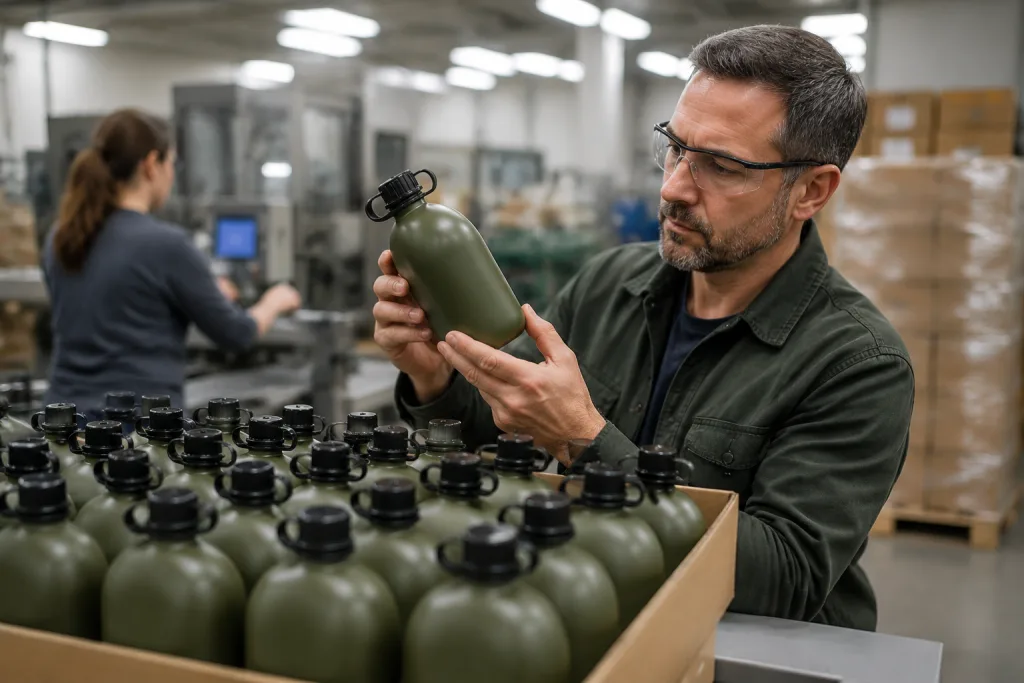
A canteen custom project often starts with a logo, but decoration is not one process. Silk screen printing, pad printing, laser engraving, heat transfer, water transfer, and full-wrap sublimation fail in different ways. We see this on the line. A cheap print can pass for a 1-day event and still be the wrong choice for outdoor retail, where the bottle rubs against webbing, sand, and a metal buckle. If you need canteen promotional units at 2,000 pcs for a conference, silk screen may be fine. If you need a customized canteen sold through outdoor stores, ask for abrasion and wash results before you release the PO; last quarter one buyer flagged logo wear after QC pulled the sample from a carton with rough kraft dividers.
Laser engraving is the safest decoration on powder coated stainless steel because the laser removes coating and exposes metal. Simple math. It does not work well for complex multi-color artwork, so do not force it just because it sounds premium. Silk screen is cost-effective for 1-2 color logos, often adding USD 0.08-0.18 per position at 1,000 pcs, depending on logo size and ink type. Heat transfer handles gradients and small details, but curved bodies need adhesion testing; we run 3M tape pull checks after curing, then inspect the edge under a 10x loupe. For aluminum bodies, decoration depends on the surface treatment, especially anodized versus spray-coated finish.
Your artwork file should be vector format, usually AI, PDF, or EPS, with Pantone references where color printing is required. Define logo size in millimeters, placement from a fixed point, and tolerance such as ±2 mm. Do not approve a mockup only. This is where projects go sideways. Ask for a physical decorated sample, then run a rub test: 500 cycles with dry cloth and 200 cycles with wet cloth is a practical buyer-side check. For dishwasher claims, use a defined cycle count and detergent; otherwise, “dishwasher safe” is just marketing language. We once had a PO typo showing 65 mm logo height instead of 56 mm, and the buyer only caught it because the pre-production sample looked too tall on the shoulder radius.
If you are working with multiple canteen manufacturers for the same campaign, decoration consistency gets harder fast. One canteen factory may use a different ink brand or curing temperature; 145°C for 18 minutes is not the same as 160°C for 12 minutes. The buyer sees the color shift, not the oven setting. A single approved golden sample and written decoration SOP help keep the distributor drinkware program consistent across batches, especially when we ship split orders from 2 production lines during peak season.
Compliance Documents Need Product Match
About 7 of 10 buyers ask for REACH, LFGB, FDA, or BPA-free papers after cartons are taped and sitting on the pallet. Wrong timing. Compliance is not a PDF decoration. It has to match the actual 304 stainless body, the coating spec, the gasket compound, the paint color, and sometimes the ink on the logo. Last month QC pulled a black powder-coated canteen sample with a 0.6 mm wall; the old 304 stainless steel report was valid, but it did not cover the matte coating or the silicone gasket. The buyer flagged it, and they were right.
For Europe, ask for LFGB food-contact testing tied to the item, REACH SVHC screening on the coating and accessories, plus packaging checks if your retailer asks for them. For the United States, FDA food-contact compliance matters for anything touching drink, and California Proposition 65 can matter if you sell through Amazon, outdoor retail, or school channels. Kids’ products are a different lane. Do not call a military-style canteen a kids bottle just because the capacity is 500 ml; the math doesn’t work until CPSIA and the relevant ASTM requirements are checked. We have seen a PO typo change “adult camping bottle” to “children bottle,” and that one word added 9 days of document chasing.
Factory audits are a separate file. BSCI, Sedex, ISO 9001, or similar documents show how the factory manages people, records, and process control. They do not prove your specific canteen customized order will pass leak testing. Still useful. When we review canteen distributors or canteen suppliers for repeat programs, we look for batch records, incoming material checks, and written corrective actions, not just a certificate scan. On the line, a 24-hour leak test at 45°C tells us more about the cap fit than a framed audit certificate in the meeting room.
From our Hangzhou, Zhejiang team, we ask for the document checklist before deposit: business license with export scope, 3 recent export references, product material declaration, food-contact reports from the last 12 months, coating or ink declarations, social audit if your buyer requires it, and a signed sample approval sheet. China has 200+ capable canteen manufacturers, but a serious factory will not push back on product-specific documentation. They may charge testing fees. Pay them if the order size supports it; a RMB 3,800 lab test is cheaper than a customs hold or a retailer rejection after we ship 120 cartons.
Inspection Should Follow Failure Modes
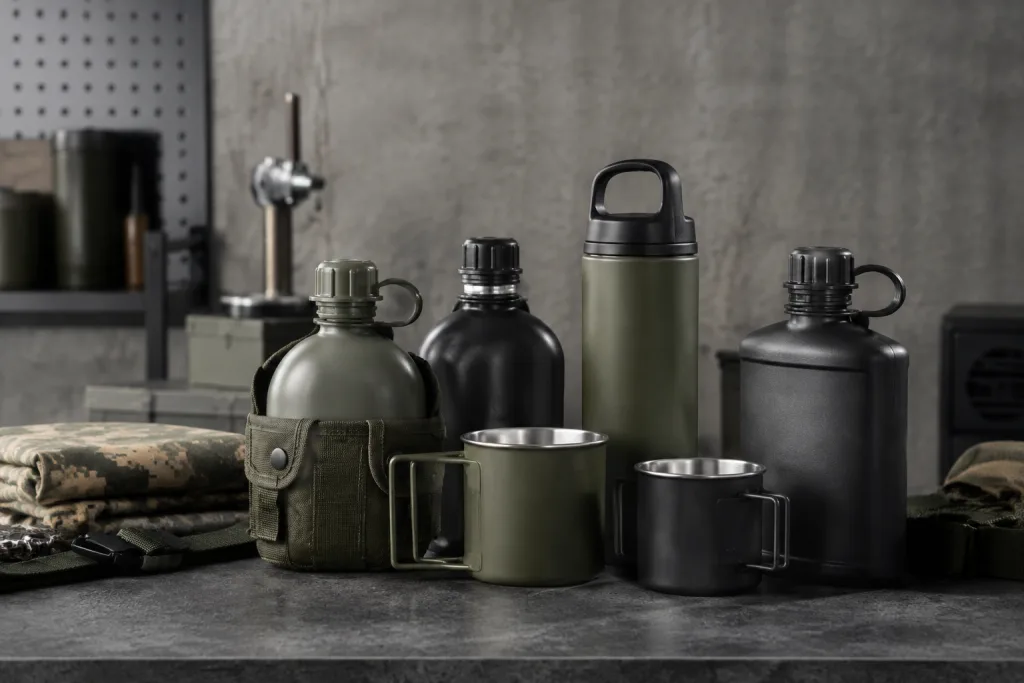
A generic inspection checklist catches generic defects. For a military-style canteen, we inspect against the ways it actually fails: leak points at the cap thread, dents on the shoulder, coating rub on the belt clip side, loose cap fit, odor, short capacity, weak logo adhesion, pouch stitch skips, and carton label mistakes. We’ve seen this go sideways. One buyer flagged 17 cartons because the PO said “matte army green” and the carton mark was typed “mat army green,” so if you are a canteen vendor selling into government-adjacent, outdoor, or promotional channels, a top-layer visual check is the wrong inspection plan.
For most custom drinkware shipments, AQL 2.5 for major defects and AQL 4.0 for minor defects is a practical baseline. Critical defects, such as sharp metal edges, contamination, or serious leakage, should be zero tolerance. We run final inspection when at least 80% of goods are packed and 100% are produced. QC should pull samples across the carton range, for example cartons 3, 28, 57, and 96 on a 100-carton lot, not only the clean cartons the line stacks near the loading door.
Capacity should be checked with water and a digital scale, not guessed by looking at the body. A 1 L canteen should not quietly become 930 ml because the mold was rounded down by 4 mm. Body dents can be judged under normal light at about 50 cm viewing distance, but deep dents, mouth deformation, and unstable standing are major defects. Smell it. Odor testing matters for caps, gaskets, pouches, and printed packaging; QC pulled one nylon pouch sample last season that smelled like fresh solvent after 24 hours in a sealed PE bag, and the math does not work if your buyer opens that carton first.
For Amazon-style or retail logistics, add barcode and carton checks. FNSKU, UPC, carton mark, country of origin, suffocation warning, and master carton dimensions must match the booking documents. A distributor growler or distributor canteen shipment can sit 12 days instead of clearing in 2 days because one side mark is wrong, even when the product itself passes. The boring checks protect your delivery date, especially when we ship mixed SKUs and the warehouse scans every master carton before unloading.
Price Gaps Usually Mean Spec Gaps
If one canteen manufacturer quotes USD 3.20 FOB Ningbo and another quotes USD 4.10 FOB Shanghai for the “same” custom canteen, don’t treat the USD 0.90 gap as margin. That is usually the wrong question to ask. We’ve seen it hide 201 steel sold as 304 stainless, a 0.42 mm body instead of 0.50 mm, a PP cap instead of Tritan, or a pouch cut from 300D fabric instead of 600D. QC pulled one sample last month where the outside looked fine, but the coating thickness gauge read 18 μm on the shoulder and 31 μm on the flat panel. Same drawing. Different product.
Ask each canteen supplier for a line-item quotation: body material and thickness, capacity, surface finish, cap and gasket, decoration method, pouch material if included, individual packaging, master carton quantity, MOQ, sample cost, tooling cost, lead time, FOB port, and payment terms. For a 3,000 pcs canteen customizable order, a realistic production lead time is 35-45 days after sample approval, plus 5-10 days for sample making if no existing approved sample is available. Rush orders work only when the line has run that SKU before. We have pushed canteens through in 28 days, but the buyer flagged 11 pcs with crooked logo position because the jig was adjusted during night shift.
For budgeting, stainless military-style canteens with basic logo decoration often sit around USD 3.50-6.80 FOB China depending on capacity, finish, cap, pouch, and packaging. Aluminum versions price lower, but check internal coating and dent resistance before you book the PO. We drop-test from 1.2 m onto a steel plate during sample review; if the side wall folds too easily, the math doesn’t work for field use. A customized growler or custom growler with vacuum insulation has welded double-wall construction, vacuum testing, and higher scrap allowance, so don’t benchmark it against a single-wall canteen.
The best canteen vendors do not say yes to every target price. They tell you what changes when you cut USD 0.30 per unit. The pouch may drop from 600D to 300D polyester. The carton may lose dividers, taking a 24 pcs master carton from clean packing to bottle-on-bottle rub marks. The coating may run thinner because the spray room speeds up the line. Fine for a one-off giveaway. Risky for reusable retail customizable drinkware. Good sourcing is not finding the lowest number; it is knowing what that number removed.
Send Your Canteen Spec Before You Quote
Share capacity, material, logo, packing, and target market. We will flag weak points before your custom canteen order enters production.
Frequently asked questions
What MOQ should I expect from vendors military canteen suppliers?
For existing military-style canteen molds, expect 1,000 pcs per color as a practical MOQ from many China factories. If you need a special powder coating color, custom pouch, retail box, or canteen customized with multiple logo positions, 3,000 pcs is more realistic. New body tooling can push MOQ to 5,000-10,000 pcs because the canteen factory must recover mold and setup costs. Sample lead time is usually 7-12 days for logo samples, while mass production normally takes 35-45 days after approval. If a canteen supplier accepts 200 pcs at a very low price, check whether it is trading stock, overrun inventory, or a different spec from your approved sample.
Is stainless steel or aluminum better for a custom canteen?
Stainless steel is usually better for durability, perceived value, and food-contact confidence, especially in Europe and North America. For a custom canteen, 304 stainless steel at 0.50-0.60 mm wall thickness gives a solid retail feel. Aluminum is lighter and can be cheaper, but it dents more easily and needs a reliable internal food-grade coating. If the coating is scratched, aluminum can create taste complaints. For canteen promotional giveaways where weight and price matter most, aluminum may work. For outdoor retail, military-style branding, or distributor drinkware programs with repeat orders, stainless steel is usually the safer specification.
How do I compare quotations from different canteen manufacturers?
Do not compare only the FOB unit price. Ask every canteen manufacturer to quote against the same spec sheet: steel grade, wall thickness, capacity tolerance, coating method, logo process, cap material, gasket material, pouch fabric weight, packaging, carton quantity, test standard, MOQ, lead time, and FOB port. A USD 0.50 gap may come from a thinner body, cheaper cap, no inner box, or lower coating quality. Also ask whether pre-shipment inspection support and compliance documents are included. A good canteen vendor will explain the cost drivers instead of hiding behind “same quality.” Put all quotations into one comparison table before choosing.
Can I order a canteen customizable with different logos in one production run?
Yes, but logo splitting affects cost and schedule. If the base canteen body, color, and packaging are the same, many canteen suppliers can split logos at 300-500 pcs per design, depending on decoration method. Silk screen printing has screen setup costs for each logo and color. Laser engraving is easier to split but slower per unit. Retail boxes, barcodes, or FNSKU labels add another layer of separation in packing. For a 3,000 pcs order with 6 logos, ask the factory to confirm packing segregation, carton marks, and overrun handling before production. Mixed-logo errors are common when the packing plan is weak.
What quality tests should be included before shipment?
At minimum, include leak testing, capacity measurement, cap fit check, coating adhesion, logo rub test, odor check, visual inspection, and carton drop test. Use AQL 2.5 for major defects and AQL 4.0 for minor defects, with zero tolerance for sharp edges, contamination, or serious leakage. For powder coating, request cross-hatch adhesion testing under ASTM D3359 or ISO 2409. For logo durability, use 500 dry rub cycles and 200 wet rub cycles as a practical benchmark. If the canteen includes a pouch, inspect stitching, buckle strength, fabric weight, and odor. Inspection should happen after 80% packing minimum, not during early production only.