Key Takeaways
- For school programs, ask for 1,000-3,000 pcs MOQ and 30-45 days lead time, not vague promises.
- Leak claims should be tested with 24-hour inversion and a 3-drop or 1.2 m impact test.
- Wall thickness below 0.7 mm on Tritan-style bodies is where many bulk kids bottle failures start.
- A qualified children water bottle factory should show AQL 2.5 for major defects and 4.0 for minor defects.
When school districts and importers look for vendors kids water bottle, they usually want one result: no leak, no complaint, no rework. The trouble starts after the PO lands on the line. A loose cap, peeling logo, 0.8 mm wall where the spec asked for 1.2 mm, or that stale plastic smell from rushed drying can all be caught before shipment if the spec sheet is tight and the first-off sample is checked with a torque tester.
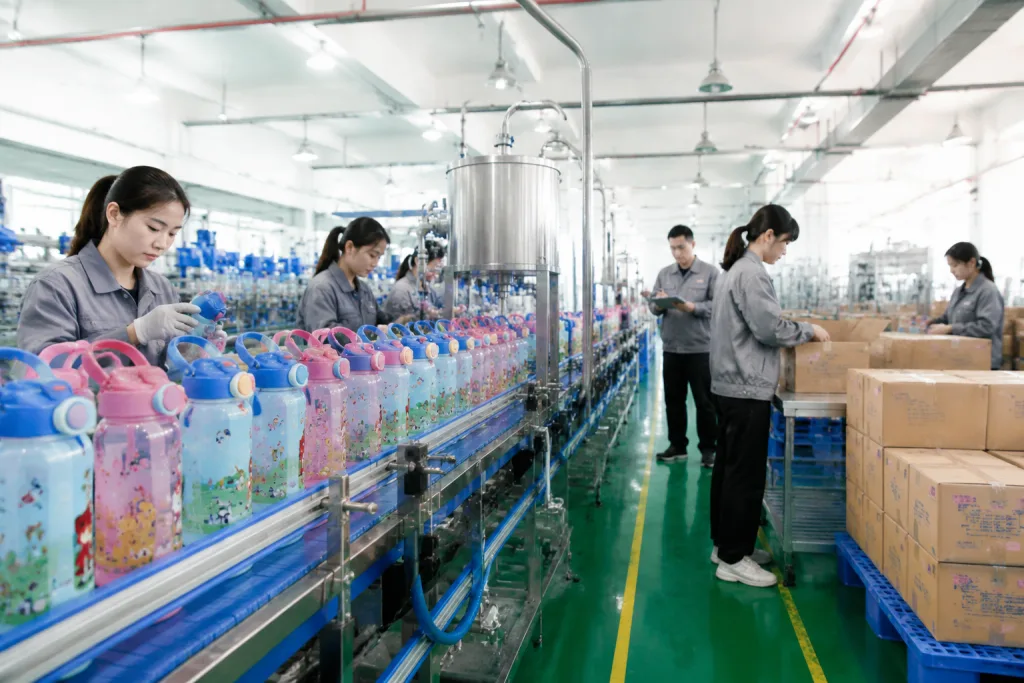
I work with buyers who need bulk children water bottle programs that survive backpacks, buses, dishwashers, and procurement checks. If you are sourcing from China or Zhejiang, the real question is not whether a children water bottle manufacturer can make a sample in 7 days. It is whether the factory can repeat it across 20,000 pieces, keep MOQ clear, hold lead time steady, and run QC with an AQL 2.5 plan that matches the buyer’s risk.
Where Kids Bottles Usually Fail
The first failure is almost always at the cap. A children water bottle can look clean in catalog photos, then leak because the hinge pin has 0.3 mm play or the silicone gasket sits 1 mm off-center. For vendors kids water bottle programs, we check the closure before the body on the line. That is where claims start. One weak cap can wet 24 bottles in a carton, soak a backpack, or kill a district pilot after the buyer flagged the first leak video.
The second failure is material mismatch. A bulk school water bottle spec that says "BPA-free" is the wrong question to ask. Ask for the resin grade on the PO, the heat limit in °C, and whether the bottle is cold fill only or safe for warm wash cycles. In Zhejiang and across China, a lot of children water bottle suppliers can make 20 nice samples in a clean lab. The hard part is repeating it with 0.7 mm to 0.9 mm wall thickness, stable injection pressure, and a cap that still seats after 3,000 open-close cycles. QC pulled the sample last month because the neck ovality hit 0.6 mm. The math doesn't work after that.
Decoration failure is the quiet one. A custom children water bottle with a silkscreen logo can look sharp on day one and peel after two dishwasher runs if the curing oven runs 8 minutes instead of 12. If you need children water bottle custom branding for school events or retail, ask for adhesion testing with 3M tape, rub testing with a 500 g load, and the print area tolerance in mm. Do not accept "good enough" on logo position. On a 500 ml bottle, 2 mm drift is visible, and we've seen this go sideways when a buyer spotted it against a mascot face.
- Cap leak: check gasket compression with a feeler gauge and confirm thread engagement in turns.
- Body stress cracks: inspect the neck finish, then drop test the bottle at the agreed fill weight.
- Print wear: verify curing time, ink type, and dishwasher result after two cycles.
- Odor complaints: confirm resin source and give finished bottles at least 24 hours of post-production airing.
If a children water bottle vendor cannot explain these failure points in plain numbers, keep walking.
How To Spec The Right Material
Material choice sets the ceiling on performance. For a custom kids water bottle, we usually quote Tritan for clear school bottles, PP for promo programs chasing a low landed cost, PET for single-wall lightweight bottles, stainless steel for insulation, and glass with a silicone sleeve only when the packing spec is strict. Tritan takes the desk-drop test better; PP saves money but scuffs faster in a backpack. Stainless steel protects temperature performance, but a 550 ml double-wall body can add 80-120 g versus plastic. Glass is the wrong question to ask for most school channels. Last month the line used a digital caliper to check 0.82 mm Tritan walls after the buyer flagged cracking around the shoulder radius.
Do not let a children water bottle manufacturer substitute materials without written approval. A 550 ml bottle that shifts from Tritan to lower-grade copolyester can pass a quick visual check and still fail odor, clarity, or crack resistance after 20 hot-wash cycles at 70°C. For school buyers, I usually write the spec with resin family, wall thickness, cap material, and the silicone grade for the gasket. If the bottle is sold as a children water bottle customizable product, lock the decoration process in the PO too: silkscreen with Pantone ink, laser mark on stainless steel, heat transfer film, or mold logo with a signed cavity drawing. QC pulled the sample once because the PO said “Trian” instead of Tritan; that small typo almost opened the door for a material swap.
For imported programs, ask for REACH, food-contact declarations, and a test report issued within the last 12 months. If the children water bottle supplier is in China, request traceability by lot and resin batch, not just a generic certificate from a trader. A factory in Zhejiang that runs 200,000 units per month should show incoming inspection sheets, color masterbatch records, and retained samples with carton labels matching the production date. We keep 2 sets of retained samples per order in the sample room for 18 months. If the supplier cannot trace one blue lid back to a resin batch, the math doesn't work for your bulk kids water bottle order.
Spec items worth locking down
- Capacity tolerance: ±5% for school-use bottles, checked with a graduated cylinder before mass packing.
- Wall thickness: 0.7-1.0 mm for most plastic bodies, measured at the shoulder, waist, and base.
- Gasket: food-grade silicone, 50-60 Shore A, with compression fit checked after 24 hours.
- Test basis: REACH, LFGB, or FDA food-contact as needed, tied to the exact material and color batch.
Print, Logo, And Artwork Risks
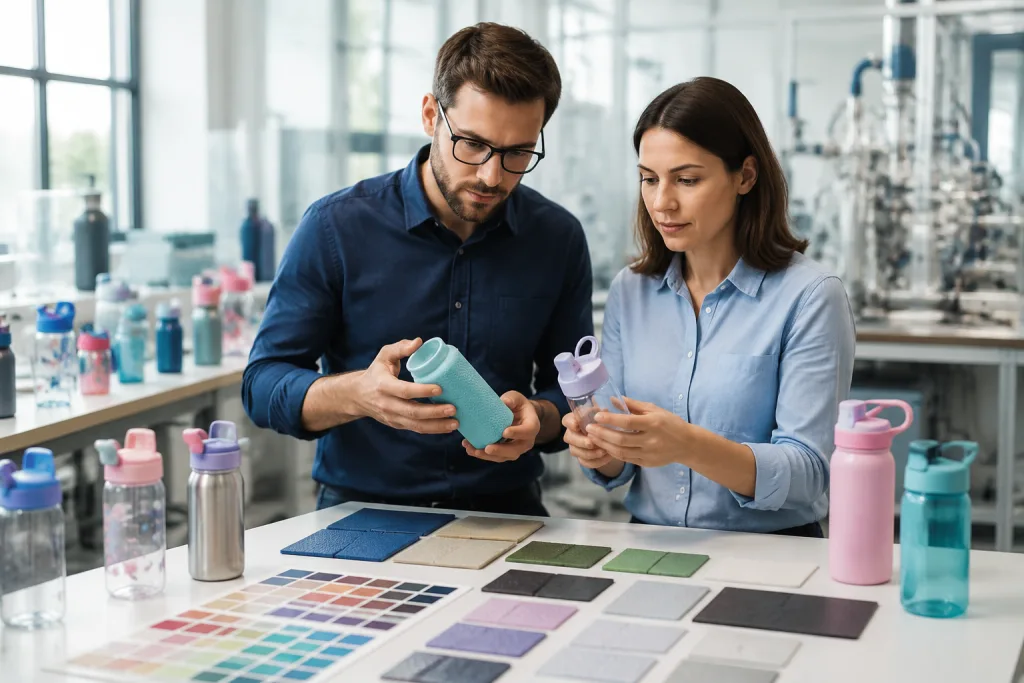
Artwork is where 6 out of 10 children water bottle wholesale programs quietly lose margin. The buyer approves a clean sample, then the line scales the logo onto a 68 mm curved body and the print starts looking stretched or 4 mm too close to the seam. We see this weekly. A custom logo kids bottle needs artwork built for the actual print method and bottle diameter, not a flat PDF from the brand team. If the vendor says one file works on every surface, the math doesn't work.
For a children water bottle customized program, we lock the print spec by method before opening the screen frame. Silkscreen is good for 1-3 solid colors and volumes above 3,000 pcs, especially when the logo sits inside a simple 45 x 60 mm print window. Laser works on stainless steel and gives a permanent mark, but it is the wrong choice for colorful kids branding. UV printing can carry small characters and gradients, but QC needs to pull the sample after curing and check edge lift with 3M tape. Ask the children water bottle vendors for abrasion results after 50, 100, and 200 rub cycles. If the logo is for school fundraising or children water bottle promotional use, it has to survive backpacks, lunch tables, and the occasional drop from 1.2 m.
Color consistency causes more buyer pushback than people expect. A red cap and red logo that miss each other by 10% look wrong under classroom LED lighting, even if the PO just says “red.” Specify Pantone, or send a physical master sample with the approved cap, strap, and printed body signed on the bottom. In China, some children water bottle manufacturers can match a sample within one production run, but only the disciplined factories hold that shade across reorder batches after the resin lot changes. We've seen this go sideways.
Do not buy artwork by email approval alone. Approve the print position with mm offsets and the signed color chip/finish on a pre-production sample.
Packaging And Transit Weak Points
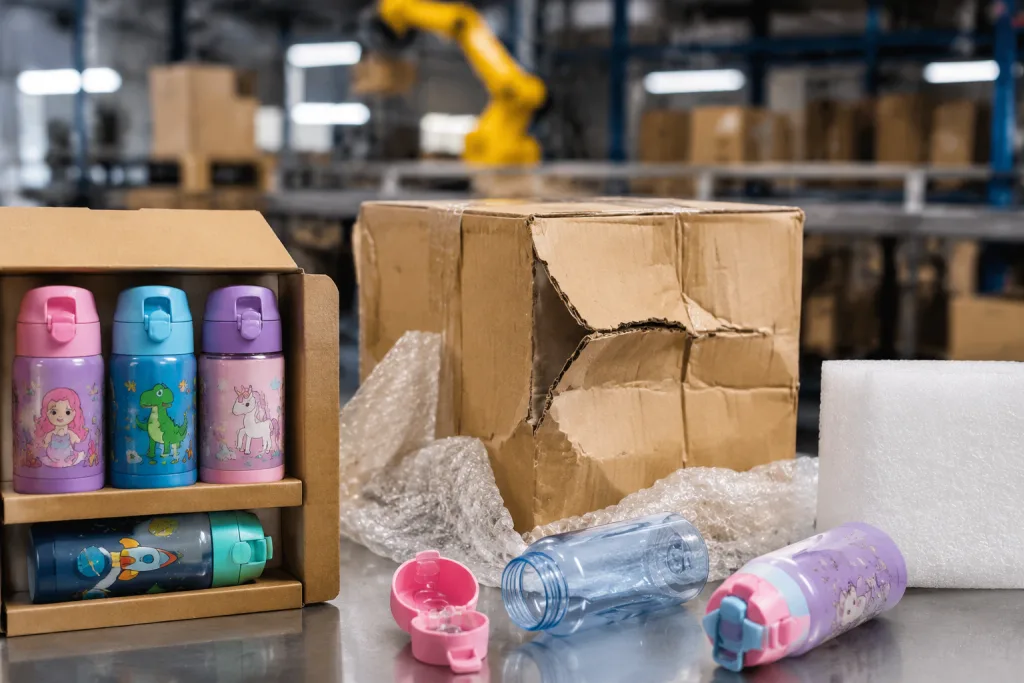
About 7 out of 10 “product defects” we see in arrival photos are packing failures, not molding or assembly problems. A bulk kids bottle can leave the line clean, pass leak test, and still arrive with a dented cap because the K=K carton is too soft, the EPE divider walked sideways, or the pallet was stacked 6 layers when the spec said 4. If you are buying a custom school water bottle for district handout, the pack has to survive warehouse forklifts, 28–35 days of sea freight, and courier sorting at the end. A loose straw or scratched lid is the wrong problem to chase after delivery. The packaging spec failed.
Ask the children water bottle supplier to put master carton count, inner box style, and drop test standard on the PI, not just in a chat screenshot. For school and importer programs, we run inner packaging that stops bottle-on-bottle scuffing; last April QC pulled a 24-pack sample and found 9 caps with rub marks after a 30-second shake on the packing table. A 24-pack outer carton is normal, but for tall 650 ml bottles we often cut it to 12 or 16 pcs so the carton does not belly out under stacking. If the buyer wants children water bottle bulk shipments to Amazon or a 3PL, carton L × W × H in cm matters. Dim weight can kill the margin faster than a USD 0.06 stronger carton.
Transit risk jumps with transparent bottles and decorated lids. Small marks show. A 1 mm rub line on a printed cap looks harmless under factory lights, then the buyer flags it when 2,000 classroom kits are opened on one Monday morning. We ask for carton drop tests from 80 cm on edges and corners, plus a shake test to see whether flip lids pop open inside the inner box. Cheap test. Expensive lesson if skipped.
- Use compartment inserts for clear bottles or lids with pad printing, UV print, or soft-touch coating.
- Specify carton compression resistance, such as 5-layer K=K or 5-layer A=B, not just carton size.
- Request pallet stacking limits in writing, including layers per pallet and “no overstack” marking on two sides.
- Match carton count to gross weight, carton cm, and dimensional freight cost before PO release.
QC Terms Buyers Should Not Skip
Inspection language keeps both sides honest. At our line in Hangzhou, a children water bottle factory that wants your order should be fine with AQL, sample size, and clear defect calls. I would not take a vague "full inspection" promise for a school program unless the criteria are written down. Major, minor, and critical defects need separate limits. A crack at the neck, a leak on the cap, a sharp rim, the wrong logo, or a missing part can all land in the critical or major bucket, depending on how the bottle is used.
We use AQL 2.5 for major defects and 4.0 for minor defects as a working baseline on many bulk children water bottle orders. For younger kids or public schools, I would tighten the leak test and sharp-edge limit right away. Ask for photo standards, not just a PDF with words. QC pulled the sample, we matched it against the master carton sample, and that saved one buyer from arguing over a tiny print shift later. Keep retained samples from pre-production and the first mass run. If a reorder drifts six months later, you need a hard reference, not memory.
A serious children water bottle manufacturer in Zhejiang or anywhere in China should talk traceability, batch coding, and corrective action reports without blinking. If a supplier cannot show how they isolate a bad cap lot from a good bottle body lot, the math does not work for your program. The same goes for MOQ and lead time. We usually see 1,000 to 3,000 pieces for a custom kids water bottle with decoration, and 30 to 45 days after sample approval is a normal schedule. If a factory promises 7 days for a fully customized run, the buyer flagged it for a reason. They are cutting corners somewhere.
Quality is not a slogan. It is controlled resin, steady tooling, and inspection that catches a bad seal before the customer does. One typo on a PO, like a missing color code or an odd cap size, can throw the whole batch off, so we check those details on the work order before the line starts. That is the real test.
Spec your next kids bottle order correctly
Send your target MOQ, artwork, and test standard. We will map the failure points, then quote the right children water bottle build for your market.
Frequently asked questions
What MOQ should I expect from vendors kids water bottle programs?
For a real custom kids water bottle, expect 1,000 to 3,000 pcs for standard tooling and 5,000 pcs or more if you need special molds, unique lids, or multiple colors. A children water bottle supplier in China may quote lower for a sample-grade run, but that often comes with higher unit cost. For a district or importer program, ask for MOQ by color, by artwork, and by packaging. One factory may accept 2,000 pcs total, but require 1,000 pcs per color. If you need a children water bottle customizable SKU with a printed logo and custom box, separate those costs early so the landed price does not jump later.
How do I test whether a bulk school water bottle will leak?
Use a simple three-step check: fill to 90%, close the cap, invert for 24 hours, then shake and compress the bottle if it has a straw or spout. For shipments, add a 1.2 m drop test on corners and a secondary check after temperature cycling between 5°C and 45°C. A weak gasket or poor thread design often fails only after stress, not during a static water-fill test. If the vendor says the bottle is leakproof, ask for the actual test method in writing. A good children water bottle manufacturer should show the cap assembly tolerance and the gasket material, not just a marketing claim.
What documents should a children water bottle factory provide?
At minimum, ask for food-contact compliance, REACH where relevant, a declaration of material composition, and product photos tied to the exact SKU. For bulk kids water bottle orders, I also recommend a carton spec, a label proof, and a pre-production sample approval sheet. If the factory is serious, it will also provide QC checkpoints, AQL plan, and lot traceability. For school procurement, the vendor should be able to issue a commercial invoice, packing list, and batch coding format. If the order goes through a children water bottle distributor, make sure the same documents match the actual producing factory, not just the trading company name.
Is Tritan better than PP for custom children water bottle orders?
Tritan usually gives better clarity, higher perceived quality, and stronger impact resistance, so it suits retail-facing custom children water bottle programs. PP is usually cheaper and works well for a simple bulk children water bottle order where cost matters more than premium appearance. If the bottle will be dropped often, Tritan can be the safer choice. If the buyer wants a lightweight promotional item or a children water bottle promotional giveaway, PP may be enough. Either way, ask the supplier to confirm wall thickness, dishwasher expectations, and whether the resin is appropriate for hot wash cycles. Material choice should follow use case, not habit.
How long does a custom kids bottle order usually take?
After sample approval, most custom kids bottle orders take 30 to 45 days for production if the mold and artwork are already confirmed. New mold development can add 15 to 25 days, and busy seasons in China may stretch the schedule further. If you need a children water bottle wholesale program with custom box, printed sleeve, and special cap, build in extra time for packaging approval. A reliable vendor should give you a Gantt-style timeline that separates sampling, tooling, mass production, inspection, and booking. If someone promises 10 days for a fully customized order, you are probably getting a rush job, not a controlled one.