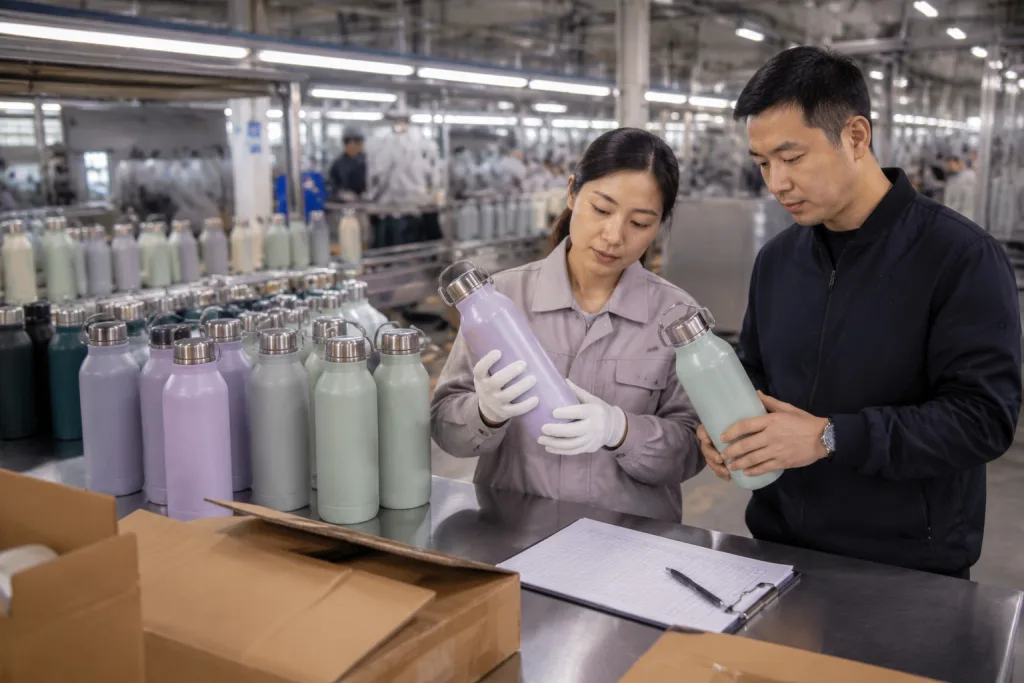
Key Takeaways
- For outdoor retail, specify 0.5 mm inner wall and 0.6 mm outer wall on 304 stainless steel where dent resistance matters.
- A practical MOQ is 1,000 pcs per size/color for custom thermos production, with lower runs usually raising unit cost by 12-25%.
- Powder coating adds about USD 0.35-0.70 per bottle but reduces visible scratching compared with basic spray paint.
- Use AQL 2.5 for major defects and AQL 4.0 for minor defects when ordering thermos bulk from China.
If you are building a vendors insulated water bottle program, you are not buying one bottle. You are buying 3,000 to 50,000 pieces that have to sit on retail shelves, survive promo giveaways, get dropped at campsites, and still come back for repeat orders without filling your inbox with lid leaks and coating complaints. QC pulled one 750 ml sample last month after a 1.2 m drop test; the cup ring looked fine, but the flip lid pin had walked out 0.6 mm. That is where programs fail.
Most quotes look the same on paper: 18/8 stainless steel, vacuum insulated, custom logo, FOB Ningbo or Shanghai. The price sheet hides the real work: 0.4 mm vs 0.5 mm wall thickness, lid tooling fit, powder coating adhesion, 5-layer export carton strength, AQL limits, and whether the line can match the same matte black again after six months. We run from Hangzhou, Zhejiang, and we have seen buyers lose more money on loose specs than on unit price. The math does not work when a buyer saves USD 0.18 per bottle, then rejects 12 cartons because the logo sits 3 mm off center.
Start With The Buyer Scenario
A solid vendors insulated water bottle brief starts with the drinking situation, not the catalog photo. For outdoor retail, we run it as a shelf SKU: stable powder color within about ΔE 1.0-1.5, barcode label that scans through shrink film, clean white or kraft shelf carton, and a lid the buyer can reorder 6 months later. Promotional brands push a different job. They need a faster custom thermos run with a crisp logo, gift box, and a landed cost that still survives ocean freight, duty, and the agency’s margin. We see this mistake often: the buyer sends one lifestyle image, then asks for 3 price levels after QC already pulled the sample.
The two jobs overlap, but the math does not match. A distributor thermos for a hiking chain may need a 750 ml body, powder coating, carry handle, anti-slip base, and 24-hour cold retention claim backed by a controlled test in our lab with a probe thermometer and 20°C room setting. A promotional thermos for a winter campaign may only need 500 ml capacity, laser engraving, 12-hour heat retention, and delivery within 35 days after artwork approval. Different pressure. Different line plan. We once had a buyer flag the same lid as “too outdoor” for a bank gift set, even though it passed the leak test at 45° for 30 minutes.
At BottleForge Industrial in Zhejiang, China, we quote stainless thermos orders in 3 working lanes: standard private label, light customization, and new mold development. Standard private label uses existing bottle shapes and gives you the lowest tooling risk. Light customization changes coating, logo, lid color, insert card, and packaging; on the floor, that usually means a Pantone chip at the spray booth, a laser jig for logo position, and a carton drop test before mass packing. New mold work makes sense when you can commit to 8,000-15,000 pcs over the first production cycle. Below that, the tooling amortization usually bites.
Do not ask 5 thermos suppliers for “best price” without locking the spec. This is the wrong question to ask. You will receive 5 different bottles, and one quote may hide a thinner inner wall, cheaper PP lid, or single-wall carton that fails at the corner after a 10 kg stack test. Ask for material grade, wall thickness, lid material, gasket material, coating process, logo method, packing method, inspection level, and FOB port. Also check the PO carefully; we once saw “304 stainless” typed correctly in the email but changed to “201” on the attachment, and the buyer only caught it after pre-production sample review.
Spec Table: Retail Versus Promo
We split these two jobs on the spec sheet before quoting. On our Hangzhou line, QC checks wall thickness with a Mitutoyo digital caliper, because 0.1 mm looks small on paper but changes dent resistance, vacuum yield, and carton damage claims.
| Spec Point | Outdoor Retail SKU | Promotional Campaign SKU |
|---|---|---|
| Capacity | 650 ml, 750 ml, 1,000 ml | 350 ml, 500 ml, 600 ml |
| Steel | 304 inner and 304 outer | 304 inner, 201 or 304 outer |
| Wall thickness | 0.5 mm inner, 0.6 mm outer | 0.4 mm inner, 0.5 mm outer |
| Finish | Powder coat, bead blast, or ceramic-look coat | Spray paint, powder coat, or polished steel |
| Logo | Laser engraving or 1-color silkscreen | Pad print, silkscreen, laser, full-wrap print |
| Packaging | Retail color box, barcode, hang tag | White box, kraft box, gift box, mailer |
| Typical MOQ | 1,000 pcs per color | 500-1,000 pcs per artwork |
| Lead time | 35-45 days after deposit | 25-38 days after artwork approval |
If you are a thermos distributor, use the retail column. We have seen 23 returned cartons from one outdoor account because the buyer’s customers dropped bottles on rock trails and blamed the brand, not the spec. For a promotional drop, the campaign column works when the bottle is handed out at a trade show or packed into an employee kit.
One warning: switching from 304 outer steel to 201 outer steel can reduce cost by roughly USD 0.15-0.35 per unit depending on size, but this is the wrong place to save money for wet use. In our 24-hour salt spray check, 201 outer bodies show rust dots faster around the base seam; for a distributors thermos line sold in coastal markets, gyms, and campsites, we run 304/304 unless the target price leaves no room.
Insulation Claims Need Test Conditions
“Keeps drinks cold for 24 hours” means little unless the test setup is printed somewhere. We can make a 24-hour cold claim look clean with ice water, a sealed lid, a 20°C lab room, and zero lid openings; QC has logged samples at 7.8°C after 24 hours under that setup. Your buyer may test the same bottle in a 38°C car cup holder or open it six times during a trail run. Different test. Different result. This is the wrong question to ask if nobody defines the conditions.
For a customizable thermos program, set the test statement before packaging artwork goes to plate making. We run a practical cold test like this: fill with 4°C water to the shoulder line, close the lid with a torque check, hold at 25°C ambient temperature, then measure water temperature after 6, 12, and 24 hours using a calibrated probe thermometer. For heat retention, fill with 95°C water and measure after 6 and 12 hours. Most 500-750 ml double-wall vacuum bottles should keep hot water above 55-65°C after 6 hours if the vacuum process is stable; when the buyer asks for “24H hot” on a 500 ml straw-lid model, the math does not work.
The factory thermos process matters because vacuum insulation is built on weld quality and evacuation control, not brochure wording. On the line, operators check the mouth weld, run the evacuation station, confirm copper lining when specified, then send samples through leak detection; QC pulled 3 pcs last month for slow temperature drop after the vacuum needle reading looked normal. In our Hangzhou-area production network, daily vacuum testing is done by batch, and obvious failures are pulled before packing. For larger orders, we can add random thermal testing during final inspection, usually 8-13 pcs per lot depending on shipment size.
Be careful with exaggerated carton claims. A 350 ml office flask and a 1,000 ml outdoor bottle should not carry the same retention promise; the smaller body has less water mass, and the buyer will flag it after one desk test. A wide-mouth lid loses heat faster than a narrow-mouth stopper by 6-10°C in a 12-hour heat check we run on 58 mm openings. A straw lid is convenient, but it is not the right choice for heat retention or leak resistance. If you sell through outdoor retailers, conservative claims cut returns and save your account managers from arguments they cannot win.

Customization Choices That Actually Matter
Custom does not have to start with a new mold. We run plenty of thermos custom orders on a stock 500 ml or 750 ml body, then lock down the powder color, logo position, lid set, and box artwork so the SKU still looks private-label. For most outdoor retailers and promo brands, this is the safer first buy; the math doesn't work on hard tooling when the opening PO is 3,000 pcs and the buyer is still testing shelf pull.
Logo method comes first. Laser engraving costs about USD 0.20-0.45 per position and holds up well on powder coat or bare stainless steel; QC usually checks the mark with a 3M tape pull and a 30 cm visual check under the line lamp. Silkscreen fits large one-color marks, usually USD 0.12-0.30 per position, but coating adhesion and thin artwork strokes can make it fail. Heat transfer and full-wrap printing look strong for a thermos promotional campaign. Budget 5-7 extra sampling days and do tape testing before mass production, because we have seen wrap seams shift 2 mm after the first oven pass.
Color is the second call. Powder coating is the practical choice for a customized thermos because it resists scratching better than basic spray paint, especially after a 500 g cross-hatch tape test on the sample bench. Pantone matching is possible, but stainless bodies, coating thickness, oven temperature, and gloss level all change the final shade. Approve a physical color chip or a pre-production sample, not just a PDF mockup. Screens lie.
Lids are where some thermos vendors cut corners. PP is common, Tritan works for transparent parts, and silicone gaskets should be food-contact grade with no sharp flash around the drinking slot. For EU programs, ask your thermos suppliers about LFGB or EU food-contact testing. For North America, FDA food-contact expectations and ASTM-related child-use requirements apply if the bottle is positioned for kids. QC pulled one sample last season because the straw lid leaked after 8 inverted shakes; cheap lid savings disappeared in one rework bill.
Packaging customization needs an early decision. A retail color box with EAN or UPC barcode, insert card, and recycled paper claim changes carton size and freight; one typo on a PO barcode can hold 40 cartons in our packing area. A simple white box may save USD 0.20-0.50 per unit. That small number becomes real money on 10,000 pcs, and it also keeps the master carton under 15 kg more often.
Cost Drivers Behind The Quote
Do not compare thermos manufacturers by FOB unit price alone. A USD 3.85 bottle and a USD 4.25 bottle can be two different builds. We’ve cut samples open with a pipe cutter and found 0.38 mm outer steel on the cheap quote versus 0.45 mm on the approved spec. The lower price may come from thinner steel, a lighter powder coat, a loose lid gasket, weak color box board, or an inspection plan that stops at a quick carton count.
For a 500 ml stainless manufacturer thermos with 304 inner and outer steel, powder coating, laser logo, and individual color box, a realistic FOB China range is often USD 3.60-5.20 at 3,000 pcs, depending on lid style and finish. A 750 ml outdoor bottle may sit around USD 4.80-7.20. A premium 1,000 ml handle bottle with thicker body and retail packaging can move above USD 8.00. These are working ranges, not promises. Steel cost, exchange rate, and order timing still move the quote; last April we had one buyer flag a USD 0.18 jump after the mill updated 304 stainless pricing before deposit landed.
MOQ is another lever. At BottleForge Industrial, common MOQ is 1,000 pcs per color for existing stainless thermos models, 3,000 pcs for special coating runs, and 8,000 pcs or more for custom mold development. Our coordinated production capacity for stainless drinkware is about 450,000 units/month across partner lines in Zhejiang and nearby China manufacturing clusters. That capacity helps in peak season, but it cannot fix late artwork approval or a PO with the Pantone code typed as 186C in one line and 168C in another. We run the line from confirmed files, not guesses.
Freight can change the decision. A bottle is bulky for its value. Sea freight is usually the only sensible choice for thermos bulk orders, while air freight is for samples, urgent 200-500 pc top-ups, or campaign shortages. The math doesn't work for flying 3,000 pcs unless the launch date is already on fire. If you sell online, ask for carton dimensions early; QC pulled one 500 ml sample carton at 47 x 32 x 29 cm, and that size changed the buyer’s warehousing and fulfillment fee model before we shipped.
Use-Case Fit Beats Lowest Price
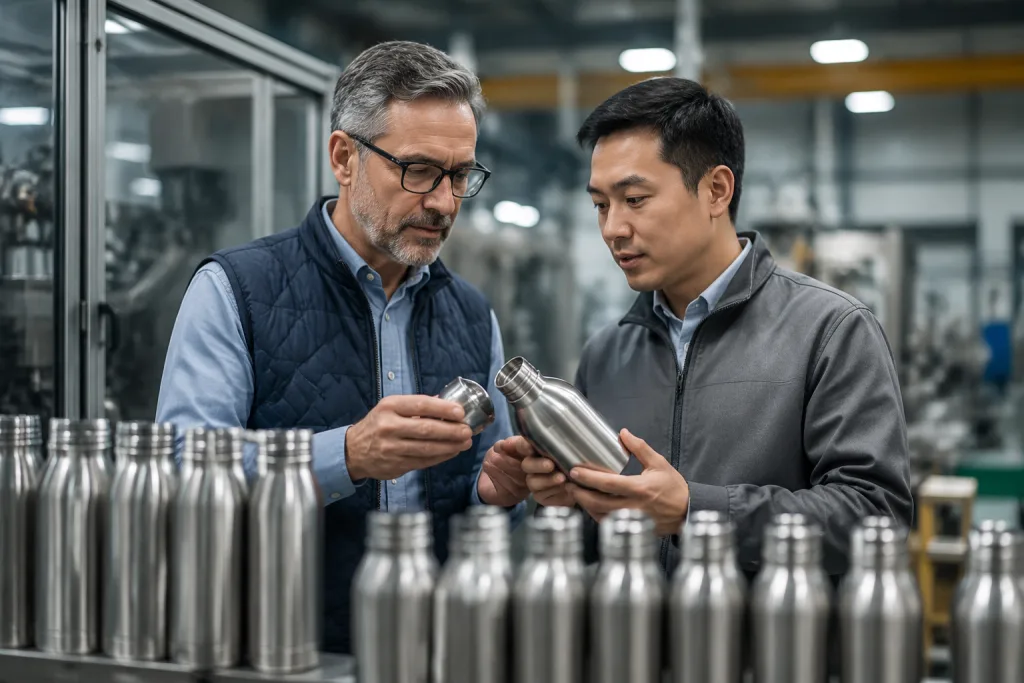
The right thermos supplier is the one whose production setup fits your sales channel. Outdoor retail, event promotion, corporate gifting, and marketplace resale do not carry the same risk. We have seen this go sideways: a buyer pushed for the lowest 500 ml quote, then QC pulled the sample and the lid thread had 0.4 mm play. Wrong question. Ask what the bottle must survive, not how cheap it can be.
Outdoor retailers: choose 304/304 steel, powder coating, replaceable lids, retail carton, barcode, and AQL inspection. Ask for drop testing from 90 cm on packed cartons if you ship through distribution centers. We run the carton drop on a concrete floor with a 12 kg master carton, then open the corner box and check dents, cap cracking, and vacuum loss. Use 1,000-3,000 pcs trial orders before committing to a full seasonal range.
Promotional brands: put logo clarity and delivery date first. Packaging still matters. A thermos customized for a trade show does not need every outdoor feature, but it must arrive on time and match the approved artwork. Last month a PO had “Pantone 186C” typed as “189C,” and the buyer flagged it only after the first print plate was ready. Build in at least 7 days for sample approval and 25-38 days for production after approval.
Distributors: plan reorders from day one. A thermos vendor that cannot repeat the same lid color, coating texture, or carton layout creates problems for your sales team. Lock a technical data sheet, approved sample, and packing file. We keep a sealed golden sample on the shelf and measure coating gloss with a gloss meter before the line starts. If you sell to several retailers, use a neutral base model with retailer-specific sleeves or stickers to cut MOQ pressure.
Marketplace sellers: check FNSKU labeling, carton weight under 15 kg where possible, and scannable outer carton marks. A good bottle with bad labeling can still be rejected by a fulfillment warehouse. We have had Amazon cartons bounced because the FNSKU sticker sat 8 mm over a carton seam and the scanner missed it. Small mistake. Expensive delay.
Lowest price has its place. For a one-off giveaway, it can win. For a distributor thermos range that must reorder for two years, the math does not work if every repeat order changes by 2 mm on the lid, 1 shade on the coating, or 3 days on the shipping cutoff. Stable manufacturing is worth paying a few cents more.
Inspection, Compliance, And Reorders
A stainless thermos order should not leave China without inspection. We run final random inspection under ANSI/ASQ Z1.4 on most export jobs, with AQL 2.5 for major defects and AQL 4.0 for minor defects. Critical defects stay at zero. No debate. Major defects include leakage, failed vacuum, sharp edges, wrong logo, serious coating damage, or incorrect material; last month QC pulled 20 samples from a 3,000 pcs lot and found 2 lids leaking after a 30-minute inverted test. Minor defects are things like 0.3 mm dust points, slight color drift inside the approved tolerance, or carton scuffs that do not crush the inner box.
Compliance depends on destination and shelf position. For Europe, check REACH and food-contact requirements, and LFGB testing is often requested for Germany or premium EU retail. For North America, FDA food-contact expectations are common, and California Proposition 65 can matter based on materials and sales channel. If children are the target user, reusing an adult bottle spec is the wrong question to ask; on the line we have seen buyers flag straw tips, silicone plugs, and detachable parts under 31.7 mm after the artwork was already approved.
Factory audits are another filter. BSCI, ISO 9001, and social compliance documents do not guarantee a perfect bottle, but they cut risk for retailers that need vendor onboarding. If you are qualifying thermos suppliers for a retail chain, collect these files before sampling, not when production is packed. We had one PO typo list “ISO 90001,” and the buyer’s compliance team held approval for 12 days while the carton supplier was already waiting for the shipping mark file.
Reorders are where disciplined buyers save money. Keep one approved golden sample, one signed specification sheet, one packaging dieline, and one QC checklist, then lock the version number in the PO. Six months later, refer to those files by name, not by memory. The math does not work if every reorder becomes a new sample round. A good thermos factory in Zhejiang can repeat work accurately, but only when the buyer and manufacturer measure against the same standard, down to the 0.5 mm logo position and the same Pantone chip taped to the sample rack.
Send Your Thermos Brief For A Factory Quote
Share capacity, lid style, logo method, target MOQ, and delivery market. We will return practical specs, pricing, and lead time.
Frequently asked questions
What MOQ should I expect for vendors insulated water bottle orders?
For existing stainless thermos models, expect 1,000 pcs per size/color as the normal MOQ. Some thermos suppliers can accept 500 pcs for laser logo on stock colors, but the unit price may rise by 12-25% because coating, setup, and packing labor are spread over fewer units. Special Pantone powder coating usually starts around 3,000 pcs per color. New mold development is a different conversation; practical commitment is often 8,000-15,000 pcs across the first run, plus tooling charges. If you are testing a retail range, start with 1,000-3,000 pcs and keep the lid, coating, and carton structure repeatable.
How long does a custom stainless thermos order take from China?
A standard custom thermos order from China usually takes 25-45 days after deposit and artwork approval. Laser logo on an existing bottle with standard packaging can be closer to 25-30 days. Powder-coated retail bottles with color boxes, barcode labels, and insert cards usually need 35-45 days. Pre-production samples add 7-12 days, and lab testing can add another 7-15 working days depending on the test house. Sea freight to Europe or North America commonly adds 25-40 days port to port, so your real launch calendar should be built backward from shelf date, not factory completion date.
Which logo method is best for a promotional thermos?
For a promotional thermos, laser engraving is the safest choice when durability matters. It costs roughly USD 0.20-0.45 per position and will not peel off during normal use. Silkscreen is cheaper for simple one-color artwork, often USD 0.12-0.30 per position, and it works well on straight bottle bodies. Full-wrap print or heat transfer gives stronger shelf impact, but you need more sampling time and adhesion testing. If your campaign deadline is tight, avoid complex wrap artwork on tapered bodies. For executive gifts, laser on matte powder coating usually looks cleaner than a large printed logo.
What defects should I inspect before shipment?
Check leakage, vacuum failure, coating scratches, color mismatch, sharp rim edges, loose lids, gasket deformation, wrong logo position, carton marking errors, and barcode scanning. For a thermos bulk order, use AQL 2.5 for major defects and AQL 4.0 for minor defects, with zero tolerance for critical safety issues. Ask the inspector to fill and invert a sample group for leakage, check assembled lid torque by hand, and run basic thermal retention checks if the order is large enough. For retail shipments, carton drop testing from 90 cm is useful because many defects happen during handling, not production.
Can one thermos vendor handle retail and distributor programs?
Yes, but only if the thermos vendor manages specifications by channel. Retail programs need stable cartons, barcode files, approved color standards, replacement lid planning, and tighter cosmetic control. Distributor programs need reorder consistency, mixed-SKU planning, and sometimes neutral packaging that can serve several accounts. A factory producing 450,000 units/month may still fail you if it treats every order as a one-off promo job. Ask for a signed spec sheet, golden sample, production photos, and final inspection report for each run. That discipline matters more than whether the supplier calls itself a thermos manufacturer, exporter, or trading partner.