Key Takeaways
- Factory direct infuser bottle orders usually start at 1,000-3,000 pcs per SKU, with 25-35 day production after sample approval
- Tritan bodies normally cost USD 1.85-3.40 FOB China depending on lid, infuser basket, logo, and carton specs
- Logo printing is usually faster and cheaper than custom molding, but less defensible for a wellness startup
- AQL 2.5/4.0 inspection and LFGB/REACH/FDA documentation should be agreed before deposit, not after production
If you sell hydration products, you already know the infuser bottle is not just a bottle with a cage inside. One weak lid, a cloudy Tritan body, a loose basket, or a 6-day logo approval delay can turn a 3,000-piece wellness launch into refund emails. We’ve seen this go sideways. QC pulled the sample after a 1.2 m drop test because the flip cap hinge opened on the second hit, and the buyer flagged the same issue their customers would have caught in week one.
From Hangzhou, Zhejiang, we see buyers compare factory direct infuser bottle supply, trading companies, and catalog distributors every week. The cheapest China quotation is often not the cheapest landed product; the math doesn’t work if a 2,000 pcs MOQ saves USD 0.18 but adds 12 days of sorting at destination. You need to compare MOQ, resin grade, basket design, test standards, lead time, and production control when something breaks. On our line, a 0.3 mm mismatch between basket thread and bottle neck is enough for QC to stop packing.
Vendor Models Compared Side By Side
Search for vendors infuser bottle suppliers and you will usually hit 3 desks: the factory infuser bottle manufacturer, the trading company, and the local distributor infuser bottle seller. All 3 can ship bottles. The difference is control, and QC sees it fast when a lid gauge shows a 0.25 mm thread shift.
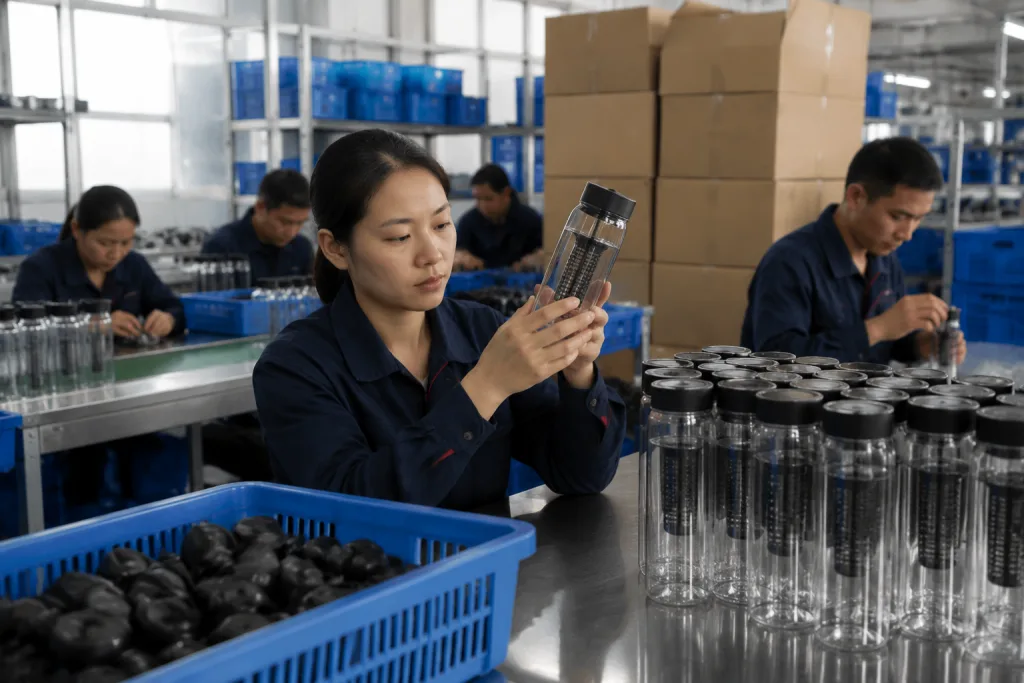
A factory direct infuser bottle supplier owns or runs injection molding, bottle blowing, assembly, and packing. For a custom infuser bottle program, one small revision can touch 5 parts: lid thread tolerance, silicone ring hardness, basket lock fit, straw hole design, and carton drop strength. At BottleForge Industrial in Zhejiang, our monthly drinkware output is around 850,000 units, with infuser bottle MOQ typically from 1,500 pcs for stock colors and 3,000 pcs for Pantone-matched parts. We run first-shot samples on the line, then QC pulls the sample for leak testing before the packing team tapes the master carton.
A trading company works when you need bottles, yoga bands, and gift boxes loaded into one shipment. The weak point is technical feedback speed. If your customized infuser bottle leaks at the lid after a 45°C water test, forwarding screenshots does not fix it. You need the person who can adjust the gasket groove by 0.15 mm and tell the mold room before the next trial.
A distributor infuser bottle source in Europe or North America is fastest for small trial runs. You may buy 100-300 pcs, sometimes with local printing. The unit cost can be 40-120% higher than FOB China, and you usually cannot change the mold, basket size, resin, or carton. For wellness brands testing ads, distributors infuser bottle supply is fine. For a retail or subscription launch, asking only who ships fastest is the wrong question; we have seen this go sideways when the buyer flagged a weak color match after 2,400 pcs were already printed.
Spec Table That Actually Matters
Infuser bottle quotes look the same until we put them on one spec sheet and weigh the samples. Last month QC pulled 12 pcs from a 700 ml run: the cheap sample was 86 g lighter because the wall averaged 1.42 mm on the Mitutoyo caliper, the lid was recycled PP, the basket stopped 28 mm short, and the K=K carton crushed at the corners after parcel drop testing. Ask vendors infuser bottle suppliers to quote against one shared spec sheet, or the math doesn't work.
Practical comparison:
- Body material: Eastman Tritan, food-grade PC, borosilicate glass, or stainless steel. For a custom fruit infuser bottle, Tritan is the usual choice on our line because buyers want clear walls, better drop resistance, and BPA-free material; we still ask for the resin grade on the PI, not just “Tritan” typed on the PO.
- Capacity: 650 ml, 700 ml, 800 ml, and 1,000 ml are normal. Fitness buyers usually push for 800-1,000 ml with a carry loop; desk wellness buyers pick 650-750 ml because the bottle still fits under a 260 mm office water dispenser.
- Wall thickness: 1.6-2.2 mm is common for Tritan. Below 1.5 mm, drop-test failure risk rises; we have seen 1.45 mm bodies crack at the shoulder after a 1.2 m corner drop.
- Infuser basket: 304 stainless steel, PP, or Tritan. Tea needs fine mesh, often around 0.5-0.8 mm holes; fruit needs wider slots and more basket volume, otherwise the buyer flags it as “decorative only.”
- Lid seal: 55-65 Shore A silicone ring is typical. Too soft deforms under torque, too hard leaks; our QC usually checks this with a Shore A durometer before the line packs the first carton.
- Packing: egg crate, white box, color box, or mailer box. Amazon and DTC brands should not use only thin color boxes; we ship mailer-ready packs when the buyer expects single-piece courier delivery, even if the MOQ is only 1,000 pcs.
For a bulk fruit infuser bottle order, I would take a 1.9 mm Tritan wall and a stronger 5-layer export carton over a fancy hang tag every time. We have seen this go sideways: the buyer loved the insert, then QC found 7 dented boxes in the first 50-carton check. The customer touches the bottle every day. The insert is gone in 10 seconds.
Fruit Versus Tea Use Cases
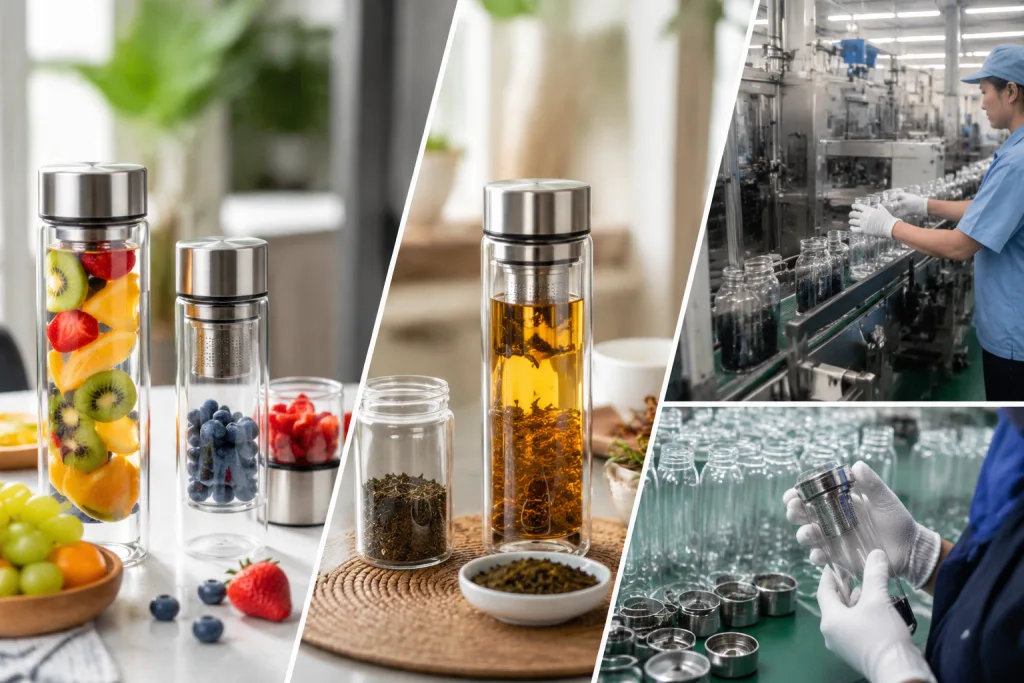
A bulk tea infuser bottle and a fruit infuser bottle bulk program should not share the same basket unless you are willing to lose performance on one side. Fruit needs volume. Lemon slices, cucumber, berries, mint: they swell, float, and block flow if the cage is short. On our Hangzhou line, we check the slot opening with a 3.0 mm pin gauge; a custom fruit infuser bottle usually uses a long cage running from the neck toward the lower third of the bottle, with 2.5-4.0 mm slots.
Tea behaves differently. A custom tea infuser bottle needs tighter filtration, especially for loose-leaf tea, rooibos, and herbal blends. Stainless steel 304 mesh at 40-80 mesh is common. If the holes are too large, QC pulls the sample because leaf dust shows up in the mouthpiece after a 5-minute steep test. If the mesh is too dense, cleaning becomes a headache, and reviews start talking about residue stuck in the cup.
For wellness brands, ask where the bottle will sell first. A distributor fruit infuser bottle with bright fruit photos works for gym counters and summer promotion kits where buyers want color on the shelf. A distributor tea infuser bottle fits office gift boxes and yoga studio retail, especially for colder-season sets. If you need one customizable infuser bottle for both, use a removable dual basket: a larger fruit cage with a small stainless mesh insert. The BOM cost may increase by USD 0.28-0.55 per unit; at 3,000 pcs MOQ the math still works if your marketing team uses both angles instead of treating it like one plain SKU.
Do not overbuild every SKU. If 80% of your buyers add lemon and mint, a customized fruit infuser bottle with a simple PP basket is enough. We have seen this go sideways when a PO says “premium mesh” but the target price is still the basic fruit model. Save the metal mesh for a premium customized tea infuser bottle line.
Customization Choices And Real Costs
Customizable infuser bottle choices run from a one-color logo to new tooling. The right question is forecast, not the mood board. For a 1,000-2,000 pcs launch, we run stock mold, custom color, and custom logo infuser bottle decoration; MOQ usually sits at 1,000 pcs per color if the resin supplier has the masterbatch ready. If your PO says 20,000 pcs inside 12 months, a custom made infuser bottle with a dedicated lid or grip shape starts to make sense, because the mold cost can be spread across repeat orders. We have seen this go sideways when a buyer approved a fancy grip at 800 pcs. The math doesn't work.
Typical FOB China costs for a 700-800 ml Tritan customized infuser bottle are USD 1.85-2.45 for stock color with one-color silk screen, USD 2.30-3.10 for Pantone lid and color box, and USD 3.20-4.80 for premium stainless basket, strap, retail box, and heavier carton. Laser marking on metal lids looks clean, but 7 out of 10 infuser bottle enquiries we get still use plastic lids, so silk screen, heat transfer, UV print, or pad printing show up more often. On the line, QC checks logo position with a 0.5 mm tolerance ruler because a centered logo in the AI file can still sit 2 mm high after heat transfer.
Logo setup fees are usually small: USD 35-80 per color for screen plates, USD 60-120 for pad fixtures, and USD 150-400 for pre-production color proofing if the artwork is complex. Mold costs are different. A new lid mold may cost USD 2,000-6,000. A full bottle set can reach USD 12,000-25,000 depending on cavities and structure. Before we cut steel, our tooling room checks the 3D file on UG and confirms wall thickness, usually 1.8-2.2 mm for the lid area; thin corners look nice on a render, then crack in drop testing.
Customizable fruit infuser bottle and customizable tea infuser bottle projects need artwork, Pantone references, barcode placement, warning text, and country-of-origin marking before sample approval. Send the working files, not a screenshot. China factories can move fast, but unclear artwork still burns time: last month one PO spelled “infuser” as “infusor,” QC pulled the sample, and the approval cycle moved from 12 days to 18 days.
Compliance Before Purchase Orders
Wellness buyers often ask for sustainable claims, BPA-free wording, and food-contact reports after price approval. Wrong order. Put compliance in the first RFQ, before artwork and carton layout. We had a PO last March with “BAP-free” typed in the spec column, and QC caught it only when the buyer flagged the label proof. That kind of miss costs 5 days.
For plastic infuser bottles, ask for FDA food-contact compliance for the US market and LFGB or EU 10/2011 migration testing for Europe. REACH matters for restricted substances in coatings, colorants, straps, and printed parts. If the bottle is for children, discuss ASTM or CPSIA requirements before tooling. For glass infuser bottle programs, check thermal shock and annealing quality; our line uses a polarized stress meter to catch bad annealing before packing. For stainless components, 304 grade verification and heavy metal testing are common.
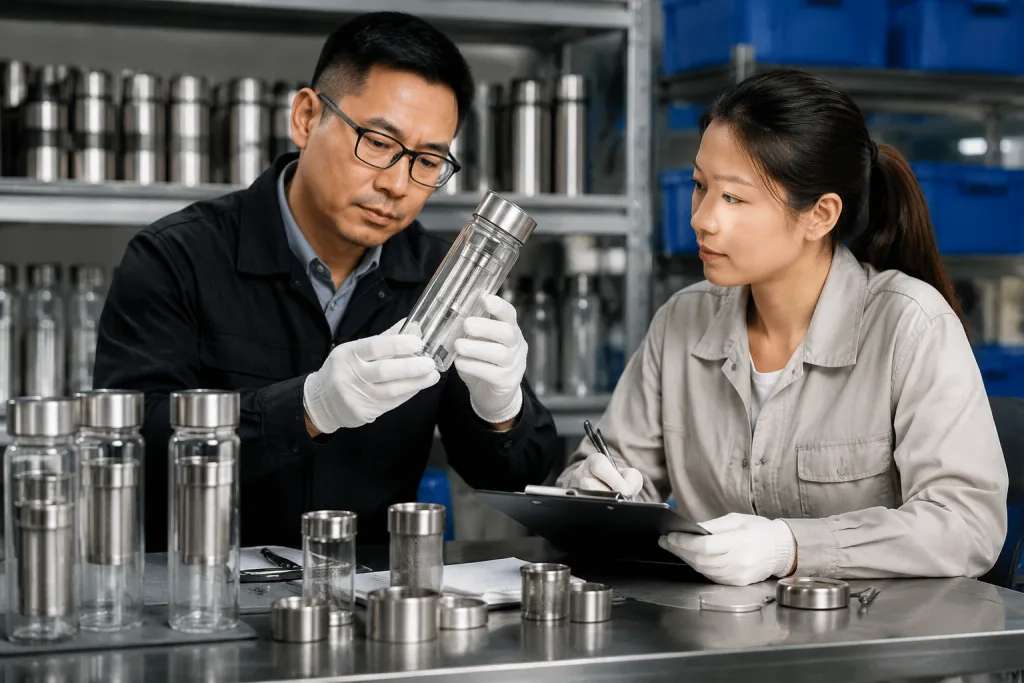
Factory audits are not a substitute for opening cartons. BSCI, ISO 9001, Sedex, or a customer audit can reduce supplier risk, but shipment inspection still needs teeth. We run AQL Level II, critical 0, major 2.5, minor 4.0 for bulk infuser bottle shipments. A practical inspection should cover leak testing at 30 seconds inverted, cap torque with a torque meter, print adhesion with 3M tape, barcode scan, carton drop, capacity check, odor check, and assembly fit. QC pulled the sample last week because the silicone ring sat 0.8 mm proud of the lid groove.
From Zhejiang, China, we normally need 7-10 days for confirmed samples and 25-35 days for mass production after deposit and packaging approval. For 10,000 pcs with custom color and box, the math does not work in 10 days unless someone is skipping incoming material checks, curing time for printing, or final inspection. We ship faster when the buyer locks the Pantone code, carton mark, and insert card on day 1. Otherwise, 25 days becomes 32 days.
Which Option Fits Your Launch
If you are a hydration startup testing one SKU, do not pay for a full custom mold. Wrong question to ask. Start with a factory fruit infuser bottle or factory tea infuser bottle design that already passed our 1.2 m drop test and 24-hour inverted leak test on the QC bench. Put the budget into two Pantone colors, a clean logo pad print, and a carton insert that explains how to load fruit without blocking the straw. A 1,500-3,000 pcs opening order is enough to read demand without tying up USD 8,000-15,000 in tooling before the product page has data.
If you are a wellness brand with retail commitments, choose a factory infuser bottle partner that can lock BOM, color masterbatch, carton layout, and inspection criteria for repeat runs. We run this with a signed BOM sheet down to gasket hardness, basket height in mm, and lid resin grade, because the math does not work when order two ships with a lid shade 5% darker. We have seen buyers flag this at warehouse receiving. Ask for a golden sample, seal it in a polybag, and keep one at your office while QC keeps one beside the caliper and color light box on the line.
If you are a distributor tea infuser bottle buyer serving 20-40 small clients, a mixed carton plan can work. For example, 6 colors x 500 pcs can meet a 3,000 pcs MOQ while giving your sales team enough range for gym shops, tea stores, and corporate gift accounts with different logo needs. QC pulled the sample last season after one PO had “mint green” typed as “mint grin,” so confirm color codes before carton marking artwork is released. For distributors fruit infuser bottle programs, seasonal colors usually outsell extra capacities; we ship more 650 ml summer sets than slow-moving 900 ml variants.
The head-to-head answer is plain: use distributors infuser bottle stock when speed and low quantity matter; use factory direct supply when margin and repeat orders matter. The best vendors infuser bottle partners will tell you when a requested feature is not worth the cost, such as a flip lock that adds USD 0.18 but fails after 3,000 open-close cycles. We have seen this go sideways. That honesty beats a polished quote that looks good in Excel and then breaks during AQL 2.5 inspection.
Send Your Infuser Bottle Spec For Factory Review
Share capacity, material, logo, packaging, MOQ, and target market. Our Zhejiang team will return practical FOB options and sample timing.
Frequently asked questions
What MOQ should I expect for a custom logo infuser bottle?
For a custom logo infuser bottle using an existing mold, expect 1,000-1,500 pcs if you accept stock bottle and lid colors. If you need Pantone-matched plastic parts, most China factories will ask for 3,000 pcs because color mixing, injection setup, and scrap rate become meaningful. For a custom made infuser bottle with a new lid or basket mold, practical MOQ is often 5,000-10,000 pcs per production run. If a supplier offers 300 pcs with custom color and a very low price, check whether they are using spray coating, mixed leftover resin, or hand assembly shortcuts. Small test orders are fine, but they should not pretend to be full OEM production.
Is Tritan better than glass for a bulk fruit infuser bottle order?
Tritan is usually better for a bulk fruit infuser bottle if your market includes gyms, travel, outdoor use, corporate wellness, or DTC parcel shipping. It is lighter, clearer than many low-cost plastics, BPA-free, and more impact resistant than glass. A 700 ml Tritan bottle may weigh 120-170 g, while a glass version can be 350-500 g before packaging. Glass feels premium and avoids plastic concerns, but freight cost, breakage allowance, and carton strength become more serious. For retail shelves or spa gift sets, glass can work. For hydration startups selling online, Tritan usually gives a safer first launch.
How long does a customized tea infuser bottle project take?
For a customized tea infuser bottle based on an existing mold, a realistic timeline is 7-10 days for sample preparation, 3-5 days for buyer review, and 25-35 days for mass production after deposit and final artwork. Ocean freight to Europe or North America can add 25-45 days depending on port and season. Air freight is possible but often adds USD 0.60-1.80 per bottle, which can destroy margin on a mid-price product. If you need a new stainless mesh basket or custom lid mold, add 20-45 days for tooling and testing before mass production starts.
Can I order one bottle design for fruit and tea?
Yes, but you need to be honest about the trade-off. A fruit cage needs larger holes and more space; a tea filter needs finer mesh and easier cleaning. The best combined design uses a removable fruit basket plus a smaller 304 stainless steel mesh insert. This can add USD 0.28-0.55 FOB per unit, plus slightly more assembly time. If your product positioning is premium wellness, the dual-use story may justify the cost. If you sell a low-price promotional bottle, use a simple PP fruit basket and do not claim it is ideal for loose-leaf tea unless the filtration is actually good.
What should I ask vendors before paying a deposit?
Before deposit, ask for a full specification sheet, material declarations, unit weight, capacity tolerance, MOQ by color, logo method, sample cost, mold ownership terms if applicable, FOB port, lead time, carton dimensions, and inspection standard. For Europe, request LFGB or EU food-contact support and REACH information. For the US, ask for FDA food-contact compliance and Prop 65 position if you sell into California. Also ask who pays if the shipment fails AQL inspection. A serious factory in China will answer with numbers, not only photos. If the supplier avoids wall thickness, resin grade, or gasket material questions, that is a warning sign.