Key Takeaways
- A 500 ml stainless hydration flask typically lands at USD 3.20-5.80 FOB China at 3,000 pcs
- Vacuum insulation performance should be tested at 6 hours and 12 hours, not just claimed
- Laser engraving suits 500 pcs trials; powder-coated custom canteen orders make more sense from 1,000 pcs
- AQL 2.5/4.0 inspection and 30-45 day lead time are normal for OEM drinkware production
Buying a vendors hydration flask looks easy until the quotes hit your inbox. One canteen supplier writes 304 stainless steel, another writes 18/8, and a third says “premium vacuum” but sends no 6-hour temperature test sheet. We’ve seen a USD 0.60 per unit gap turn into a bigger bill when QC pulled the sample and found 3 leaking lids in 80 pieces, plus powder coating that scratched under a 3M tape test. Cheap is not the same as controlled.
You need a plain way to compare a canteen factory, a canteen manufacturer, and trading vendors without getting buried in sales talk. BottleForge Industrial is based in Hangzhou, Zhejiang, and we run custom drinkware orders for B2B buyers who need locked specs, realistic lead times, and documents that pass with Europe and North America teams. On our line, a 750 ml flask lid thread gets checked with a go/no-go gauge before packing; if the buyer flagged “matte black” on the PO but the artwork file says “soft touch black,” we stop and confirm it before mass production. That small pause saves containers.
The head-to-head spec comparison
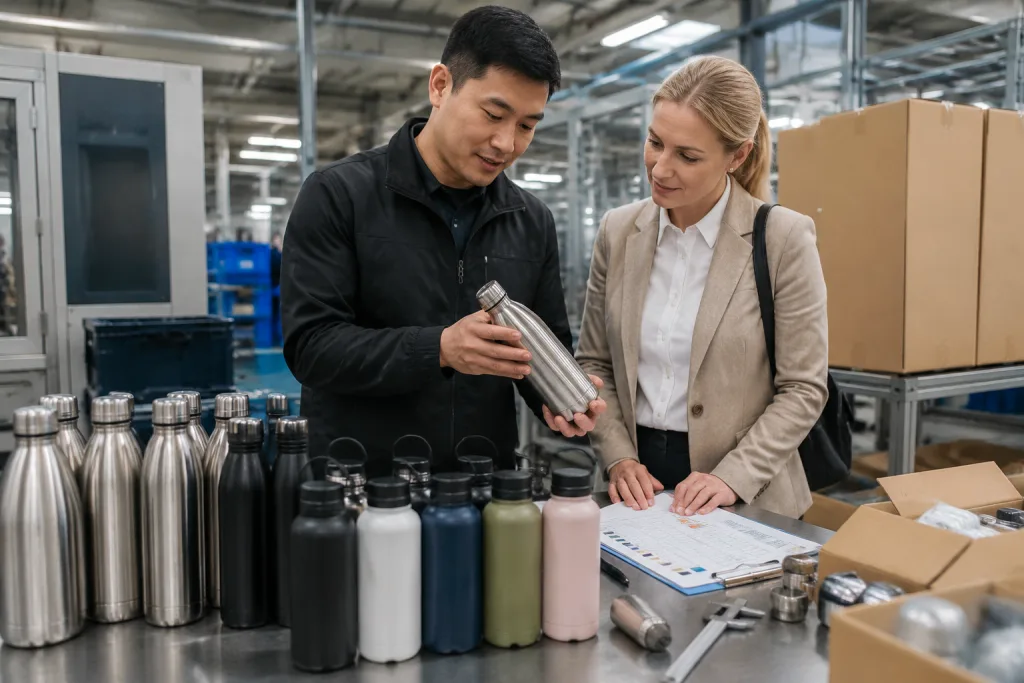
If you are sourcing a vendors hydration flask, start with the spec sheet, not the hero photo. Photos won’t show 0.40 mm body steel, a loose silicone gasket, weak powder-coat adhesion, a soft 5-ply carton, or the small line on the quote that says “white box excluded.” Ask for one comparison table before sampling. We run this check with a digital caliper, a gasket pull test by hand, and a carton drop note from QC.
| Spec | Budget promotional flask | Retail-grade hydration flask | Outdoor custom canteen |
|---|---|---|---|
| Body material | 201 or 304 stainless | 304 stainless, food-contact inside | 304 or 316 stainless |
| Capacity range | 350-600 ml | 500-1,000 ml | 750 ml-1.9 L |
| Wall thickness | 0.35-0.40 mm | 0.40-0.50 mm | 0.50-0.60 mm |
| Insulation | Single wall or basic vacuum | Double-wall vacuum | Double-wall vacuum or non-insulated rugged body |
| Typical MOQ | 500-1,000 pcs | 1,000-3,000 pcs | 2,000-5,000 pcs |
| FOB price range | USD 1.80-3.20 | USD 3.20-5.80 | USD 5.50-11.00 |
The budget version works for canteen promotional campaigns where the buyer wants 90 days of logo exposure, not a bottle that survives 3 school years. The retail-grade option fits distributor drinkware programs, gym brands, and corporate gift ranges, but the math doesn’t work if the buyer expects retail packaging at a promo FOB price. The outdoor custom canteen is for harder use: thicker steel, larger volume, tighter leak testing, and fewer arguments when QC pulled the sample after a 1.2 m drop test.
Our Zhejiang production network can handle 450,000 units/month across stainless bottles, travel tumblers, and growlers. Capacity is not the bottleneck. A loose spec is. We’ve seen this go sideways when a PO said “silk print” on page 1, then the buyer flagged the approved sample and asked for powder coat plus laser engraving; that change can add 7-10 days and means the line reruns adhesion tests before we ship.
Match flask type to sales channel
A hydration flask going to a retail distributor has a different job than a canteen printed for a trade show booth. We have seen this go sideways: the buyer saves USD 0.18 on steel, then QC pulls 47 dented samples during AQL 2.5 carton drop check. Wrong spec, wrong channel.
For promotional use, chase unit cost and logo visibility first. Delivery matters too. A 500 ml single-wall stainless bottle with silk screen printing is often enough. On the line, this type of canteen promotional order often runs 0.35 mm steel, a PP screw lid, and standard white box packaging with 48 pcs per export carton. If the campaign is price-driven, 24-hour heat retention is the wrong question to ask.
For retail, the spec needs to tighten. We check mouth finish with a 0.02 mm feeler gauge, then compare powder coating panels under the light box before packing. You need cleaner rim polish, tighter color consistency, barcode or FNSKU application, spare parts control, and carton marks that match your warehouse process. A distributor canteen program normally needs replacement lids available for at least 12 months. If you sell through Amazon FBA, we ship only after checking outer carton weight, individual polybag warnings, suffocation labels, and scannable FNSKU placement.
For outdoor, camping, and club channels, buyers often compare a custom growler or customized growler against large-capacity flasks. A 1.9 L growler needs stronger handle welds, thicker base steel, and a lid that survives repeated opening; our welding jig leaves no room for a loose handle here. For beer or cold brew, ask for internal electropolishing and odor testing. For water-only use, standard passivation is usually fine.
No canteen vendor should sell you one “best” flask. Good factories ask where it will be sold, how it will be packed, how long the user expects insulation, and what failure rate your channel can tolerate. We once had a PO typo showing 18 days instead of 12 days lead time, and the buyer flagged it before deposit; that small detail changed the whole packing schedule.
Factory versus vendor trade-offs
Buyers often put canteen vendors, canteen suppliers, and canteen manufacturers on the same line of a sourcing sheet. On the factory floor, they are different animals. A canteen factory controls the lid tooling, laser welding, inner-wall polishing, vacuum test, powder coating, and final assembly. A trading canteen vendor usually books those steps with 2-5 workshops, then chases the schedule by phone. Both models ship orders. The risk sits in different places. We have seen this go sideways when QC pulled 80 pcs from the line and nobody could say which subcontractor changed the silicone gasket hardness.
If you are developing customized drinkware with a new lid mold, a direct manufacturer is the safer bet. Tooling for a lid can cost USD 1,200-4,500 depending on threads, flip parts, silicone seals, and handle structure. The same engineering team should check leakage, torque, dishwasher exposure, and drop performance with the actual torque meter and 1.2 m drop jig used before mass production. One team, one answer. If a vendor outsources every part, accountability gets muddy when the lid leaks at 2% during inspection and the buyer flags it two days before loading.
Trading vendors make sense for mixed-container orders. If your purchase order includes stainless flasks, glass bottles, plastic shakers, and accessories, one coordinator cuts emails and PO revisions. Still, ask harder questions: who signs off the AQL inspection, which factory holds BSCI or ISO 9001 documentation, and whether the quotation is FOB Ningbo, FOB Shanghai, or EXW Zhejiang. Small wording matters. Last quarter we saw a PO typo list EXW Zhejiang while the buyer budgeted FOB Ningbo, and the inland trucking alone added about USD 180 per 40HQ.
At BottleForge Industrial in Hangzhou, Zhejiang, we operate as a canteen manufacturer with export engineering support. For a standard custom canteen, our practical MOQ starts at 1,000 pcs for existing shapes and 3,000 pcs for custom colors with stable powder coating. Normal production lead time is 30-45 days after deposit and sample approval. For new molds, add 20-35 days before mass production. The math does not work if a buyer asks for 300 pcs with a private lid mold; the CNC room, mold trial, and T1 sample review already eat the margin before the first carton is packed.
Do not choose a supplier only because the sample looks good. Choose the one that can repeat the sample 3,000 times inside AQL limits, after QC cuts open cartons from the middle of the pallet.
Customization methods compared clearly
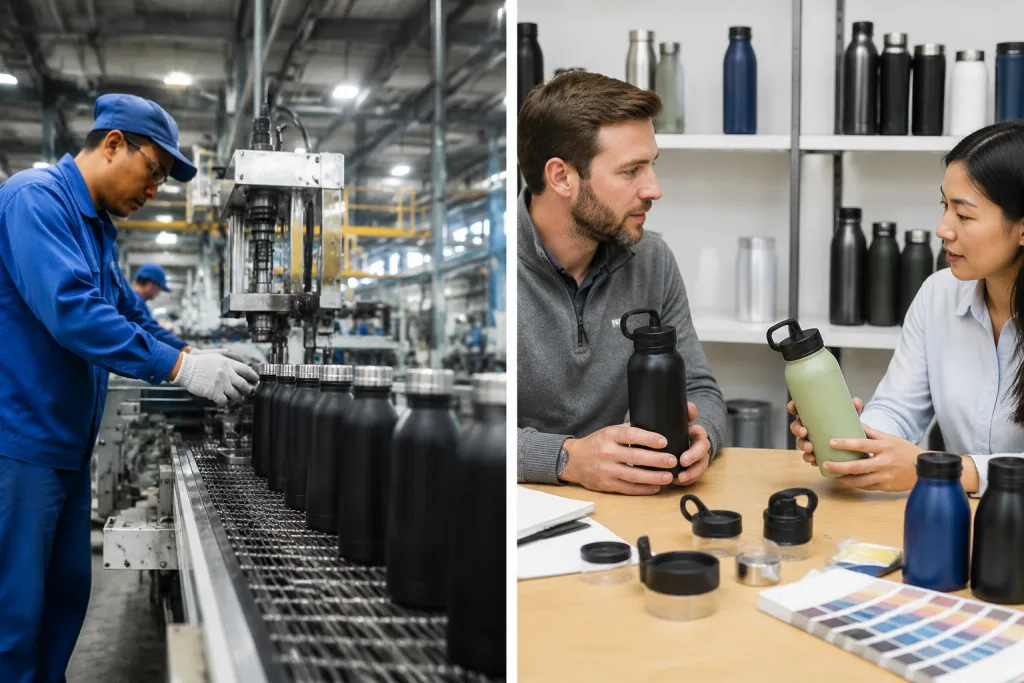
Customizable drinkware is not just a logo on steel. Each decoration choice changes unit cost, line speed, scrap rate, and the feel when the buyer picks up the flask. We run sample checks under a 6500K light box because a “close enough” black logo on a matte black powder coat is where complaints start. Order size and sales channel decide the method.
- Silk screen printing: Best for simple 1-2 color logos with solid blocks. Typical add-on cost is USD 0.08-0.25 per unit. It works for canteen custom giveaways, but on a 72 mm curved body, fine text under 1.2 mm often stretches or fills in. QC pulled the sample on one job because the buyer’s PO said “navy,” while the artwork file said Pantone 2965C.
- Laser engraving: A safe choice for stainless steel, powder coat, and small batch personalization. It is clean, durable, and often USD 0.20-0.60 per unit depending on logo size and engraving time. For 500-1,000 pcs trials, this is usually the lowest-risk route; the math doesn't work if you open screens and fixtures for a logo the buyer may change next month.
- Powder coating: Better grip and a stronger retail shelf feel. Expect USD 0.35-0.90 per unit depending on color, finish, and masking. We require cross-hatch adhesion testing and 3M tape testing before shipment, and we check coating thickness with a film gauge because 35 μm and 65 μm do not age the same after a week in a hot warehouse.
- Heat transfer or full-wrap print: Good for lifestyle graphics, gradients, and large visual panels. It needs tighter setup control, especially at the seam; a 1 mm misalignment is easy to see on a 360° wrap. Test abrasion, dishwasher exposure, and color shift before mass production, not after 3,000 pcs are packed.
- Embossed or molded parts: Best for long-term brand ownership. Tooling cost is higher, but the result feels less like a generic bottle. We usually ask for a locked 2D drawing and a 3D file before cutting mold steel, since one 0.3 mm logo edge change can delay the line by 7-10 days.
A canteen customizable for corporate gifting may only need a laser logo and kraft box. A retail customized canteen may need Pantone-matched powder coat, engraved logo, printed insert card, barcode label, and master carton drop-tested to ISTA-style handling. Different projects. We’ve seen this go sideways when a buyer approves artwork for a gift order, then asks for retail packaging after the bottles are already on the packing table.
For EU buyers, decoration materials must align with REACH expectations, especially coatings, inks, and silicone parts. For North America, we often prepare FDA food-contact declarations and can test against LFGB or ASTM-related requirements when requested. Ask for the compliance path before approving artwork, not after production starts in China; once the coating line is booked for 18,000 pcs, changing ink chemistry is not a small edit.
Pricing that actually means something
A low unit price means nothing if the quote is built on different assumptions. We see this every month. When comparing canteen distributors, a canteen supplier, or a direct factory, put each offer into one landed-cost sheet with the same bottle spec, carton count, logo method, and loading port. Last week QC pulled a 750 ml sample that looked fine, but the carton was 5-ply on one quote and 3-ply on another. That price gap was not “savings.”
For a 750 ml double-wall stainless vendors hydration flask with powder coating and laser logo, a realistic FOB China range is USD 4.20-6.80 at 3,000 pcs using an existing mold. A thinner promotional version may be USD 2.60-3.80. A premium handle-lid version with 316 inner steel, retail box, and spare gasket can reach USD 7.50-10.50. If one quotation is 25% lower than the rest, check the steel grade with a PMI gun, ask for vacuum test records by batch, and confirm the lid drawing is the same version. The buyer flagged this once after the PO said 304 stainless, but the cheap sample used a lighter lid and a 0.28 mm outer wall.
MOQs have factory logic behind them. Existing stainless shapes with laser engraving can start at 500 pcs because we run them between regular jobs on the line. Custom powder colors usually need 1,000 pcs, since the coating booth loses about 8-12 kg of powder during cleaning and color change. New lid colors may require 3,000 pcs to cover plastic injection setup, color masterbatch, and first-piece approval. New bottle molds generally make sense from 5,000-10,000 pcs unless you accept higher tooling amortization per unit. Asking for 200 pcs in a private Pantone color is the wrong question to ask; the math does not work.
Packaging is where cheap quotes often go sideways. A plain white box may be USD 0.12-0.25. A printed retail box can be USD 0.35-0.80. Molded pulp inserts add volume, hang tags need manual tying, and UPC/FNSKU labels slow packing when the sticker position has a 2 mm tolerance. On one Amazon order, the buyer flagged it because the PO typo showed “FNSKUU,” and the warehouse refused 18 cartons until we re-labeled them. If you are a distributor growler or distributor canteen buyer, ask whether labor for label application is included.
Payment terms are usually 30% deposit and 70% before shipment for first orders. Established buyers may negotiate better terms after 2-3 successful shipments, but factories in Zhejiang and wider China still need deposit coverage for steel coils, lids, coating powder, cartons, and labor scheduling. We ship faster when the deposit clears before the steel is cut; 12 days of waiting on payment can turn a 35-day lead time into 47 days before booking space.
Quality checks before shipment
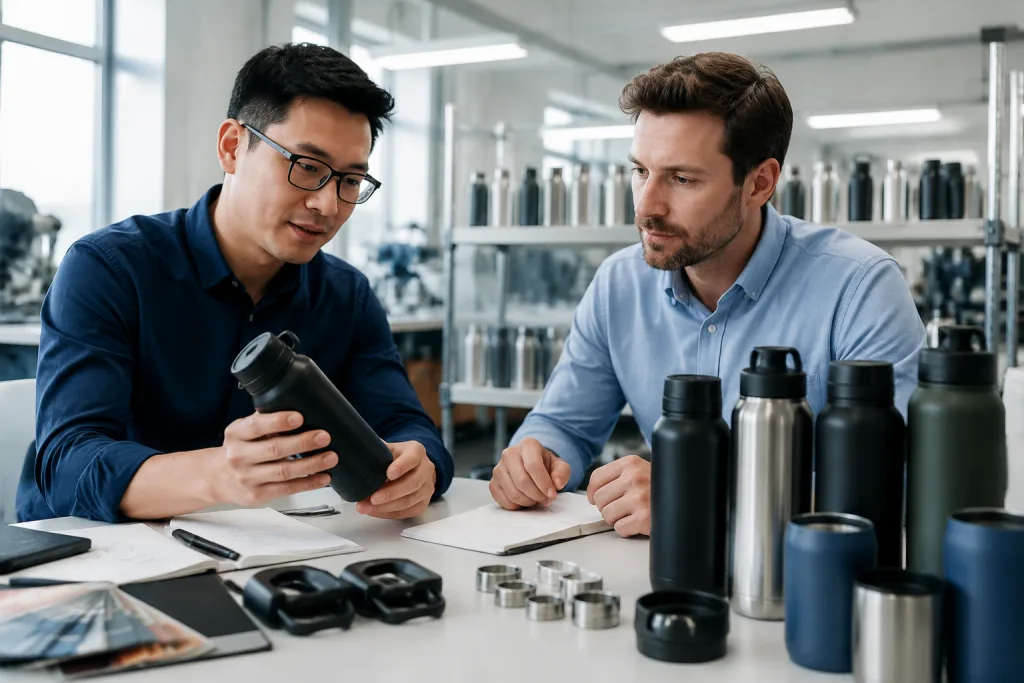
Quality control for customized drinkware should be boring, written, and measurable. If a supplier says “our QC checks everything,” ask for the inspection checklist and the gauge readings. For drinkware, we run capacity on a 1 L measuring cylinder, weight on a 0.1 g scale, height with calipers, then check mouth diameter, wall thickness, lid torque, leak testing, coating defects, color difference, logo position, carton marks, and packaging accuracy.
For most B2B orders, use AQL 2.5 for major defects and AQL 4.0 for minor defects. Critical defects should be zero. A leak is critical. A sharp burr on the mouth is critical; QC pulled one last month at 0.3 mm after polishing and the line stopped. Wrong logo color is major. A tiny speck inside tolerance is minor. Define this before production. Arguing after inspection burns 2 days vs 20 minutes on the pre-production checklist.
Vacuum flasks need thermal testing. We fill with 95°C water, record with a probe thermometer after 6 hours and 12 hours at room temperature, then log the bottle ID on masking tape. For cold retention, fill with 4°C water and measure after 12 hours. The exact pass level depends on volume and design, but the test method must stay consistent. Cutting open samples to check copper plating or the vacuum layer destroys the bottle, but for 5,000 pcs and up, the math works.
Drop testing matters more than buyers expect. A retail box should survive a 76 cm drop sequence better than a loose promotional carton; we use corner, edge, and face drops on the packed box, not an empty sample box. Master cartons should use 5-ply corrugated board for heavier bottles and growlers. For a 24 pcs carton of 750 ml stainless bottles, keep gross weight around 12-16 kg when possible. Warehouse staff in Europe and North America will not handle weak cartons gently. We’ve seen this go sideways.
Pre-shipment inspection should happen when 100% of goods are produced and at least 80% packed. If the canteen factory asks you to inspect at 50% packed, this is the wrong question to accept: you can still miss packaging defects, mixed colors, missing inserts, or a PO typo on the carton mark such as “750ML” printed as “705ML.”
Use-case fit before purchase order
Before you issue a purchase order, pin down the job the bottle has to do. For a conference giveaway, we run a simple custom canteen with silk screen logo, 500-750 ml capacity, and a 500-1,000 pcs MOQ; our pad-print table can clear that faster than laser, and the buyer usually accepts a 0.3 mm logo tolerance if the unit price stays under control. Fast and cheap enough. For a brand launch, use a retail-grade vendors hydration flask with powder coat, laser logo, FNSKU or UPC setup, and 3,000 pcs production. QC pulled the sample last month because the barcode was 2 mm too close to the bottom curve, which would have failed warehouse scanning. For outdoor specialty retail, choose a thicker custom growler or large customized canteen with tested handle strength and spare lid availability.
If you are a canteen distributor serving 6 or 12 clients, keep two base molds in your range instead of chasing every new shape. This is the wrong question to ask if the buyer only says, “What new bottle do you have?” Stable molds cut sampling charges, and the line holds neck thread consistency better when we are not changing jigs every other day. The same applies to distributor drinkware programs: fewer core SKUs with full spec sheets beat a catalog with 80 weak options and missing carton marks.
For private label buyers, ask your canteen manufacturers for a control sample, production sample, and sealed approval sample, but do not treat them as desk decorations. Keep one in your office and one at the factory in China, with the Pantone chip taped to the sample bag and the logo height written in mm on the label. When the second order starts six months later, you have a physical standard for color, logo size, lid fit, and packaging. We have seen this go sideways when a PO typo changed “matte black” to “metal black.”
The strongest sourcing process is simple. Fix the use case, freeze the specification, confirm compliance, approve a real sample, inspect against AQL, and ship only when packaging is correct. On our floor, that means the carton drop test is done, the inner polybag warning is checked, and the barcode scans before the container booking is released. That is how a hydration flask becomes a repeatable product instead of a one-time purchasing headache.
Send your flask spec for a factory quote
Share capacity, logo method, MOQ, market, and packaging needs. We will return a practical FOB China quote with lead time and risks.
Frequently asked questions
What MOQ should I expect for a custom hydration flask order?
For an existing stainless steel flask shape, a practical MOQ is 500 pcs for laser engraving and 1,000 pcs for simple silk screen printing. If you need a custom powder-coated Pantone color, expect 1,000-3,000 pcs because coating lines need setup time and material loss must be covered. New lid colors often start around 3,000 pcs. A fully new mold usually makes sense from 5,000 pcs or more, with tooling from about USD 1,200 to USD 6,000 depending on the body, lid, and handle structure.
How do I compare a canteen factory and a trading vendor fairly?
Use the same written specification and ask both to quote FOB terms with packaging, logo method, inspection standard, lead time, and compliance documents included. A direct canteen factory should give clearer answers on wall thickness, welding, polishing, coating, and vacuum testing. A trading vendor may be useful for mixed orders, but you need to know which factory produces each item. Ask for AQL 2.5/4.0 inspection acceptance, production photos, and a sealed sample. If one quote is 20-30% cheaper, assume something is different until proven otherwise.
Which customization method is best for distributor drinkware?
For distributor drinkware, laser engraving and powder coating are usually the safest combination. Laser marks are durable, clean, and suitable for repeat orders with different client logos. Powder coating gives better grip and retail value than plain stainless steel, but it needs adhesion testing and color control. Silk screen printing is cheaper, often USD 0.08-0.25 per unit, and works for promotional canteen orders. Full-wrap printing is attractive for lifestyle graphics but needs more sampling and abrasion testing, especially if the product will be sold online with high customer expectations.
What lead time is normal for customized drinkware from China?
For existing molds, normal lead time is 30-45 days after deposit and final sample approval. If the order uses standard colors and laser logo only, it may be closer to 25-35 days in a quiet season. Custom powder colors, printed retail boxes, or multiple SKUs can push production toward 45-55 days. New tooling adds 20-35 days before mass production. Around Chinese New Year, capacity tightens across Zhejiang and other China production areas, so place purchase orders 30 days earlier than usual.
What quality documents should I request before shipment?
At minimum, request a pre-shipment inspection report, material declaration, food-contact statement, and packaging photos. For EU sales, ask about REACH, LFGB if needed, and coating or silicone test reports. For North America, FDA food-contact declarations are common, and specific retailers may ask for ASTM-related testing. Your inspection report should show AQL level, sample size, defect classification, leak test results, logo check, carton marks, and quantity count. For vacuum flasks, ask for 6-hour and 12-hour insulation test data, not just a marketing claim.