Key Takeaways
- A practical starting MOQ is 1,000 units per model and 500 units per color for most stainless hydration bottles
- Lock capacity, steel grade, lid material, coating, logo method, and carton data before sampling
- Use AQL 2.5 for major defects and AQL 4.0 for minor defects on pre-shipment inspection
- Normal lead time is 25-35 days after sample approval and deposit for standard custom drinkware
You are not buying a bottle. You are buying a repeatable supply result: ΔE under 1.0 on the powder-coat color, lid torque around 8–10 kgf·cm, carton marks matching the PO, barcode set 18 mm from the box edge, and no ugly call when the first 3,000 units hit your warehouse. We’ve seen 7 vendors hydration bottle projects go sideways because the buyer approved a nice sample but never locked the carton layout or lid gasket spec.
Here is one real order path we run often: a 750 ml stainless sports bottle for a North American distributor drinkware program, with logo print, retail box, and mixed colors. BottleForge Industrial manufactures in Zhejiang, China; on this type of order, QC pulls the pre-production sample from the line, checks the logo with a 3M tape test, and flags small issues before packing starts. The wrong question is “Can you make this bottle?” The better question is “Can you ship the same bottle 12 days from now, with the same lid fit and no barcode mistake on carton 27?”
Start With The Actual Use Case
The buyer situation is straightforward: you need a vendors hydration bottle for an outdoor retail chain, plus a smaller corporate gifting run. The wrong first move is asking 12 canteen suppliers for “best price 750 ml bottle” and lining up the replies as if they describe the same item. They won’t. Last month we saw one RFQ where the buyer typed “750ml” on the email, but the PO attachment said “700 ml”; QC pulled the sample before mass production because the tooling drawing showed a 68 mm base, not the requested 72 mm.
Start with the user and the sales channel. Gym retail needs a one-hand lid, powder coating that survives bag abrasion, and a 5-layer export carton that can take parcel shipping without corner crush. Event canteen promotional orders can use simpler packing, but logo alignment and Pantone color matching carry more weight because the bottle sits in someone’s hand as a brand impression. Distributor canteen programs need carton labels, SKU separation, and replenishment dates that do not drift from 12 days to 18 days. We run different packing instructions on the line for each case; mixing them is how rework starts.
For this order, the working spec is 750 ml, 18/8 stainless steel inner and outer wall, double-wall vacuum insulation, powder-coated body, PP lid with silicone gasket, 7.2 cm bottom diameter, and 26.5 cm height. Target weight is 360-390 g. If a quote comes back at 290 g, you are not looking at a miracle price. The math doesn’t work. It usually means thinner steel, lighter lid construction, or a real capacity closer to 680 ml. Our incoming check uses a digital scale, caliper, and water-fill test before the sample goes to the buyer’s desk.
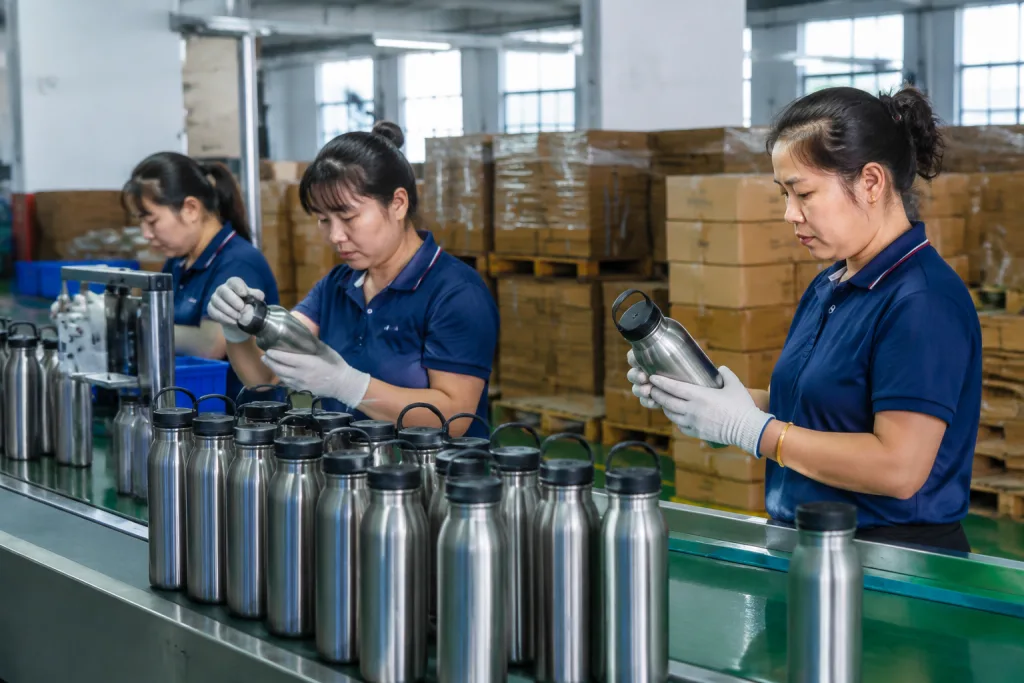
In Zhejiang, 40 or 50 China factories can make a similar-looking bottle. The difference is whether the canteen manufacturer controls welding, vacuum testing, coating adhesion, and lid assembly under one QC process. BottleForge’s monthly output is about 650,000 drinkware units across stainless bottles, tumblers, and growlers, but we still push buyers to define the order before chasing price. A vague RFQ creates vague accountability. We have seen this go sideways when the buyer approved a showroom sample, then flagged coating chips at AQL 2.5 because nobody wrote the cross-cut adhesion requirement into the spec sheet.
Turn The RFQ Into Specs
Your RFQ should read like a PO draft, not a mood board. A good canteen vendor can tighten the details, but you need to own the buying terms and the working requirements. For a customized drinkware order, spell out the model type, capacity, material, finish, logo method, packaging, compliance market, quantity split, Incoterm, and delivery date; our merchandiser once lost 2 days because the buyer wrote “blue” on the RFQ and “Pantone 296C” on the PO.
For example: 3,000 units total, 750 ml stainless vacuum sports bottle, 1,000 black, 1,000 navy, 1,000 white. Laser logo on one side, 45 mm wide. Individual kraft box, 24 pcs per export carton. FOB Ningbo. Required for the United States market. Need FDA/LFGB food-contact documentation and third-party inspection before shipment. That is enough for us to open a cost sheet, check the 750 ml body on the digital caliper, and confirm whether the current line can run it without changing the lid assembly jig.
That one paragraph puts canteen suppliers on the same baseline. It also stops the usual mess: one canteen factory prices silk screen with a 1-color logo, another prices laser engraving at 45 mm, one includes retail boxes, and one assumes bulk packing in PE bags. If you are comparing FOB prices, packaging differences alone can move cost by USD 0.25-0.70 per unit. We see this go sideways during bid review when the buyer flags a USD 0.40 gap, then QC pulls the sample and finds the cheaper quote had no inner box.
For this scenario, a realistic FOB China price range is USD 4.10-5.60 per unit depending on steel thickness, coating, lid complexity, and box artwork. A custom canteen with a flip straw lid costs more than a screw lid because the mold parts, silicone tube, 100% air-pressure leak test, and assembly time add labor on the line. If you ask for a custom growler or customizable growler at 1.9 L, the price structure changes again because steel consumption and carton volume dominate the cost; the math does not work if someone quotes it like a 750 ml bottle.
Do not hide the real annual volume. If you need 3,000 units now and 20,000 units over 12 months, say that. A serious canteen manufacturer in China may price the first order differently if tooling, color development, or packaging setup can be spread across repeat production; on our side, a powder-coating color change can take 45 minutes, while repeat black runs usually stay inside the normal shift plan.
Sample Before You Negotiate Hard
Sampling is where the canteen customized idea meets the line. For a standard body with a custom logo and color, we run samples in 7-10 days after artwork confirmation, assuming the AI file is clean and the Pantone code is not missing from the PO. If you ask for a new lid mold or a body shape our spinning machine has not run before, prototype timing moves to 20-35 days, and tooling may cost USD 800-3,500 depending on cavity count, thread detail, and lid structure.
For the buyer scenario, approve three items as separate samples, not one mixed promise: construction, color, and logo. The construction sample checks capacity, mouth opening in mm, lid fit, leak resistance, and hand feel; QC pulled one last month because the silicone ring sat 0.6 mm proud and the cap felt gritty. The color sample checks powder coating against Pantone or RAL reference under a light box. The logo sample checks position, size, and method. A glossy render is not approval. We have seen this go sideways.
Laser engraving is durable and clean on stainless or powder coat, but it will not reproduce full-color artwork. Silk screen costs less on larger flat-ish areas, usually USD 0.06-0.15 per color per position, but adhesion depends on coating surface, mesh setup, and ink curing time in the oven. Heat transfer gives more color detail but needs abrasion testing with 3M tape and a 500 g rub pass. For a canteen promotional order with a one-color logo, silk screen is usually fine. For a premium retail vendors hydration bottle, laser looks sharper and cuts complaint risk.
Ask the canteen supplier to finish basic sample checks before dispatch: 24-hour water leak test, capacity check with a measuring cylinder, coating cross-hatch adhesion test, and logo rub test. These are shop-floor filters, not fancy laboratory work. Our QC bench uses a 1 L measuring cylinder, 3M 600 tape, and a simple upside-down rack over white paper. If a sample leaks on your desk, mass production will not fix it by luck. The math does not work.
Once approved, freeze the golden sample. Mark it with date, version, color code, logo file name, and buyer signature. One sample stays with you, one stays with the canteen factory in Zhejiang. Put both in polybags, tag them, and keep them away from the packing line, because one buyer once flagged a 2 mm logo shift after the operator followed an old sample. That reference is what your QC inspector should use later.
Price The Whole Landed Risk
Unit price is the wrong place to stop. A USD 0.18 cheaper canteen vendor gets expensive fast when the 5-ply export carton fails a 76 cm drop test, FNSKU labels scan to the wrong ASIN, or QC pulls a lid sample and finds the silicone gasket changed from the approved shore hardness. For distributor drinkware, we price product, color box, master carton, Hangzhou-to-Ningbo inland freight, export handling, sea or air freight, duty, inspection, possible rework, and the sales days lost when goods miss the warehouse booking.
For this 3,000-unit order, assume each export carton holds 24 units. You will ship around 125 cartons. If each carton is 46 x 34 x 31 cm, total volume is roughly 6.1 CBM before pallets. A USD 0.30 per unit packaging change becomes USD 900. Small carton changes hurt. If the carton grows 15%, the math can move against you in Amazon-style parcel networks or regional distributor warehouses, especially when the buyer’s PO says “no carton over 15 kg” and the packed sample comes out at 15.8 kg on our floor scale.
Payment terms also matter. We run 30% deposit and 70% before shipment on most China canteen orders. For repeat buyers with stable volume, some factories discuss 30/70 against bill of lading copy or limited credit terms. Be careful with any canteen supplier offering a low deposit, a low price, and no written inspection plan. We’ve seen this go sideways: the buyer flagged it only after the carton mark on the PO said “matte black” but the factory printed “matt black,” then nobody wanted to pay for relabeling before vessel closing.
Build compliance cost into the quote from day one. For North America, confirm food-contact safety, CPSIA relevance if kids use is involved, and ASTM expectations for packaging or labeling where applicable. For Europe, ask about LFGB, REACH, and packaging waste requirements. If the bottle includes plastic, silicone, coating, and printed ink, each material needs checking against the exact BOM. On the line, QC keeps the approved PP straw, silicone seal, coating chip, and ink drawdown card in the sample cabinet; a responsible canteen manufacturer should know which test reports match those materials and which ones are only close.
For BottleForge Industrial in Zhejiang, a standard MOQ is 1,000 units per model, with 500 units per color when using existing powder colors. Custom colors usually need 1,000 units per color because coating setup loss is real, not a sales trick. On a small run, the powder booth still needs purge time, spray-gun adjustment, and about 20 to 40 bottles of color-tuning scrap before the line is stable.
Control Production Before It Runs
After deposit, the order starts moving the same day in most factories. Your PO either keeps the line clean or gives both sides something to argue about on WeChat at 11 p.m. Put the approved sample number on it, not just “same as sample.” Add artwork file version, Pantone or RAL color, packing method, carton marks, barcode files, inspection standard, shipment term, and required ship date. We once had a PO with “PMS 186C” in the artwork folder but “PMS 185C” on page 2; QC pulled the sample under the D65 light box and the buyer flagged the red before coating started.
For a customized canteen or customizable drinkware order, we run a pre-production meeting before stainless steel, lids, and cartons are released. Twenty minutes is enough if the right people join. Confirm steel grade, body thickness target in mm, lid components, coating color, logo placement, box artwork, carton quantity, and pallet requirement. If your canteen distributor customer is waiting for delivery, bring your operations person onto the call, not just sourcing. Carton marks matter. A 10 mm barcode shift can make warehouse scanning fail, and that is not a design issue.
Mass production for this order would normally take 25-35 days after sample approval and deposit. The line sequence is body forming, welding, vacuum process, polishing, coating, logo application, assembly, leak testing, packing, and final QC. Vacuum insulation is the wrong thing to check only at final inspection. We check it during production with the vacuum tester and hot-water holding test because 1,200 packed bottles with failed insulation do not rework nicely. The math doesn't work.
Ask for production photos, but do not treat photos as QC. Photos prove the goods exist. They do not prove coating adhesion, capacity, lid torque, or leak resistance. A useful mid-production update shows quantity completed, internal defect rate, packaging status, and any difference from the approved sample. If a canteen factory reports a 6% coating scratch issue on the hanging line and sorts it before packing, that is better than sending pretty photos and hiding the problem until AQL 2.5 inspection.
If you are ordering a customized growler, distributor growler, or canteen customizable design with accessories, add an assembly checklist. We ship sets with straws, brushes, spare gaskets, instruction leaflets, and sometimes 2 lid types in one inner box. Missing a 0.8 RMB gasket creates more customer service cost than the part itself. We have seen this go sideways when the buyer approved the bottle but never approved the accessory count.
Inspect Like The Goods Are Yours
Pre-shipment inspection should start after production is 100% finished and at least 80% packed, not while the line is still chasing lids and color boxes. We run ANSI/ASQ Z1.4 sampling, or the buyer’s equivalent AQL plan. For drinkware, our normal setup is AQL 0 for critical defects, AQL 2.5 for major defects, and AQL 4.0 for minor defects. Critical defects are unsafe material, sharp metal burrs, contamination, or serious leakage. Major defects are wrong logo, poor lid fit, failed vacuum performance, heavy coating peel, or incorrect capacity. Minor defects are small cosmetic marks inside the signed limit board; QC usually keeps that board beside the light box with a 0.5 mm feeler card.
For a 3,000-unit lot under General Inspection Level II, the sample size is typically 200 units. That catches line-wide trouble without tearing open every master carton. Your inspector should check appearance, dimensions, actual capacity, weight, odor, lid assembly, gasket placement, barcode scan, carton drop condition, and packing assortment. Use a digital caliper for mouth diameter, a scale for unit weight, and a graduated cylinder for capacity. For insulated bottles, run a hot water temperature retention check on selected units; we usually log starting water at 95°C and check the reading after 6 hours. For leak testing, invert filled bottles for 30 minutes and shake test a smaller sample. QC pulled the sample last month because 14 caps had twisted silicone rings after assembly.
Define acceptable cosmetic limits before inspection. A 0.5 mm dot on the bottom may pass. A 3 mm scratch on the front logo side should fail. This is the wrong question to ask after packing. If the buyer flagged “minor scratches” but the PO only says “good surface,” the math does not work for either side. Put the defect photos, viewing distance, and lamp condition in writing before mass production; our inspection table uses 600 lux light and a 30 cm viewing distance.
When defects exceed AQL, do not jump straight to cancellation. Ask for sorting, a rework plan, re-inspection date, and who pays the cost. A practical canteen supplier should already have internal QC data and can isolate batches by production date or color; our traveler card shows coating date, oven line, and packing shift. If the defect is wrong logo position across all units, that is serious. If it is 2% loose retail boxes, rework is manageable. We have seen this go sideways when a buyer demanded cancellation over 63 dented boxes in a 3,000-unit shipment, while the bottles inside were clean.
This is also the point to verify export documents: commercial invoice, packing list, bill of lading instructions, certificate of origin if needed, and test report copies. China export paperwork is routine when prepared early; it gets painful after the vessel closing date. Check the PO spelling too. One buyer sent “matte balck” on the artwork file and “matte black” on the invoice, and the forwarder held the draft bill for 1 day while everyone asked which typo was official.
Build Reorders Into The First Order
Sharp buyers treat the first vendors hydration bottle order as the master product file, not a one-off PO. Put the approved AI/PDF artwork, golden sample photos, AQL 2.5 report, carton dimensions, HS code notes, and 6 pieces of customer feedback in one folder. We do this on our side too: QC tags the sealed sample with a red label, then stores the caliper record for mouth diameter and body height. No treasure hunt later. When your sales team asks for a reorder, nobody should rebuild the job from 47 scattered emails and a PO with “mat black” typed instead of “matte black.”
For a canteen distributor, reorder speed pays the bills. If the first run used existing molds and standard colors, repeat lead time is usually 20-28 days after deposit, as long as 304 stainless sheet and lid parts are in stock. If you chose a special coating powder or custom lid color, book material 14 days earlier. We run into this every spring: the buyer flags a hot SKU, then asks why the line cannot restart tomorrow. The math doesn't work if the powder supplier needs 12 days and the bottle line already has 3 export orders waiting.
Track complaints by defect type, not just by customer name. Split leakage and denting from coating chips, odor, wrong color, barcode failure, and carton damage, then count them against shipped pieces. If 1.2% of complaints are carton crush from parcel shipping, the fix is probably an ECT 44 carton with 5 mm corner guards, not a new bottle. QC pulled the sample. If gasket loss shows up on 18 out of 1,500 pieces, add a spare gasket or tighten assembly inspection with a simple pull check at the packing table. Good canteen manufacturers like specific feedback because it gives the next run a clean target.
This is where line extensions make sense. Once the 750 ml item is stable, add a 500 ml kids bottle or 1 L sports bottle first, then look at a custom growler or customizable canteen set using the same finish code and packaging style. A family look is cheaper when the gift box dieline, barcode position, and color card stay consistent. For distributor growler or customized growler programs, keep the same QC discipline: capacity verification by scale, lid torque check at 8-10 kgf.cm, leak testing, coating adhesion, and carton strength. We've seen this go sideways when the new size skips the leak jig because “only the height changed.”
A reliable canteen vendor is not the factory that says yes to every request. It is the one that tells you when a spec will raise MOQ, slow production, or lift defect risk. Last month we pushed back on a 300-piece custom gradient coating because the spray line setup loss alone was 42 bottles. That honesty beats a low first quote that turns into claims, delays, and awkward calls with your key account.
Send Your Bottle Spec And Target Quantity
BottleForge will review capacity, MOQ, logo method, packaging, and lead time before you commit budget to sampling.
Frequently asked questions
What MOQ should I expect for a vendors hydration bottle order?
For an existing stainless steel model, expect 1,000 units per model as a practical MOQ. If you split colors, 500 units per color is usually workable when using standard factory colors. Custom Pantone powder coating often needs 1,000 units per color because coating setup, cleaning loss, and scrap are real costs. New molds are different: a custom lid or body shape may require 3,000-5,000 units for the first order plus tooling charges. If a canteen supplier offers 100 units with full customization, check whether it is using stock goods, digital print, and higher unit pricing.
How long does custom drinkware production take in China?
For standard customized drinkware, sample production usually takes 7-10 days after artwork confirmation. Mass production normally takes 25-35 days after sample approval and 30% deposit. Add 3-7 days if you need custom retail boxes, barcode label approval, or special carton marks. Ocean freight to North America can add roughly 18-35 days depending on port pair and season. Europe is commonly 28-40 days by sea. If your launch date is fixed, work backward from warehouse delivery, not factory completion.
Should I choose laser engraving or silk screen printing?
Laser engraving is better when you want a durable, premium mark and the artwork is one-color or line based. It usually costs more than basic silk screen but reduces rubbing and peeling complaints. Silk screen is practical for canteen promotional orders, especially simple logos on smooth powder coating. A one-color silk screen logo often costs around USD 0.06-0.15 per position depending on size and volume. For full-color graphics, heat transfer or UV print may work, but you should request abrasion and dishwasher-related guidance before approval.
What inspection standard should I put on the purchase order?
Use ANSI/ASQ Z1.4 or ISO 2859-1 sampling with General Inspection Level II unless your customer requires something else. A common drinkware AQL is 0 for critical defects, 2.5 for major defects, and 4.0 for minor defects. Critical defects include sharp burrs, unsafe contamination, and serious leakage. Major defects include wrong logo, failed insulation, wrong capacity, loose lid, or heavy coating damage. For a 3,000-unit order, your inspector will often check about 200 units. Put the standard on the PO before production starts.
Can one canteen manufacturer supply bottles, canteens, and growlers?
Yes, if the factory has the right forming, welding, vacuum, coating, and assembly capability. Many canteen manufacturers can produce stainless hydration bottles, custom canteen items, travel tumblers, and custom growler models from related processes. The key is not the catalog size; it is process control. Ask for monthly capacity, internal QC steps, material test reports, and photos of actual production lines. At BottleForge in Zhejiang, China, we prefer to confirm the exact model family first because a 500 ml bottle and a 1.9 L growler have very different steel usage, carton volume, and inspection focus.