Key Takeaways
- MOQ should be matched to process: 1,000 pcs for laser logo, 3,000 pcs for custom coating, 5,000 pcs for molded accessories
- Leak testing should cover 100% of units, not only AQL sampling
- 304 stainless steel at 0.45-0.55 mm wall thickness is a safer B2B baseline
- Plan 30-45 days production after artwork and pre-production sample approval
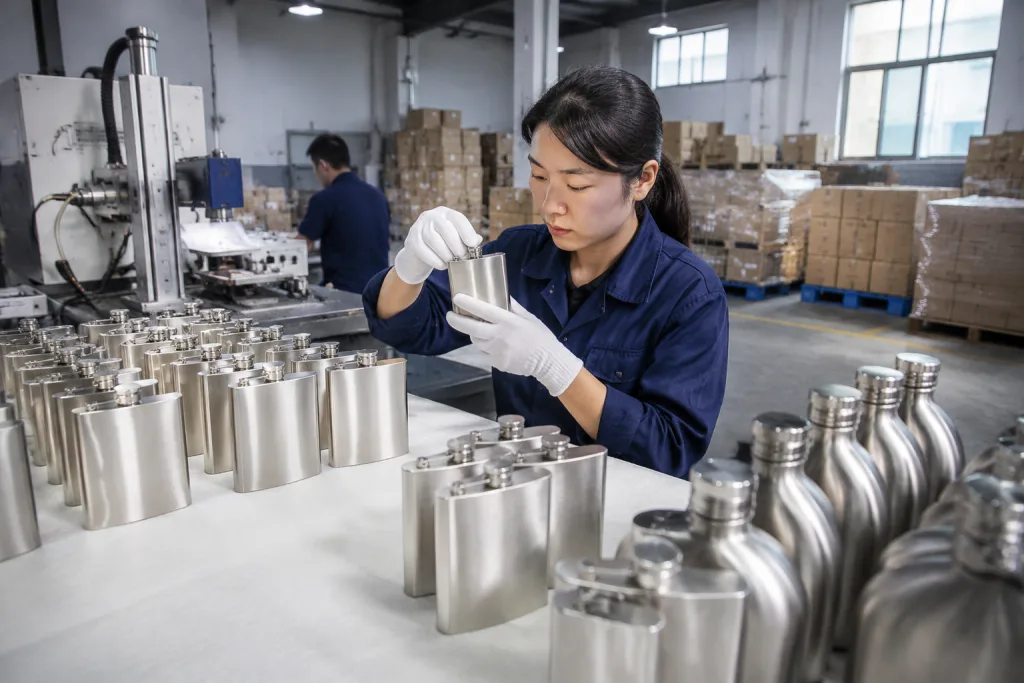
A hip flask or canteen looks simple until the first 38 cartons land with caps weeping at the thread, powder coating scratched near the shoulder, laser logos fading after a 3M tape pull, and outer cartons split after a 1.2 m drop test. Cheap unit price. Expensive cleanup. For B2B buyers, “can you make it?” is the wrong question to ask. The better question is, “what fails when we run 5,000 pieces on the line with a tight ship date?”
We manufacture custom drinkware in Hangzhou, Zhejiang, and we see the same buyer mistakes about 6 times a month. If you are comparing a canteen supplier in China, a canteen factory in Zhejiang, or several canteen vendors for a promotional program, lock the failure points before pushing for the final USD price. Last month QC pulled the sample because the PO said matte black, the artwork file said gunmetal, and the buyer flagged it only after pre-production photos. That is how small gaps turn into 12 days of rework instead of 2 days of confirmation.
The cap leaks first
The first failure we see on vendors hip flask orders is usually not the body. It is the closure system. A cap can look clean in a supplier photo and still wet the inner carton after 20 minutes, especially when the gasket is 0.8 mm instead of 1.2 mm, the thread pitch drifts, or the hinge pulls the cap off-center by half a millimeter. Cheap tooling shows up here fast. On canteen customized projects, QC pulled samples from one 3,000 pcs run where the flask body passed air pressure, but 17 caps leaked at the hinge after packing.
Specify the cap material, gasket material, thread engagement, and test method on the PO. For stainless hip flasks, we run food-grade silicone gaskets instead of low-grade rubber because silicone holds compression after 50 open-close cycles on the bench. Ask for 100% leak testing with water for at least 30 seconds per unit. For a screw cap canteen customized for outdoor retail, we prefer an inverted shake test plus a standing test for 10 minutes on random packed units; the line can do this with a plastic test tray and a simple timer, no fancy lab gear needed.
Do not accept “leakproof” as a specification. Too loose. Write it like this: filled to 90%, cap closed by normal hand torque, inverted and shaken 20 times, no visible leakage at cap, seam, or hinge. That wording gives the QC inspector in China something enforceable on the line. We have seen this go sideways when a buyer’s PO only said “no leak,” then the factory passed a 5-second upright check and shipped wet cartons anyway.
If you are a canteen distributor or distributor drinkware buyer, ask whether replacement caps are available before you lock the artwork. A 2% spare cap pack costs little, often USD 0.03-0.08 per unit depending on design, and it can cut a retail complaint cycle from 18 days to 3 days. For larger distributor canteen programs, keep the cap design stable across 2 or 3 SKUs so your after-sales team is not sorting five different gaskets by eye in the warehouse.
Steel grade gets quietly downgraded
About 7 out of 10 buyer RFQs we see say “stainless steel” without naming the grade. Too loose. For custom canteen and hip flask production, we normally spec 304 stainless steel for the liquid-contact body and stamp it on the material line of the PI. Some low-cost quotes switch to 201 stainless steel; after mirror polishing on the buffing wheel it can pass a quick desk check, but it loses corrosion resistance faster with lemon drinks, salt air, or 30-day warehouse storage. We’ve seen this go sideways when QC pulled the sample and found rust dots around the welded neck after a 24-hour salt spray check.
For B2B orders into Europe and North America, we advise 304 stainless steel with 0.45-0.55 mm wall thickness for most single-wall hip flasks and canteens. Below 0.40 mm, denting and seam distortion show up faster; our line checks this with a digital micrometer at the rim, body, and base before polishing. Go much thicker and the piece feels solid, but the math doesn’t work: FOB cost rises, carton weight moves from about 13 kg to 17 kg on a 100 pcs carton, and buyers start pushing back on freight. A custom growler or customizable growler needs different engineering because the volume is higher and pressure expectations can change, but the first question stays the same: what steel grade are we buying?
Ask for material declarations and, when the order value supports it, third-party testing for food-contact compliance. For Europe, REACH and LFGB-style testing may be requested depending on product and market. For the United States, FDA food-contact expectations and California Proposition 65 screening can matter for promotional channels. A reliable canteen manufacturer in Zhejiang or elsewhere in China should not be offended by these requests; last month one buyer flagged a missing heat number on the MTC, and we corrected it before pre-production sample approval.
The test has to match the production batch. This is the wrong question to ask: “Do you have a lab report?” A clean report from 2024 does not prove your 2026 order is compliant, especially if the steel coil changed after Chinese New Year. Put batch traceability into the purchase order: steel coil record, production date, PO number, and sample retention for 12 months. Good canteen manufacturers already run this file because it protects both sides when a distributor growler or canteen promotional program gets audited; we keep one sealed sample in the QC room with the PO sticker, even when the buyer’s PO has a typo in the item code.
Logos fail after coating
Decoration is where custom drinkware buyers burn budget fast. A logo can look clean on one hand-made sample, then drift in bulk when coating thickness runs 45 microns on Monday and 72 microns after the powder gun is adjusted. On vendors hip flask projects, we run laser engraving, silk screen printing, pad printing, water transfer, powder coating, and sometimes UV printing, but the buyer flagged one flask last month because the logo sat 2 mm off-center in the curved fixture. That is the real risk.
Laser engraving is the safer choice for stainless hip flasks because there is no ink adhesion to fight. It works well for 1,000 pcs MOQ and above, with a typical logo area under 60 x 60 mm. Color is the catch. Laser comes out silver, dark grey, or tone-on-tone depending on the surface finish, and the sample room cannot turn that into exact Pantone 186C with a setting change on the fiber laser. If your brand needs exact Pantone color, you move into printing or coating, and the failure modes change.
For printed or coated designs, require a cross-hatch adhesion test, alcohol rub test, and packing abrasion check. We use a cross-cut knife, 3M tape pull after cutting, 50 alcohol rub cycles, and 24-hour dry time after curing before QC signs the sample card. For a canteen promotional order, that level usually passes. For retail customized drinkware, I would add a dishwasher simulation or hot-water soak if the claim appears on packaging, because we have seen this go sideways when the PO says “dishwasher safe” but the artwork approval only mentions hand wash.
Be careful with matte black. It sells, but it shows scratches fast if the coating is too soft or cartons are packed without PET sleeves between flasks. A canteen vendor may quote USD 0.10 less by using thinner coating or skipping a primer layer, and the math does not work after 3 cartons come back with rubbed corners from a 14 kg master carton. If you want a premium customized canteen, spec powder coating thickness around 60-80 microns and confirm curing time on the pre-production sample.
Samples hide production variation
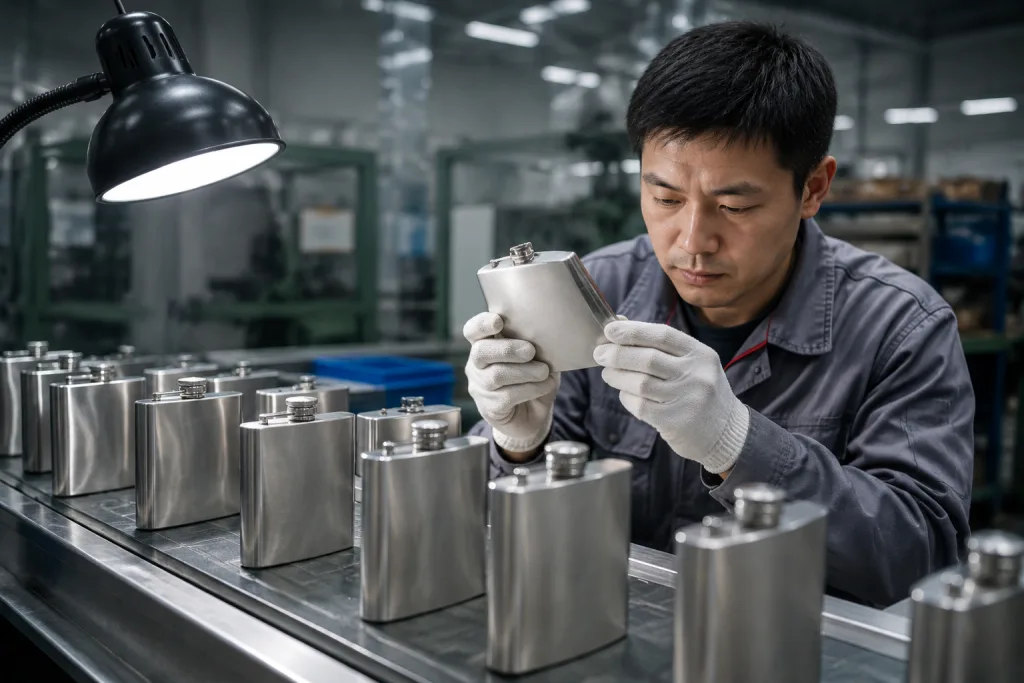
A clean sample does not prove the bulk order will match it. One senior technician can baby a sample through welding and buffing at 6 pcs/hour; the line runs much faster, and that is where flask seams, mirror polish, coating edges, and logo position start to drift. At BottleForge Industrial in Hangzhou, Zhejiang, our drinkware output is about 450,000 units/month across bottles, tumblers, flasks, and canteens, but we treat the pre-production sample as a control document, not a sales souvenir. QC pulled one flask sample last month with a 0.8 mm logo shift after the pad-printing jig warmed up. Small shift. Big argument.
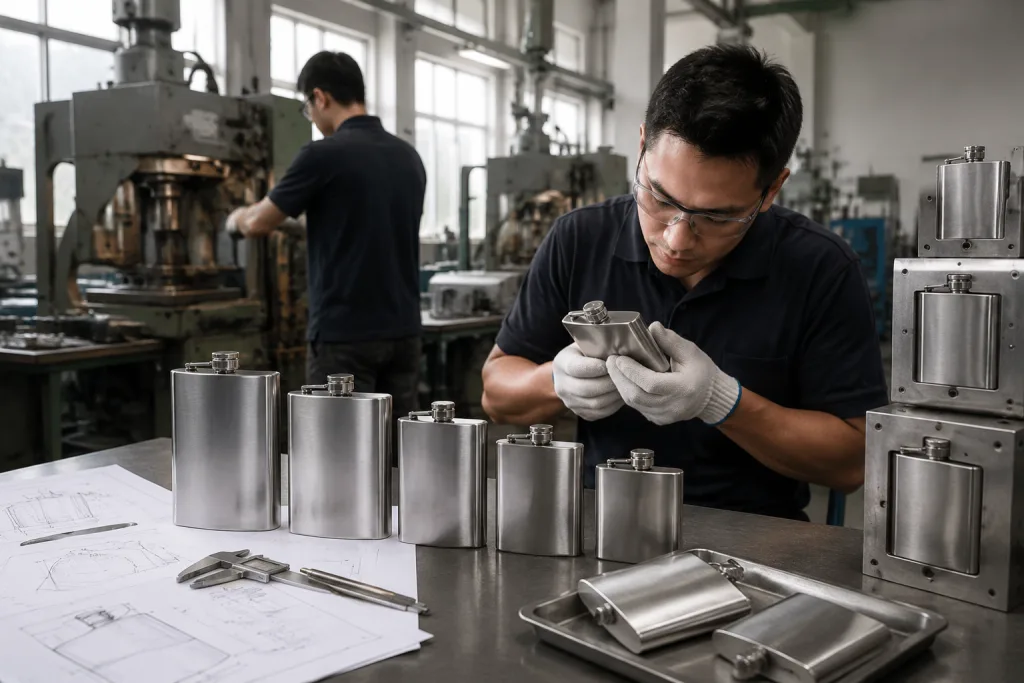
Before you approve a canteen customizable project, sign off on a golden sample and a specification sheet. The spec sheet should include capacity tolerance, body dimensions, mouth diameter, wall thickness, weight range, surface finish, logo position tolerance, cap torque feel, packing method, and carton drop requirement; if the list feels long, cut the product risk instead, not the spec. For example, a 6 oz hip flask might allow ±5% capacity tolerance, ±1.5 mm body dimension tolerance, and ±2 mm logo placement tolerance. We run these checks with a digital caliper, a 0.01 g scale, and a simple logo-position template because “looks okay” does not survive a buyer claim. Without numbers, QC becomes personal opinion.
AQL is useful, but it cannot replace process control. For most export drinkware, buyers use AQL 2.5 for major defects and 4.0 for minor defects. Critical defects such as leakage, sharp burrs, broken glass, contamination, or wrong material should be 0 acceptance. If a canteen supplier says “we passed AQL” but skipped 100% leak testing, the math does not work; 1 leaking flask in a 12-piece gift set can ruin the whole carton. On our line, operators use a water-fill leak bench before packing, and QC marks failures with red tape before they reach the inner box.
If you are comparing canteen suppliers, ask how they handle first-piece inspection and line patrol inspection. A practical answer sounds like this: first 20 pcs checked after setup, inspection every 2 hours, coating thickness checked twice per shift, and final inspection before packing. Ask who signs the patrol sheet and what happens when the coating gauge reads 18 μm against a 22 μm target. A vague answer like “our QC checks everything” is not enough for distributor drinkware or canteen distributors who will carry the customer complaints later. We have seen this go sideways when a PO had “matte black” typed as “mate black” and nobody locked the approved finish chip.
Capacity claims create complaints
Capacity mistakes look boring until customs asks why the label says 16 oz and our graduated cylinder shows 452 ml at the safe fill line. We see the same issue on 6 oz, 8 oz, 16 oz, 20 oz, and 32 oz flasks and canteens. Some factories quote brimful volume because it makes the spec look better. Buyers usually mean usable fill below the mouth, with 8-12 mm left for the cap thread and shaking. For a customized growler or custom growler, foam headspace and cap depth can steal another 20-35 ml. The buyer flagged it once after retail complaints, not during sample approval.
Write the capacity method on the PI and artwork proof. If you sell a 16 oz canteen, say whether it is brimful 473 ml or practical fill around 450 ml measured with a 500 ml measuring cylinder on the QC bench. For North American buyers, ounce claims on packaging need proof if Target or Amazon asks. For European distributors, ml markings should match the declared volume, not the nicest number in the catalog. If the carton says 16 oz, the hangtag says 500 ml, and the online listing says 473 ml, the math does not work. Customers blame the brand, not the canteen factory.
Dimensional drift hits accessories first. A pouch or box insert may fit the gold sample but jam on bulk if the canteen manufacturer does not hold the body diameter within ±0.3 mm. For vendors hip flask orders with gift boxes, we approve the box with five production pieces, not one sample. Small rule. It saves arguments. Last March, QC pulled a coated flask from the line and the insert was too tight because powder coating added 0.1-0.2 mm per side; the gift box supplier said the sample was fine, but bulk packing slowed from 900 pcs/day to 520 pcs/day.
For distributor canteen and distributor growler programs, keep one master technical file per SKU. Include the drawing, capacity method, approved artwork, barcode, FNSKU if used for Amazon FBA, carton dimensions, gross weight, and spare part list, with the latest PO number marked clearly so nobody ships from an old file. We run into this after about 6 months, usually when the original sales contact leaves or a new factory merchandiser copies the wrong PDF. This is the wrong place to save 10 minutes. One typo on a PO, such as “450 ml” becoming “500 ml,” can turn a clean reorder into a relabeling job.
Cartons lose the shipment
Packaging is not decoration. It is part of the product. A hip flask can pass polishing, leak testing, and logo inspection, then arrive dented because the inner bag is 0.025 mm, the divider was skipped, or the carton spec was copied from a domestic Taobao job. For FOB Ningbo or FOB Shanghai shipments from Zhejiang, the same carton is touched 6-9 times by our packing team, the trucker, CFS warehouse staff, the forwarder, customs inspectors, and the final-mile carrier before your customer opens it. Cartons take the beating.
For metal canteens and hip flasks, we run individual polybag or paper wrap, then white box or color box, then master carton. Master cartons should usually stay under 15 kg gross weight; above that, the line starts seeing crushed corners when workers stack by hand. If your order is for e-commerce or Amazon FBA, carton labels, FNSKU application, suffocation warnings, and drop-test expectations must be confirmed before production. Fixing label errors after packing can cost USD 0.05-0.20 per unit and delay shipment by 3-7 days; we had one PO where the buyer typed “FNSK0” with a zero, and QC pulled 24 cartons back for relabeling.
Drop testing should match the sales channel. A simple distributor shipment can use an ISTA-style 1A approach with corner, edge, and face drops. For glass bottle or premium gift-box drinkware, you need stronger inserts, often 1.5 mm E-flute or molded pulp instead of a loose white box. For canteen promotional orders, buyers often ask us to cut the divider to save USD 0.03 per set, but the math does not work if 3% of units arrive scuffed. Cut the fancy box printing if you must. Keep metal away from metal.
Ask your canteen vendor for packed carton photos, carton size, gross weight, and pallet loading plan before shipment. If the goods are going to a North American warehouse, confirm whether pallets must be heat-treated and whether cartons need PO labels on two sides. These details are not glamorous, but they are where 7 out of 10 last-minute shipment problems start in the final 48 hours before vessel closing; last month the buyer flagged a PO label on only one short side, and the warehouse refused the pallet until we reworked it with a tape gun and fresh labels.
Price gaps usually have reasons
If one quote comes in 18% under the rest, something changed. Maybe it is 201 steel sold as 304 stainless, 0.45 mm body sheet instead of 0.55 mm, one less buffing pass on the polishing wheel, a thinner silicone gasket, lighter powder coat, shorter QC time, B-flute carton instead of K=K, or a tighter payment term hidden in the PI. Same product photo. Different flask. We run into this every month when a buyer sends 6 screenshots from Alibaba and asks us to “match the cheapest one.” That is the wrong question to ask. First make the quotes comparable.
For a basic stainless hip flask with one-position laser logo, a realistic China FOB range might be USD 1.20-2.40 depending on capacity, finish, cap design, and packaging. A powder-coated custom canteen with color box may sit closer to USD 3.50-7.50. A larger customizable growler can run higher, especially with double-wall vacuum insulation or retail packaging. These are planning ranges, not promises. Last week our line checked a 6 oz flask body with a digital caliper and found 0.08 mm variance between two supplier blanks; that small number changed the polishing yield and scrap cost. Steel price, RMB exchange rate, and order volume move the final number.
Our normal MOQ in Zhejiang is 1,000 pcs for stock-shape laser logo, 3,000 pcs for custom color coating, and 5,000-10,000 pcs when new molded plastic or silicone accessories are required. Standard lead time is 30-45 days after deposit and approved pre-production sample. If a canteen factory promises 12 days for a fully customized canteen with new coating, custom box, and third-party testing, ask what is being skipped. We ship fast when materials are ready, but the math does not work if the coating line needs 2 color trials, the box artwork has a typo on the PO, and QC still needs AQL 2.5 inspection before loading.
A good quotation should state Incoterms, payment terms, sample cost, production lead time, carton details, inspection standard, compliance documents, and validity period. Ask for carton size in cm, gross weight per carton, packing ratio, and which test report is being reused versus newly applied. QC pulled the sample once because the quoted carton used 5-layer paper, but the mass cartons arrived at 4.8 kg lighter per 100 pcs than the approved packing spec. If you are a canteen distributor comparing canteen manufacturers, do not buy from the lowest spreadsheet line. Buy from the vendor who can explain what can go wrong and how they will prevent it.
Send your flask spec before quoting blind
Share capacity, material, logo method, packing, MOQ, and target market. We will flag the production risks before giving a factory price.
Frequently asked questions
What MOQ should I expect for vendors hip flask orders?
For a stock stainless hip flask with laser engraving, 1,000 pcs is a practical MOQ in China. If you need a custom Pantone coating, expect 3,000 pcs because coating line setup and color matching waste are real costs. For a molded cap, silicone grip, custom funnel, or special retail box insert, MOQ can move to 5,000-10,000 pcs. Small trial orders are possible, but the unit price may be 20-50% higher and you may have fewer decoration choices.
How do I choose between a canteen supplier and a trading company?
A direct canteen factory is usually better when your order has technical risk: custom cap, coating, capacity tolerance, or compliance testing. A trading company can be useful when you need many unrelated SKUs bundled together. Ask for production photos, BSCI or ISO audit status, monthly capacity, and who controls final QC. If the seller cannot explain wall thickness, gasket material, AQL level, or leak test method, they are not managing the product deeply enough.
What inspection standard should I put on the purchase order?
Use AQL 2.5 for major defects and AQL 4.0 for minor defects as a normal baseline, with 0 acceptance for critical defects. Critical defects should include leakage, sharp burrs, wrong material, contamination, broken packaging that exposes the product, and unsafe odor. Add 100% leak testing for every hip flask or custom canteen, because leakage is too serious for sample-only inspection. Also define logo tolerance, coating adhesion test, carton drop test, and approved golden sample.
Can you support Amazon FBA or distributor warehouse labeling?
Yes, but labeling must be confirmed before packing. For Amazon FBA, you may need FNSKU labels, carton labels, suffocation warnings on polybags, and carton weight limits. For distributor drinkware warehouses, you may need PO labels on two carton sides, mixed-SKU pallet rules, or heat-treated pallets. Label rework after packing can add 3-7 days and USD 0.05-0.20 per unit, so send the routing guide with the purchase order, not after production.
What lead time is realistic for customized drinkware from Zhejiang?
For stock-shape hip flasks or canteens with laser logo, plan 25-35 days after sample approval. For custom coating, printed packaging, or third-party compliance testing, 30-45 days is more realistic. New tooling or molded accessories can push the timeline to 60 days or more. Add 3-5 days for artwork confirmation and 5-10 days for sample shipping if you need physical approval in Europe or North America before mass production.