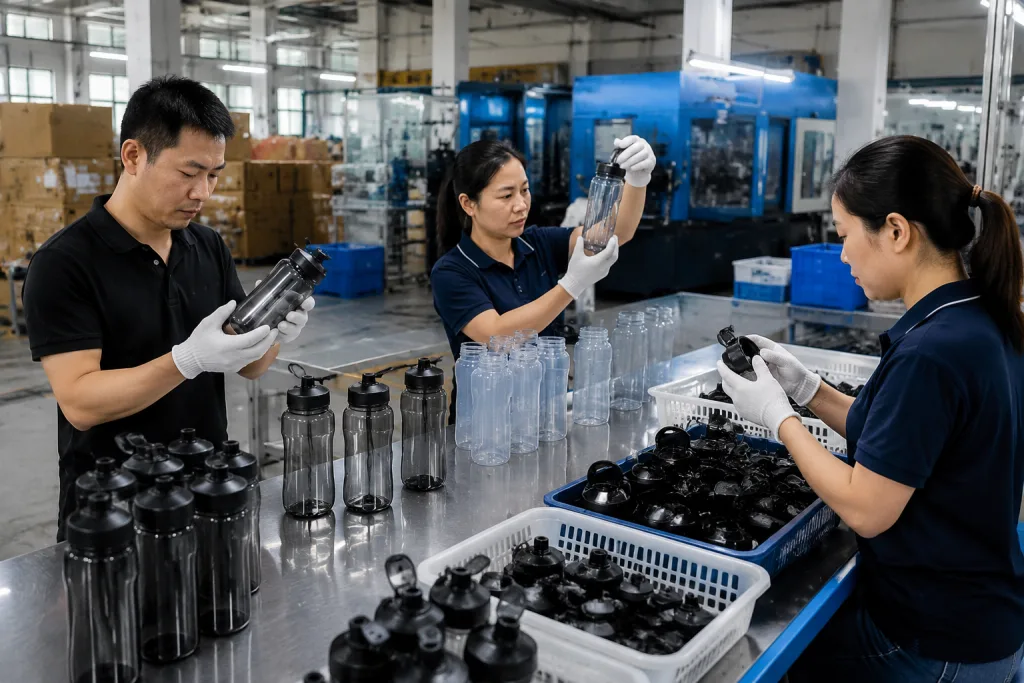
Key Takeaways
- Set AQL at 2.5 major / 4.0 minor and define leak testing at 100% for caps
- For PP shaker bottles, specify 0.8-1.2 mm body wall and food-contact LFGB or FDA compliance
- A realistic custom gym water bottle MOQ starts at 1,000-3,000 pcs per color
- Plan 7-10 days for sampling and 25-35 days for mass production after artwork approval
A gym bottle order usually fails in small, boring ways before your customer sees it. The cap weeps after 300 open-close cycles on our torque tester. The logo scratches off after 20 dishwasher runs. The carton arrives crushed because someone saved USD 0.03 on corrugated board and dropped from 80 cm during pre-shipment check. Small stuff. If you are comparing vendors gym water bottle options for a fitness brand or gym chain, these details decide whether members keep the bottle or complain at the front desk.
From our factory network in Zhejiang, China, we see the same 6 preventable problems across bulk sports water bottle and custom shaker bottle projects. MOQ pressure, loose lid tolerances, weak printing, thin cartons, late artwork, and unclear color standards all show up before production if the buyer asks for the right checks. “Find the cheapest supplier” is the wrong question to ask. The math doesn’t work when QC pulls 32 leaking samples from a 500-piece pilot run. We write the spec first, then lock tooling, sampling, and mass production around the failure points we already know.
The cap is the first failure
On bulk gym water bottle orders, the first complaint is usually the cap, not the bottle body. We have seen a bottle pass the catalog photo test and still leak in a gym bag after 14 days of use. The weak spots are usually shallow thread bite, a gasket that measures 45 Shore A when the drawing says 55 Shore A, or cap shrinkage from an unstable injection run. QC pulled 32 caps from one lot last month and found 0.4 mm variation on the thread start. That is enough to make a fitness club buyer angry when members toss bottles into lockers with towels, sweat, and cleaning spray.
Do not approve a cap because one sample sits nicely on your desk. That is the wrong question to ask. Ask the vendor to write down the sealing system: thread turns, gasket material, gasket hardness, and test method. For flip lids, require hinge cycle testing. We run 1,000 open-close cycles for standard sports caps and 3,000 cycles for premium gym retail bottles, using a small pneumatic jig on the line rather than somebody clicking it by hand for show. For screw caps, request an inverted leak test for 30 minutes at room temperature, then a shake test with 50% fill volume.
If you are sourcing a customizable gym water bottle for a chain rollout, keep the leak standard simple enough for factory QC to run at 10 p.m. without debate: fill to 90%, close cap with normal hand torque, invert for 30 minutes, then shake 20 times. Clear spec wins. For mass production, caps should be 100% leak checked, or checked before final assembly on high-risk designs. AQL spot checking alone does not work here. We have seen this go sideways after one leaking bottle soaked a member’s phone inside a locker, and the buyer flagged the whole 5,000 pcs shipment.
One practical detail: avoid over-designed lids unless the retail price supports them. Straw lids and push buttons add parts, springs, mold seams, and assembly mistakes. On one distributor gym water bottle program, the PO even called the part a “straw lip” instead of “straw lid,” and the buyer still wanted zero returns on a USD 2.30 bottle. The math does not work. A clean screw lid often beats a clever lid that returns at 4%.
Plastic bodies crack for predictable reasons
For PP, PE, Tritan-style copolyester, and PC-free sports bottles, cracking is almost never random. We see the same causes on the line: thin wall sections, mold cooling set too hard, low-grade resin, neck stress, or buyer sketches with a sharp waist that puts force into one small area. A bulk fitness water bottle sold through gyms gets dropped from 1.2 m onto rubber flooring, jammed into 72 mm cup holders, and washed in hot water after training. Your spec must assume abuse. Pretty shape first is the wrong question to ask.
For PP shaker bottles, we recommend a body wall around 0.8-1.2 mm depending on volume and shape. Below 0.7 mm, you save weight but the math doesn't work: QC pulled samples last season with oval bodies, sink marks near the logo panel, and caps that no longer sat flat after a hot-water check. For larger 1,000 ml bottles, ribs or gentle contours add stiffness without pushing the bottle into a heavy, slow-cooling part. If you are ordering a bulk shaker bottle with a mixing ball or grid, check the mouth diameter and internal corners with a simple 150 mm caliper. Protein powder packs into sharp corners. Then the buyer flags “smell” and “dirty bottom” complaints.
Ask for resin documentation before deposit. For Europe, request LFGB or EU 10/2011 food-contact support where applicable. For North America, FDA food-contact grade resin is the common baseline. If your brand sells cleaner materials, ask whether the color masterbatch and lid components are covered, not just the bottle body. We've seen this go sideways: 1 supplier showed a report for natural PP, then ran 8,000 colored pcs with a different masterbatch because the PO only said “blue as sample.”
For a customized fitness water bottle, confirm temperature claims in writing. “Dishwasher safe” means little unless the factory states a temperature, cycle count, and rack position, such as top rack at 65°C for 30 cycles. A conservative claim like hand-wash recommended is safer for low-cost PP, especially when the lid has a silicone seal and a printed graduation scale. For premium copolyester bottles, we run the 70°C for 30 cycles check before printing approval, not after 20,000 pcs are packed and the cartons are already strapped on the pallet.
Decoration fails when artwork beats process
Logo durability is where about 6 in 10 custom gym water bottle projects get caught during sampling. A fine gradient, tiny QR code, or wraparound slogan can look clean in the brand deck, then break down on a curved body with 0.3 mm texture. We run into this on the line when the fixture is set right but the ink still skips near the bottle shoulder. Decoration options include silkscreen printing for simple spot colors, pad printing for small curved panels, heat transfer for full-color artwork, laser marking on stainless parts, and in-mold labeling for high-volume plastic programs. Each one has a hard stop.
For a custom logo shaker bottle, silkscreen is usually the cost-effective choice for 1-2 color logos. Expect around USD 0.05-0.12 per print position depending on size, color count, and order volume. Heat transfer gives better full-color graphics, but the math does not work if the buyer expects promo pricing and retail-grade abrasion at the same time. QC pulled one sample last month where a towel rub took off the edge of a yellow transfer after 80 strokes. Pad printing works for small curved areas, but it is not magic; tiny text under 5 pt often fills in or breaks.
Write the print spec like a manufacturing document, not a design wish. Include Pantone codes, print size in mm, placement tolerance, acceptable color difference, and adhesion test. A basic cross-hatch tape test after 24 hours of curing catches weak ink systems; we use a 3M 600 tape strip and check the grid under a 10x loupe. For distributor shaker bottle orders, add a rub test: 500 cycles dry rub and 100 cycles wet rub is a reasonable starting point for gym merchandise. Short specs go sideways.
Be careful with dark bottles and bright logos. White underbase may be required, turning a 1-color print into 2 passes. Metallic inks and neon colors often need separate approval, and the buyer flagged this once after the PO said “silver” while the artwork file showed Pantone 877 C. If you want a customizable shaker bottle platform where multiple gyms order their own logo, keep the decoration window flat and standardized, for example 60 mm × 45 mm on the front panel. That reduces setup errors and keeps repeat orders consistent.
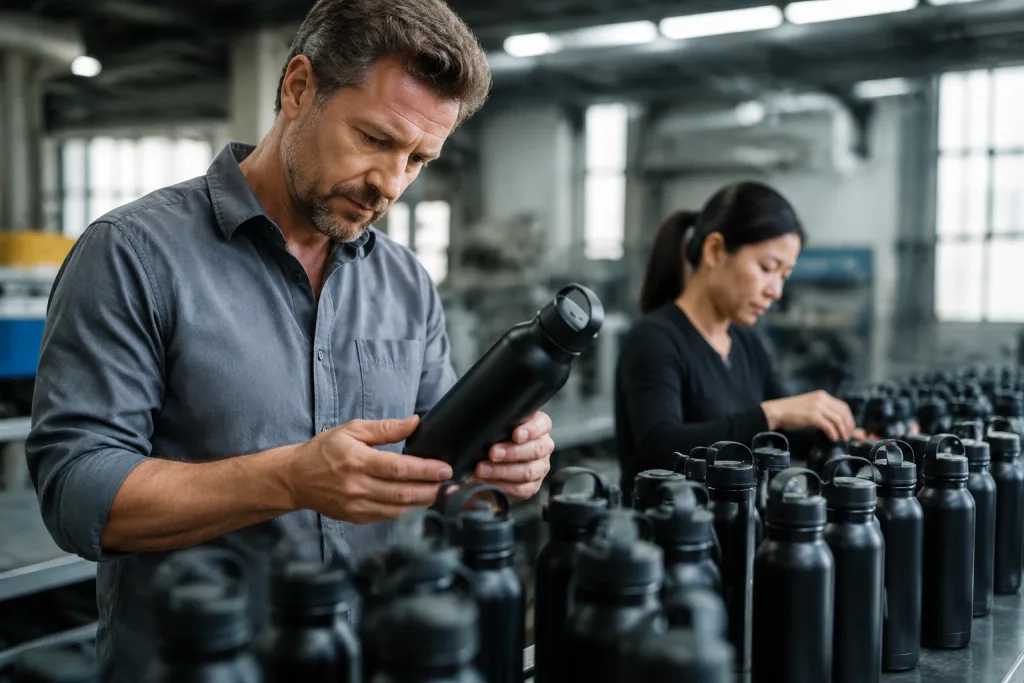
Shaker inserts create hidden problems
A custom made shaker bottle has more parts than buyers expect: body, lid, flip cap, silicone gasket, mixing grid or ball, sometimes a supplement compartment, sometimes a carry loop. Each extra part adds tolerance risk. We see it on the line: a 0.3 mm gap at the lid seat can make the grid rattle, and QC pulled one sample last month where the spring ball wire grade was missing on the PO. The ball can rust if the wire grade is not locked, the compartment can cross-thread, and the lid can feel rough after powder residue builds up.
If you source a customized shaker bottle, write the mixing component clearly on the spec sheet. Stainless mixing balls should be 304 grade, typically 0.6-0.8 mm wire depending on diameter. Plastic mixing grids should sit firm, but not so tight that the user needs pliers to remove them. We run a 30-second shake test with 30 g whey powder in 300 ml water, then open the cap and check the hinge area with a cotton swab. Water-only testing is the wrong question to ask. Real powder shows clumping, trapped residue, and cap pressure fast.
Odor is another common failure. Low-grade PP and recycled-content materials can hold smell after protein use, especially after the bottle sits closed in a gym bag for 12 hours. For a fitness brand, this is a brand problem, not a factory excuse. If your product is a distributor fitness water bottle or gym welcome-kit bottle, virgin food-grade PP is worth the small cost increase in most orders. For export from China, we run random odor checks after bottles are sealed in polybags for 48 hours; QC opens 5 pcs per color because some smells only show after packaging.
For compartment shaker designs, request torque checks on threaded sections. Over-tight threads frustrate users; loose threads leak powder in bags. A practical range is hand-tight closure with no visible gap, then no powder escape after 20 shakes. Simple test. We have seen this go sideways when a buyer approved the drawing but skipped assembled samples, and 2,000 sets later the lower cup shed powder into cartons during the drop test. Basic checks prevent returns.
Color consistency gets underestimated
Color starts more buyer-factory arguments than caps or cartons. Your team signs off a matte black sample, then the bulk goods land looking charcoal, too glossy, or a little blue under 6000K warehouse lamps. We’ve had QC pull 18 bottles from a gym rollout carton and line them up beside the golden sample; 6 looked off enough for the buyer to flag it. For customizable sports water bottle programs across 20 or 200 gym locations, that makes the rollout look sloppy even when the bottle seals fine.
The fix is to lock the color standard before the line runs. Pantone is a starting point, not the final answer. For plastic, approve a physical color chip or signed golden sample, then write that sample number on the PO; one buyer once typed “Mat Black” instead of “Matt Black,” and the supplier read it as a different finish. Resin type matters because the same masterbatch reads differently in PP, PE, and copolyester. Wall thickness changes color depth too. A 0.9 mm translucent bottle and a 1.2 mm bottle will not look identical even using the same formula.
For matte finishes, say exactly what you want: mold texture, spray coating, or soft-touch coating, with the texture code written on the tooling sheet. Mold texture is durable and low-risk; we check it with a gloss meter and a fingernail scratch during first-piece approval. Spray and soft-touch coatings feel more retail, but they scratch, peel, or fail REACH chemical checks if the coating factory cuts corners. For a custom fitness water bottle meant for heavy gym use, I would pick molded texture over soft-touch unless your retail price covers extra cross-cut, alcohol rub, and abrasion tests.
For large chain orders, split-color production needs a real schedule, not a wish list. At BottleForge Industrial in Zhejiang, we typically run up to 450,000 plastic sports bottle units per month across standard programs, but every color change means hopper cleaning, purge waste, and a fresh first-article check. If you need 12 bottle colors at 1,000 pcs each, the math does not work like one clean run at 12,000 pcs. Expect higher unit pricing, 2–3 kg of purge material per color on some lines, and more QC attention before packing.
Cartons fail before bottles do
We see buyers spend 40 emails on the bottle and leave export packaging to the last PO revision. Wrong move. In one 8,000 pcs gym water bottle order, QC passed the bottles, then QC pulled the sample cartons and found crushed corners, scuffed lids, 312 missing FNSKU labels, and two blue cartons mixed into the black SKU. If you sell through gyms, distributors, or online channels, those packing misses turn into receiving delays and chargebacks.
For export cartons, specify 5-ply corrugated board for most bottle programs and write the drop test into the order sheet. We run a practical test: 10 drops from 76 cm for cartons under 10 kg, close to ISTA-style warehouse handling. Carton weight should normally stay below 15 kg for manual warehouse handling; once it hits 17 kg, the line complains and the carton corners start losing shape. If each custom sports water bottle is retail boxed, ask for an inner carton or divider when the printed surface can rub during 28-35 days of ocean freight.
If you are preparing Amazon-style or 3PL shipments, lock the packaging before mass production. FNSKU labels, suffocation warnings, carton labels, master carton dimensions, barcode placement, and pallet requirements change packing speed and cost; our packing table can lose 1,200 pcs per shift when label placement is unclear. A vendor that quotes FOB Ningbo or FOB Shanghai without asking your shipping channel is guessing. We’ve seen this go sideways.
For distributor sports water bottle orders, request a packing list format by SKU, color, and carton number. Mixed-carton packing can save freight on small orders, but it also creates picking mistakes; last May, the buyer flagged carton 46 because the PO said “matte navy” and the carton mark said “matt naby.” For gym chains receiving at multiple locations, pre-sorted cartons by club can be worth USD 0.08-0.20 per unit because it saves 4-6 hours of local sorting.
Sampling is not a ceremony
Sampling should kill doubt, not give you a desk souvenir. Before you pay a bulk deposit, lock the bottle weight in grams, the material grade, the lid thread structure, the logo method, the carton packing, the test standard, and which defects you will reject. On a recent 750 ml gym bottle, QC pulled the sample and found the lid gasket was 0.6 mm thinner than the drawing. That leaks. For most custom sports water bottle and customized gym water bottle projects, we run a proper pre-production sample in 7-10 days after artwork and color confirmation. If tooling is required, add 15-25 days depending on mold complexity.
A clean sourcing sequence is simple: confirm target volume with the retail price, choose material with capacity, approve the structure sample with caliper checks, approve color and decoration under a light box, sign the golden sample, then release mass production. No shortcuts here. Standard MOQ in Zhejiang, China is often 1,000-3,000 pcs per color for existing molds and 5,000 pcs or more for fully custom shapes. Unit prices can range from about USD 0.85-1.80 FOB for PP shaker bottles and USD 2.20-4.80 FOB for higher-grade copolyester or stainless hybrid sports bottles, depending on cap, print, and packaging. We had one buyer push for 500 pcs in 4 Pantone colors; the math does not work once the line changeover and pad-printing plates are counted.
Do not let the vendor replace the approved sample without written notice. Put this sentence in your purchase order: mass production must match signed golden sample in material, color, structure, logo position, packaging, and function. Then define inspection clearly: AQL 2.5 major / 4.0 minor is common for drinkware, with critical defects such as leaking, sharp edges, wrong material, odor contamination, and missing logo set at 0 acceptance. We have seen this go sideways when a PO says “same as sample” but the approved lid photo is missing; the buyer flagged it only after 38 cartons were opened at destination.
Good vendors gym water bottle sourcing is not about dumping every risk onto the factory. That is the wrong question to ask. The job is to make risk visible while there is still time to weigh a sample, run a leak test, check carton drop results, and fix the line before the container leaves China.
Send us your gym bottle spec before quoting
Share capacity, material, logo, MOQ, market, and packing needs. We will flag risky details before you commit to tooling or production.
Frequently asked questions
What MOQ should we expect for a custom gym water bottle order?
For existing molds, a realistic MOQ is usually 1,000-3,000 pcs per color. A simple custom logo shaker bottle can start at 1,000 pcs if you use stock bottle colors and 1-2 color printing. Custom colors, custom caps, or retail packaging often move the MOQ to 3,000-5,000 pcs. A fully custom made shaker bottle with new tooling may require 10,000 pcs or more to make the mold cost sensible. If you need 500 pcs for a gym event, use a stock bottle and accept higher unit pricing.
How long does production take for bulk gym water bottle orders?
For standard molds, plan 7-10 days for sampling after artwork confirmation and 25-35 days for mass production after sample approval and deposit. Add 5-7 days if you need complex packaging, FNSKU labeling, or multiple gym-location carton splits. New mold projects usually add 15-25 days for tooling and first trial samples. Shipping from China to North America or Europe then adds roughly 25-40 days by sea, depending on port and season. Air freight is faster but often ruins the economics for low-cost bottles.
Which material is best for a bulk fitness water bottle?
It depends on use and price. PP is common for a bulk shaker bottle because it is light, affordable, and handles protein powder well; FOB pricing often starts around USD 0.85-1.80. Copolyester is clearer and more premium, but usually costs more and needs careful scratch testing. Stainless steel is better for insulated sports bottles but heavier and higher priced. For gym chains, PP or copolyester usually gives the best balance. For any material, require food-contact documentation such as FDA, LFGB, or EU 10/2011 support.
Can one vendor handle different bottles for retail, staff, and member giveaways?
Yes, but separate the specs. A retail custom sports water bottle may need thicker walls, better packaging, and stronger logo testing. A staff bottle may prioritize durability and easy cleaning. A member giveaway bottle may target a lower FOB price and simpler decoration. One vendor can manage all three if they have stable molds, documented QC, and packing control. Ask for separate quotations by SKU with material, weight, decoration method, carton size, and lead time. Do not compare only the headline unit price.
What should be included in a QC inspection for customized sports water bottle orders?
At minimum, inspect appearance, color, logo placement, print adhesion, capacity, weight, cap fit, gasket placement, odor, sharp edges, carton labeling, and packing quantity. Leak testing should be stricter than normal AQL sampling; for high-risk cap designs, ask for 100% leak checks during production. Use AQL 2.5 major / 4.0 minor for general defects, with critical defects at 0 acceptance. For shaker bottles, add mixing grid fit, ball material check, thread torque, and powder shake testing using 30 g powder in 300 ml water.