Key Takeaways
- Specify 304 stainless steel, 0.5-0.6 mm inner wall, and 0.6-0.7 mm outer wall for most 64 oz growlers
- Use AQL 2.5 for major defects and AQL 4.0 for minor defects on export inspections
- Plan 30-45 days production after sample approval for custom growler orders from China
- Do not approve cartons until they pass a 76 cm drop test on filled retail packaging
A growler looks simple until 3,000 pieces land with loose lids, orange-peel powder coat, and carton corners crushed 12 mm in from the edge. QC pulled the sample with a torque meter, and the cap slipped before 0.8 N·m. Then the argument starts: design problem, canteen factory problem, or inspection points missing from the PO?
If you are buying a vendors growler bottle program for retail, promo, brewery merchandise, or distributor drinkware, write the RFQ around failure modes. This is the right fight to have early. We run into the same 5 problems on China custom drinkware orders: wrong steel grade, weak vacuum retention, poor caps, unstable decoration, and packaging that saves USD 0.18 but creates USD 2.00 of damage. Last month a buyer flagged a 1-letter typo on the color code after the line had already mixed 42 kg of powder.
Steel Choice Fails First
The first steel failure is usually small. QC pulled 12 mouth-area samples last month and found 3 with pin-point rust after a 5% salt spray spot check; the buyer flagged it before carton sealing. It also shows up as a metallic smell after a vinegar test, or a buyer asking why the customized growler feels thinner than the approved sample. For B2B custom drinkware, write the steel grade and wall thickness into the purchase order. Do not leave it in a WeChat sampling note.
For food-contact growlers, we run 304 stainless steel on the inner wall as the safe default. Some cost-driven projects use 201 stainless on the outer shell, but 201 inside the liquid contact area is asking for trouble; the math doesn't work if one complaint wipes out the margin on 2,000 pcs. If your vendors growler bottle will be sold in Europe, ask for LFGB or EU food-contact documentation where applicable. For North America, ask for FDA food-contact compliance support and material declarations. REACH still matters when coatings, straps, silicone parts, or printed inks are involved, and our lab usually asks for the ink code before they quote testing.
A practical 64 oz stainless growler spec is 0.5-0.6 mm inner wall and 0.6-0.7 mm outer wall. Go lighter and the sample can look fine under a desk lamp, then dent in brewery, camping, or distributor canteen channels after one drop from 80 cm. We have seen this go sideways. If you are ordering a custom canteen or customizable canteen in smaller 18-32 oz sizes, thickness can be adjusted, but do not let the canteen supplier make that decision alone. Put the mm range on the PO and ask the line to check it with a digital thickness gauge before mass forming.
Ask your canteen manufacturer to record material grade on the bill of materials and confirm it again in the pre-production sample. In Zhejiang, China, our incoming material inspection checks coil certificates, thickness, and surface condition before forming; one 2024 PO even had “304 outer / 201 inner” typed backward, and QC caught it before cutting. Boring work. It prevents arguments later.
Vacuum Performance Gets Overpromised
Vacuum insulation is where supplier talk gets sloppy. Buyers hear “keeps cold 24 hours” or “hot 12 hours,” then the lab sheet shows no fill temperature, no room temperature, and no start time. That claim is noise. We have seen a double-wall growler pass visual check under a 600 lux inspection lamp, then drop temperature too fast because the vacuum pull was weak, the TIG welding heat zone ran wide by 2-3 mm, or the base seal got nicked on the polishing wheel.
For a 64 oz custom growler, we run a cold-retention check with 4°C water, capped tight, stored at 20-25°C ambient temperature, then measured after 12 or 24 hours with a probe thermometer through the same test cap. Hot testing uses 95°C water, with readings at 6 and 12 hours. Set the pass line before mass production. For example, hot water must stay above 55°C after 12 hours under the stated ambient condition. If the PO only says “good insulation,” the math does not work; each canteen vendor will grade the same growler a different way.
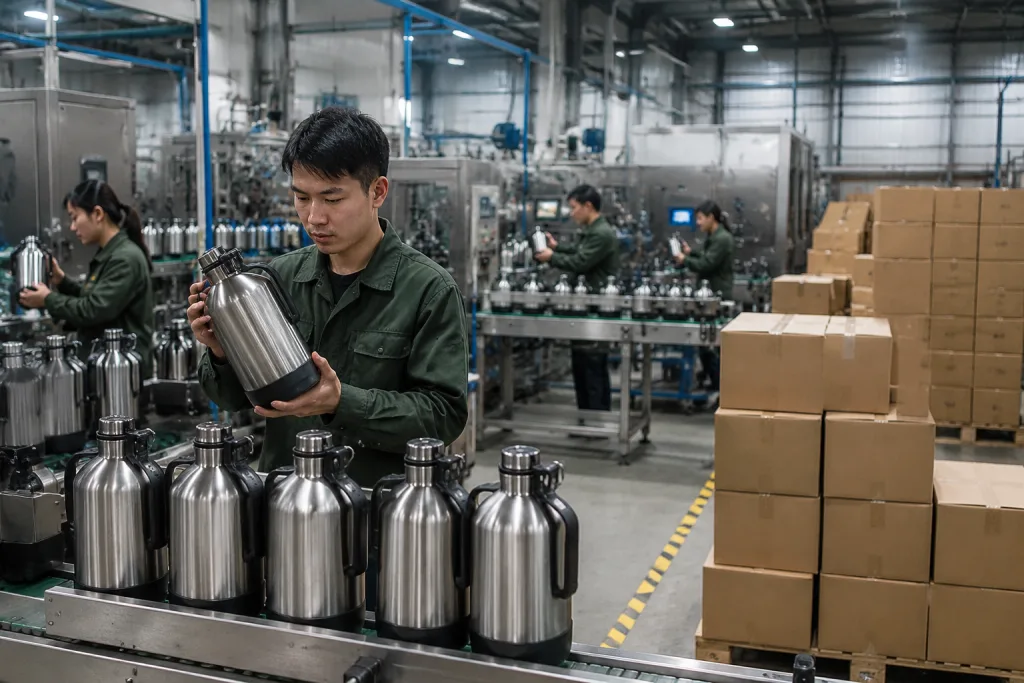
Vacuum failure is hard to see, so inline testing matters. A canteen factory should run vacuum detection equipment on the line, then pull random retention samples by batch after packing color and logo are confirmed. At BottleForge Industrial in Hangzhou, Zhejiang, our drinkware lines can output about 450,000 stainless units/month across bottles, tumblers, and growlers, but speed means nothing if the vacuum reject rate gets buried. For export orders, we prefer reporting actual sampling results, such as 32 pcs checked from a 3,000 pcs batch, instead of writing “QC passed” on a one-line inspection note.
If you are comparing canteen manufacturers, ask for their historical vacuum defect rate on similar capacity products. Ask the awkward question. A serious canteen supplier can give a number, explain the test gear, and show what QC pulled from the last batch. A weak one changes the subject to price or tells you “no problem” before checking the line records.
Lids Leak From Bad Tolerances
Most growler complaints start at the lid. The body gets blamed first, but we usually find the problem in thread tolerance, gasket hardness, cap shrinkage, or closing torque. The logo can be perfect. It still fails the order if 12 cartons out of 600 come back with beer, coffee, or water stains around the retail box seam.
Write the lid spec in numbers, not adjectives. If the lid uses a threaded stainless or PP cap, confirm thread pitch in mm, gasket outside diameter, gasket thickness, silicone hardness, and spare gasket packing. We run 50-60 Shore A food-grade silicone on many drinkware caps, but cap design decides the final call. Too soft, and QC can see the gasket roll under a torque driver; too hard, and the seal opens after 200 open-close cycles.
Leak testing should be simple and strict. Fill the growler to rated capacity, close the lid at normal hand torque, invert it for 10 minutes, then shake it horizontally for 30 seconds. For travel and outdoor distributor growler programs, add a pressure or hot-water cycle test if the use case calls for it. “Checked by eye” is the wrong answer. We have seen this go sideways when QC pulled the sample dry, then found droplets under the cap after the carton drop test.
This also applies to canteen customized and canteen promotional projects. If you are a canteen distributor selling through 3 sales channels, one leaking cap can become 40 returns because the end users repeat the same filling and carrying habits. Ask your canteen suppliers to keep lid and gasket retain samples from each production lot. If a buyer flags leakage 45 days after shipment, you need the batch code, gasket lot, and retained sample on the table, not guesses.

Coating Looks Good Until Handling
Powder coat, spray paint, and plated finishes often pass the first photo review. The trouble shows up after carton packing, 3 warehouse moves, or 7 days in a sales rep’s car at 38°C. QC pulled one matte sample last May: the handle rub area failed after 20 strokes with a white cotton cloth and a 500 g weight. Scratches, orange peel, color drift, and weak adhesion usually mean the pretreatment line was rushed.
For customized drinkware, lock the finish standard before sample approval. A matte black powder coat should not turn into 3 blacks across 2 production lots. Ask for a Pantone reference or physical color chip, and keep a signed golden sample in the QC room, not just a WeChat photo. For adhesion, a cross-hatch tape test with 3M 600 tape is our basic check. For outdoor custom canteen orders, run a boiling water or dishwasher simulation only when the sales copy claims that use. Do not print “dishwasher safe” on the box unless the coating and decoration passed that test; we’ve seen this go sideways with Amazon buyers.
Logo application has its own traps. Laser engraving is durable and clean on 304 stainless surfaces, but it will not give full-color artwork. Silk screen printing keeps the unit price down for 1-color logos, yet the ink still needs adhesion testing after 24 hours of curing. Heat transfer gives broader color range, but curved growler bodies can push the artwork 2 mm off center if the jig is loose. A canteen customizable program with wraparound artwork needs a print tolerance, such as ±1.5 mm vertical alignment and a defined seam position; the buyer flagged this once when the PO said “logo centered” but the artwork file showed a left seam.
For a custom drinkware buyer, the cheapest decoration quote is often just a missing test. Wrong question. Ask what the price includes. We run abrasion testing, tape testing, and packing rub checks before bulk shipment, then record the result on the inspection sheet beside the AQL 2.5 note. If the canteen vendor says those checks are unnecessary, assume they are selling decoration as a visual add-on, not an export-grade process.
Capacity And Shape Drift Quietly
Capacity problems get ugly fast because the buyer can check them with a kitchen scale in 2 minutes. If you sell a 64 oz growler that only reaches 60 oz at the practical fill line, the buyer will flag it before the first reorder. We have seen this go sideways on a pilot lot where QC pulled the sample, filled it on a 0.1 g bench scale, and found the lid intrusion had eaten 118 ml more than the drawing allowed. The usual causes are simple: old tooling data, cap depth ignored, or capacity measured to the brim instead of the line people actually fill to.
Define rated capacity and usable capacity as two separate numbers on the spec sheet. Brim capacity means liquid filled to the top edge. Usable capacity leaves room for the cap, foam, carbonation, or safe handling. For brewery merchandise, this is not paperwork. A custom growler used for draft beer should not need overfilling to match the label claim. We run the fill check with water at room temperature, then record the weight in grams and convert it, because “looks full” is the wrong test. If you are selling canteen custom or customized canteen products into outdoor retail, the stated ounce size needs to match trail use, not a lab-only brim number.
Shape drift shows up when tooling is worn or polishing takes too much metal off the shoulder and base. It affects packaging fit and sleeve labels first, then the buyer starts questioning overall quality. Your drawing should show total height, body diameter, mouth diameter, base diameter, and tolerance, with inspection points marked in mm. A normal tolerance might be ±1.0 mm on key dimensions for stainless drinkware, but confirm it with your canteen manufacturer before mold work starts. On our line, a digital caliper caught a 1.6 mm shoulder drift after the polishing wheel was changed, and that saved 3,000 sleeves from being scrapped.
For distributor canteen and distributor growler orders, carton and shelf fit are part of the product, not a shipping afterthought. If your retail display is designed around a 120 mm diameter body and production lands at 123 mm, the math doesn't work: 24 pieces per carton can drop to 18, and freight cost moves with it. We ship enough mixed-SKU cartons to know this mistake hurts margins. Measure 12 pilot run pieces before authorizing full mass production, and make QC write the actual diameter on the inspection sheet, not just “pass.”
Inspection Plans Miss Real Risks
About 8 out of 10 buyers ask for “QC before shipment” and think the problem is solved. It is not. This is the wrong question to ask. Inspection only works when the checklist matches how a growler bottle actually fails on the line. A plain visual check will catch dents, oil fingerprints, and crushed K=K export cartons, but it can miss weak vacuum, a lid gasket sitting 1 mm off, color drift against the approved Pantone chip, and barcodes that scan on a phone but fail on a Zebra scanner.
For export custom drinkware, we suggest using AQL 2.5 for major defects and AQL 4.0 for minor defects unless your brand has a stricter standard. Critical defects should be zero acceptance. Sharp metal burrs on the mouth rim, unsafe contamination, serious leakage, or wrong food-contact material go straight into critical. Major defects include poor insulation, obvious coating damage, wrong logo position, missing accessory, or non-scannable barcode. Minor defects cover small cosmetic marks inside the agreed viewing distance, usually 30 cm under normal QC table lighting. QC pulled a sample last month where the logo was only 3 mm high on one side, but the buyer’s artwork allowed 1 mm, so the math did not work.
Your inspection checklist should include capacity check with a graduated cylinder, lid leak test, vacuum spot test, coating adhesion spot test, logo position, carton drop condition, FNSKU or UPC scan, carton marks, and quantity count. If the order is for Amazon FBA or a North American distributor drinkware program, barcode readability and carton labeling are not optional. We have seen this go sideways: 42 cartons arrived with a PO typo in the FNSKU label, and the buyer flagged it before the warehouse would receive stock. A good canteen distributor loses money when cartons are relabeled after arrival.
China factories can work to tight standards, but they need the standard before production. Our MOQ for most stainless custom growler projects is 1,000 pieces per color, with 7-10 days for sampling and 30-45 days for production after approval. Send the checklist before we run the first 50 pieces, not after the pallets are wrapped. If you push inspection requirements after packing, you are paying to find problems late, and rework that takes 12 days before packing can turn into 18 days after cartons are sealed.
Packaging Saves Pennies, Then Breaks
Packaging is where buyers try to claw back 3% to 6% margin. I get it. But growlers are heavy, rigid, and easy to dent at the shoulder and base; QC pulled a 64 oz sample last month with a 2 mm flat spot after one short carton drop. A thin white box and soft master carton can look fine in factory photos, then collapse during LCL trucking, port stacking, or courier delivery.
For a 64 oz stainless vendors growler bottle, we run an individual kraft or color box with EPE protection around the cap and base, then a 5-ply export carton. The master carton needs to match real shipping weight, not the cheapest carton quote; the math doesn't work if you save USD 0.18 and eat 9 damage claims. If the product is retail packed, run a 76 cm drop test on corners, edges, and faces. If it is e-commerce packed, use ISTA-style testing, or at least run our internal drop plus 30-minute vibration check on the packed carton.
Carton markings should show item number, color, quantity, gross weight, net weight, carton size, country of origin, and required customer routing marks. For FBA, labels need clean placement and scannability; we use a Honeywell scanner before sealing because one buyer flagged 41 cartons with wrinkled barcodes. For a canteen promotional shipment, mixed-color cartons need tight control because promo deadlines leave no time for sorting 800 pieces at the destination warehouse.
Good packaging is not fancy. It is specified, tested, and repeatable. Whether you buy from a canteen vendor, canteen suppliers, or larger canteen manufacturers in China, ask for packed-carton photos before final inspection, including top, side, open-box, and carton-mark shots with a tape measure in frame. The last 2% of cost is often where the first 20% of damage claims begin.
Send your growler spec before you request quotes
We will review capacity, lid, coating, logo, packaging, MOQ, and lead time before your China production starts.
Frequently asked questions
What MOQ should I expect for a custom growler order?
For stainless steel custom growler projects, a realistic MOQ is usually 1,000 pieces per color when using existing tooling. If you need a new body shape, new lid mold, or custom handle structure, expect higher commitments because tooling and setup costs must be spread across the order. For simple laser engraving on a stock growler, some China factories may quote 500 pieces, but the unit price will be higher. At BottleForge Industrial in Zhejiang, sampling normally takes 7-10 days after artwork and specs are confirmed. Mass production is usually 30-45 days after sample approval, depending on coating, packaging, and inspection requirements.
How much does a vendors growler bottle cost FOB China?
For a 64 oz double-wall stainless vendors growler bottle using 304 inner steel, FOB China pricing often sits around USD 6.80-10.50 per piece for 1,000-3,000 pieces, depending on lid design, coating, logo process, and packaging. Laser engraving may add about USD 0.20-0.60 per unit. Full retail color boxes can add USD 0.35-0.90 per unit. A very low quote may use thinner steel, cheaper lid parts, weak cartons, or limited QC. Ask each canteen supplier to separate product, decoration, packaging, and testing costs so you can compare the real build, not just the headline price.
Which logo method is best for customized growler orders?
Laser engraving is the safest choice for durability, especially on powder-coated stainless growlers where the logo reveals the metal underneath. It works well for brewery, outdoor, and corporate custom drinkware programs. Silk screen printing is cheaper for one-color logos on smooth surfaces, but you need ink adhesion testing and a clear viewing standard. Heat transfer or UV printing can handle more colors, but curved bodies create alignment risks. For most customized growler orders above 1,000 pieces, approve a physical pre-production sample and define logo position tolerance, usually around ±1.5 mm to ±2.0 mm depending on artwork size.
What certifications should a canteen manufacturer provide?
Start with food-contact material documentation for stainless steel, silicone, plastic cap components, coatings, and inks. For Europe, ask about LFGB, EU food-contact compliance, and REACH where coatings or accessories apply. For North America, ask for FDA food-contact support and relevant material declarations. Factory audits such as BSCI or ISO 9001 can help, but they do not replace product testing. A canteen manufacturer should also provide inspection reports, material certificates, and packaging test records for your order. If you are selling to children or using painted coatings, ask early about ASTM or CPSIA-related requirements because testing timelines can add 7-14 days.
Can one supplier handle growlers, canteens, and tumblers?
Yes, but check whether the supplier actually manufactures the core products or trades between factories. A capable canteen factory or drinkware manufacturer can usually manage stainless growlers, sports bottles, travel tumblers, and custom canteen programs under one QC system. That helps if you are a distributor canteen buyer building a full seasonal range. The benefit is consistent color control, packaging standards, and inspection reporting. The risk is assuming every product uses the same process. A vacuum growler, single-wall canteen, and plastic-lid tumbler need different tests. Ask for category-specific QC checklists before placing a combined order.