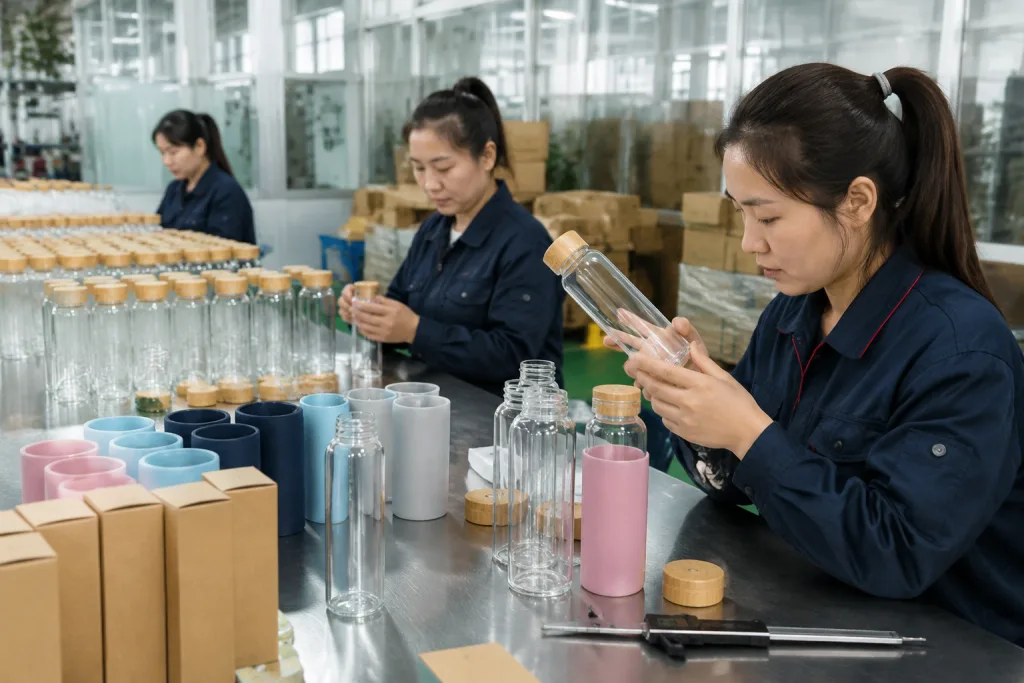
Key Takeaways
- Start RFQs with glass type, capacity tolerance, lid material, sleeve thickness, carton drop standard, and target MOQ of 1,000-3,000 units
- Borosilicate glass usually costs USD 0.45-1.20 more per unit than soda-lime glass but handles thermal shock better
- Approve a sealed golden sample before bulk production and keep AQL inspection at 2.5 major / 4.0 minor
- Plan 25-35 days for production after deposit and artwork approval, plus 7-35 days for freight depending on route
Glass looks simple until you buy 5,000 or 20,000 pcs. A wellness brand asks for a clean custom glass water bottle with a bamboo lid, silicone sleeve, and plastic-free gift box; then our quote sheet comes back with 2 glass options, 8 sleeve colors, 3 logo methods, carton drop-test notes, and a 1.5% breakage allowance. QC pulled one sample last month where the sleeve was 1.2 mm loose at the shoulder, and the buyer only saw “same bottle, lower price” from another supplier. That is the wrong question to ask. If you compare vendors glass water bottle pricing only by unit cost, the math goes sideways in packing, rework, and claims.
We manufacture drinkware in Hangzhou, Zhejiang, and we ship from China to Europe and North America every month. For borosilicate glass bottle bulk orders, the real work starts before the PO is signed: mouth diameter in mm, lid gasket material, sleeve Pantone, inner box paper weight, master carton size, and spare parts ratio all need to be locked. We run RFQ, pre-production sample, pilot carton, then bulk production, because a “bamboo lid” line on a PO is not enough for the line or your warehouse. One buyer once typed 500 ml on the PO but approved a 550 ml sample; our carton scale caught the mismatch before mass packing.
Start with the RFQ, not price
The first mistake is asking a borosilicate glass bottle supplier, “What is your best price for 500 ml?” Wrong question. We get 12 to 18 RFQs like this most weeks, and the quotes come back messy because each factory guesses the missing specs. One borosilicate glass bottle manufacturer may price 1.5 mm wall glass with a PP lid and no sleeve. Another may price 2.0 mm glass, stainless-steel cap shell, silicone seal, printed sleeve, and individual kraft box. Both prices are technically true. Only one fits your retail shelf. Last month QC pulled two 500 ml samples from the same buyer brief; one weighed 238 g, the other 312 g, so the freight and breakage math changed before we even touched logo cost.
Your RFQ should read like a future PO. Put the commercial and technical requirements in one sheet so every borosilicate glass bottle vendor quotes the same scope, not their own shortcut. For wellness brands and sustainable retailers, we run these RFQ line items through a simple Excel sheet before sampling:
- Item: custom glass water bottle, 350 ml / 500 ml / 750 ml / 1,000 ml, with target finished weight if your shelf set has limits
- Glass: high borosilicate, clear, food-contact grade, approximate wall 1.8-2.2 mm, measured at the body with a digital caliper
- Lid: bamboo outer cap with 304 stainless insert or PP inner thread, specify flat top or rounded edge
- Seal: LFGB-grade silicone ring, spare ring if required, plus pull-test check after assembly
- Sleeve: silicone 1.5-2.0 mm, color matched to Pantone if MOQ allows, with shrinkage checked after boiling-water test
- Logo: screen print, laser on lid, decal, or sleeve debossing, with artwork size in mm and print position marked
- Packing: individual box, 24 pcs master carton, export carton 5-ply, with carton drop test noted if you ship e-commerce
- Compliance: LFGB, FDA food contact, REACH for silicone and coatings, with test report name matching the selling company
- Trade term: FOB Ningbo or Shanghai, or DDP only if you need landed costing, because duty assumptions can move the unit cost fast
At BottleForge Industrial in Zhejiang, our practical MOQ for a borosilicate glass bottle customizable project is 1,000 units for stock mold with logo, and 3,000-5,000 units when custom sleeve color, lid structure, or retail packaging is involved. Below that, the math often doesn't work. We have seen this go sideways when a buyer approved a price based on “plain box” but the PO later said “retail gift box with barcode sticker”; the line had to stop for 2 days while purchasing rechecked paper stock and carton dimensions. If a quote ignores MOQ, tooling, sample cost, and packaging, it is not comparable yet.
Turn design ideas into PO lines
A buyer’s mood board helps the first call, but the PO needs terms QC can measure with a digital caliper and a 500 ml fill test. “Eco bottle with premium look” cannot be inspected. “500 ml high borosilicate glass, 65 mm body diameter, 225 mm height, matte sage silicone sleeve, bamboo cap with 304 insert, one-color logo at 45 x 22 mm” gives the line something to build and QC something to reject.
From RFQ to draft PO, split the bottle into bill-of-material lines. This is where we see 6 out of 20 borosilicate glass bottle distributors lose margin: they sign off on a clean render, then the buyer flags the seal material, lid insert, carton strength, or FNSKU label position after pre-shipment photos. We had one PO last month with “sillicone” typed in the lid line and no gasket hardness listed, so QC pulled the sample and measured it at 50 Shore A before we let packing start. If you sell through retail chains or online fulfillment, packaging is not decoration. It is part of the product.
Useful PO line items
- Bottle body: 500 ml ±3%, borosilicate glass, clear, no visible bubbles over 1.0 mm in logo area
- Sleeve: removable food-grade silicone, 1.8 mm nominal thickness, Pantone sage reference approved by sample, sleeve seam trimmed flush within 0.5 mm
- Lid: bamboo outer, stainless inner, silicone gasket, leak test 30 minutes inverted, gasket hardness confirmed before mass production
- Decoration: screen print logo, white ink, 50 x 25 mm, alcohol rub test 50 cycles, position checked with logo jig
- Packaging: white kraft retail box, E-flute insert, barcode sticker on bottom right panel, FNSKU kept 8 mm from box edge
- Carton: 24 pcs per export carton, gross weight below 15 kg if possible, carton drop test passed before booking
For a borosilicate glass bottle custom program, decide early between stock mold and private mold. This is the wrong question to leave until sampling week. Stock mold keeps lead time around 25-35 days after deposit, and we can usually run sleeve color matching while the glass line is scheduled. Private mold gives stronger brand ownership but adds roughly USD 800-2,500 tooling cost and 20-30 days before sampling; the math does not work if your first trial order is only 1,000 pcs and the buyer still has no sell-through data. If you are testing a new wellness line, start with a stock custom borosilicate glass bottle and upgrade after the repeat PO proves demand.
Sample like you plan to inspect
Do not treat sampling as a design preview. It is the first QC gate. For borosilicate glass bottles, we run blank stock samples in 3-5 days and decorated samples in 7-12 days after artwork confirmation. A custom silicone sleeve or new lid tooling pushes the sample room to 15-25 days, especially if the mold shop needs a 2D gasket drawing before CNC work starts. Rush samples can be done, but the math gets ugly: the bottle arrives fast, then the buyer flags the missing EAN barcode, wrong insert size, or a 5 mm carton layout shift later.
Ask for three sample types, and make each one earn its place. The structure sample is for capacity, grip, lid fit, thread feel, and drinking comfort; QC should fill it to the marked line and check the mouth diameter with a caliper. The decoration sample must use the real logo process, not a sticker pretending to be silk screen, laser mark, or heat transfer. The packing sample needs the retail box, insert, barcode, warning label, and master carton layout, with the carton flute and paper weight written on the sample tag. Do not approve bulk from a hand-carried bottle wrapped in foam. We have seen this go sideways.
For glass, the golden sample is not just the bottle. It includes sleeve hardness, gasket fit, logo location, box paper weight, and carton orientation.
After samples arrive, run checks that match real complaints. Fill with room-temperature water, invert for 30 minutes, shake 20 times, and leave upright overnight. Simple test. Smell the cap gasket, because one batch of silicone lids once failed at the buyer’s desk before any lab saw it. Measure capacity on a scale, not by eye. Inspect sleeve flash lines and color under daylight, then compare against the Pantone chip under a D65 lamp if color matters. Put the packed bottle on a 76 cm table and run a basic carton handling test if packaging is already approved. This does not replace lab testing, but it catches leakage, odor, sleeve burrs, and box crush marks before AQL 2.5 inspection day.
If you need borosilicate glass bottle promotional stock for a campaign, confirm whether the supplier is pulling existing inventory or starting new production. Existing blank stock ships faster, often 12 days vs 18 days for a fresh decorated run, but sleeve and box color consistency can drift when components came from different batches in China. Ask for the batch card. One buyer pushed back after 3,000 pcs because half the sleeves came from an older lot and looked dull beside the new retail boxes.
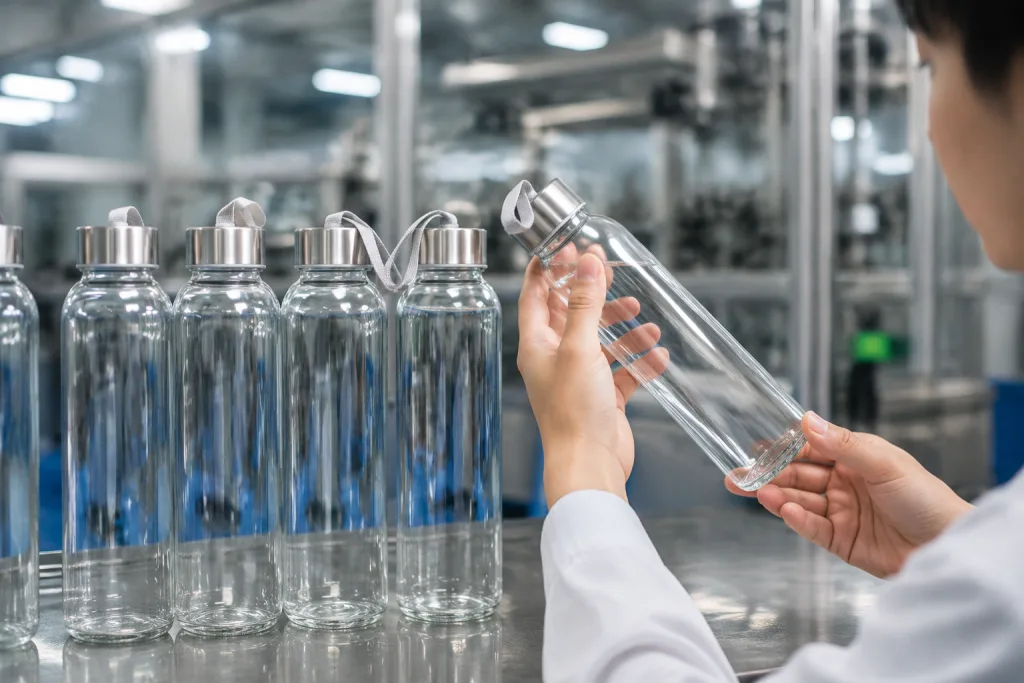
Price the whole landed project
Unit price is one line on the costing sheet. For bulk glass water bottle orders, landed cost comes from breakage allowance, carton cube, HS duty code, pallet loading, inspection cost, and replacement terms. We run this on a packing table with a tape measure and a 5-layer carton sample, not just from the quotation file. A 500 ml customized glass water bottle may quote at USD 2.20 FOB, but the delivered cost can move by USD 0.40-0.90 per unit once packaging and freight are added.
Typical FOB China ranges stay steady when the spec sheet is locked. A 500 ml stock high borosilicate bottle with bamboo lid and plain sleeve may sit around USD 1.85-2.80 at 3,000 units. Add custom sleeve color, retail box, and two-position branding, and the range often becomes USD 2.45-3.60 because the line needs extra print setup plus carton sorting. A heavier 750 ml bottle with premium box can exceed USD 4.00. Lowball quotes usually cut something we later find in QC: glass wall down by 0.3 mm, loose silicone gasket, weak K=K carton, or no final inspection. The math doesn't work if the buyer wants retail-ready packaging but prices it like a naked bottle in a master carton.
Your PO should show commercial lines separately. We have seen this go sideways when one buyer wrote “packing included” on the PO, then flagged the retail insert charge after the pre-production sample was signed. Keep each cost line clean:
- Product unit price: FOB Ningbo, USD per piece
- Sample fee: refundable or not, with courier cost separated
- Tooling: sleeve mold, lid mold, bottle mold if private
- Packaging: included or itemized for retail box and insert
- Spare parts: extra gaskets, lids, or sleeves at 1-2% if needed
- Inspection: buyer-arranged third party or factory internal QC
If you are a borosilicate glass bottle distributor or distributor glass water bottle buyer serving 3-5 retailers, ask for carton dimensions and CBM before you approve price. Glass is not light. Last month QC pulled a 500 ml sample packed 48 pcs per carton, and the carton measured 62 x 42 x 38 cm; it looked cheap per piece but wasted pallet height. Saving USD 0.08 on the bottle while adding 18% carton volume is the wrong question to ask.
Lock compliance before deposit
Lock compliance before you pay the deposit. It is cheaper to change a lid spec on day 2 than to argue with the line after 12,000 bottles are packed in 5-layer cartons. For Europe, ask for LFGB food-contact testing on each touching part: glass body, silicone gasket, plastic insert, coating, ink. REACH is needed for silicone sleeves, sprayed colors, pigments, and soft-touch finishes. For the United States and Canada, FDA food-contact expectations apply; some chain retailers also ask us to check packaging labels against ASTM-style handling and warning language. Children’s bottles are a separate job. CPSIA, small parts, and age grading can change the whole quotation, especially if QC can pass a loose charm through the small-parts cylinder.
Do not accept a certificate that only says “glass cup passed” when your order has a bamboo lid, silicone gasket, painted sleeve, and printed retail box. The tested material must match the BOM on your PO. We have seen this go sideways: the buyer flagged a black sleeve at inspection, but the report covered only clear silicone from a 2022 order. A serious borosilicate glass bottle manufacturer will tell you which parts are already covered and which need fresh testing. New lab tests usually take 5-10 working days and cost USD 120-450 per material group, depending on migration items, heavy metals, and color count.
At our Hangzhou, Zhejiang operation, we file supplier declarations and production records by batch, then match them to the carton mark and final packing list. Export buyers in China now ask for traceability, not just a PDF certificate sent after the container sails. For sustainable retailers, be careful with claims. “Reusable” and “plastic-reduced packaging” are safer than loose “zero waste” wording. Bamboo lids still have seals, adhesives, and inner structures. If your packaging says dishwasher safe, the cap and decoration must support that claim; in our last 30 bamboo-lid projects, 19 lids were hand-wash only even though the glass body passed dishwasher testing.
Put compliance documents into the PO appendix. Make the wording specific before shipment: LFGB report for the glass body, lid liner, and gasket; REACH statement for the silicone sleeve with color code; Prop 65 warning decision if selling in California; packaging artwork approval after your team checks recycling marks and barcode size. Small detail, big headache. We once had QC pulled the sample because the PO said “LFGB for bottle,” while the buyer expected the painted logo ink to be covered too.

Control bulk production in stages
Bulk production should not start with radio silence and finish with a panic inspection. A workable borosilicate glass bottle suppliers process needs gates. We run it this way: deposit received, final AI/PDF artwork approved, pre-production sample signed, then components checked against the golden sample on the bench under a D65 light box. Glass bodies, lids, sleeves, boxes, stickers, cartons. All must match. If the sleeve is 1.5 mm loose or the logo sits 3 mm off center, assembly waits.
Our BottleForge Industrial factory network in Zhejiang and nearby China glass-processing areas can support about 180,000 glass drinkware units per month across standard lines, depending on decoration complexity. For a 5,000-unit customizable glass water bottle order, the usual production calendar is 7-10 days for material preparation, 5-8 days for decoration, 3-5 days for packing, and 1-2 days for final inspection and loading. Two-color printing with retail box approval is not the same job as a blank bottle in a master carton; we have seen buyers lose 6 days because the PO said “matte black sleeve” but the approved sample was charcoal gray.
Use AQL inspection, not “check carefully.” That phrase means nothing on the line. For most adult drinkware orders, AQL 2.5 major / 4.0 minor is a practical baseline. Critical defects should be zero. Define defects before inspection, and put them on the QC sheet with photos from the approved sample:
- Critical: cracked glass, sharp edge, contamination, severe leakage found after a 30-minute inverted leak test
- Major: wrong capacity, wrong logo, lid not fitting, sleeve color outside approved range by more than one Pantone step
- Minor: tiny cosmetic mark outside logo area, small box scuff, minor sleeve parting line under 20 mm
Ask for inline photos, but do not rely on photos alone. Photos miss weight, lid torque, carton strength, and the small glass chip QC pulled from a mouth rim at 9:40 p.m. For orders above USD 8,000, a third-party pre-shipment inspection is cheap insurance. If you are buying borosilicate glass bottle wholesale for multiple stores, add a carton drop test or at least an internal packing test from 76 cm on 1 corner, 3 edges, and 6 faces. Glass failures often come from bad packing design, not bad glass; this is where the math doesn't work if you save USD 0.06 on dividers and then replace 3% of the shipment.
Ship cartons your warehouse can use
The shipment is not finished when the bottles pass final inspection. It is finished when your warehouse can receive it without a 9 a.m. email chain. Put carton marks, barcode placement, pallet pattern, and replacement terms on the PO. We once had a buyer flag an FNSKU placed 12 mm too close to the carton seam; the scanner missed 6 cartons during inbound. If you sell on marketplace channels, list FNSKU, suffocation warning for polybags if used, master carton labels, and “do not separate” wording where required. For boutiques or wellness retailers, push us on retail box cleanliness and carton handling. The line may think a light scuff is harmless. Your customer will not.
For sea freight from China, plan 28-35 days to 12 major North American ports and 30-40 days to common European inland destinations after vessel departure, depending on routing and customs. Air freight can be 5-9 days, but the math often breaks on glass once chargeable weight passes 300 kg. Rail to Europe works for some programs, but moisture control needs checking; QC pulled a carton last winter with a 13% moisture reading after warehouse staging, and the corner crush told the story.
Write the breakage allowance into the order. For well-packed borosilicate glass bottle customized orders, 0.5-1.0% transit loss is a practical discussion point, but this is the wrong question to ask if the packaging was never tested. We run dividers, snug inserts, and 5-ply export cartons, then check carton drop results before loading. Keep carton gross weight reasonable. Above 18 kg, warehouse handling gets rougher; we have seen loaders grab the strap instead of the carton body, and glass bottles do not forgive that.
When choosing between borosilicate glass bottle vendors, pick the one who asks annoying questions before the deposit invoice. Capacity tolerance, gasket material, carton drop, barcode location, and compliance scope are not small details unless you enjoy claims files. Ask for the actual caliper reading on the mouth finish, the gasket spec, and a photo of the packed master carton on the scale. Those 3 checks decide whether your bulk borosilicate glass bottle shipment lands as sellable inventory or sits in receiving while everyone argues over who missed the typo on the PO.
Send your glass bottle RFQ for engineering review
Share capacity, lid, sleeve, logo, packaging, MOQ, and destination. We will return a practical quote with risks called out.
Frequently asked questions
What MOQ should I expect for a custom borosilicate glass bottle?
For a stock mold custom borosilicate glass bottle with one logo, a realistic MOQ is 1,000 units. If you need a custom silicone sleeve color, custom retail box, or mixed lid finish, expect 3,000 units. For private mold glass body development, many borosilicate glass bottle manufacturers ask for 5,000-10,000 units because tooling setup and annealing control take time. Below 1,000 units, the unit price rises quickly and factories may use available components instead of producing a matched batch.
Is borosilicate glass better than regular glass for water bottles?
For drinkware, borosilicate is usually the safer sourcing choice when you want a premium reusable bottle. It has better thermal shock resistance than common soda-lime glass, so it handles warm filling, washing, and daily temperature changes better. That does not mean it is unbreakable. A 1.8-2.2 mm wall borosilicate bottle still needs good packaging and sensible use instructions. For wellness retail, the extra USD 0.45-1.20 per unit is often justified by fewer complaints and a cleaner product story.
How long does sampling and bulk production take?
Blank stock samples usually take 3-5 days. Decorated samples with screen print, laser lid logo, or sleeve branding normally take 7-12 days after artwork approval. A new sleeve mold or private bottle mold can push sampling to 15-30 days. Bulk production for a 3,000-10,000 unit borosilicate glass bottle wholesale order is commonly 25-35 days after deposit, approved sample, and confirmed packaging. Add lab testing time if LFGB, REACH, or retailer-specific reports are needed.
What should I check before paying the balance?
Before balance payment, check the pre-shipment inspection report, final carton photos, carton marks, barcode placement, and packed quantity. Use AQL 2.5 major / 4.0 minor, with zero tolerance for cracked glass, sharp edges, contamination, or severe leakage. Ask the borosilicate glass bottle factory to provide packed master carton dimensions, gross weight, and loading photos. If you have FNSKU or retailer labels, verify them on both retail box and master carton before goods leave China.
Can one supplier handle bottles, sleeves, lids, and packaging?
Yes, but confirm whether the supplier manufactures all parts or manages a component supply chain. Most borosilicate glass bottle suppliers specialize in glass forming, decoration, assembly, and export coordination, while bamboo caps, silicone sleeves, and boxes may come from partner factories. That is normal in Zhejiang and broader China supply chains. What matters is who owns the final QC. Your PO should make the glass bottle vendor responsible for complete assembled goods, not only the bottle body.