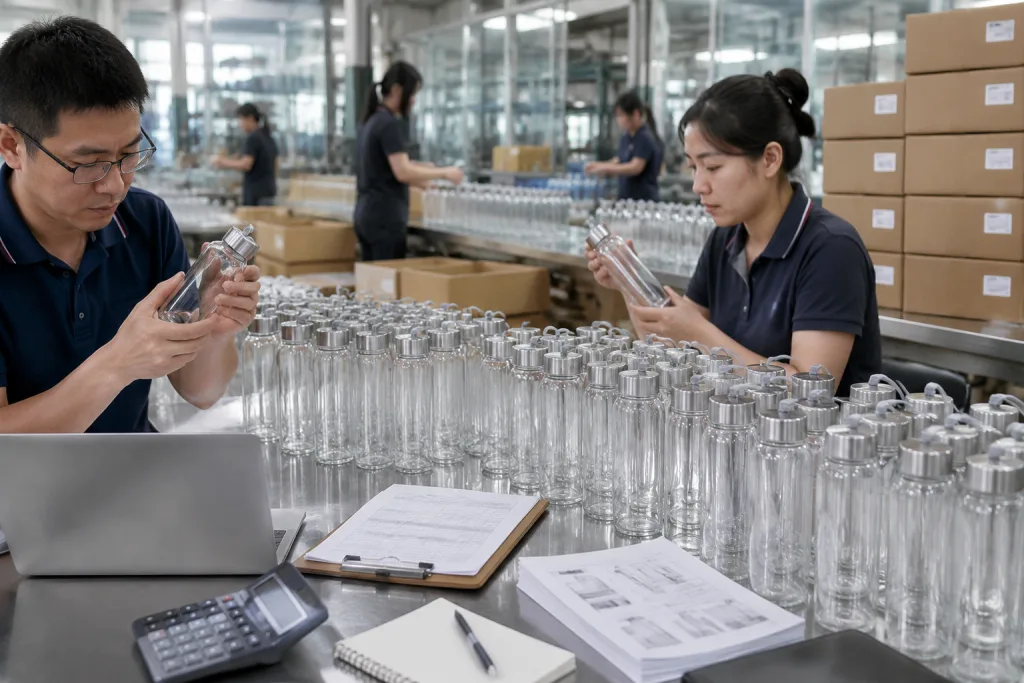
Key Takeaways
- Set RFQ specs at 3,000 units per SKU minimum before comparing vendors glass bottle pricing
- Approve a physical sample, not only a rendering, before paying the 30% bulk deposit
- Use AQL 2.5 major / 4.0 minor inspection terms for glass bottle export orders
- Confirm carton drop test, barcode, FNSKU, and pallet data before mass packing starts
Buying from vendors glass bottle programs looks easy until the quote sheet lands with no glass grade, carton size shown as “standard,” and a logo charge that jumps after the first sample. We see this 6-8 times a month. If you source custom drinkware for retail, promo, or distributor channels, the wrong question is “who is the cheapest canteen vendor?” Lock the spec first: glass type, wall thickness in mm, cap material, packing method, drop-test requirement, and logo process before a deposit leaves your account. QC pulled one buyer’s sample last quarter because the PO said matte black, but the artwork file said glossy black.
BottleForge Industrial works from Hangzhou, Zhejiang, with production partners across Zhejiang and nearby China supply clusters. For a standard glass bottle line, our practical MOQ starts at 3,000 units per color, sample lead time is 7-10 days, and bulk lead time is usually 30-45 days after deposit and approved sample. We run the line tighter when the buyer signs off on a 500 ml drawing, carton mark, and lid torque target before sampling. Small detail, big difference. A missing barcode on the master carton once cost 2 extra inspection hours at our packing table. Here is the sourcing flow we use with serious buyers.
Start With A Useful RFQ
A weak RFQ creates weak quotes. Ask 5 canteen suppliers for “500 ml glass bottle with logo,” and you will get 5 prices that do not line up. One factory quotes borosilicate glass, one quotes soda-lime glass, and another leaves out the silicone sleeve or inner divider without saying it clearly. We’ve seen this go sideways: the buyer flagged the gap only after QC pulled the pre-production sample, and the project lost 12 days before artwork was even locked.
Your RFQ should read like a rough purchase order. State the bottle capacity, glass type, mouth diameter in mm, lid material, sleeve material, logo method, packing, destination port, target launch date, and compliance market. For Europe, ask about LFGB, REACH, and food-contact documentation. For the U.S., ask for FDA food-contact basis and California Prop 65 risk screening if the item will be sold nationally. Small detail, big difference. On our line, a 38 mm mouth and a 45 mm mouth use different lid tooling, and the wrong size on a PO typo has pushed sampling from 7 days to 14 days.
RFQ line items to include:
- Item: 500 ml glass bottle, borosilicate, single wall, clear body, with target wall thickness confirmed before sampling
- Lid: bamboo outer shell with PP inner insert and silicone seal, checked by torque test on 10 pcs
- Decoration: 1-color silk screen logo, 60 mm x 35 mm, one position, artwork supplied in AI or PDF
- Packing: individual kraft box, 24 pcs/master carton, export carton 5-ply, carton drop test requested if retail shelfing matters
- Quantity: 3,000 / 5,000 / 10,000 units pricing breaks
- Trade term: FOB Ningbo or FOB Shanghai, quoted in USD
At BottleForge in Zhejiang, we can quote a standard 500 ml glass bottle at roughly USD 1.15-1.85 FOB depending on glass wall thickness, lid, sleeve, and packaging. A canteen customized with a silicone sleeve and retail box can easily add USD 0.35-0.70 per unit. Put that in the RFQ early, not after your finance team approves a budget. The math doesn’t work if the buyer budgets for a plain bottle and then asks us to add a 180 g kraft box, EVA divider, and 2-color print after the quote sheet is signed.
Compare Quotes Without Fooling Yourself
When the quotes land, don’t rank them by unit price. That is the wrong question to ask. We’ve seen vendors glass bottle quotes hide cost in mold polishing, screen-printing setup, inner trays, pre-shipment inspection, and truck freight to Ningbo or Shanghai port. A canteen factory that looks USD 0.08 cheaper per unit can lose the deal on the second page of the PI: USD 220 for screen setup, 5-layer cartons changed to thin B-flute, or a plant sitting 900 km from the nominated port. QC pulled one sample last March where the bottle passed the drop test, but the carton corner crushed at 13.6 kg. The math didn’t work.
Build a comparison table before you push for a discount. We run it like landed cost, even on FOB terms. Put unit price, MOQ, sample cost, sample time, tooling cost, logo setup cost, carton size, gross weight, estimated CBM, compliance documents, payment terms, and valid quote period in the same sheet. Add one column for “unclear cost” and force the supplier to fill it. For distributor drinkware buyers, CBM can hurt more than the bottle price; a bulky gift box can turn a 12-day sea freight quote into an 18-day consolidation headache if the forwarder flags over-volume cargo.
Quote comparison line items:
- MOQ: 3,000 units per SKU, 1,000 units per logo if shared base stock is available; confirm whether mixed colors count toward the MOQ or the line treats each color as a separate SKU
- Sample fee: USD 50-150 for existing mold, USD 300-800 for custom mold prototype; ask if the fee includes logo proofing and 2 pcs for buyer-side drop testing
- Logo setup: USD 60-180 per color for silk screen, lower for repeat orders; we usually see buyers flag this when a PO says 1C logo but the artwork file has 2 Pantone colors
- Carton: 24 pcs/carton, target carton weight under 15 kg for manual handling; ask for carton dimensions in mm, not just “standard export carton”
- Payment: 30% deposit, 70% before shipment after inspection; tie the balance payment to AQL 2.5 or your agreed inspection report
For custom canteen and customizable drinkware orders, ask whether the quoted mold is private or shared. Shared mold is fine for a 5,000 pcs promotional run where speed matters. Private mold makes sense when your retail brand needs a recognizable silhouette or registered design, but check who owns the cavity insert and whether the supplier can run it for another buyer after 24 months. A custom growler or customizable growler needs tighter control on closure torque, gasket fit, and pressure claims than a basic water bottle, especially if buyers may fill it with carbonated beverages. We’ve seen this go sideways: one buyer approved the body shape, then rejected mass production because the cap torque drifted from 18 kgf·cm to 11 kgf·cm on the line. Don’t let a canteen supplier tell you all glass containers behave the same.
Turn Specs Into A Sample PO
The sample PO is where casual sourcing turns into a job the factory can run. Do not write “make sample as discussed.” Write the exact bottle, cap, print, carton mark, and pass/fail standard. On our line in Hangzhou, the merchandiser keys the PO into the sample sheet; if the PO says only “clear bottle with logo,” the sample room will choose the nearest 500 ml mold and the buyer will flag the wrong shoulder radius 9 days later.
For vendors glass bottle programs, ask for at least three sample units per SKU. Keep one with your product team for hand feel and shelf review, keep one sealed in your compliance or QA file with the date sticker, and keep one for drop, leak, or dishwasher testing. If you are a canteen distributor selling into multiple retail accounts, order five to ten samples. We have seen this go sideways when one buyer kept the only good sample, the photographer needed the same unit, and the warehouse still had no bottle to check the 38 mm barcode label against the carton face.
Sample PO line items:
- Sample quantity: 5 pcs approved construction sample
- Glass: borosilicate, 2.0-2.3 mm nominal wall thickness
- Logo: white silk screen, Pantone reference supplied by buyer
- Cap seal: food-grade silicone, no visible odor, leak test required
- Sample lead time: 7-10 days after artwork approval
- Courier: DHL/FedEx/UPS collect account or prepaid quoted separately
Check the sample like a buyer, not like someone who already loves the design. Fill it with water and invert it for 4 hours on white tissue; QC pulled one last month where a slow leak showed only after 90 minutes around the silicone ring. Wash it 3-5 cycles if the decoration claims dishwasher resistance. Measure capacity to the fill line with a 1,000 ml graduated cylinder, not just brimful volume. Inspect bubbles larger than 1.5 mm near the lip, black stones in the glass body, scratches across the logo area, wall thickness swings outside 2.0-2.3 mm, lid wobble, and print drift from the center line. A customized growler or customized canteen also needs a full-weight hand check. 750 ml glass with a sleeve can feel too heavy for some promotional users, and pretending that weight does not matter is the wrong call.
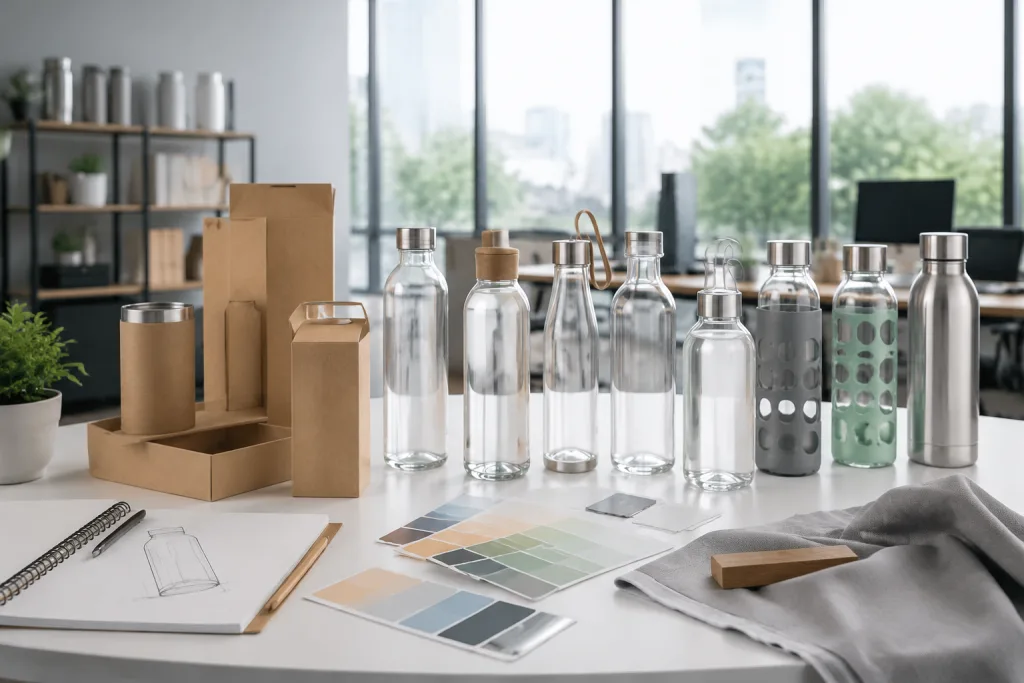
Approve Artwork And Compliance Early
Artwork approval is not just a “logo looks okay” step. It decides print cost, reject rate, line speed, and legal risk. We run a 4-color wraparound print on a tapered glass bottle much slower than a one-position laser mark on a stainless lid; last month QC pulled 32 samples because the red band climbed 3 mm near the shoulder. Big difference. For canteen promotional items tied to a fixed launch date, simple decoration is usually the safer buy unless the brand team accepts the extra scrap and sampling time.
For glass, silk screen is the normal cost-friendly choice. Heat transfer can carry photo-style graphics, but we still do 3M tape adhesion and hot-water soak before signing off. Laser engraving works on metal lids; it does not behave well on most glass bodies unless the surface has frosting or coating. Decals suit retail graphics, but they add curing time and often push MOQ from 1,000 pcs to 3,000 pcs. A canteen customizable for several client logos should use the same print window each time, usually 45-70 mm wide on a straight bottle wall, checked with a simple caliper before the screen frame is made.
Artwork and compliance PO line items:
- Artwork file: AI or PDF vector, fonts outlined, Pantone code included; do not send only a JPG pulled from a website
- Print tolerance: logo position ±2 mm, color tolerance Delta E agreed if critical; the buyer flagged Delta E 4.8 on a navy logo once, so write the limit down
- Compliance: LFGB or FDA food-contact report for glass, PP, silicone, coating; match the report to the actual lid gasket and coating batch
- Audit request: BSCI or ISO 9001 factory documents if required by retailer; ask before deposit, not during final inspection
- Labeling: country of origin “Made in China,” recycling marks where applicable; confirm barcode location and sticker size in mm
China export factories can ship clean retail goods, but the rules need to be locked before the line starts. Zhejiang supply chains are strong for drinkware assembly, packaging, and Ningbo port loading, but buyer discipline still matters. We have seen this go sideways: one PO said “customized drinkware with logo,” then the buyer complained about carton crush after 18 kg cartons were stacked 5 layers high. The factory followed its normal standard. If your PO names the standard, material, print tolerance, barcode location, and carton strength, you have something enforceable.
Write The Bulk PO Like A Contract
The bulk PO should read like a small contract, with commercial terms tied to production details. We see 6 out of 10 first-time buyers make it too thin. They send a PO with item name, quantity, price, and delivery date, then expect the bottle line to follow 37 scattered email messages and two WhatsApp photos. Bad plan. Email is not a control document; our merchandiser still prints the PO and clips it to the pre-production sample card at the line.
Your bulk PO should name the approved sample reference, artwork version, product specification, packing method, inspection standard, and shipment terms. If the order ships to Amazon FBA, spell out FNSKU placement, suffocation warning text for polybags, carton weight limits, and case pack rules; last April QC pulled a sample because the FNSKU was 4 mm too close to the carton edge. If it ships to a retail DC, add routing guide notes and pallet specs. A distributor growler program needs mixed SKU carton labels too, or the wholesaler will cut open 80 cartons just to receive stock.
Bulk PO line items:
- Product: 500 ml clear glass bottle with bamboo-look lid, silicone seal, and approved lid fit from PP sample No. S-042
- Quantity: 10,000 units, 2 logos, 5,000 units per logo, no logo mixing inside one inner carton
- Unit price: USD 1.52 FOB Ningbo, including 1-color logo and kraft box
- Deposit: 30% by T/T, balance 70% after passed inspection before shipment
- Lead time: 35 days after deposit and written pre-production sample approval
- Inspection: AQL 2.5 major / 4.0 minor, 100% carton count, leak test sampling
- Documents: commercial invoice, packing list, bill of lading, test reports
A capable glass bottle vendor will not fight a detailed PO. Good factories prefer it because clear tolerances stop rework before the furnace schedule, decal room, and packing tables get locked. If a factory refuses to put agreed tolerances into the PO, that is not “flexibility”; the math does not work once 10,000 units are packed and the buyer flags a 2 mm logo shift at final inspection. You are not buying a catalog photo. You are buying physical stock that must survive packing, inland trucking, ocean freight, and customer handling.

Control Production Before Packing
Mass production cannot be a black box. You do not need to watch every furnace setting on the IS machine, but you do need control over the checks that decide whether goods can ship. For vendors glass bottle orders, we run incoming glass body inspection, lid and silicone seal fit checks, decoration adhesion tests, leak testing, packaging assembly review, and final carton marking against the PO. QC pulled 32 bottles last month because the carton mark printed “GLSS” instead of “GLASS.” Small typo. Big delay.
Ask for a pre-production sample made from bulk materials before full decoration starts. This is not the sales sample. The sales sample often comes from stock on the sample shelf. The pre-production sample should use the actual glass batch, actual lid, actual silicone ring, actual printing ink, and actual color box. For a canteen manufacturer producing 80,000-120,000 drinkware units per month, this checkpoint is normal line work. If the factory sounds surprised, push back. We have seen this go sideways when the approved lid was 0.4 mm tighter than the bulk lid and the buyer flagged leaks at destination.
Production control line items:
- Pre-production sample: 2 pcs per SKU approved by photo and courier if needed, with lid torque and net weight recorded on the QC sheet
- Inline update: production photos at 20%, 50%, and 80% completion, including glass body, printing, packing table, and master carton view
- Leak test: minimum 20 pcs per SKU inline check, inverted for 30 minutes on white absorbent paper
- Print adhesion: 3M tape test or agreed equivalent on decorated samples, checked before the line runs the next 5,000 pcs
- Carton drop: ISTA-style internal drop check from 76 cm for packed carton, with corner, edge, and face drops recorded
Glass breakage is usually a packing system problem, not just a glass problem. Thin dividers, loose bottle movement, weak outer cartons, and cartons over 18 kg create claims later. For North America and Europe, we usually recommend 5-ply export cartons, individual boxes, and dividers when glass-to-glass contact is possible. If you are buying canteen promotional goods for events, cutting USD 0.12 from packaging is the wrong saving. The math does not work when 3% of units arrive broken and your distributor asks for credit notes.
Inspect, Ship, And Reorder Smarter
Final inspection should happen when 100% of goods are produced and at least 80% are packed. QC pulled the sample after 82% of cartons were sealed, then checked mouth diameter with a digital caliper and ran a 30-minute upside-down leak test. Use AQL, not “check some cartons.” For glass bottles, major defects mean leakage, cracked glass, unsafe sharp edges, wrong logo, missing parts, severe print defects, or an incorrect barcode. Minor defects mean a 1 mm cosmetic dot inside the approved limit, slight print shade variation against the signed color chip, or carton scuffing that will not hurt retail sale. Asking the factory to check a few cartons is the wrong question to ask.
Final shipment line items:
- Inspection standard: ANSI/ASQ Z1.4, General Level II unless otherwise agreed
- AQL: critical 0, major 2.5, minor 4.0
- Loading: photos of the open container, half-loaded container, full container, seal number, and final carton count
- Shipping mark: SKU and PO number on two carton sides; quantity, gross/net weight, and carton dimensions checked against the packing list
- Reorder file: final BOM, locked artwork, carton spec with paper weight, inspection report, and test reports
For reorder planning, keep your approved sample, final inspection report, and packing photos in one locked file. We have seen a canteen distributors program go sideways on order two because the lid supplier changed, the box dropped from 5-layer to 3-layer paper, or the print moved 4 mm toward the shoulder. The buyer flagged it after the cartons reached Rotterdam. Put “no material substitution without written approval” on the PO. It sounds strict because it should be strict.
BottleForge Industrial, based in Hangzhou, Zhejiang, supports FOB Ningbo and FOB Shanghai shipments from China, with typical bulk capacity around 100,000 custom drinkware units per month depending on the product mix. We ship mixed glass bottle and lid programs, but the math does not work if a buyer wants 12 SKUs at 300 pcs each with four carton marks and no shared components. If you need a distributor canteen, distributor drinkware, or distributor growler program, we would rather challenge your spec before the line opens than apologize after shipment. That is the cheaper way to buy.
Send Your Glass Bottle RFQ For Review
Share capacity, logo, MOQ, packaging, and destination. We will return practical FOB pricing, sample timing, and risk notes before you issue a PO.
Frequently asked questions
What MOQ should I expect from vendors glass bottle suppliers?
For standard glass bottle shapes, expect 3,000 units per SKU as a realistic MOQ, with 5,000-10,000 units giving better FOB pricing. If you use stock glass and only add a 1-color logo, some canteen vendors can support 1,000 units, but unit cost and setup cost will be higher. For private mold glass, the MOQ is usually 10,000-30,000 units because tooling, trial production, and reject rate must be absorbed. At BottleForge in Zhejiang, we usually recommend starting with 3,000-5,000 units for a new custom canteen design before committing to a larger retail rollout.
How long does sampling and bulk production take?
A normal sample takes 7-10 days after artwork approval if the mold exists. Add 5-7 days if special coating, complex heat transfer, or a non-standard lid is involved. Bulk production usually takes 30-45 days after deposit and approved pre-production sample. During peak China export months, especially before major retail seasons, build in another 7-10 days. If you need canteen promotional stock for a fixed event date, work backward from the delivery date and include ocean freight, customs clearance, and local trucking. Air freight is possible but often uneconomical for glass because of weight and packaging volume.
Which logo method is best for customizable drinkware glass bottles?
For most customizable drinkware glass bottles, 1-color silk screen printing is the best balance of cost, speed, and appearance. Setup is often USD 60-180 per color, and repeat orders are faster because screens and artwork are already confirmed. Heat transfer is better for multi-color graphics but needs stronger adhesion testing and usually costs more. Laser marking is suitable for stainless steel lids, not clear glass bodies in most cases. If you are a canteen distributor managing many client logos, keep the print area standardized and avoid wraparound art unless you accept higher reject rates and longer setup time.
What quality standard should be written on the PO?
Use ANSI/ASQ Z1.4 inspection with General Level II and AQL critical 0, major 2.5, minor 4.0 for most export glass bottle orders. Critical defects include broken glass, sharp edges, unsafe contamination, or materials that fail food-contact requirements. Major defects include leakage, wrong logo, wrong capacity, cracked lids, missing seals, or incorrect barcode. Minor defects include small visual marks within agreed limits. Your PO should also state leak test method, print adhesion test, carton drop expectation, and carton count verification. Without written AQL terms, the canteen supplier may apply its own internal standard, which may not match your retailer’s expectations.
Can one canteen factory handle glass bottles, growlers, and stainless items?
Some canteen manufacturers can coordinate glass bottles, stainless tumblers, and custom growler programs, but they may not make every component in one building. That is normal in China. The important question is who controls engineering, inspection, packaging, and export documents. A trading-only canteen vendor may chase price without owning quality control. A stronger canteen supplier will manage approved factories, keep BOM records, inspect to AQL, and consolidate shipment if needed. For mixed programs, confirm MOQ per category: glass may start at 3,000 units, stainless at 1,000-3,000 units, and customized growler molds may require 10,000 units or more.