Key Takeaways
- A realistic MOQ for custom infuser bottle projects is 1,000-3,000 units per color
- Tritan, PP, stainless steel, and borosilicate glass fit different retail prices and testing needs
- Logo lead time is usually 7-10 days for samples and 25-35 days for mass production
- AQL 2.5/4.0 inspection should be agreed before paying the 70% balance
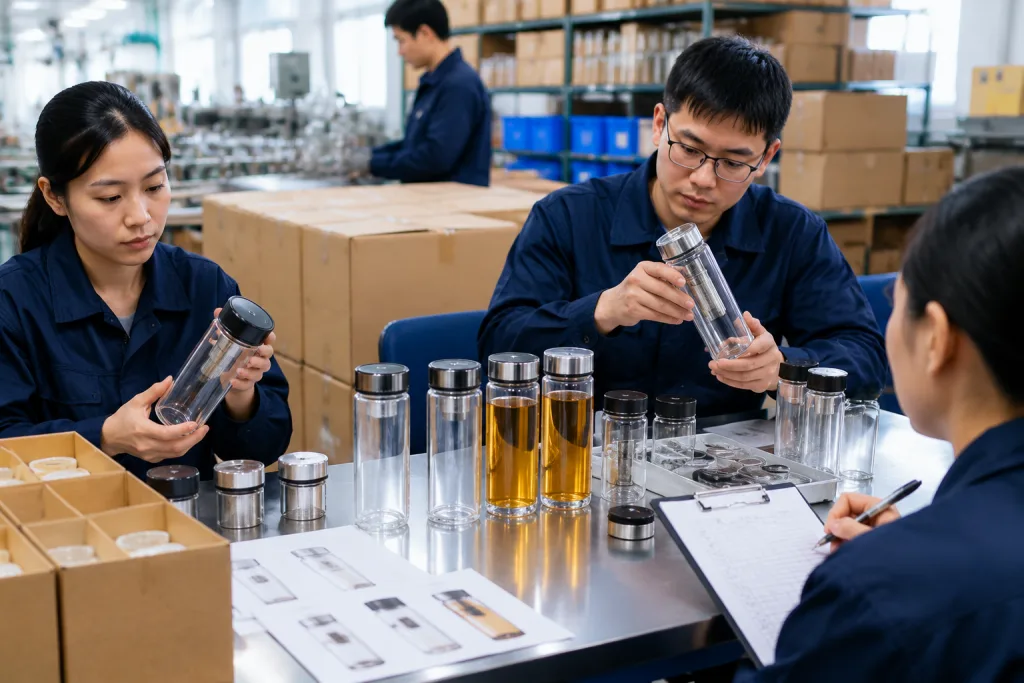
If you are building a wellness brand or hydration startup, the phrase vendors fruit infuser bottle usually means this: you need a bottle that looks shelf-ready, passes FDA or LFGB checks, and does not tie up cash for 28 days because the logo film was wrong. We see it on the line. A 0.3 mm shift in pad printing can turn a clean retail sample into a buyer complaint.
The wrong question is “which infuser bottle is cheapest?” A gym fruit bottle and a cold brew tea bottle run different lid tooling, filter mesh, carton drop-test targets, and MOQ math; the same plan does not work for both. BottleForge Industrial in Hangzhou, Zhejiang works with bulk infuser bottle buyers who need straight comparisons before they place a custom order in China. Last month, QC pulled a sample because the PO said 650 ml, but the inner box artwork still read 600 ml.
Start With The Bottle Type
Most sourcing mistakes start when a buyer writes custom fruit infuser bottle on the RFQ and stops there. Wrong question. A lemon cage for 4 mm fruit slices is not the same part as a 304 stainless tea basket with 0.6 mm mesh for loose-leaf tea. We had one wellness-box buyer flag this after QC pulled the sample: the PO said “infuser,” but their customer expected tea, not cucumber water. If you sell to gyms, yoga studios, detox programs, or subscription wellness boxes, match the bottle to the way people will use it.
This is the quick comparison we run with new buyers before we open a mold file:
| Type | Best fit | Typical capacity | Retail position |
|---|---|---|---|
| Tritan fruit infuser | Gym promos, sports retail, 30-day hydration campaigns | 650-1,000 ml | Mid-price, light body, good drop performance |
| Borosilicate glass infuser | Spa channels, office detox sets, wellness gift boxes | 450-750 ml | Premium shelf look, clean taste, needs safer packing |
| Stainless tea infuser | Tea brands, commuter bottles, corporate gifting | 350-600 ml | Better margin, heavier feel, tighter filter spec |
| PP budget infuser | Events, coupons, starter kits under tight cost | 500-800 ml | Low cost, simple lid, fewer custom options |
A bulk fruit infuser bottle order for a fitness campaign usually needs drop resistance and bright color matching more than insulation. Pantone control matters here; our line checks color chips under a D65 light box before mass packing. A bulk tea infuser bottle order needs tighter mesh, better heat resistance, and a lid that does not trap tea residue after 20 wash cycles. If you are comparing vendors, ask for the exact filter material, mesh opening, lid gasket material, and wall thickness in mm. “Food grade” is not a spec. It is just sales talk unless the factory can send LFGB, FDA, REACH, or matching migration reports for the actual material batch.
Material Choices Compared Honestly
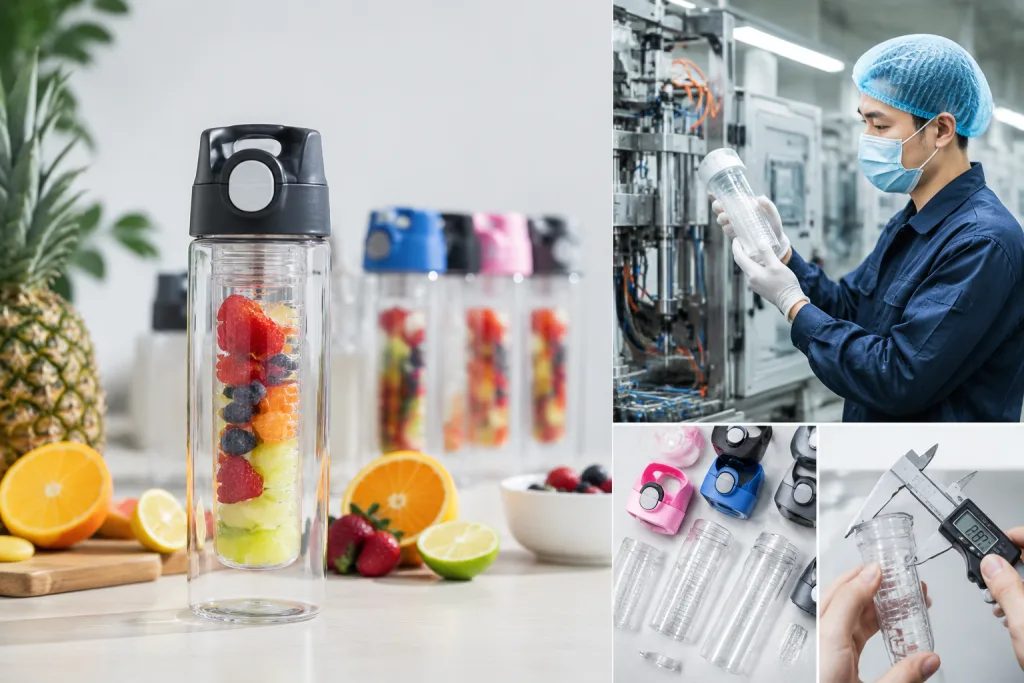
For a customizable fruit infuser bottle, we usually start buyers on Tritan, and for good reason. It is BPA-free, clearer than PP, lighter than glass, and it survives warehouse handling better when a carton gets dragged instead of lifted. We run 2.0-2.5 mm walls on most 650-800 ml bottles; QC checks this with a digital caliper at the shoulder and base, not just on the flat body. For FOB Ningbo or Shanghai, a simple Tritan model with one-color print usually sits around USD 2.10-3.20, with the lid structure and color box doing most of the damage to the price.
Glass feels more “wellness,” but the math gets tight fast. Borosilicate glass at 2.0-2.2 mm wall thickness works for office detox bottles and spa retail, but you need 5-layer cartons, foam or molded pulp, and a proper 1.2 m drop test before you promise clean replacement terms. We had one EU buyer flag 7 broken pieces in a 240-piece mixed carton trial; the product looked great, but the freight weight and after-sales claim made the reorder harder. If your distributors fruit infuser bottle program ships mixed cartons across Europe, glass can make money, but it gives you less room for rough handling.
Stainless steel makes more sense for a custom tea infuser bottle or customizable tea infuser bottle, especially when the buyer asks about hot water use in the first email. For single-wall tea bottles, 201 or 304 stainless can work, but we push 304 for food-contact parts because this is the wrong place to save USD 0.18. For double-wall vacuum bottles, 0.4-0.5 mm inner and outer wall gauge is common, and the line checks vacuum performance after welding before print. Stainless is not the cheapest choice, but it feels solid in hand and carries gift packaging without looking cheap.
PP is the budget route for event giveaways. No shame there. It works for a factory direct infuser bottle promotion when the buyer’s target is 10,000 pcs at a tight landed cost, but it scratches faster and the color looks softer after a few dishwasher cycles. Use PP when cost beats shelf appeal; we’ve seen this go sideways when a buyer tried to position PP as a premium retail bottle.
Spec Table For Buyer Decisions
Screening vendors fruit infuser bottle suppliers? Put every quote into one comparison table. We see this go sideways about 6 times a quarter: one factory prices a bare bottle in a polybag, the next includes a 350gsm color box, and the “cheaper” line is not cheaper once QC checks the carton spec.
| Spec point | Fruit infuser | Tea infuser | Buyer note |
|---|---|---|---|
| Filter design | Large removable cage, usually 45-55 mm diameter | Fine mesh basket, check mesh gap before sign-off | Fruit needs space; tea needs cleaner filtration |
| Leak test | Inverted 4 hours | Inverted 4 hours after hot water cycle | Hot liquid shows weak silicone gaskets fast |
| Logo method | Silkscreen or UV print on straight walls | Laser or pad print on curved lids | The buyer flagged logo stretch on a 68 mm curved body last month |
| MOQ | 1,000-3,000 units | 1,000-2,000 units | Lower MOQ often means stock color only |
| Packaging | Color box or kraft box | Rigid box optional | Retail channel decides whether the box cost makes sense |
A proper factory infuser bottle quote separates mold cost, unit price, logo setup, carton size, gross weight, and HS code. Ask for it line by line. For a custom made infuser bottle, tooling can range from USD 800 for a lid insert adjustment to USD 8,000 or more for a new body mold; our mold room checks the insert drawing in mm before we open steel. If you only need a custom logo infuser bottle, paying for a new mold is the wrong question to ask. Use an existing body, then change the lid color, print, sleeve, and box first.
Our Zhejiang production partners run 300,000-500,000 drinkware units per month, and we ship infuser bottle orders in 25-35 days after artwork and pre-production sample approval. The line usually starts after QC pulled the sample, matched the Pantone chip under a D65 light box, and signed the gasket fit with a 0.2 mm tolerance check.
Logo And Packaging Trade-Offs
For a startup, decoration is where a 6 mm logo move can change both unit cost and shelf value. Silkscreen is the safe choice for one or two flat-color logos. We run it on Tritan and PP for customized fruit infuser bottle orders in 1,000-5,000 units, and the math usually works: USD 40-80 setup per color, 7-10 days for the first logo sample, then 3-5 days if the buyer only changes the Pantone. QC pulled one sample last month because the screen frame left a 1.5 mm shadow on the shoulder curve. Small stuff. Buyers still notice.
Laser engraving looks cleaner on 304 stainless and it will not rub off after normal washing. On clear plastic, this is often the wrong question to ask because the mark disappears once water and fruit slices sit behind it. UV printing gives full-color impact, but we always test it on the actual bottle radius; curved bodies can stretch 6 pt text until “INFUSER” looks like “INFU5ER.” For a customized infuser bottle, keep the main logo under 45 mm wide on curved bodies unless you approve a wrap print fixture, which adds about USD 120-180 tooling and 2-3 days on the line.
Packaging should follow the sales channel, not the buyer’s favorite box photo. Amazon-style ecommerce needs ISTA-aware cartons, barcode placement, and FNSKU labels if you use FBA; one PO came in with the FNSKU pasted into the artwork layer, so prepress stopped it before 3,000 boxes were printed wrong. Retail distributors infuser bottle programs usually ask for hang tags and multilingual care cards, with carton marks separated by SKU. Corporate wellness kits often choose kraft boxes because they hide 2-3 mm scuffs better than glossy white boxes after a sea shipment.
One practical rule from our quote desk: if the bottle sells under USD 12 retail, keep packaging below USD 0.35 per unit. If it sells above USD 20, a better insert or matte box can lift the unboxing feel, but do not spend USD 0.60 on a box while keeping a cheap gasket. We have seen this go sideways. A 0.8 mm softer silicone ring fixed more complaints than any belly band ever did.
Testing, Compliance, And Inspection
Wellness buyers often spend 20 minutes discussing the fruit chamber and skip the compliance file. That is the wrong question to ask first. For Europe, ask for LFGB food-contact testing and REACH screening on the plastic lid, Tritan body, silicone gasket, and any colored PP insert. For North America, FDA food-contact compliance is the baseline, and 3 of our US retail buyers also ask for California Proposition 65 evaluation when the bottle goes into Amazon, club stores, or pharmacy chains. Kids’ use or school programs can trigger ASTM or CPSIA checks; we had one PO held for 9 days because the buyer typed “school gift set” in the remarks and forgot to tell the test lab.
For a distributor tea infuser bottle, heat resistance matters on the line, not just in a catalog. We run the lid through repeated hot water cycles at 95°C, then QC pulls the sample for upside-down leak testing after 30 minutes. Room-temperature shaking tells you almost nothing. Silicone gaskets should be removable or cleanable with a 6 mm brush, because tea residue sits in the groove. Stainless filters need a burr check, broken mesh check, and passivation review; last month QC flagged 14 pieces with sharp wire ends under a 10X magnifier. On glass bottles, request thermal shock testing and carton drop testing from at least 76 cm for export cartons.
Inspection terms should be locked before production starts, before the factory cuts film or prints the first logo. We recommend AQL 2.5 for major defects and AQL 4.0 for minor defects on most bulk infuser bottle orders. Critical defects such as leakage, sharp edges, wrong material, bad odor, or failed barcode scan should be zero tolerance. A pre-shipment inspection should check appearance, capacity with a graduated cylinder, logo adhesion with 3M tape, carton marks, drop test, leak test, and packaging count. We have seen this go sideways: the buyer approved the bottle, then rejected 2,400 cartons because the outer carton mark missed one letter in the SKU.
China factories can produce strong drinkware, but the acceptance standard has to be written like a work order. “Please make good quality” is not enforceable. The math doesn’t work when a USD 0.18 inspection checklist is skipped and a 40HQ gets stuck at the buyer’s warehouse. A signed golden sample, approved artwork file, and inspection checklist give the line something to follow and give QC a ruler to measure against.
Factory Direct Or Trading Vendor
A factory direct infuser bottle order is not automatically better than buying through a trading vendor. This is the wrong question to ask first. Start with order volume, logo process, forecast stability, and who will answer when the silicone gasket is 0.4 mm loose after the first PP sample. We run better on repeat SKUs, stable colorways, and technical calls about molds, lid torque, filter fit, or production yield.
A trading vendor makes sense if you are filling one container with 12 unrelated items, not just bottles. The trade-off is slower feedback when QC pulled the sample and found the fruit rod rubbing against the inner wall. If your distributor infuser bottle program has six colors, two lid types, and carton labels with Amazon FNSKU plus a buyer SKU, direct factory communication cuts down the small mistakes. We have seen this go sideways over one typo on a PO: “matte blue” became “metal blue.”
For first orders, we often suggest a controlled path: choose an existing mold, customize color and logo, run 1,000-3,000 units, then review return rates and customer photos before investing in tooling. A customizable infuser bottle does not need to be fully custom on day one. For 8 out of 10 wellness startups we quote, the math works better with a semi-custom launch: Pantone body color, one proven flip lid, laser logo or screen print, and a box that survives a 12 kg drop-carton check.
BottleForge Industrial is based in Hangzhou, Zhejiang, close to mature drinkware supply chains in eastern China. That matters on the floor. Mold shops, printing vendors, silicone suppliers, carton plants, and export trucks are within a practical radius, so when a gasket fit issue shows up during pre-production, we can get the supplier in with calipers the same day. Distance can mean 12 days vs 18 days on a fix, and buyers feel that delay before peak season.
Send Your Infuser Bottle Spec For Review
Share capacity, material, logo, packaging, and target price. We will reply with MOQ, lead time, and factory-direct options from China.
Frequently asked questions
What MOQ should I expect for a custom fruit infuser bottle?
For most custom fruit infuser bottle orders, plan on 1,000-3,000 units per color if you use an existing mold. A stock bottle with one-color logo can sometimes start at 500 units, but the unit price will be higher and color choices are limited. Fully custom tooling usually only makes sense above 5,000-10,000 units because mold cost, sampling revisions, and testing fees need to be spread over enough volume. For startups, we usually recommend a first run of 1,000 or 2,000 units with custom logo, custom box, and one approved color before expanding.
Is Tritan better than glass for bulk fruit infuser bottle orders?
Tritan is better for sports, gym, and ecommerce orders because it is lighter, impact-resistant, and cheaper to ship. A 750 ml Tritan bottle may weigh 150-220 g, while a glass infuser bottle can be 350-500 g before packaging. Glass looks more premium and gives a cleaner taste profile, so it fits spa, office, and gift channels. If you sell through distributors fruit infuser bottle programs with many parcel shipments, Tritan usually has fewer breakage claims. If your brand is positioned around premium wellness rituals, glass can justify the higher freight and packaging cost.
Can I use the same bottle for fruit and tea infusion?
You can, but it is often a compromise. Fruit needs a larger cage with wider openings so berries, lemon, cucumber, or mint can release flavor and be removed easily. Loose-leaf tea needs a finer mesh, usually stainless steel, to prevent leaf particles from escaping. A custom tea infuser bottle also needs better heat testing, especially around the lid gasket and drinking spout. If your brand wants one SKU for both uses, choose a bottle with interchangeable filters. The tooling cost is higher, but it gives you cleaner merchandising for fruit, tea, and cold brew positioning.
How long does production take for customized tea infuser bottle orders?
For an existing mold, sample production normally takes 7-10 days after artwork confirmation. Mass production usually takes 25-35 days after sample approval and deposit payment. Add 5-7 days if you need custom color matching, and add more time before holidays in China, especially before Chinese New Year. A customized tea infuser bottle with stainless parts may also need extra time for filter mesh confirmation and logo testing. Sea freight to Europe or North America can add 25-45 days depending on port, season, and whether you ship FOB, CIF, or DDP.
What should I check before paying a vendors fruit infuser bottle supplier?
Ask for the material grade, test reports, exact capacity, MOQ by color, logo method, packaging spec, carton dimensions, lead time, payment terms, and AQL inspection standard. You should also request photos or video of leak testing, filter assembly, and logo adhesion testing. Before the 70% balance payment, arrange pre-shipment inspection or at least a detailed factory QC report with random carton checks. For a vendors fruit infuser bottle order, do not rely only on catalog photos. Approve a physical golden sample and keep one sealed sample with both buyer and supplier for dispute reference.