Key Takeaways
- A realistic MOQ for custom sports water bottle production starts at 1,000-3,000 units per model
- Tritan, PP shaker, stainless steel, and HDPE bottles fit different gym use cases
- Logo durability depends more on surface texture and wash conditions than artwork complexity
- A 30-40 day production lead time is normal after artwork and sample approval
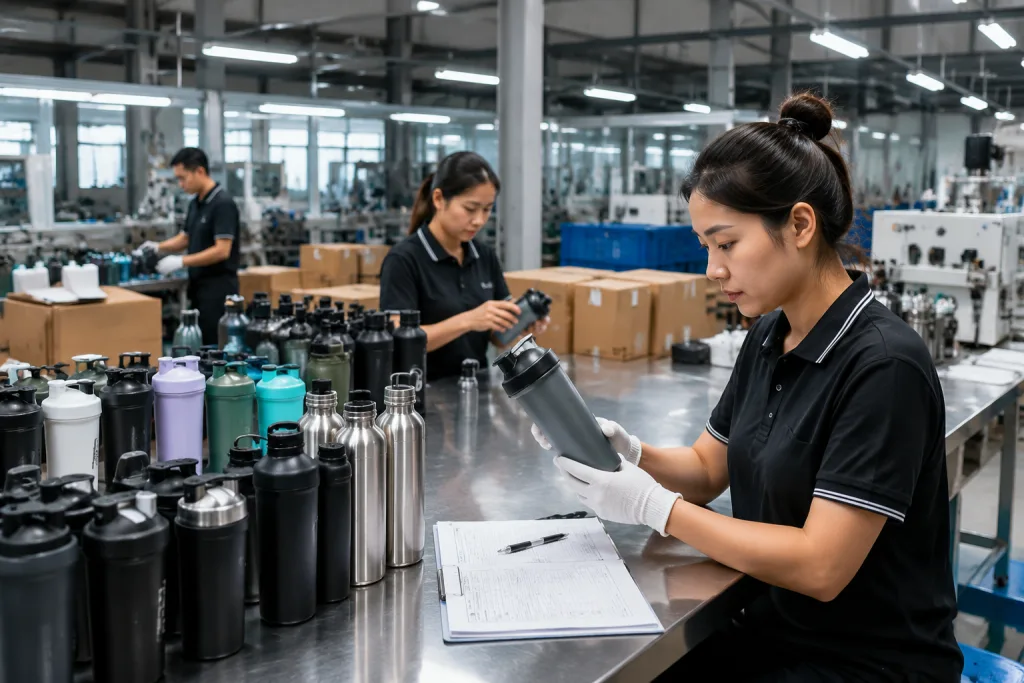
If you search for vendors fitness water bottle, you are probably past the catalog stage. You need a bottle spec that survives 1.2 m drops on gym floors, wet locker-room benches, retail shelf rub, and 24-bottle subscription box packing without turning into a claims problem. QC pulled a sample last month with a 0.6 mm cap gap after the shaker test. It leaked.
At BottleForge Industrial in Hangzhou, Zhejiang, we see this go sideways in roughly 7 out of 10 early RFQs: buyers pick a custom fitness water bottle by shape first, then the buyer flags cap seepage, logo abrasion, or a carton cube that pushes freight from 12 cartons per CBM down to 8. For fitness brands and gym chains buying from China, appearance is the wrong first question. We run the line better when the spec sheet compares lid structure, wall thickness, coating method, packing size, and MOQ before artwork starts.
Compare Bottle Types Before Pricing
Most fitness buyers ask for a quote too early. “Send price for 750 ml bottle with logo” is the wrong question to ask if you want a clean vendors fitness water bottle comparison. A 750 ml Tritan flip bottle with a spring lid, a 750 ml PP shaker with a mixer grid, and a 750 ml stainless vacuum bottle with 304 stainless steel can differ by USD 1.80-5.50 FOB China before decoration and packaging. Last week QC pulled the sample on a 750 ml lid because the silicone ring sat 0.4 mm proud; that small fit issue changes both leak risk and carton rework cost.
Use the table as the first filter before you ask the factory to cost molds, logo, color box, or 12 kg master cartons. It will not pick the winner for you. It shows where each format works and where the math starts to go sideways, especially when the buyer flags “same price as last order” but changes from single-color print to full-wrap artwork.
| Type | Common size | Material | Typical FOB range | Best fit |
|---|---|---|---|---|
| Tritan sports bottle | 650-1000 ml | Eastman Tritan or equivalent copolyester | USD 2.20-4.20 | Retail fitness brands, boutique gyms |
| PP shaker bottle | 500-800 ml | Food-grade PP, PE ball or mixer grid | USD 1.10-2.40 | Protein promos, member packs |
| Stainless sports bottle | 500-950 ml | 304 stainless steel, single or vacuum wall | USD 3.20-7.80 | Premium membership gifts |
| HDPE squeeze bottle | 500-750 ml | LDPE or HDPE | USD 0.65-1.35 | High-volume gyms, races, events |
If you need a bulk fitness water bottle for a gym chain opening 40 locations, we run PP shaker or HDPE squeeze bottles first because cost and replacement tolerance usually beat Tritan. For ecommerce or studio retail, a customizable sports water bottle in Tritan or stainless gives stronger shelf value, especially when the customer handles the sample at reception. Cheap is not the issue. The bad buy is a spec that does not match real use; we have seen this go sideways when a PO says “matte black” but the approved sample was glossy Pantone Black C.
Tritan Versus PP Shaker
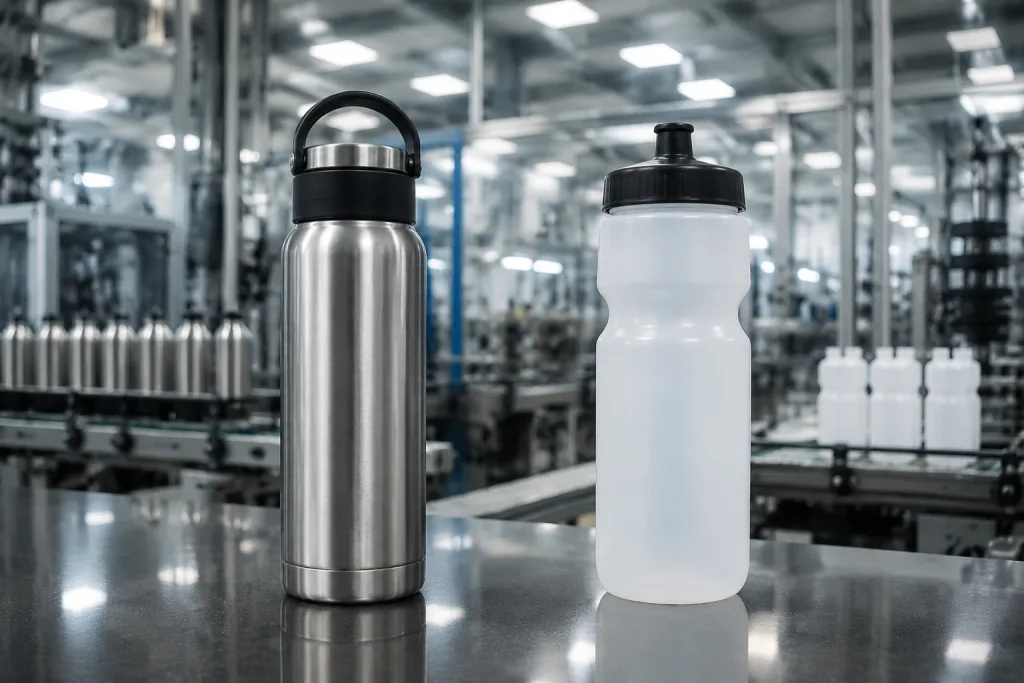
Tritan and PP shaker bottles get quoted side by side, but they are not the same product. Tritan is clearer and stiffer, so it looks better under retail shelf lighting; PP is lighter and cheaper, which fits protein powder kits where the bottle gets replaced after 3-6 months. On our line, QC pulled 20 pcs last week and the PP cup passed drop testing, but the Tritan sample won on scratch marks after the 3M tape rub.
For a custom gym water bottle used during HIIT, cycling, or personal training, Tritan feels cleaner in the hand and gives stronger color transparency. Wall thickness is commonly 1.8-2.3 mm for mid-range sports bottles. A locking flip lid, silicone seal ring, and carry loop add cost, but they cut leakage complaints; we usually see cap sets add USD 0.18-0.42 depending on the mold. If your gym sells bottles at USD 12-18 retail, Tritan can support that shelf price. The buyer flagged leakage at 45 degrees once, and the fix was not the cup body. It was seal compression.
A bulk shaker bottle is more price-sensitive. The cup body is usually PP with 1.2-1.8 mm wall thickness, a screw cap, and either a wire whisk ball or plastic mixer grid. For a custom logo shaker bottle, the print area is large and simple, but the surface can flex. That matters. A wide single-color silkscreen logo usually holds better than a tiny 4-color design across a curved ribbed body, especially when the operator sets the screen frame 2 mm off-center. We run a cleaner result on bold logos.
For protein brands, a custom made shaker bottle with ml/oz scale, leak-tested cap, and powder scoop compatibility beats a premium material story. This is the wrong question to ask if the pack will sit inside a whey bundle. For gyms, the deciding point is usage frequency. If members carry it daily, upgrade the cap. If it is a joining gift, control cost and keep the logo bold. We ship more PP shakers for 3,000-10,000 pc promo orders, while Tritan fits smaller retail runs where the buyer cares about hand feel.
Do not buy a customizable shaker bottle only by cup weight. Cap fit, thread precision, and seal compression are where most claims begin; our AQL table has caught more bad lids than bad cups.
Stainless Versus Squeeze Bottles
Stainless steel and squeeze bottles sit at opposite ends of the fitness drinkware shelf. Both sell, but to different buyers. A customized sports water bottle in 304 stainless steel works as a brand item. A squeeze bottle is gym stock. We run both types through different lines in Zhejiang; QC pulled 32 samples last month where the only issue was buyers mixing “premium member gift” and “opening-day giveaway” on the same PO.
For gym chains, stainless fits VIP tiers, trainer uniforms, corporate wellness packs, or retail counters. Standard vacuum bottles use 0.4-0.5 mm inner and outer stainless walls, copper coating on higher-spec insulation models, and powder coating or spray painting outside. A 750 ml vacuum bottle with custom logo may cost 4-6 times more than a basic squeeze bottle, but members keep it on the desk or in the car. The buyer often pushes back on carton weight here: 24 pcs can reach 9-11 kg depending on lid style.
Squeeze bottles are blunt and practical. Low cost. Light cartons. Easy handout for bulk gym water bottle campaigns. The trade-off is lower perceived value and weaker decoration options. A large one-color print works. Fine gradients, metallic effects, and small QR codes fail too often; our pad-printing operator rejects QR codes under 18 mm because scanners miss them after the bottle curves. If the bottle goes into team bags, event bins, or reception counters, the math works.
From our Zhejiang production network, we usually guide buyers this way: choose stainless when the bottle carries the brand story; choose squeeze bottles when the bottle carries water and a logo at the lowest landed cost. For distributors gym water bottle projects, this saves time and avoids quoting a USD 5.80 vacuum bottle to a buyer whose target is USD 1.10 FOB Ningbo. We’ve seen this go sideways when the buyer says “premium” on Monday and sends a 20,000 pcs giveaway budget on Tuesday.
If you sell to fitness clubs in Europe, check REACH requirements for coatings and silicone parts. For North America, ask for FDA or LFGB food-contact declarations depending on the market channel. Documentation should be fixed before deposit, not during customs clearance. Our sales team now checks this at PI stage because one buyer once typed “LFGB lid only” on the PO, then expected full-bottle LFGB reports at shipment inspection.
Use-Case Fit for Fitness Channels
A distributor fitness water bottle order almost never runs on one spec. We see this on the line every month: a gym chain wants 8,000 cheap member gifts, while a yoga studio PO may show 1,200 pieces with “matte sage” typed as “mat sage” and the buyer still expects retail shelf color control. Same product name. Different job.
- Gym chain member gift: 600-750 ml PP shaker or squeeze bottle, MOQ 3,000-10,000 units, front logo at 55-70 mm wide, packed to survive locker-room drops and rough carton stacking.
- Boutique studio retail: 650-850 ml Tritan, matte or translucent color, MOQ 1,000-3,000 units, with hang tag or retail box; QC pulled the sample last April because the matte coating showed finger marks under the light box.
- Premium trainer bottle: 750-950 ml stainless vacuum bottle, laser logo or powder-coated print, MOQ 1,000 units per color, with color ΔE checked against the approved swatch before mass packing.
- Supplement promotion: customized shaker bottle with mixer grid and embossed scale; the carton-ready multipack needs dividers if warehouse staff will pick by 6-pack or 12-pack.
- Event or race pack: lightweight squeeze bottle, one-color print, 15-25 kg master carton limit for manual handling; race buyers usually push back on freight first, not bottle quality.
For distributors fitness water bottle programs, carton dimensions decide more profit than 2 cents on the unit price. This is the wrong question to ask: “Can you make the bottle cheaper?” Ask how many cartons fit a 20 ft container. We run PP shaker bodies nested at 48-60 pieces per carton when the lid design allows it, but bulky carry handles, gift boxes, and wide lids push up CBM fast. On a 20 ft container, a 12-18% carton cube difference can wipe out a small FOB saving; we have seen a USD 0.06 cheaper bottle land higher after freight because the carton shipped too much air. The tape measure matters.
Amazon and direct-to-consumer brands need to brief packing before quotation. If FNSKU labeling, individual polybags, drop testing, or barcode stickers are needed, tell the factory early; these services add USD 0.03-0.18 per unit depending on labor and scanning steps. For retail chains, confirm GS1 outer labels, mixed-color packing, and pallet height limits before we open the carton artwork file. China factories can handle it, but the math does not work if packing changes after the quote, especially after QC has already checked a 10-carton pre-shipment sample against the first packing spec.
Logo Methods and Surface Reality
Decoration is where 6 out of 10 custom fitness water bottle projects start to drift from the mockup. A logo on a flat PDF is not a logo on a tapered, textured bottle body spinning in a jig. The right method depends on material, coating, logo size, and how the buyer expects the bottle to be washed.
Silkscreen printing is the line workhorse for bulk sports water bottle orders. It is cost-effective and clean for one to three colors, as long as the artwork is built correctly. On PP shaker cups and HDPE squeeze bottles, we usually run screen printing first; last month QC pulled 32 samples because a 42 mm logo sat too close to the molded grip ribs. Typical setup cost is USD 35-60 per color per position, with unit print cost around USD 0.05-0.18 depending on coverage.
Laser engraving fits stainless steel bottles when the buyer wants a permanent mark. It does not give strong contrast on every powder coating color, and this is where the math doesn't work if the client expects bright white on matte black from laser alone. It will not peel. For a custom gym water bottle used daily by trainers, laser is often worth the extra USD 0.08-0.25 per unit. Pad printing works for smaller cap logos or curved lid parts; heat transfer handles more colors, but we run abrasion tape and dishwasher checks before calling it safe.
For a customized fitness water bottle with a large wraparound design, request a printed pre-production sample. Do not approve mass production from a digital mockup only. Curvature can stretch text, and a 1 mm registration shift shows up fast on thin lines; we have seen a 210 mm wrap look fine on screen, then fail at the bottle seam during trial printing. If the product is a customizable fitness water bottle sold online, photograph the actual sample before launch so the listing does not promise one finish and the carton delivers another.
At BottleForge Industrial, our normal artwork check includes Pantone reference, print size in mm, logo position tolerance, and sample photo confirmation. We also check the PO file name because “logo_blue_v3” and “logo_blue_final” have caused 2 avoidable reprints this year. That is basic discipline, not a premium service.
Factory Metrics That Matter
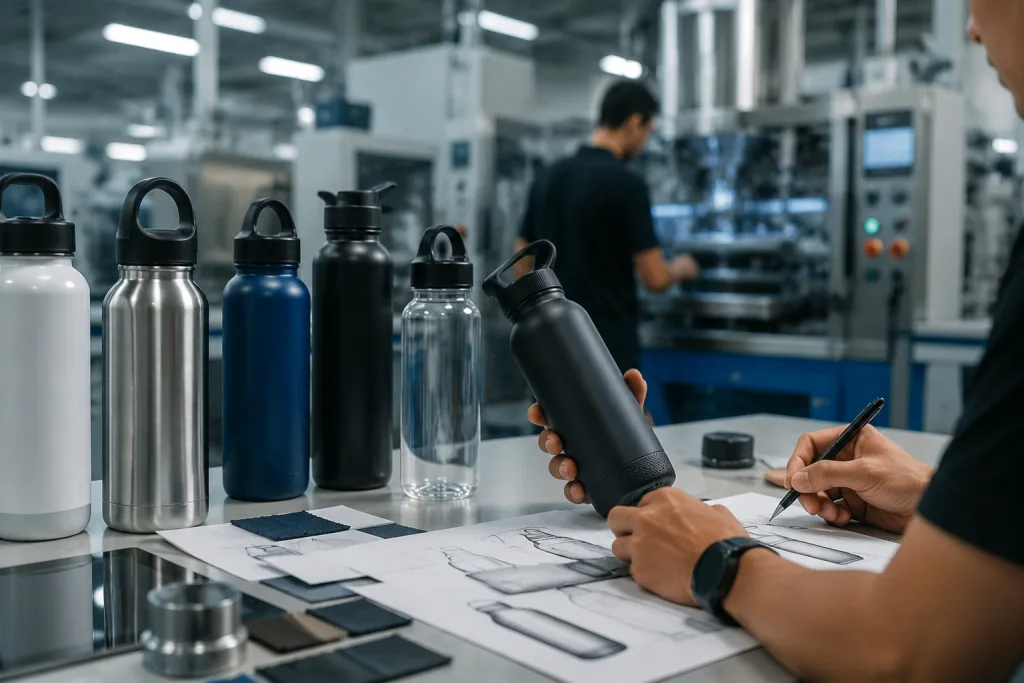
A reliable vendor should be able to talk numbers without hiding behind “large capacity.” We hear that phrase 6 or 7 times a month, and it is the wrong answer. For sports bottles, ask for monthly line output by bottle type, which molds are open now, MOQ by Pantone color, sample days from artwork file, mass-production days after deposit, and the exact defect claim rule. If the sales sheet says “500,000 pcs/month” but the mold room only has 2 running cavities for your lid, the math does not work.
Our Hangzhou, Zhejiang team coordinates China production lines with a combined drinkware capacity of about 450,000-600,000 units per month across plastic sports bottles, shaker bottles, and stainless bottles. We run separate lines for Tritan-style plastic bodies, PP shaker cups, and 304 stainless shells, so capacity is not one big bucket. For most custom sports water bottle orders, practical MOQ starts at 1,000 units for existing molds and 3,000 units per color for cost-efficient production; below that, color changeover waste on the injection machine eats the margin. New private mold projects usually start above USD 3,000-8,000 in tooling, depending on cap complexity and cavity count. Last month, one buyer pushed for 800 pcs in 4 colors, and the line supervisor flagged the setup loss before we quoted.
Normal sample timing is 5-7 days for logo samples on existing stock shapes, or 10-15 days when custom colors and special components are involved. Real calendar time matters. Mass production is typically 30-40 days after deposit, artwork approval, and sample sign-off, not from the day somebody sends a loose WhatsApp image. Peak season before summer promotions can add 7-14 days, especially for stainless powder coating and multi-color printing. We have seen this go sideways when a PO had “matte black” typed once and “gloss black” typed on the packing page; QC pulled the sample board before the oven run and saved 12,000 bottles from rework.
Quality control should be stated in measurable terms. We recommend AQL Level II with critical defects at 0, major defects at 2.5, and minor defects at 4.0 for most distributor sports water bottle orders. Leak testing should include 30 minutes inverted static testing on filled bottles and random shake testing after cap assembly. For shaker bottles, thread smoothness and cap torque should be checked with a torque meter, because a cap that is too tight causes complaints almost as fast as a cap that leaks. On the line, QC also checks flash around the drinking spout; even 0.3 mm rough plastic can get a buyer complaint from gym retail.
If you are comparing distributors shaker bottle suppliers, ask for a packing photo, inspection report template, and food-contact test reports before paying the balance. Serious China vendors will not be offended by that request. We ship better when the buyer asks early, not after 96 cartons are already wrapped on the pallet. A clean report should show carton size, gross weight, sampling quantity, and leak-test result, not just a smiling warehouse photo.
How to Shortlist Vendors
Shortlisting vendors for fitness water bottle projects starts with a tighter question. Asking 10 factories for the cheapest version of a bottle you have not defined is the wrong question to ask. You will get 10 FOB prices, 10 wall thickness guesses, and 10 lid assumptions. Last month, QC pulled two “same size” 750 ml samples from the line; one measured 72 mm at the body, the other 76 mm, so the carton count changed.
Your RFQ should include capacity in ml, material preference, lid type, logo method, Pantone colors, target market, order quantity, packaging style, and required certifications. If you are open to alternatives, write it plainly: “Quote Tritan and PP separately for 5,000 units, one-color logo, individual polybag, FOB Ningbo or Shanghai.” We also ask buyers to attach the logo file in AI or PDF, not a 400 px JPG pasted into Excel. That lets vendors quote the same bottle, the same print, and the same packing.
For fitness brands, the best supplier is not the one shaving USD 0.04 off the first price. It is the one who flags problems before they land on your inspection report. A good vendor will tell you if a 0.25 mm logo line is too fine for silkscreen, if the cap is not suitable for carbonated drinks, or if a custom PMS color pushes MOQ from 3,000 to 5,000 pcs. A weak vendor says yes to everything. We’ve seen this go sideways.
For gym chains and distributors gym water bottle programs, ask for a side-by-side quote with three clear levels. Economy can be an HDPE squeeze bottle around 60 g, standard can be a PP shaker with a mixing ball, and premium can be Tritan or 304 stainless with better retail packaging. Put each option on the same sheet with FOB price, mold cost, sample time, production lead time, and carton size. The buyer flagged this once because our first quote missed “master carton 5-ply” from their PO. Fair point.
That is the practical way to source from Zhejiang and wider China: match the use case first, check material limits, confirm decoration, then talk price. If the bottle fits the gym floor, the bike cage, or the retail shelf, we can work through color cards, print position, and carton marks. If it does not fit, the math does not work. A lower FOB price just buys you complaints 12 days after delivery instead of repeat orders 18 days later.
Send your bottle spec for a factory quote
Share quantity, material, logo, market, and packing needs. Our Zhejiang team will return a practical FOB comparison, not a vague catalog price.
Frequently asked questions
What MOQ should we expect for a custom fitness water bottle order?
For existing molds, a realistic MOQ is 1,000-3,000 units per model, depending on material and color. PP shaker and squeeze bottles are usually easier at 3,000 units because color matching and printing setup are spread over more pieces. Tritan and stainless bottles can sometimes start at 1,000 units if you accept standard body colors. For a fully customized fitness water bottle with private color, special cap, or retail packaging, expect 3,000-5,000 units. Private molds are a different budget, often USD 3,000-8,000 for tooling before production.
Which bottle type is best for a gym chain member gift?
For most gym chains, a PP shaker bottle or HDPE squeeze bottle is the safest member-gift option. It keeps the unit price under control, usually around USD 0.65-2.40 FOB China depending on size and decoration. A bulk gym water bottle order for new member packs should prioritize leak resistance, simple one-color branding, and carton efficiency. If the gift is tied to a premium membership tier, Tritan or stainless makes more sense. For daily reception giveaways, do not overbuild the product; members need something useful, clean, and easy to replace.
Can we use the same logo method on all bottle materials?
No. Silkscreen works well on PP shaker bottles, Tritan sports bottles, and many squeeze bottles, but it is not always ideal for textured or highly curved surfaces. Laser engraving is mainly for stainless steel and gives a permanent mark, usually adding USD 0.08-0.25 per unit. Heat transfer handles more colors, but you should test abrasion and hot-water exposure. For a custom shaker bottle, one or two strong print colors usually outperform a complicated design. Always approve a physical logo sample before mass production.
How long does production take after we approve the sample?
For an existing mold custom sports water bottle, normal mass production is 30-40 days after deposit, artwork approval, and sample confirmation. Logo samples usually take 5-7 days if the bottle shape and color are available. Custom colors, special lids, stainless coating, or retail packaging can push samples to 10-15 days. Add 7-14 days during peak spring and early summer demand. Sea freight to Europe or North America is separate, often 25-40 days port-to-port depending on route and congestion.
What quality checks should distributors request before shipment?
Ask for AQL inspection, leak testing, logo adhesion checks, carton drop testing, and packing photos. For distributor shaker bottle orders, cap thread fit, seal ring placement, mixer ball or grid count, and printed scale accuracy should be checked. A common AQL setup is Level II, critical defects 0, major 2.5, minor 4.0. For food-contact products, request FDA, LFGB, or REACH-related documents based on your market. Do this before balance payment. A simple inspection report can prevent thousands of unsellable bottles from reaching your warehouse.