Key Takeaways
- For stainless steel drink bottles, realistic OEM MOQ starts at 1,000-3,000 units per color depending on finish and lid type
- A 500 ml double-wall bottle usually needs 0.45-0.55 mm 304 stainless steel for stable dent resistance
- Expect 25-35 days for repeat production after artwork approval and deposit, plus sea or rail freight time
- Use AQL 2.5/4.0 inspection, REACH/LFGB or FDA documentation, and packaging drop tests before shipment
If you search for vendors drink bottle, you probably do not need another glossy PDF with 42 bottle photos. You need a canteen supplier that can hold Pantone color within ΔE 1.5, keep the logo centered within 1 mm, pack to your carton mark, pass AQL 2.5, and ship on the date printed on the PO. Miss one line item. The buyer flagged it, and the order turns into daily WeChat chasing.
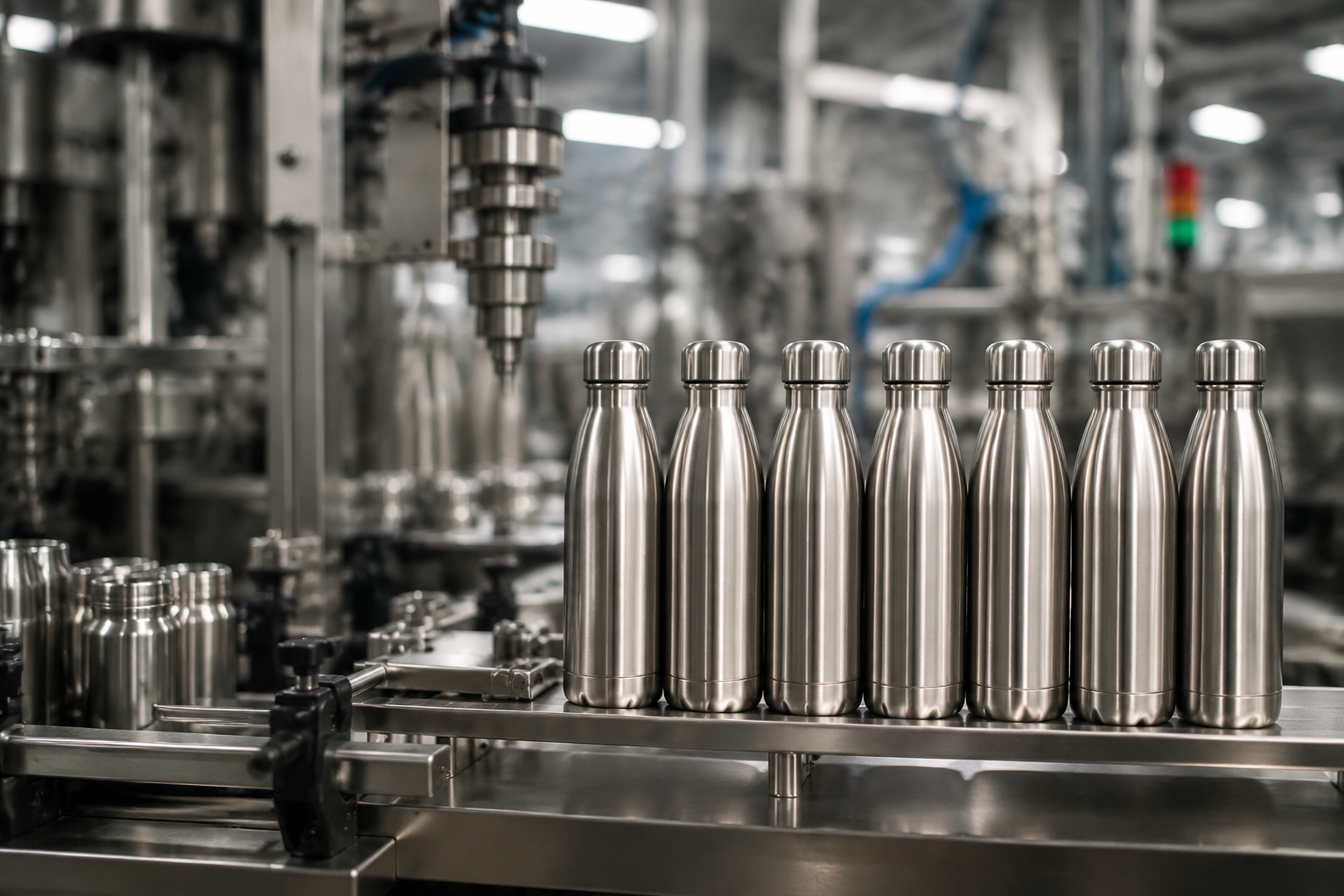
BottleForge Industrial is a Hangzhou, Zhejiang drinkware manufacturer. We run distributor bottle orders for Europe and North America, usually from 1,000 pcs MOQ to 20,000 pcs replenishment lots. China has plenty of canteen vendors. The wrong question is “who has the lowest bottle price?” The better question is which factory fits your channel margin, compliance file, and reorder rhythm without changing the cap gasket after QC pulled the sample from the line.
What does vendor really mean?
Buyers use the phrase vendors drink bottle too loosely. On one RFQ it means a trading office with 6 people; on the next it means a canteen shop that owns 2 logo-printing machines; sometimes it means a full export factory handling tooling, coating, retail boxes, AQL 2.5 inspection, and FOB loading. This is the wrong question to ask unless you also ask who touches the bottle after the steel coil is cut. We have seen orders go sideways because the PO said “vendor” but the buyer assumed welding, powder coating, and carton drop-test control were under one roof.
If you are buying for retail, corporate gifting, Amazon, clubs, outdoor shops, or a distributor canteen program, ask which steps are done in-house and which are sent out. Vacuum forming uses different people and gauges than laser engraving; powder coating needs a clean line, not just a spray gun in the corner. A supplier that only prints blank stock can work for a 500-unit canteen promotional order, especially if the logo is a 1-color silkscreen at 45 mm wide. It is weak for a canteen customized project with unique lid tooling, Pantone-matched coating, and a buyer who will reject 3% shade drift under a light box.
Here is the practical test: ask for photos or video of the line producing your product category this month, not a general factory tour from three years ago. Simple request. In Zhejiang, China, our facility can handle about 450,000 stainless drinkware units per month across bottles, tumblers, and custom growler orders, with standard OEM MOQs from 1,000 units for selected stock molds. That scale is not a bragging point by itself. It tells you whether the canteen supplier can absorb repeat orders without moving your delivery slot from 32 days to 45 days when a larger buyer drops a rush PO. QC pulled a sample last month where the carton mark had the buyer’s item code typed as “BTL-750” instead of “BTL-75O”; that kind of miss is easier to catch when packing is on the same floor.
- Trading vendor: flexible sourcing, but process control usually sits with 2 or 3 outside factories.
- Printing vendor: good for fast logo work on blank stock, limited help with lid fit, coating adhesion, or leak testing.
- Canteen factory: stronger control over metal forming, coating, and QC because the line sees the defect before packing.
- Export manufacturer: runs production, compliance paperwork, packaging specs, and FOB shipment handling under one export team.
Which bottle spec should you buy?
The safest spec is not the highest-priced spec. The wrong question to ask is “what is your best bottle?” Ask what your channel can tolerate when 24 cartons get stacked on a wet pallet or a courier drops a master carton from 80 cm. For most B2B custom drinkware programs, we start with material: 304 stainless steel, 316 stainless steel, Tritan, borosilicate glass, aluminum, or PP. Stainless steel is still our default for premium distributor drinkware because it handles transit and daily desk use. Tritan fits gym chains and youth sports orders where buyers want see-through bodies and lower weight. Glass can work for wellness brands, but the line needs stronger inner boxes; QC pulled 3 cracked samples last April when a buyer insisted on thin kraft packaging.
For a custom canteen, settle wall thickness before artwork. A 500 ml double-wall vacuum bottle commonly uses 0.45-0.55 mm inner and outer 304 stainless steel, and we check it with a digital thickness gauge before polishing. Go thinner and you may save USD 0.10-0.18 per unit. The math often does not work. We have seen 0.38 mm bodies pass the quote stage, then show 7 dents in a 20-piece drop test after rough retail handling. For a large customized growler, 0.60 mm is sensible because a 1.9 L body has more surface area and more leverage when it hits the floor.
Ask your canteen manufacturer for the real BOM, not the lazy phrase “food grade.” We list the bottle body, lid shell, silicone gasket, straw, paint, and adhesive line by line, because one wrong gasket spec can hold up a shipment for 12 days vs 18 days if retesting is needed. For EU buyers, REACH, LFGB, and heavy metal testing are normal. For North America, FDA food-contact expectations and sometimes ASTM-related child safety checks apply, especially for kids drinkware. One buyer flagged a PO typo where “PP lid” became “PC lid”; that small line would have failed their compliance file.
Do not approve a quote until capacity, lid material, gasket material, coating type, carton size, and testing standard are written on the same spec sheet.
If you plan a canteen customizable range, keep one body mold and change color, logo, sleeve, or lid. Simple wins. We run MOQ cleaner that way: 1 body mold, 6 powder-coated colors, 2 lid options, fewer dead parts sitting in Hangzhou warehouse racks. A completely new mold should be saved for programs with at least 10,000-20,000 units forecasted over 12 months, because tooling, sampling, and first-article inspection eat time before the first carton ships.
How should customization be quoted?
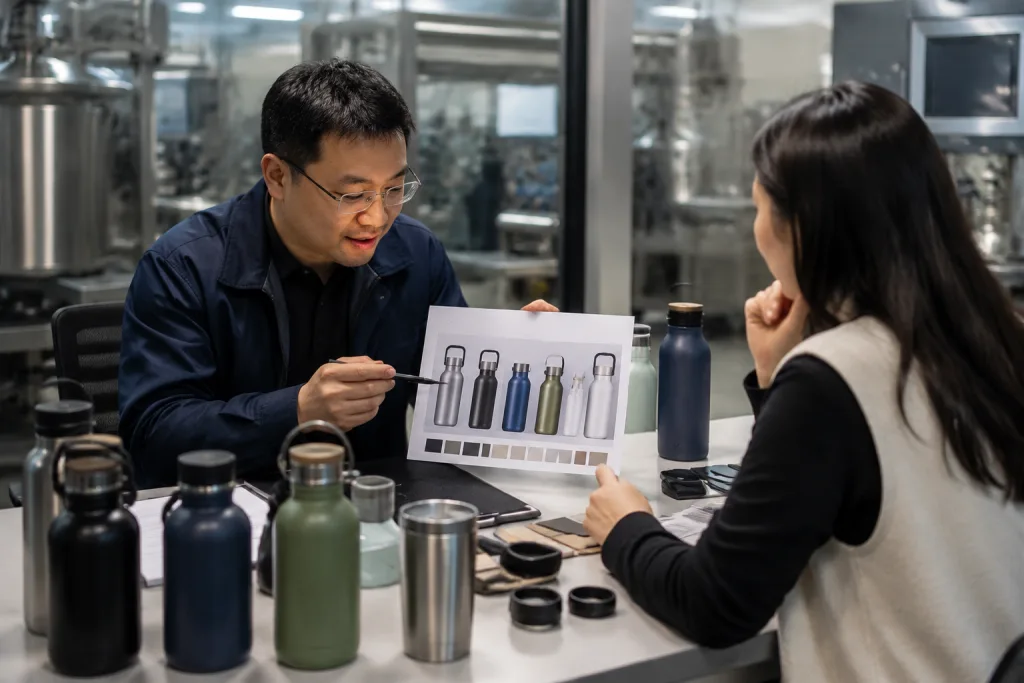
Customization looks easy until the quote sheet has blank boxes. For a canteen custom order, we might be pricing only a 45 mm logo, or we might be pricing a lid tooling change, private PMS lid color, powder coating, individual kraft boxes, barcode stickers, master carton marks, and pallet height limits. Those are not the same job. Last month QC pulled a sample where the PO said “black lid,” but the approved sample was charcoal gray 432C.
For logo work, we usually run silkscreen, laser engraving, heat transfer, UV print, water decal, embossing, or full-wrap sublimation on surfaces that can take the process. Laser engraving holds up well on 304 stainless, but it cuts through to the metal, so it will not match a bright brand color. Silkscreen works for one or two solid colors on a smooth bottle body. Heat transfer and UV handle gradients, but ask for a 3M tape pull test, 500-cycle abrasion check, and dishwasher advice before your sales team promises too much.
Typical decoration costs are easy to explain if the artwork is clear. A one-color silkscreen logo may add USD 0.05-0.12 per unit at 3,000 pieces. Laser engraving may add USD 0.12-0.35 depending on size and position. Custom gift boxes can add USD 0.18-0.60 per unit, with 350 gsm white card costing less than a rigid box with a molded pulp insert. A new injection lid mold can run from USD 2,000-8,000, and the math does not work if the first order is only 500 pieces.
Use this checklist before accepting a canteen customized quote:
- Logo file format: AI, PDF, or EPS vector. A JPG pulled from a website will slow the line.
- Pantone code and surface finish: matte, gloss, metallic, rubberized, or powder coat. Send the PMS number, not “same as last time.”
- Print location and maximum artwork size in millimeters. We mark this on a flat dieline before sampling.
- Retail box dimensions, paper gsm, barcode, warning text, and recycling marks. One wrong digit on an EAN code means rework.
- Inner carton and master carton quantity, gross weight, and drop-test target. Buyers often flag this after seeing a 16 kg carton.
- Incoterm: EXW, FOB Ningbo, FOB Shanghai, CIF, DDP, or other agreed term. Freight cost changes the landed price fast.
A good canteen supplier will push for these details before quoting. It feels slow. We’ve seen this go sideways when a buyer approves a low price first, then adds retail packaging, Amazon labels, and a 1.2 m pallet rule after sampling.
What MOQ is actually workable?
MOQ is not a punishment. It is the break-even point where stainless coil buying, mold setup, powder loss, logo screen setup, AQL 2.5 inspection, and 5-layer export carton packing start to make sense. For vendors drink bottle sourcing from China, we price MOQ by body mold, color, decoration, and packaging; on the line, even changing from a 6 cm logo to a wrap print means a new screen and another setup on the pad printer.
For stock 304 stainless steel bottles with a simple logo, 500 units can work from inventory, but the unit price is higher and the color rack may only have 3 or 4 safe choices. For OEM powder coating, 1,000 units per color is the cleaner starting point. For Pantone-matched coating, 2,000-3,000 units per color is safer because the coating booth loses about 8-12 kg of powder during cleaning and color tuning. For a custom growler or customizable growler with special lid tooling, plan on 3,000-5,000 units unless you accept a higher mold and setup charge. The math does not work under that.
Distributors often ask if one MOQ can be split across five colors. Sometimes yes, if the finish is stock and the canteen factory already runs those colors that week. If you request five custom colors at 400 units each, the quote will hide the pain somewhere: a higher unit price or 12 extra days of lead time. We have seen this go sideways when QC pulled the sample under a D65 light box and the buyer flagged the blue as 1.5 Delta E off target.
A realistic timeline for a canteen promotional order should be written on the PO before deposit. Digital mockup takes 1-2 working days after artwork; last month one buyer lost 2 days because the PO listed “matte black” while the AI file said “gloss black.” Pre-production sample takes 7-12 days for common decoration, or 15-25 days if coating or tooling is new. Mass production usually needs 25-35 days after sample approval and deposit. Peak season before September can stretch this by 7-15 days in Zhejiang and other China manufacturing regions.
If you are a canteen distributor testing a new account, start with one hero size and two colors. Simple wins. We ship cleaner programs when the first run is 1,000 units in black and 1,000 units in white, with one carton mark and one barcode sticker format. Reorder after sell-through data. That beats spreading budget across six SKUs, then arguing with the warehouse for nine months about slow-moving teal bottles.
How do you check quality before shipment?
Quality control starts before production, not at the loading dock. Your PO should lock the approved sample, measurement tolerance in mm, logo position tolerance, leak test method, coating adhesion standard, carton drop test, and inspection level. We usually staple the signed sample tag to the QC file before the line opens. Without that, every defect argument turns into “your opinion versus ours.”
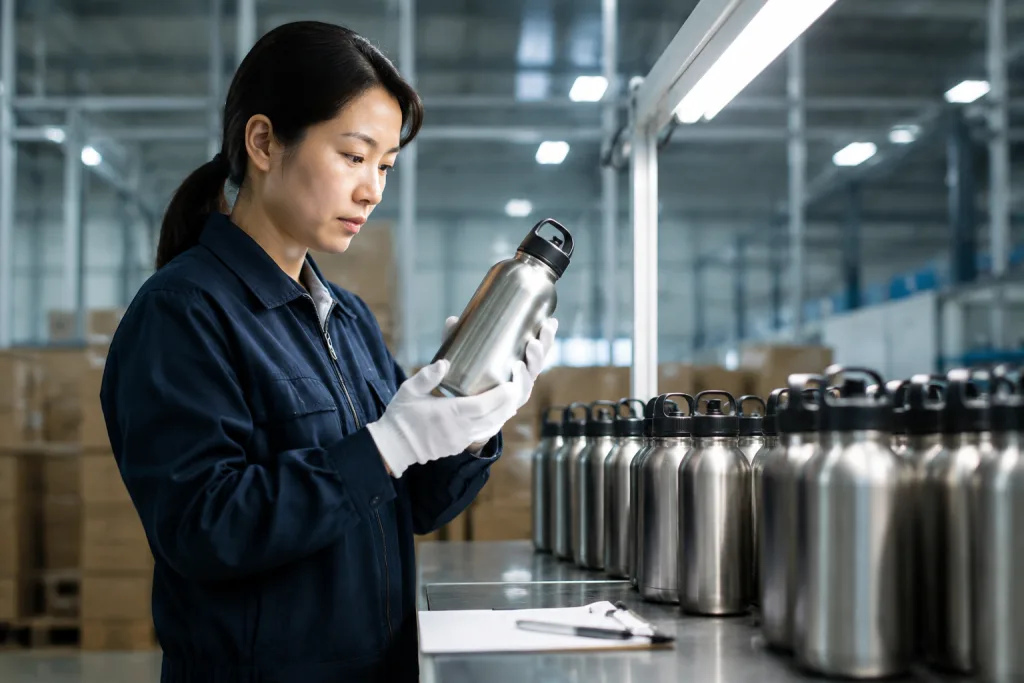
For stainless customized drinkware, we run vacuum insulation testing, coating adhesion checks on powder-coated or painted finishes, lid torque checks with a torque meter, silicone gasket fit checks, leak testing, visual inspection under 600–800 lux lighting, and carton weight verification. For a vacuum bottle, the heat retention test uses 95°C water at room temperature, then QC checks after 6, 12, or 24 hours based on the product claim. One buyer once asked every bottle to match the golden sample within 1°C after 12 hours. The math does not work unless you pay for tighter process control and slower output.
Third-party or buyer inspection should use AQL. A common setup is General Inspection Level II, Critical 0, Major 2.5, Minor 4.0. Critical defects include unsafe sharp edges, wrong material, severe leakage, or contamination. Major defects include wrong logo, obvious dent, coating scratch beyond the agreed mm limit, failed lid fit, or incorrect barcode. Minor defects include small cosmetic marks within tolerance. QC pulled 200 pcs last month and found 7 lids with weak thread bite, so we stopped packing before the inspector arrived.
Ask canteen manufacturers for batch traceability. At minimum, cartons should connect to production date, line, inspection record, and material lot. We print the line number and date code on the outer carton, then match it against the gasket lot in the incoming material sheet. This matters for canteen suppliers serving EU and North American retailers, where recall handling and documentation matter. A low FOB price is useless if you cannot identify which 2,400 units used the questionable gasket lot.
For ecommerce orders, add FNSKU or marketplace label checks to the inspection plan. Scan 32 cartons with the same handheld scanner your 3PL uses, not just a phone app in the sample room. We have seen this go sideways: the bottle looked perfect, but the buyer flagged one digit wrong on the FNSKU and the shipment failed receiving.
Which certifications should matter?
Buyers ask us for “all certificates” on about 6 out of 10 new bottle inquiries. That is the wrong question to ask. Start with the destination country and the shelf where the bottle will be sold, then match the risk to the paperwork. If we ship a stainless canteen program into Germany, we check LFGB, REACH, food-contact migration, packaging waste markings, and, if the retailer asks, BSCI or Sedex social audit files. For the US and Canada, we usually pull FDA food-contact documentation, Prop 65 review when the coating or ink needs it, CPSIA for children’s products, and the packaging rules from the retailer portal. Last month QC pulled a 304 stainless sample with a 0.6 mm wall and the buyer still flagged the swing tag recycling mark before they looked at the bottle.
Factory audits and product tests are not the same thing. BSCI, Sedex, ISO 9001, or similar documents tell you about management control and social compliance, not whether your bottle’s silicone gasket passed migration testing. Product test reports should show the exact material, model, color or coating where relevant, test standard, laboratory name, and report date. Watch old reports. We have seen this go sideways when a 2022 LFGB report covered a PP lid, but the order used a Tritan spout with a different silicone ring, 48 mm across on the drawing.
For a canteen promotional project used at trade shows, the compliance load can be lighter than retail, but it does not disappear. If the item touches food or drink, material safety still matters. Kids bottles need tighter review. Straws, spouts, small parts, and painted surfaces add test items that a plain adult steel bottle does not have. On the line, a 7 mm straw stopper looks harmless until the inspector checks it against the small-parts cylinder and the buyer asks why CPSIA was not quoted.
Here is a practical document pack to request before deposit, especially before you release a 30% TT payment:
- Business license and export record for the China entity.
- Factory audit report if required by your buyer or retailer.
- Material declaration for stainless steel, plastic, silicone, paint, and coating, with grade names such as 304 stainless and PP listed line by line.
- Recent LFGB, REACH, FDA, or relevant food-contact reports, dated within the last 24 months where your retailer allows it.
- Pre-shipment inspection template and AQL standard, normally AQL 2.5 for major defects unless the PO says otherwise.
- Carton marks, pallet rules, and shipping document samples, including the exact SKU and PO number so nobody copies last season’s typo.
A serious canteen supplier will not claim one report covers everything forever. Materials change, coatings change, and regulations move. We run sample retention for 12 months on export orders because buyers come back asking about gasket material after delivery, not during sampling.
What should the final RFQ include?
A tight RFQ saves more money than hard bargaining. We see this every week. If you send “please quote customized canteen, 750 ml, logo, best price,” our sales desk has to guess the steel, lid, coating, carton, and test market. You get 6 quotes that look cheap on paper but price different bottles. The math doesn’t work.
Your RFQ should name the target capacity, material, insulation spec, lid style, surface finish, logo method, artwork size, order quantity by color, packaging, compliance market, delivery term, destination port, and target ship date. If retail is USD 19.99 and your landed cost ceiling is USD 6.20, say it. We can run a 750 ml body with a simpler PP lid or change a gift box from 350 gsm to 300 gsm to hold margin, but we need the commercial target before the line opens a mold trial.
For a distributor growler program for outdoor shops, write it like this: 1.9 L stainless body, 304 inner and outer steel, powder-coated matte black and green, laser logo at 55 mm wide, leakproof screw cap, individual printed box, REACH/LFGB test support, FOB Ningbo, 3,000 units split across two colors, and pre-shipment inspection by AQL 2.5/4.0. QC pulled a similar sample last month because the cap torque felt loose at 1.2 N·m. That kind of RFQ gets a serious quote.
State the rejects too. No substitute steel grade. No logo fading after 50 dishwasher cycles. Cartons under 15 kg for warehouse handling. If you need that, write it into the RFQ, not in a WhatsApp message after mass production. Zhejiang factories run FOB Ningbo and FOB Shanghai shipments all day, but we still need your packing rule, barcode position, and sales channel before we print the first carton.
The best vendor relationship does not come from the lowest first quote. It starts when your canteen factory, logistics partner, and sales team work from one written spec and one approved sample with a signed date sticker. We’ve seen this go sideways from one PO typo: “matte green” became “mint green,” and 42 cartons had to be held before shipment.
Send your drink bottle RFQ for factory review
Share quantity, market, logo method, and target delivery date. We will return practical MOQ, FOB pricing, sampling time, and compliance notes.
Frequently asked questions
What is the normal MOQ for a custom drink bottle order?
For a simple logo on available stock, some vendors can start at 500 units, but color and model options are limited. For OEM production from a canteen factory in China, 1,000 units per color is a more practical baseline. Pantone powder coating usually works better at 2,000-3,000 units per color because the coating line has setup and cleaning loss. New lid tooling or a customized growler body can push MOQ to 3,000-5,000 units. If you are testing a new channel, ask for one stock mold, two colors, and retail packaging first.
How much should I budget per bottle FOB China?
A basic 500-750 ml single-wall stainless bottle may quote around USD 1.60-3.20 FOB, depending on steel thickness, lid, and finish. A double-wall vacuum bottle is more often USD 3.20-6.80 FOB for mainstream B2B quality. Premium powder coating, laser engraving, custom box, and better leakproof lids can add USD 0.40-1.50 per unit. A custom growler or large distributor growler may range higher because of more steel, larger cartons, and slower polishing. Always compare quotes with the same material, wall thickness, decoration, packaging, and inspection terms.
Can I mix several colors under one MOQ?
Sometimes, but it depends on whether the colors are stock or custom. If a canteen supplier already runs black, white, navy, and silver every month, splitting 1,000-2,000 units across those colors can be workable. If you need four Pantone-matched powder coats at 500 units each, expect higher pricing or a refusal. Custom coating has line cleaning, sample matching, and scrap risk. For a new canteen distributor program, two colors at 1,000 units each usually gives better quality control than five colors at 400 units each.
How long does a canteen customized project take?
For a standard model with logo decoration, plan 1-2 working days for mockup, 7-12 days for a pre-production sample, and 25-35 days for mass production after approval and deposit. Custom coating, new packaging, or lid tooling can add 10-25 days. Ocean freight to Europe or North America commonly adds 25-45 days depending on port and season. If you need goods for a dated promotion, give your canteen manufacturer the event date, not just the requested ship date. Peak season in China can easily add one to two weeks.
What documents should I request before paying a deposit?
Ask for a written quotation with material, capacity, lid details, decoration method, packing, MOQ, lead time, payment term, and Incoterm. Then request business license, factory profile, relevant audit documents such as BSCI or Sedex if your customer needs them, and food-contact test reports for the actual materials. For EU orders, REACH and LFGB are common. For North America, FDA food-contact documentation and Prop 65 review may be relevant. Also ask for the pre-shipment inspection standard, ideally AQL General Level II with Critical 0, Major 2.5, Minor 4.0.