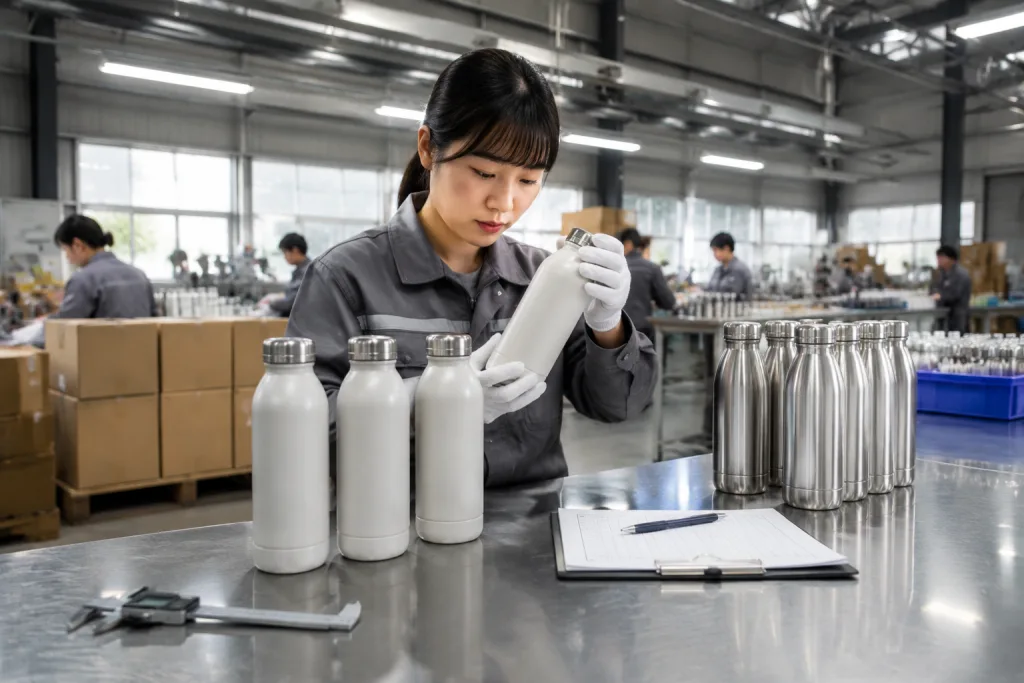
Key Takeaways
- For a 5,000 pc double wall canteen order, confirm 304 inner steel, 0.45-0.55 mm wall thickness, and 6-12 hour thermal claims before sampling.
- A practical MOQ for custom canteen colors is usually 1,000 pcs per color, while full custom tooling normally starts above 5,000 pcs.
- Use AQL 2.5 for major defects and AQL 4.0 for minor defects on final inspection, with vacuum leak testing pulled from each carton lot.
- FOB Ningbo lead time is typically 30-40 days after artwork and pre-production sample approval for standard double walled bottles.
You are not just buying a bottle. You are fixing the steel grade, vacuum hold time, logo process, carton CBM, barcode label position, and whether the supplier can run the same finish again after 90 days. We see this go sideways about 3 times a month: the quote looks clean, but the spec sheet leaves a 0.4 mm wall tolerance, no Pantone limit, and no carton drop-test requirement. QC pulled one sample last April where the buyer approved “matte black,” but the line ran two different powder batches under the same PO.
Here is a real-style order for vendors double walled bottle sourcing: 5,000 pieces of a 750 ml stainless steel canteen for a North American outdoor promotion. BottleForge Industrial in Hangzhou, Zhejiang runs orders like this for distributors and brand owners who need a canteen manufacturer in China, not a catalog trader asking the factory after every buyer question. The wrong question is “what is your cheapest price?” The better one is “can you hold vacuum loss under spec after laser logo, 1.2 m carton drop, and AQL 2.5 inspection?” We ship these projects from the line with barcode rolls checked against the PO; one typo in a UPC can burn 2 days before vessel closing.
Start with the actual use case
The first mistake is asking a canteen supplier for “your best double wall bottle” before you say where the bottle will sell. Wrong question. A retail outdoor bottle and a corporate gift order need different targets on coating life, carton drop strength, barcode setup, and lid feel. Amazon FBA adds its own headaches: polybag warning text, carton weight, and scannable labels. For event resale, the buyer usually pushes harder on landed cost and delivery date. If you skip this, the canteen factory will quote the model already sitting on the sample shelf, not the safest one for your channel. We see it often: QC pulled the sample, the coating looked fine, then the buyer flagged that the 78 mm body would not fit their display tray.
For this buyer scenario, assume you need 5,000 pcs of a 750 ml double walled stainless steel bottle with a screw cap, powder coating, one-color logo, and individual kraft box. Your customer wants a durable custom canteen for a trail event, but the budget is not luxury retail. The math doesn’t work for a fresh mold here. We would run a proven body shape from the line, then tune the lid, logo position, and box print. A new mold can add USD 1,200-3,500 and 20-30 days before mass production even starts. On a 5,000 pcs order, that tooling cost hits every bottle. Last month we had a PO with “750ML” in the item name but “650 ml” in the artwork file; that kind of typo gets expensive after film output.
At BottleForge Industrial in Zhejiang, China, we pin down five points before quoting: capacity tolerance, lid type, steel grade, finish, and packing. A normal 750 ml bottle may measure 72-78 mm in diameter and 270-285 mm in height depending on the shoulder design. Those numbers decide more than the rendering. If your buyer has shelf trays, bike cage fit, or mailer limits, ask for a caliper-checked sample size, not just a 3D image. We run capacity checks with water weight on the bench, and a 15-20 ml gap can start an argument when the retail label says 750 ml.
For a canteen promotional order, ask who carries the risk if the end customer changes artwork after sampling. We’ve seen this go sideways. Good canteen manufacturers freeze a signed specification sheet before production, then the line follows that sheet. It should include logo size in millimeters, Pantone color, powder coating color, barcode requirements, carton marks, and inspection standard. If a canteen vendor will not write those details down, the low price is probably missing something. On one trail event order, the buyer changed the logo from 38 mm to 52 mm after approval; pad printing could not cover it cleanly, so the sample had to move to laser marking.
Build the bottle specification first
A double walled bottle looks simple on the shelf. In the quote, you are paying for steel grade, seam welding, vacuum draw, coating thickness, and the seal stack inside the lid. For Europe and North America food contact orders, we run 304 stainless steel on the inner wall as the starting point. Some buyers ask for 201 stainless steel outside to pull cost down; that works only when the use case is clear and the PO says it clearly. For premium customized drinkware, 304 inner and 304 outer is easier for your sales team to defend when the buyer flags material on a spec sheet.
For the 750 ml order, a practical spec is 0.45-0.50 mm inner wall, 0.50-0.55 mm outer wall, copper-free vacuum insulation, silicone sealing ring, PP lid components, and powder coating at 60-80 microns. We check coating with a film thickness gauge on the line, not by eye. The bottle should pass 100 percent leak testing during production, not just a sample leak test from the top carton. Keep thermal claims conservative: hot water retention around 55-60°C after 6 hours from a 95°C fill under lab conditions, with the final number tied to lid design and room temperature.
Do not print big performance claims on packaging unless you have test data. “Keeps hot 24 hours” sells well, then goes sideways when the cap is wide mouth or the handle lid creates a thermal bridge. QC pulled samples last month where the bottle body was fine, but the lid insert leaked after 8 inversion cycles. A serious canteen manufacturer will tell you where the design gives up insulation to make the bottle easier to drink from.
- Capacity: 750 ml nominal, with ±3 percent tolerance stated on the PI and carton mark file.
- Food contact: LFGB or FDA test route depending on market, with the test item matching the final lid and seal.
- Compliance: REACH for coatings when selling into the EU, checked against the approved powder code.
- Packaging: drop test carton design if shipping by courier or FBA, especially for 12 kg master cartons.
If you are comparing canteen suppliers, force every quote into the same spec. This is where the math often lies. One vendor may quote thinner steel, a lighter lid, or a cheaper coating and look USD 0.35 lower. On 5,000 pcs that is USD 1,750 saved, until returns start and the buyer sends photos of dented shoulders from the first courier drop.
Choose decoration without ruining yield
Logo method is where buyers get themselves into trouble. If a canteen is customizable by laser engraving, screen print, heat transfer, or full wrap, that does not make each option sensible for a 5,000 pcs order. For 5,000 pcs, we run one-color silk screen or laser engraving first because the line is stable and QC can check it fast with a 0.5 mm logo position tolerance. Full wrap artwork can look sharp, but the seam, left-right alignment, and scratch resistance need extra sampling; last month QC pulled 32 pcs from a 200 pcs pre-production run because the wrap seam walked by 1.8 mm.
For powder coated bottles, laser engraving cuts through the coating and shows the stainless steel below. Tough finish. Good outdoor look. Fine text under 1.2 mm stroke width is where we see logos fill in or turn weak, especially on rough matte black powder. Silk screen gives stronger brand color, but the result depends on ink adhesion, oven curing time, and coating texture. We run cross-hatch adhesion checks with 3M tape and alcohol rub tests before mass production approval. If the logo must match a brand guide, send Pantone C numbers and allow a working tolerance; powder coating is not offset printing, and the math does not work if the buyer expects paper-print accuracy on a curved bottle.
A canteen customized for corporate gifting may need individual names or variable data. That points to laser, but variable engraving adds handling time at the worktable. For 5,000 pcs with unique names, expect barcode sorting, 5,000 artwork records, and a higher reject allowance. We have seen this go sideways when a PO had “Jon” in the Excel file and the buyer meant “John”; the machine engraved exactly what was supplied. For standard canteen promotional work, keep it simple: one logo position, one logo size.
Custom growler and customizable growler orders bring a different problem: large curved surfaces magnify print distortion. A 1.9 L customized growler may need a wider fixture and slower printing speed than a 750 ml custom canteen, so the unit cost moves. We use a diameter-matched jig on the screen print table; if the bottle rocks even 0.3 mm, the edge of the logo starts to feather. If a canteen vendor quotes the same logo price for every diameter, ask how they hold the bottle during printing.
Choose decoration after confirming the surface finish. A logo that works on polished steel can fail on matte powder coating.
Sample approval is not a photo
Photo approval is too thin for custom drinkware. We ask for at least one physical pre-production sample; for distributor programs, we run two pieces: one stays with you, one gets sealed in our sample cabinet with a date label and PO number. That sealed piece is what QC pulls when the line starts. Without it, the buyer flagged “blue looks darker” turns into a meeting about phone screens, not bottle color, logo height, or lid torque.
For the 5,000 pc order, the sampling path is normally 7-10 days for an existing bottle shape with standard lid, plus 3-5 days courier time to Europe or North America. If the finish is a custom Pantone powder coat, add 3-7 days for color matching. Sample cost may be USD 80-180 including decoration setup, often refundable against mass production if the order reaches MOQ. One real case: the artwork file said Pantone 5463C, but the PO had 563C, and QC caught it before we mixed 12 kg of powder.
When the sample arrives, don’t stare only at the logo. Fill it with hot water at 90°C, weigh it full and empty on a 0.1 g scale, leave it upside down for 4 hours on white tissue, check the cap thread by hand, smell the silicone ring, and inspect the inside weld line under an LED inspection lamp. Pretty photos are easy. A good canteen factory in China can shoot a bottle from the best angle; your job is to test it the way a customer tests it on Monday morning in a car cup holder.
Approve with written tolerances. Use numbers: logo centerline ±2 mm, color Delta E under agreed visual standard or approved color chip, bottle weight ±5 percent, carton gross weight ±1 kg, capacity within ±3 percent. We also write lid fit notes such as “no cross-threading after 10 open-close cycles,” because we’ve seen this go sideways on reorder lots. If you are a canteen distributor selling to multiple accounts, this discipline protects you when the same buyer comes back six months later asking why the new batch feels lighter.
The same approach applies to customizable drinkware beyond canteens: travel tumblers with slider lids, sports bottles with straw caps, kids bottles with bite valves, and growlers with wide-mouth threads. A sample is not a souvenir. It is a control document, and the math doesn’t work if you treat it like a sales photo.
Price the landed order honestly
FOB unit price is one line on the quote, not the landed cost. For a 750 ml vendors double walled bottle order with powder coating, one-color logo, and kraft box, we would expect FOB Ningbo around USD 3.20-4.60 per piece, depending on 304 stainless thickness, lid mold, coating loss rate, box paper weight, and the weekly steel sheet price. If a quote shows USD 2.40 for the same spec, the math doesn't work. QC usually finds the gap later: 0.38 mm outer wall instead of 0.45 mm, 201 outer steel, a 250 gsm box swapped for 300 gsm, loose lid fit on the torque tester, or a trader hiding margin behind a short spec sheet.
For BottleForge Industrial, a standard-model MOQ is 1,000 pcs per color, with better pricing from 3,000 pcs up. Our partner lines in Zhejiang run about 300,000 stainless steel drinkware units per month across bottles and tumblers; growlers take more line time because the body is larger and polishing is slower. Normal lead time is 30-40 days after deposit and approved pre-production sample, not after your first inquiry. Peak season before Q4 often adds 7-15 days. We've seen this go sideways when a buyer approved artwork on Monday but sent the deposit 12 days later, then asked why the line had moved to another PO.
Payment terms for new buyers are usually 30 percent deposit and 70 percent before shipment after inspection. Established buyers can ask for other terms, but a China factory still needs deposit coverage for raw material, powder coating, lids, boxes, and the production slot. No deposit, no coil booking. If your purchasing team needs 14 days to release deposit, put those 14 days into the schedule instead of pushing the factory after PPS approval. Last month, one PO had the logo Pantone typed as 186C in the email and 186U on the attachment; QC pulled the sample before mass printing, but it still cost 2 days.
Landed costing should include inland freight to Ningbo or Shanghai, ocean or air freight, duty, customs brokerage, inspection fee, destination trucking, and FBA prep if Amazon is involved. Distributor growler and distributor canteen programs often miss carton volume, which is the wrong place to save five minutes. A 750 ml bottle in an individual box may pack 24 pcs per master carton, with carton size around 48 x 34 x 31 cm and gross weight around 10-12 kg. If the gift box grows by 8 mm to fit a thicker insert, we ship fewer cartons per pallet, and freight per piece moves fast.
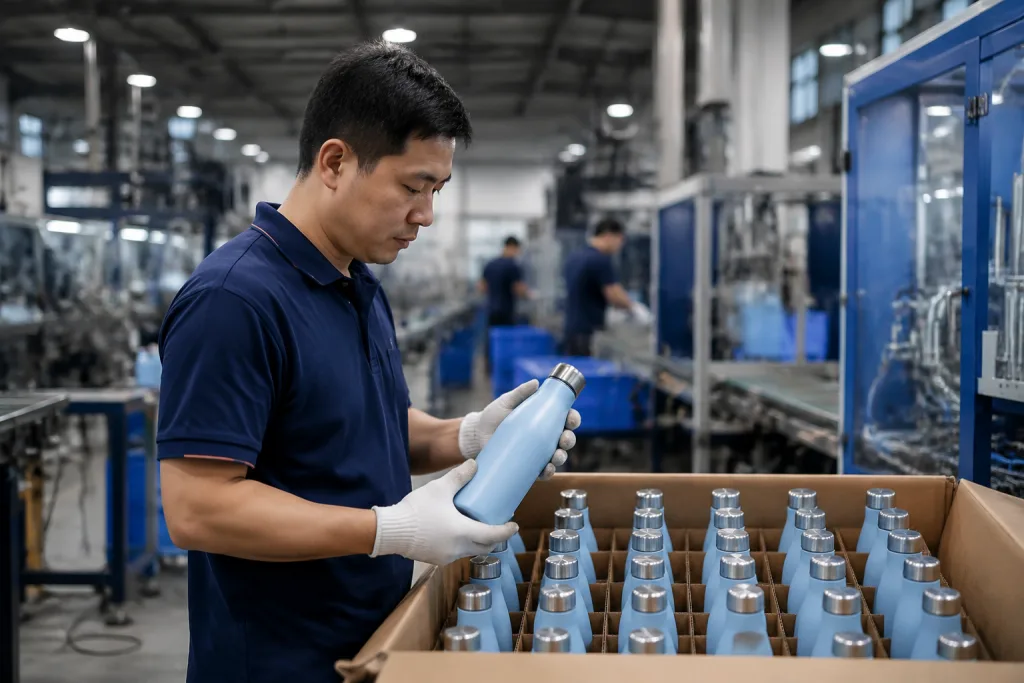
Run QC before the balance payment
Run final inspection when at least 80 percent of the goods are packed and 100 percent are produced. Not at container loading. For the 5,000 pc order, we use ANSI/ASQ Z1.4 sampling with AQL 2.5 for major defects and AQL 4.0 for minor defects unless the buyer’s QC manual calls for tighter limits. Critical defects stay zero tolerance: leaking bottle, sharp edge, contamination, wrong material, unsafe odor, or failed food-contact component. On the line, QC usually pulls cartons with a random-number sheet and opens them on the packing bench, not from the neat top row the packer wants to show.
The inspection checklist must match the purchase order and sealed sample. Check capacity with a graduated cylinder, appearance under a 6500K light box, coating scratches, dents, logo position in mm, logo adhesion, lid fit, silicone ring placement, odor, packaging, carton marks, barcode scanability, and drop-test results if required. For Amazon or retail distribution, scan FNSKU or EAN samples from at least 8 cartons, including bottom-layer cartons. We once had a buyer flag one digit wrong on the PO barcode artwork; the bottles looked good, but the shipment still failed. A good-looking bottle with the wrong barcode is a warehouse problem waiting to happen.
Vacuum performance is hard to inspect fast, but we still run a spot test. Fill selected bottles with 95°C water, close the lid, wait 5-10 minutes, and touch the outer wall. If the shell turns warm fast, QC pulls the sample for vacuum failure. For deeper validation, run a 6-hour or 12-hour temperature retention test on pulled samples, not just one hero sample from the office shelf. A serious canteen supplier should also keep in-line vacuum testing and leak testing records; ask for the log sheet with date, station name, and rejected pcs count.
Ask for production photos, but do not treat them as inspection. Photos show progress; calipers, barcode scanners, leak-test fixtures, and opened cartons show the truth. If defects exceed AQL, settle rework, reinspection, or a commercial deduction before balance payment. Paying first and arguing later is the wrong question to ask—the math does not work once 312 cartons are already at the forwarder. Working directly with canteen manufacturers, not only canteen vendors, matters here because the factory can re-sort, reprint, replace lids, or remake defective units before we ship.
Plan reorders before launch
Plan the reorder before the first shipment leaves China. If your first 5,000 pcs sell through, you need the same coating spec, lid fit, carton print, and logo position again, not a “close enough” repeat. That only happens when the first order file is locked. We keep the approved artwork, Pantone chip, golden sample, carton dieline, AQL 2.5 inspection report, and material test documents in one folder, with the PO number written on the sample tag. Ask the canteen manufacturer to keep the same coating supplier and lid mold for repeat orders where possible.
Reorder risk is real. QC pulled a repeat sample last season where the black powder coat was 1.5 gloss units off and the buyer flagged it against the first shipment photo. Silicone ring hardness can change if the supplier swaps material. A lid that looks identical may run 0.2 mm loose on the thread gauge. For a brand owner, those small differences create customer service noise. For canteen distributors, they create awkward calls with retail accounts that expect the shelf sample and reorder stock to match.
If you expect an ongoing program, tell the factory early. We can reserve common components for 60 days, suggest a stock color, or recommend a bottle body with stable tooling. Customizable canteen projects that use common tooling are easier to reorder than custom canteen shapes with private molds. Full custom tooling can make sense at 20,000 pcs per year, but the math does not work for a one-time 1,000 pc promotion after mold cost, sample rounds, and 12–18 days of tooling lead time are added.
For broader customized drinkware programs, build a small approved range: one custom canteen for outdoor use, one travel tumbler for desk and car cup holders, one sports bottle with a proven flip lid, and one customized growler for premium accounts if your MOQ supports it. This gives your sales team choice without forcing operations to manage 15 unrelated SKUs. We have seen this go sideways when a buyer sent 17 SKU codes and one PO had “matte sand” typed as “matt sand.” Good sourcing is not about endless options. It is about cutting the range until quality, price, and delivery stay under control.
Send your bottle spec for a factory quote
Share capacity, quantity, logo method, market, and deadline. We will return a practical FOB quote with MOQ, lead time, and QC notes.
Frequently asked questions
What MOQ should I expect from vendors double walled bottle suppliers?
For standard stainless steel double walled bottles, expect 1,000 pcs per color as a practical MOQ for powder coating and logo decoration. Some canteen suppliers may accept 500 pcs if using stock colors and laser engraving, but the unit price usually rises by USD 0.40-0.90. For custom mold work, 5,000-10,000 pcs is more realistic because tooling, fixtures, and production setup need to be amortized. If you are testing a new distributor drinkware program, start with an existing 500 ml, 750 ml, or 1,000 ml body and customize color, logo, lid, and packaging before paying for a new shape.
How do I know if a canteen factory is using safe materials?
Ask for the exact material specification, not just “food grade.” For stainless bottles, 304 stainless steel should be used on the inner wall, with silicone seals and PP or stainless lid components depending on design. For Europe, request LFGB food-contact testing and REACH compliance for coating where relevant. For the US, FDA food-contact expectations and California Proposition 65 review may apply depending on sales channel. A serious canteen manufacturer in China should provide test reports from recognized labs such as SGS, TÜV, Intertek, or BV. Also inspect odor, weld cleanliness, and coating adhesion during sampling.
Is laser engraving better than silk screen printing for custom canteen orders?
Laser engraving is usually more durable because it removes the coating and exposes stainless steel, so it will not peel like ink. It works well for outdoor, corporate, and premium custom canteen orders. Silk screen printing is better when you need a specific brand color, large solid logo, or lower-cost decoration on 1,000-5,000 pcs. The trade-off is adhesion risk, especially on textured powder coating. For silk screen, require a cross-hatch adhesion test and alcohol rub test before mass production. For fine logos under 1.2 mm line width, test both methods before approving the order.
What inspection standard should I use for customized drinkware?
Use ANSI/ASQ Z1.4 or ISO 2859-1 sampling with AQL 2.5 for major defects and AQL 4.0 for minor defects as a normal commercial baseline. Critical defects should be zero tolerance, including leakage, unsafe sharp edges, contamination, wrong material, and serious odor. For a 5,000 pc customized drinkware order, inspection should happen when production is complete and at least 80 percent is packed. Pull samples across cartons, not from one neat stack near the factory office. Check logo placement, coating, dents, lid fit, capacity, packaging, barcode scans, and carton marks against the approved sample.
Should I buy through a canteen vendor or directly from canteen manufacturers?
A trading canteen vendor can be useful for very mixed small orders, but direct canteen manufacturers give you better control when the order has custom color, logo, packaging, testing, and repeat demand. For 3,000-5,000 pcs and above, direct factory communication usually reduces specification drift and speeds up rework decisions. The key is not only price; it is whether the supplier controls welding, polishing, coating coordination, assembly, and QC. If a vendor cannot answer wall thickness, AQL level, coating test method, or lead time by production stage, you are probably not talking to the team that will make the bottles.