Key Takeaways
- A realistic MOQ for custom stainless travel tumblers is 1,000 pcs per color for powder coating and 500 pcs for laser logo stock color projects
- For 304 stainless double-wall tumblers, FOB China pricing usually ranges from USD 3.20 to USD 7.80 depending on lid, coating, and capacity
- Use AQL 2.5 for major defects and AQL 4.0 for minor defects on coffee mug customized orders
- Normal production lead time is 25-35 days after artwork approval, with sample approval adding 5-10 days
You are not buying a generic cup. You are buying a branded item that sits on a desk, rides in a 75 mm car cup holder, gets scrubbed with the wrong sponge, and carries your coffee brand or gift budget for 2 to 5 years. So a vendors coffee tumbler quote should not open with color names and clean mockups. That is the wrong question to ask. We start with capacity, insulation target, lid leakage, coating durability, carton packing, compliance, and who pays if the logo is printed 3 mm off-center.
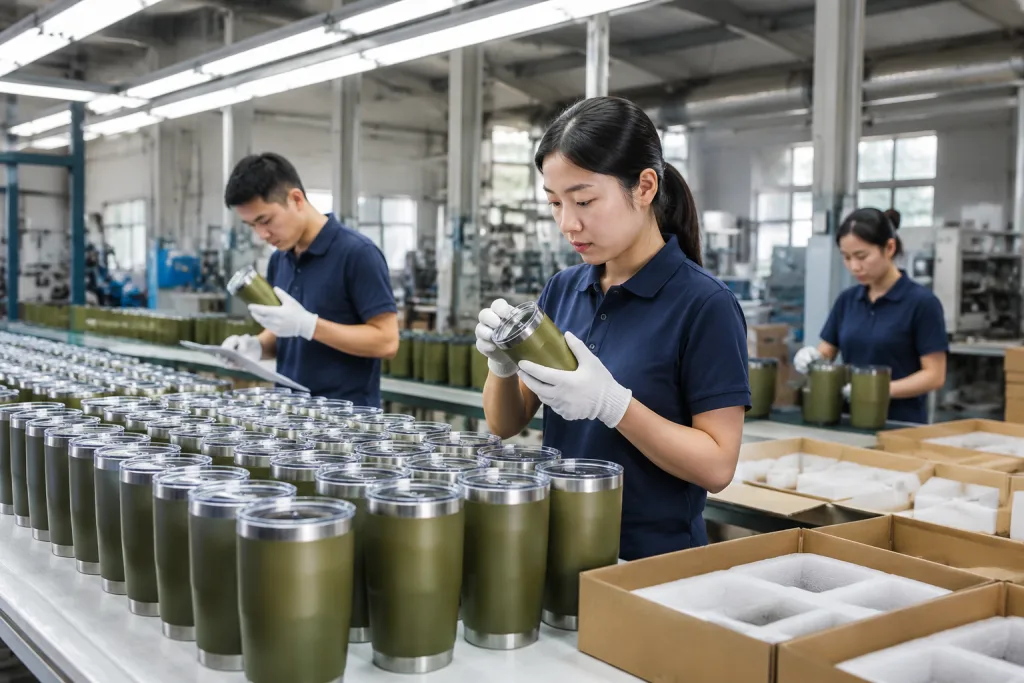
From our Zhejiang factory network, we see this every month: a buyer asks for a bulk coffee tumbler, gets 6 sharp prices, then QC pulled the sample and finds a loose slider lid, thin powder coating, or a 58 × 42 × 36 cm carton that pushes freight cost up. The cheap line looks good on day one. The math does not work after rework, repacking, and 12 days lost before shipment. A good coffee mug factory direct project is not complicated, but it needs disciplined questions before deposit.
Start With The Use Case
The first procurement question is not “bulk coffee mug or bulk travel tumbler.” That is the wrong question to ask. Ask where the cup will sit at 8:30 a.m. A tumbler sold at a coffee roastery counter gets judged by mouthfeel, lid noise, and whether it fits under the espresso machine. One packed into a 3,000-set onboarding kit gets judged by logo position, gift box corners, and whether we ship before the HR launch date. We had a buyer flag a 2 mm logo shift on the pre-production sample, even though the cup itself passed. Coffee brands usually need the retail feel and the corporate deadline.
For hot coffee, 12 oz, 16 oz, and 20 oz are the practical sizes, but each one has a job. A 12 oz travel tumbler suits café merchandise, flat whites, and espresso-based drinks where the counter staff wants a small footprint. A 16 oz size is the safe workhorse for a vendors coffee tumbler program because it fits most cup holders and gives enough straight wall for a coffee mug custom logo at 45-55 mm high. We run this size most often on the laser line. A 20 oz cup feels more premium in hand, but the carton count drops from 24 pcs to 20 pcs in many master cartons, and the lid needs a stronger slider because the filled weight is higher. The math does not always work.
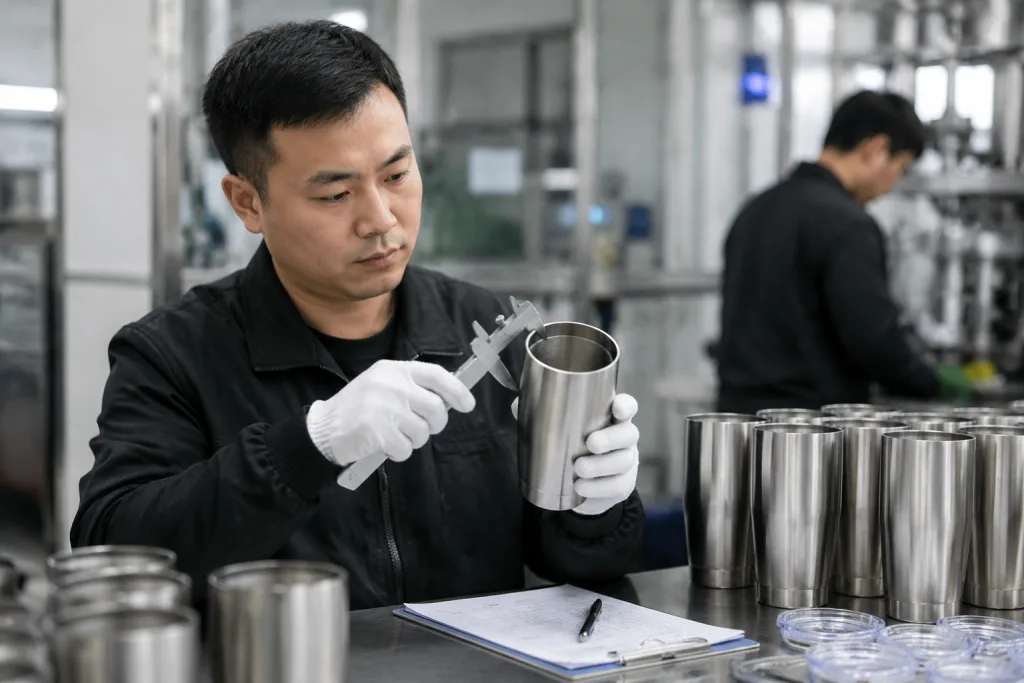
Ask your coffee mug manufacturer for the real dimensions: top diameter, bottom diameter, height, and weight without liquid. Do not rely on the catalog render. A bottom diameter of 68-73 mm usually fits North American and European car cup holders. If the base is 78 mm, you will get complaints even if the product looks clean in photos. QC checks this with a digital caliper, not a guess. Wall thickness also matters. For common 304 stainless construction, inner wall thickness around 0.4 mm and outer wall around 0.5 mm are normal. Thinner walls can cut cost by USD 0.15-0.30, but we have seen this go sideways when cartons take a corner hit and QC pulled 7 dented samples from a 125-piece inspection lot.
For a coffee mug promotional campaign, a simpler lid can pass if the MOQ, budget, and delivery date are tight. For paid retail, do not cheap out here. A slider lid should open smoothly after 500 cycles, the silicone ring should sit flat after hot-water testing, and the drinking port should not whistle or splash. Small stuff becomes public fast. On one reorder, the buyer flagged splash marks around the port during a 90°C fill test, and the review team would have had to answer that later. Fix it before mass production.
What Should The RFQ Include
A thin RFQ creates messy quotes. If your email says only “quote 16 oz coffee mug customizable, logo attached,” each coffee mug supplier fills in the blanks their own way. One factory may price stock black with one-position laser engraving; another may include custom powder coating, 1.2 m carton drop testing, and a molded insert tray. We saw this last April: QC pulled a 16 oz sample from the line, and the buyer flagged the quote because the “same mug” had a 0.4 mm thinner outer wall. The math doesn’t work unless the spec is locked.
For a proper bulk coffee travel mug RFQ, include a checklist like this:
- Capacity: 12 oz, 16 oz, 20 oz, or the exact milliliter fill line measured to the lid seal.
- Material: 304 stainless steel inside and outside, or 304 inside with 201 outside when the target price leaves no room.
- Insulation: hot retention target, such as 60°C after 6 hours from 95°C starting water, tested with a probe thermometer in the QC room.
- Lid type: press-fit, screw lid, slider, flip lid, straw lid, or sip-through lid, with silicone ring hardness if leakage is a concern.
- Logo method: laser engraving, silk screen, heat transfer, UV print, embossing, or full-wrap print, plus artwork size in mm.
- Finish: powder coating, spray paint, plating, matte, gloss, or raw stainless, with Pantone code and scratch-test expectation.
- Packing: white box, kraft box, color box, belly band, master carton quantity, FNSKU if needed, and barcode position on the box.
- Compliance: LFGB, FDA food contact, REACH, CA Prop 65, or ASTM where relevant to your sales market.
- Inspection: AQL level, carton drop test, leakage test, coating adhesion test, with pass/fail photos in the inspection report.
If you are comparing a coffee mug supplier directory or a coffee mug supplier list, make every vendor answer in the same table. Do not accept “similar quality.” Ask for steel grade, lid material, coating process, logo setup fee, sample fee, MOQ, lead time, FOB port, and carton dimensions; one buyer once sent us a PO with “FOB Ningbo” typed as “FOB Ningo,” and that small typo delayed the booking by 2 days. At BottleForge Industrial in Hangzhou, Zhejiang, we quote travel tumbler projects with MOQ, tooling assumptions, and production capacity stated up front; our current travel tumbler line capacity is about 450,000 units/month in China with standard lead time of 30 days after approved pre-production sample.
How Much Should You Pay
There is no useful single price for a vendors coffee tumbler. This is the wrong question to ask first. Price moves with SUS 304 coil cost, powder yield on the spray line, lid structure, MOQ, and packing spec. For 16 oz double-wall 304 stainless travel tumblers, FOB Ningbo or Shanghai pricing commonly sits around USD 3.20-4.20 for a stock body with laser logo at 1,000 pcs. Custom powder coating with 18-22 micron film thickness and an upgraded slider lid usually puts the same tumbler at USD 4.60-6.20 when we add an individual color box. A heavier retail-grade model with 0.5 mm outer wall, premium screw lid, and full-wrap artwork can reach USD 6.80-7.80. QC pulled a matte black sample last month where the logo shifted 1.5 mm after laser positioning, so yes, small spec details affect the quote.
A cheaper quote can be valid. Ask what changed. Did the vendor switch outer steel from 304 to 201? Did they cut vacuum testing from 100% to spot check? Did they quote 0.35 mm outer wall instead of 0.5 mm? Did they remove the color box? Did they assume EXW instead of FOB? We have seen this go sideways: a buyer saved USD 0.35 per cup, then lost the saving when 47 cartons showed corner crush after a 12 kg stack test. If lids leak during a holiday gift shipment, the math doesn't work.
For coffee mug in bulk programs, volume discounts are real, not magic. Moving from 1,000 pcs to 3,000 pcs may reduce unit price by 5-9%. Moving from 3,000 pcs to 10,000 pcs may reduce another 4-7%, depending on coating yield and packaging. The line still needs setup time, color change cleaning, and lid assembly labor. We run powder coating in batches, and a 10,000 pcs order in 2 colors is easier than 6 colors with 1,666 pcs each. If a coffee mug oem manufacturer offers a 25% discount just for doubling volume, check the specification again. Something changed.
Budget for fixed costs too. Sample fee may be USD 80-180 for a coffee mug custom made sample with logo. A new mold lid can cost USD 1,500-5,000. Custom gift box artwork may need USD 120-300 for proofing and plate charges. Corporate buyers often miss these line items, then push the supplier to hide them inside unit price. Bad habit. We once had a PO typo list “1C logo” while the approved artwork was 2C, and the reorder argument took 4 emails to settle. Put the charges in the quote sheet, or future reorders get messy.
Logo And Finish Decisions
A custom coffee mug project wins or loses on the shelf. The tumbler can pass leak testing and still look like a cheap giveaway if the logo is fuzzy or off-center. We’ve seen this go sideways on a 1,200 pcs order where QC pulled the sample and the buyer flagged a 1.5 mm logo tilt. Pick the decoration method by wear life first, artwork second.
Laser engraving is the safe bet for stainless and powder-coated tumblers. Clean edge. Permanent mark. Low drama on the line. On powder coating, the laser burns through the coating and shows the metal underneath, so it works best for simple one-color brand marks. For coffee mug private label projects, this is usually where the math works: setup cost is low, often USD 30-80, and MOQ can be 500 pcs when we run existing body colors from stock powder.
Silk screen printing saves money on larger artwork, but travel tumblers are curved, so registration tolerance matters more than the catalog photo suggests. If your logo has 3 colors, 6 pt text, or hairline strokes under 0.3 mm, ask for a printed sample before mass production. Heat transfer and UV printing carry more color, but adhesion testing has to be real. We run a cross-cut tape test, alcohol rub test, and only support a dishwasher claim if that exact finish passed testing; 8 out of 10 bulk tumbler specs we see still end up hand-wash recommended, even after the buyer asks for dishwasher safe.
Powder coating beats ordinary spray paint for most bulk travel mug orders. A sensible coating thickness is 60-90 microns. Too thin, it chips at the base after a drop test. Too thick, it gets orange-peel texture near the rim, and QC will catch it under the light box. Ask whether the factory masks the drinking lip and base contact point; poor masking leaves sharp edges and color build-up. For coffee mug promotional products, looser color tolerance may pass. For retail coffee brands, define the Pantone range before sample approval, or the buyer will argue over half a shade on the PP sample.
If you need coffee mug private labeling, put the bottom logo, hangtag, care card, barcode, and carton mark into the RFQ stage. Small items still stop production. We had one PO with the barcode digit typed wrong, and fixing the artwork after deposit turned a 12-day print schedule into 18 days.
Quality Checks Buyers Can Enforce
You do not need to become a factory engineer, but you do need a written inspection plan before mass production starts. Good coffee mug manufacturers expect it; we run smoother when the buyer sends a 1-page checklist with the PO. Weak suppliers push back because it removes the “acceptable by factory standard” escape hatch, and we have seen this go sideways when the only approved sample is a photo in a WhatsApp thread.
For a bulk coffee mug order, use AQL 2.5 for major defects and AQL 4.0 for minor defects unless your retailer requires stricter limits. Major defects include leakage, wrong logo, exposed rust, sharp edges, serious dents, failed vacuum insulation, missing silicone ring, or incorrect packing. Minor defects include small coating specks, slight color variation within approved range, light carton scuffing, or minor print misalignment inside tolerance. Be strict here. Last month QC pulled 32 samples from a 3,000 pcs coffee tumbler lot and found 2 cups with silicone rings missing after the lid assembly station changed operators.
The inspection checklist should include:
- Leakage test: fill with water, close lid, invert for 30 seconds, then shake 10 times. Do not call every slider lid leakproof; most are splash-resistant only, and buyers flag this fast after the first Amazon return batch.
- Vacuum test: hot water at 95°C, measure outside wall temperature after 5 minutes and liquid temperature after 6 hours. We use a probe thermometer and mark the cup base with a grease pencil so the same sample is tracked.
- Coating adhesion: cross-cut tape test on 3-5 samples per color. Use fresh 3M tape, not the dusty roll sitting beside the powder coating line.
- Logo position: tolerance such as ±2 mm vertical and horizontal from approved sample. Put the approved sample on the table and measure with a caliper, not by eye.
- Carton drop: ISTA-style drop sequence from 76 cm for export cartons under 10 kg, if required. If the carton corner crushes and the inner polybag tears, the math does not work for warehouse handling.
- Food contact: confirm FDA or LFGB test report covers the actual material, not only a similar bottle. A report for 304 stainless does not automatically cover a new lid plastic or printed ink.
For Europe, REACH and LFGB are common requests. For the United States, FDA food-contact compliance and CA Prop 65 review may be needed, especially for coatings and printed inks. If the product is for children, requirements change; treating a kids tumbler as a standard coffee mug bulk order is the wrong question to ask. Ask the coffee mug factory for test reports dated within the last 12-24 months and check the model/material scope; we once had a buyer flag one PO typo where “PP lid” became “PS lid,” and that single letter delayed shipment by 6 days.
Supplier Vetting Without Guesswork
Buyers often search for 20-name coffee mug distributor lists because they want a safe shortcut. Directories give you names; they do not tell you whether the line rejects a crooked laser logo or lets it pass. We see this every month. Whether you buy through a distributor or coffee mug factory direct, ask the same hard questions before you send a PO.
Start with factory identity. Is the supplier a trading company, factory, or hybrid exporter with partner factories? None of these is automatically bad. A solid exporter in Zhejiang may handle artwork, inline QC, carton marks, and vessel booking better than a small workshop running only press and polish machines. The point is control. Ask who owns welding, polishing, coating, assembly, and final packing. Ask for the business license, BSCI or Sedex audit if available, ISO 9001 status if claimed, production photos, and a live video walkthrough where you can see the argon welding station, polishing wheels, powder coating oven, assembly benches, and packed cartons with shipping marks.
Then check communication quality. A capable coffee mug supplier should answer whether the lid is PP, Tritan, or AS; whether silicone is food-grade; whether the inner steel is 304; whether spare lids are stocked; and whether the MOQ applies per color, per logo, or per total order. Short answers are fine. Empty answers are not. If they dodge these questions and only repeat “best quality, best price,” move on. We had one buyer flag a quote last year because the supplier wrote “304 body” but the BOM showed 201 outer shell; QC pulled the sample, and the magnet test made the problem obvious.
For China sourcing, payment terms show how mature the supplier is. Normal terms are 30% deposit and 70% before shipment after inspection, or 30/70 against copy documents for established buyers. For new custom projects, a supplier may ask for sample fee and mold fee before sampling. That is normal. Paying 100% before production is the wrong risk to take. We run custom lid molds only after the fee lands, then send a 3D file and pre-production sample; a 0.3 mm lid fit issue is cheaper to fix before the mold shop cuts steel.
At BottleForge Industrial in Hangzhou, Zhejiang, we prefer buyers to send a comparison sheet. It keeps both sides honest. If another China quote is lower, we can usually find the reason in one review: steel grade, lid structure, coating thickness, inspection level, or packing. Sometimes the math doesn’t work. A quote that is USD 0.42 lower may have no drop test, thinner cartons, or no spare gasket bag; we ship 24 pcs per master carton, and one weak carton corner can turn into 3 claims before the container even reaches Hamburg.
Timeline And Reorder Planning
A travel tumbler program usually runs late because approvals sit in someone’s inbox, not because the factory forgot the order. Work backward from the delivery date. For a normal 1,000-5,000 pc bulk coffee tumbler order, we run 5-10 days for sample making and courier delivery, 2-4 days for buyer review, 25-35 days for mass production after written approval, and 25-40 days for ocean freight to North America or Europe by port and season. Air freight is faster, but the math often hurts: USD 1.20-3.50 per unit for a stainless tumbler, and we have seen quotes jump higher when cartons hit 12 kg dimensional weight.
Holiday corporate-gift buyers should approve samples by August 25-31 if they want November delivery by sea. Don’t push this. Coffee brands launching seasonal merchandise should lock color and logo at least 60-75 days before the retail date. If the order needs custom powder coating, printed gift boxes, FNSKU labeling, or Amazon carton rules, add 5-8 days because QC still has to check barcode scan, carton drop-test corners, and the 3 mm logo position tolerance before the line packs.
Reorders are easier when the approved sample is documented. Keep the Pantone number, coating finish, logo file version, lid type, silicone color, carton mark, barcode, and inspection standard. A coffee mug custom program needs a specification sheet, not just a purchase order. We had one reorder where the PO said “same as last time,” but the old logo file was V3 and the buyer attached V2; QC pulled the sample before mass printing, or 3,000 lids would have carried the wrong mark.
For private label coffee mug programs, plan spare parts. Ordering 2-3% extra lids and silicone rings is cheap insurance for retail shelves and distributor stock. If you sell through coffee mug distributors, replacement parts cut returns and protect margin; one missing silicone ring can turn a USD 6.80 tumbler into a refund ticket. The best bulk travel tumbler is not the lowest first invoice. It is the one we ship consistently, pass under AQL 2.5, and reorder without drama.
Send Your Tumbler Spec For A Factory Quote
Share capacity, logo, color, quantity, and delivery market. We will return a practical MOQ, FOB price, sample plan, and inspection checklist.
Frequently asked questions
What MOQ should I expect for a vendors coffee tumbler order?
For most stainless travel tumblers, expect 500 pcs if you use an existing body color with laser engraving, and 1,000 pcs per color for custom powder coating. Full-wrap printing, custom molded lids, or retail gift box programs may push MOQ to 2,000-3,000 pcs. If a coffee mug manufacturer accepts 100 pcs with custom coating, check whether it is hand-sprayed, locally subcontracted, or priced with a high setup charge. For corporate-gift buyers testing a campaign, we usually suggest 500 pcs laser logo first, then move to 1,000-5,000 pcs once the design and user feedback are proven.
Is a bulk coffee travel mug leakproof or only splash-resistant?
Most coffee travel tumblers with slider lids are splash-resistant, not fully leakproof. They are designed for desk, café, commute, and car cup-holder use, not for throwing into a backpack upside down. If you need true leakproof performance, choose a screw lid or locking flip lid and require an inverted leakage test for 30 seconds plus a shake test. The trade-off is drinking comfort and cleaning complexity. For coffee mug promotional products, splash-resistant lids are often acceptable. For retail coffee brands charging USD 18-30 per unit, define the leakage claim clearly on packaging to avoid returns.
Which logo method is best for coffee mug private label orders?
Laser engraving is the lowest-risk method for most coffee mug private label projects, especially one-color logos on powder-coated stainless tumblers. It is permanent, clean, and usually adds only USD 0.10-0.25 per unit depending on size and position. Silk screen is cheaper for simple one-color prints but less durable on curved coated surfaces if adhesion is poor. UV and heat transfer allow more colors but need stricter testing. For coffee mug custom made retail items, approve a physical sample, not only a digital mockup, and set logo position tolerance at about ±2 mm.
How do I compare quotes from different coffee mug suppliers?
Put every quote into one table with capacity, steel grade, wall thickness, lid material, coating type, logo method, packing, MOQ, sample fee, lead time, FOB port, carton dimensions, and inspection standard. A USD 3.60 quote and a USD 4.40 quote may not be for the same product. One may use 201 outer steel, thinner coating, no color box, or EXW terms. Ask each coffee mug supplier to confirm AQL level and whether food-contact reports apply to the exact model. For coffee mug factory direct buying from China, clarity beats aggressive negotiation.
What lead time should corporate-gift buyers plan for?
Plan 40-55 days before shipment for a normal customized travel tumbler order: 5-10 days for sampling, 2-4 days for approval, and 25-35 days for mass production. Add ocean freight time separately, usually 25-40 days to Europe or North America depending on destination port. If you need FNSKU labels, printed inserts, custom color boxes, or multiple delivery addresses, add 5-8 days. For November and December gift programs, do not wait until October to approve artwork. Rush orders are possible, but they reduce choices and increase air freight cost.