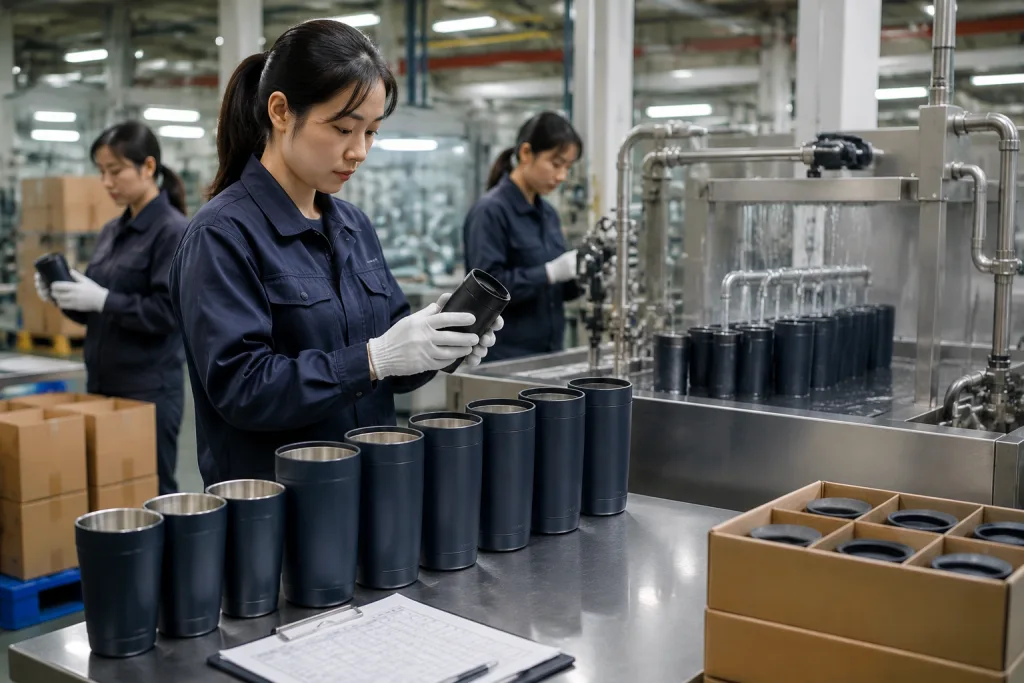
Key Takeaways
- For travel tumblers, spec 304 stainless steel at 0.45-0.55 mm inner wall and 0.50-0.60 mm outer wall for stable vacuum performance
- A realistic MOQ for coffee mug custom made orders is 1,000-3,000 pcs per color, depending on coating and lid type
- Use AQL 2.5 for major defects and AQL 4.0 for minor cosmetic defects on bulk travel tumbler inspections
- Plan 7-10 days for pre-production samples and 30-40 days for mass production after artwork approval
A vendors coffee travel mug order usually fails in boring places: a lid gasket that drops from 2.2 mm to 1.6 mm after heat cycling, a powder coat that chips at the sip rim, a logo that looks fine on the golden sample but ghosts after 500 dish cycles. We’ve seen this go sideways. If you buy for a coffee brand or a corporate-gift program, those small misses turn into 3% return claims, bad reviews, and the kind of Friday call nobody wants with the end client.
Our Hangzhou, Zhejiang team sees the same problems across China export projects, whether the PO says bulk coffee mug, bulk coffee travel mug, or coffee mug promotional product. Last month QC pulled 12 samples from the line and flagged a lid fit at 0.35 mm over tolerance; the buyer thought the color was the risk, but the seal was the problem. The fix is not “choose a better mug.” That is the wrong question to ask. Write the failure out of the specification before tooling, sampling, and AQL inspection start.
The Lid Fails First
Ask a coffee mug supplier what makes a tumbler good and 7 out of 10 will start with insulation hours. Buyers call us about lids first. The body can hold vacuum for 8 hours, but one bad sip-port seal turns the SKU into a return problem. QC pulled 32 samples from a 3,000-piece pre-shipment lot last May; 5 showed slow dripping at the slider after the carton-drop test. Loose sliders, stretched silicone rings, and lids that pop under hot-fill pressure are the usual troublemakers.
For a vendors coffee travel mug program, decide early: spill-resistant or leakproof. Different claim. A push-on lid with a sliding mouthpiece is fine for desk and car use, but do not call it bag-safe. We've seen this go sideways when a buyer's Amazon listing said “leakproof” and the actual lid was only a friction-fit PP cap. If your sales channel wants a strong claim, we run a threaded lid with a full silicone seal and test it upside down for 30 minutes after filling with 90°C water.
Write the lid spec like an engineer, not like a catalog page. Require food-grade PP or Tritan, silicone gasket hardness around 50-60 Shore A, and a gasket that can be removed for cleaning with a pick tool or by hand. Ask for lid fit tolerance, usually within ±0.20 mm on the sealing diameter. On the line, our go/no-go gauge catches this before assembly; if the factory cannot explain that number, you are not talking to a serious coffee mug factory.
For corporate gifts, check drinking comfort too. A lid can pass a leak test and still feel cheap if the slider rattles. For coffee brands, cupholder fit matters: 68-74 mm bottom diameter works for most North American cars. At BottleForge Industrial in Zhejiang, our normal travel tumbler line runs about 450,000 units/month, but we still reject lid molds when the slider gap is inconsistent by more than 0.30 mm. Capacity means little if the lid design is lazy.
Vacuum Claims Get Exaggerated
8 out of 10 coffee mug manufacturers will quote “12 hours hot, 24 hours cold” because it sounds safe on a sell sheet. The test can pass in a lab, then disappoint in a café handoff with the lid opened 6 times before lunch. A 20 oz bulk coffee tumbler filled with 95°C water, tested at 20-22°C room temperature, should still be above 55°C after 6 hours if the vacuum is sound. We run that check with a probe thermometer and a 6-hour log sheet. That is the right benchmark for hot coffee, not a slogan.
The failure usually starts with thin steel, poor welding, or weak vacuum sealing at the base. For stainless steel travel tumblers, specify 304 stainless steel for food-contact surfaces. Common wall thickness is 0.45-0.55 mm inner and 0.50-0.60 mm outer. Going thinner can save USD 0.08-0.15 per piece, but the math doesn't work when cartons arrive with dents and QC pulls 3 cracked bases from a 200-piece inspection lot. For lower-cost promotional runs, 201 outer steel can be used, but keep 304 on the inner wall if the product touches coffee.
Ask your coffee mug oem manufacturer for a vacuum test method. A basic factory should run hot water testing or a thermal imaging check. Better lines use vacuum decay testing before packing; on our line, QC marks failed cups with red tape before they reach the lid assembly table. Your purchase order should define a reject condition, for example: surface temperature rise beyond the approved range after 5 minutes with boiling water, or temperature retention below agreed data at 2, 4, and 6 hours.
Do not approve a coffee mug factory direct quote that lists only capacity and color. A serious quote should mention material grade, inner and outer thickness, lid material, coating, logo process, packaging, Incoterm such as FOB Ningbo or FOB Shanghai, and lead time. We have seen a PO typo change “powder coating” to “painting,” and the buyer flagged it only after the pre-production sample. In China, small wording gaps become real production gaps.
Coatings Chip Where Hands Touch
Powder coating looks simple until the first 48 cartons land with rim chips, hook marks, and orange peel you can feel with a fingernail. For bulk travel mug orders, coating failure gets noticed fast because the end user grips the same spot 20 times a day. Matte black, cream, and white show scratches sooner than metallic or speckled finishes; QC pulled a 304 stainless sample last month and found 0.8 mm silver dots around the drinking rim after the jig change. If your buyer wants a premium coffee mug private label look, lock the coating standard before the line starts.
Start with the coating type. Powder coating holds up well for coffee mug customized projects, and we run it most often on 500 ml and 600 ml travel tumblers. Spray paint costs less and can look smooth, but the math does not work if the buyer expects retail-shelf durability at a giveaway price. Ceramic-look coatings feel good in hand, but we check staining with coffee, black tea, and hand oil on a white cotton cloth after 24 hours. For a coffee mug promotional order, skip the cheapest finish unless the campaign is meant to last 30-45 days and the buyer accepts that trade-off in writing on the PO.
Use physical tests. A cross-hatch adhesion test should reach 4B or 5B, cut with a 1 mm blade grid, not a random box-cutter scratch. A 3M tape pull test after curing is the floor. For higher-end coffee mug custom programs, request 50-100 dishwasher cycles, even if the care card still says hand wash only. Check rim impact too. We’ve seen this go sideways when the lip, bottom edge, and handle area touch the coating jigs; one buyer flagged 17 chipped handles from a 2,000 pcs pilot run.
Color matching is another trap. A Pantone target on paper will not match curved stainless steel 1:1, especially under warm showroom lights. Ask for one flat color plaque and one finished tumbler sample, then approve color under D65 light if possible. For repeat coffee mug distributors, keep a retained sample in your office and another in the factory QC room with the PO number, color code, and approval date written on the label. Small detail, big save. It stops the second PO from drifting two shades away from the first.
Logos Look Cheap Fast
Logo decoration is where a decent bulk coffee travel mug turns into repeat orders or 312 complaint photos from a distributor’s sales team. The common failures are logo drift, thin white ink, laser marks that disappear under shop lighting, and wrap artwork with a 2 mm step at the join. We see it on the line. QC pulled one matte black 500 ml tumbler last month because the logo sat 3.8 mm lower on the second cavity jig; the buyer flagged it before the carton test was even finished. For coffee brands, the logo is not trim. It is why the mug exists.
Pick the process from the artwork, not from last year’s PO. Laser engraving is clean and permanent on 304 stainless steel or powder-coated tumblers, but the math does not work if the buyer expects Pantone 186C red. Silkscreen keeps cost down for 1-2 color logos on straight walls; on tapered bodies, we run a curved jig and still set a ±1.5 mm placement limit. Heat transfer handles gradients and photo-style designs, but we test edge lift with 3M tape and 30 scuff strokes before approval. UV printing suits detailed coffee mug customizable artwork, though the surface needs plasma treatment or primer, then an abrasion check after curing.
For coffee mug custom made work, define placement in millimeters. Do not write “logo centered.” Write: logo width 55 mm, vertical center 92 mm from bottom, tolerance ±1.5 mm, facing opposite seam or facing sip opening. If retail packaging has a window, define logo orientation to the box front, including handle direction for handled mugs. Small point, big headache. We once had 4,800 tumblers pass AQL 2.5 for print adhesion, but the logo faced the side panel in the window box, so the shelf display looked wrong.
Ask for editable AI files with outlined fonts, vector PDF for checking scale, or CDR when the artwork came from an older local design shop. Require a digital proof plus 1 physical pre-production sample before mass printing starts. For coffee mug private labeling, check bottom markings, care labels, barcodes, and FNSKU placement if shipping to fulfillment centers. Barcode labels are not “packing details.” We have seen a PO typo put the FNSKU on the polybag instead of the carton label, and that pushed warehouse receiving from 6 days to 13 days.
Packaging Is Not Decoration
Packaging failure hurts because it shows up after the tumbler has already passed the line. We have seen 304 stainless bodies pass vacuum test, then arrive with flat spots because the inner tray was 1.5 mm too loose. Cracked lids and rubbed powder coating are usually carton-engineering issues, not tumbler issues. A 3,000 pcs corporate gifting order can clear AQL 2.5 and still look second-hand if the buyer only approves the cup and ignores the box.
Define the packing route before we quote. For ecommerce, we run a stronger single box, PE bag or tissue wrap, and a carton layout that can take a drop test without the lid punching through the side wall. For wholesale coffee mug distributor shipments, a printed gift box inside a master carton can work, but the buyer should confirm stacking height; one UK buyer flagged crushed bottom-layer boxes after 5 cartons were stacked in a forwarder warehouse. For event giveaways, the math is different. White box or egg-crate packing is fine if the buyer accepts lower shelf impact.
Use carton data, not guesswork. A common 20 oz tumbler gift box may be around 90 x 90 x 190 mm, with master cartons of 24 pcs. Carton gross weight often lands around 9-12 kg depending on bottle weight and packaging. Keep master cartons under 15 kg where possible; warehouse teams in Europe and North America appreciate it, and damage rates usually drop. For Amazon-style routing, confirm FNSKU, suffocation warning if polybags are used, and carton labels before production packing starts. QC pulled one packed sample last month because the PO said “carton mark: black,” but the artwork file showed blue; small typo, 600 cartons at risk.
For ISTA-style checks, run a 1.2 m drop test on the export carton: one corner, three edges, and six faces. It is not perfect, but it catches weak corners and loose internal fit; we measure the post-drop gap with a 150 mm caliper when the insert looks suspicious. If your coffee mug supplier list does not ask about packing method, carton size, and pallet loading, the list is incomplete. Packaging deserves a line in the quote, the sample approval, and the final inspection checklist. This is where we have seen orders go sideways.
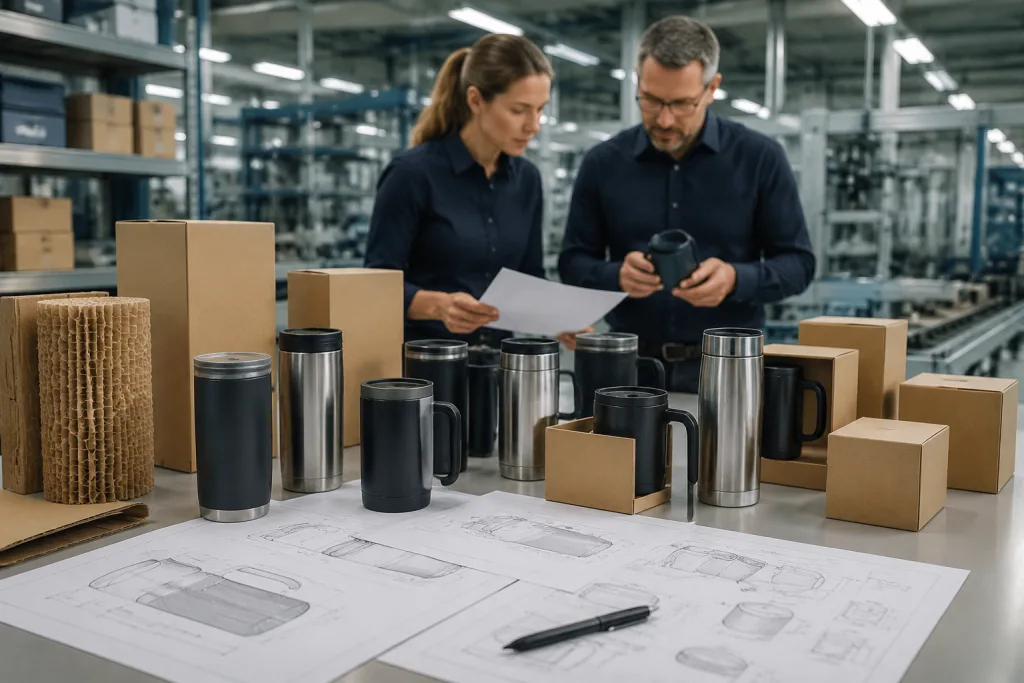
Compliance Paperwork Arrives Too Late
Compliance gets treated like a folder we send after the price is locked. Wrong order. If you sell in the EU, you need food-contact compliance and REACH-related checks for coatings, inks, and silicone parts when those parts touch the drink or mouth. If you sell in the United States, check FDA food-contact expectations, California Proposition 65 where relevant, and ASTM or CPSIA considerations if a child could use the product. For a standard adult bulk travel tumbler, we run the first check around food-contact safety, heavy metals, and label claims; QC pulled one coated 40 oz sample last month because the ink spec on the PO said “matte black,” but the artwork file called for “soft-touch black.”
Ask for reports before you approve the vendor, not after deposit. Reports must match the material and product type. A generic stainless steel report from 2021 does not cover a new coated travel tumbler with a different PP lid, silicone gasket, and UV logo ink. For coffee mug promotional products, 6 out of 10 corporate buyers we deal with now ask for BSCI, ISO 9001, Sedex, or a similar factory audit document during onboarding. These audits do not prove the tumbler is safe. They keep procurement moving. We have seen this go sideways when a buyer paid a 30% deposit, then their compliance team rejected the supplier because the audit name did not match the factory name on the proforma invoice.
In China, export factories can usually provide SGS, Intertek, TÜV, or BV test reports if the project size justifies it. If you need fresh testing, budget roughly USD 250-800 per test package depending on scope and lab. Add 5-10 working days to the timeline. Do not squeeze this into the last week before shipment. The math doesn't work: the lab may need 2 finished samples, 1 spare lid, and the final coating thickness checked on a micrometer before they even start the test.
For a coffee mug supplier directory comparison, give extra weight to vendors who ask where the product will be sold. A factory that quotes the same item for Germany, California, and Canada without asking compliance questions is saving 12 minutes on email and pushing the risk onto you. We ask this before sampling because the line needs to know whether to use the standard silicone ring or a tested batch tied to a current report number.
Inspection Finds Problems Too Late
The worst QC result is not a failed report. It is finding a predictable failure after 2,400 of 3,000 pcs are already in export cartons. For coffee mug in bulk projects, inspection has to start before final random inspection. We run a pre-production sample first, then check first-off units while the line is still slow. QC pulled the sample at 9:20 a.m.; the lid was 0.6 mm tight on the PP thread, and the buyer flagged the twist feel. That is still fixable. Lid fit, color, logo position, and inner box layout can be corrected before packing tape and pallet wrap make every change expensive.
Set AQL before the order. A practical standard is AQL 2.5 for major defects and AQL 4.0 for minor defects. Critical defects should be zero tolerance. Major defects include leakage, poor vacuum, sharp edges, wrong material, nonfunctional lids, and incorrect logo. Minor defects include 1-2 coating specks outside the grip area, slight color variation within the approved Pantone range, or small scuffs on the color box. If your purchase order does not define defects, the math does not work. We have seen this go sideways over one PO typo: “matte black lid” in the artwork file, “gloss black lid” in the purchase order.
For a 3,000 pc coffee mug bulk order, a final random inspection may pull 200 pcs under general inspection level II, depending on the standard used. Add special tests: leak test on 20-32 pcs at 45 degrees for 10 minutes, vacuum retention check on 8 pcs after hot water filling, barcode scan test with a handheld scanner, carton drop test from 76 cm, and count verification by carton weight. Small checks catch big trouble. If the order is coffee mug factory direct, you still need independent eyes or a clear factory QC report with close photos, caliper readings, and carton markings.
At BottleForge Industrial in Hangzhou, Zhejiang, our normal MOQ for coffee mug custom color production is 1,000 pcs per color, with 7-10 days for sampling and 30-40 days for mass production after deposit and artwork approval. Those numbers work only when the buyer approves specs early. A late coating change from powder matte to glossy spray can add 5-7 days because the line needs a new color plate and oven setting. Late logo or lid mold changes reset the clock. No shortcut there.
Send Your Travel Tumbler Spec for Review
Share capacity, quantity, logo files, and target market. Our Zhejiang team will check the weak points before quoting.
Frequently asked questions
What MOQ should I expect for vendors coffee travel mug orders?
For most stainless steel travel tumblers, expect 1,000-3,000 pcs per color for coffee mug custom production. If you use an existing body, standard lid, and one-color laser logo, 1,000 pcs is often workable. Custom powder coating, molded lids, full-wrap printing, or coffee mug private labeling with retail packaging usually pushes MOQ toward 3,000 pcs. For a new mold, tooling cost and MOQ are separate; tooling may run USD 2,000-8,000 depending on body and lid complexity. China factories quote lower MOQs sometimes, but the unit price and QC stability often suffer below 1,000 pcs.
What is a realistic factory direct price for a bulk coffee tumbler?
For a 16-20 oz stainless steel vacuum tumbler, factory direct FOB China pricing often ranges from USD 3.20-6.50 per piece, depending on steel thickness, lid design, coating, logo method, and packaging. A basic bulk coffee mug with standard color and laser logo may sit near the lower end. A premium coffee mug custom made program with powder coating, retail gift box, full-color print, and stronger lid can move above USD 6.00. Treat very low quotes carefully. Saving USD 0.30 per unit is pointless if coating chips, lids leak, or cartons fail during ocean freight.
How do I compare coffee mug distributors and manufacturers?
A coffee mug distributor may be faster for small runs, mixed SKUs, or domestic replenishment, but you pay a markup and have less control over materials. A coffee mug manufacturer or coffee mug oem manufacturer gives you better control over wall thickness, coating, logo placement, packaging, and compliance documents. For orders under 500 pcs, distributors are often practical. For 1,000 pcs and above, factory direct sourcing from China usually gives better customization value. Ask every vendor for material grade, AQL standard, sample timing, lead time, export carton data, and past test reports before comparing price.
Which logo method works best for coffee mug promotional products?
For long-life coffee mug promotional products, laser engraving is the safest because it will not peel or fade. It works best on powder-coated stainless steel and gives a clean, premium look, but only in the exposed steel color. Silkscreen is cost-effective for simple 1-2 color logos, usually adding about USD 0.10-0.25 per unit depending on size. Heat transfer or UV printing is better for full-color artwork, but you should test abrasion and dishwasher exposure. For corporate gifts, request a physical sample and define logo position tolerance at ±1.5 mm.
What should be on my purchase order for a bulk travel tumbler?
Your PO should list capacity, material grade, wall thickness, lid material, gasket type, coating, Pantone reference, logo method, logo size, packaging, carton quantity, barcode requirements, compliance standard, AQL level, Incoterm, and delivery date. For example: 20 oz, inner 304 stainless steel 0.50 mm, outer 304 stainless steel 0.55 mm, powder coated black, laser logo 55 mm wide, AQL 2.5/4.0, FOB Ningbo. Attach artwork files and approved sample photos. This level of detail protects both you and the coffee mug factory when production starts.