Key Takeaways
- Start with 12 oz, 16 oz, and 20 oz sizes; most coffee-gift programs do not need more than 3 SKUs
- A realistic custom MOQ is 1,000 pieces per color for powder-coated stainless travel tumblers
- Laser engraving lasts longer than silkscreen, but usually costs USD 0.12-0.35 more per unit
- Plan 25-35 days for production after artwork approval, plus freight time from China
If you search for vendors coffee mug, another supplier list will not solve much. The real job is choosing a mug your coffee brand or client logo can survive on, without 3% of cartons coming back for lid leaks, weak heat retention, scratched coating, or a ship date that misses the promo window. We have seen this go sideways: QC pulled 12 samples from a 500-piece pre-shipment lot, and 2 lids wept at the silicone plug after a 45° tilt test.
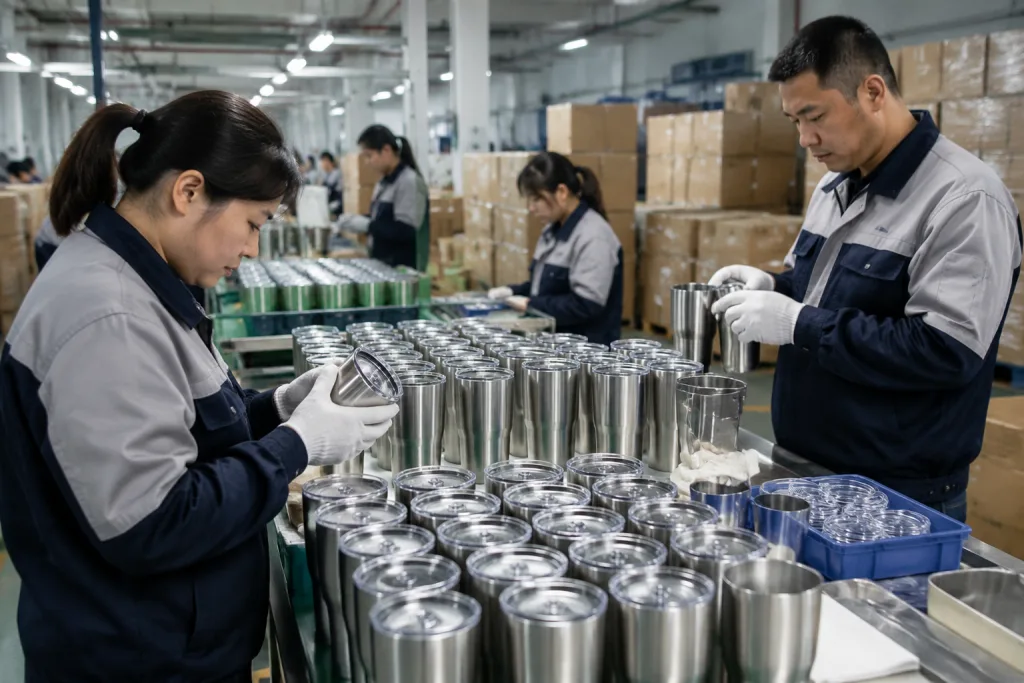
Travel tumblers look simple in a catalog photo. They are not. A 20 oz stainless tumbler can be built with different steel grades, wall thickness, lids, powder coating, logo processes, cartons, and inspection levels. BottleForge Industrial manufactures in Zhejiang, China, and on the line we run buyers through four decisions before quoting: drinking use, cup construction, logo method with artwork size in mm, and the compliance route. Ask those first. Chasing the lowest FOB price before that is the wrong question to ask; the math does not work once the buyer flags a peeling logo or a PO typo delays carton marks by 2 days.
Decide the Drinking Situation First
The first mistake is asking a coffee mug manufacturer for a quote before the use case is clear. This is the wrong question to ask. A 300 ml desk mug, a 500 ml commuter tumbler with a cup-holder base, and a 1-day conference giveaway need different lids, wall thickness, carton packing, and logo methods. We see this on RFQs every month: the PO says “coffee mug,” then QC pulled the sample and the buyer flagged the lid because their sales team planned to throw it in a backpack.
For coffee brands, we usually run 12 oz and 16 oz travel tumblers because they cover espresso drinks, drip coffee, and most 72-76 mm car cup holders. Corporate-gift buyers often step up to 20 oz because the logo panel looks better and the gift feels heavier in hand. For a bulk coffee travel mug order, that extra 4 oz usually adds 18-35 g of stainless steel per piece and can push a 40HQ carton plan from about 11.5 kg to 13 kg per master carton. The math still works if the buyer wants a premium hand feel. It does not work if the target is the lowest landed cost.
Think through the drinking behavior before we quote mold, lid, and packing:
- Retail coffee brand: choose a smooth lip radius, a lid that does not hit the nose, and shelf-ready packaging with barcode space.
- Corporate gift: keep the logo area clean, use safe colors like black or sand beige, and pack each piece in a gift box that survives courier handling.
- Event giveaway: chase unit cost through a simple lid, tight carton layout, and a production window the line can actually hit.
- Subscription or loyalty reward: lock the powder-coating color by Pantone number and keep the same lid tooling for repeat orders.
If you are comparing a bulk coffee mug against a bulk coffee tumbler, be honest about leakage expectations. Most slide lids are splash-resistant, not leakproof; on our tilt test, they fail once the cup lies sideways for 30 seconds. A screw lid with silicone gasket is better for bags and car commuting, but it changes the drinking feel and adds parts for injection molding, gasket assembly, and lid torque checks. We’ve seen this go sideways when a buyer saves USD 0.18 on the lid, then gets 2% complaints from field staff carrying samples in laptop bags.
Set the Product Spec Before Price
Price quotes are useless unless every vendor is quoting the same build. A coffee mug factory can cut USD 0.18-0.35 by changing 5 things: steel thickness, lid weight, carton flute, coating brand, or inspection level. We see this on RFQs every month. QC pulled one 16 oz sample last March that looked fine on the desk, but the caliper showed a 0.36 mm inner wall instead of the requested 0.45 mm. Lock the spec first, then talk price.
For stainless travel tumblers, ask for the steel grade, thickness, finished weight, and insulation target. A typical custom travel tumbler uses 304 stainless steel inside, 201 or 304 outside, and a vacuum double-wall structure. Inner wall thickness is often 0.4-0.5 mm, outer wall 0.5-0.6 mm. For premium retail, we prefer 304 inside and outside, even if it adds roughly USD 0.20-0.45 per unit depending on size and market steel price. The buyer often pushes back here, but the math gets ugly when 2% of lids rust at the rim after a salt-spray check.
A practical specification for a coffee mug custom made program could read like this: 16 oz capacity, 304 inner/304 outer stainless steel, double-wall vacuum insulation, powder coating with 60-80 μm film thickness, BPA-free AS or Tritan lid, silicone gasket, 8-10 hour warm-retention claim under lab conditions, and food-contact packaging. That gives a coffee mug supplier something precise to cost. On the line, we also write the target net weight on the work order, because a 12 g weight drop usually means someone changed steel or plastic.
Do not overbuy insulation claims. Some catalogs claim 12 hours hot, but coffee drinkers usually finish within 2 hours. A stable 55-60°C drinking temperature after 4 hours is more useful than a marketing number tested with boiling water in a closed cup. This is the wrong question to ask if the cup is for office coffee, not camping. If you are buying coffee mug in bulk, ask for a sample test report with starting water temperature, room temperature, and measurement intervals; our lab sheet records 95°C start water, 23°C room temperature, and readings at 1, 2, and 4 hours.
Choose Branding That Survives Use
Your logo method should match the sales channel. A coffee mug promotional order for a 2-day trade show does not need the same abuse resistance as a retail tumbler sold by a coffee roaster for USD 24.99. Still, this is where we see orders go sideways: the buyer asks for the cheapest decoration, QC pulls the sample after 3 dishwasher cycles, and the mark already has hairline scratches near the grip area.
For stainless tumblers, we run silkscreen printing, laser engraving, heat-transfer printing, water transfer, and full wrap powder coating with print. Silkscreen is the low-cost choice for one-color logos on smooth powder coating, especially when the artwork has lines above 0.3 mm. Laser engraving cuts through the coating and shows the 304 stainless underneath, so it lasts, but the logo comes out metal-color only. Heat transfer handles gradients and retail artwork better, but the math does not work if the buyer expects zero rejects on curved cups; on the line, a 1 mm shift around the seam is enough for QC to flag it.
As a working range from our Zhejiang production lines, a one-color silkscreen logo often adds USD 0.05-0.15 per piece. Laser engraving adds about USD 0.12-0.35 depending on logo size and machine time. Full-color heat transfer can add USD 0.30-0.80. These are not promises for every design, but they are close enough to reject quotes that look too clean; last month one PO even listed “laser print” and the buyer meant engraving, which changed the sample charge by USD 45.
If you need a coffee mug customizable platform for 20 corporate clients, keep the base tumbler standard and change only the logo. If every client asks for a different Pantone coating, your MOQ, lead time, and defect rate climb fast; we have seen 12 days become 18 days just from powder color changeovers and extra 60° gloss checks. For a coffee mug customized retail line, custom colors make sense because shelf recognition sells. For corporate-gift buyers, black, white, navy, stainless, and dark green usually cover 80% of demand.
Understand MOQ and Factory Direct Math
Factory direct is not magic. A coffee mug factory direct price is lower because your team owns the drawing, the logo file, the carton mark, the forwarder booking, and the pre-shipment check. That is the trade. If your order is 200 pieces, a local distributor is often the better buy after bank fees and inland freight. If your order is 1,000-10,000 pieces, direct sourcing from China can make financial sense; below that, the math often breaks before the first carton reaches Ningbo port.
At BottleForge Industrial in Zhejiang, China, our usual MOQ for a standard stainless bulk travel tumbler with custom logo is 1,000 pieces per color. For custom powder coating, we prefer 2,000 pieces per color because the coating line needs gun cleaning, color matching under a D65 light box, and QC sampling from the first 30 pcs off the line. Monthly capacity is about 450,000 stainless drinkware units across travel tumblers, sports bottles, and thermos products, but capacity does not fix a messy PO. We once had a buyer write “mat black” instead of “matte black” on the purchase order; QC pulled the sample, and we stopped before 6,000 lids were packed wrong.
A rough FOB Ningbo or Shanghai price for a 16 oz stainless bulk travel mug may sit around USD 3.20-5.80 depending on steel grade, lid type, coating thickness in microns, logo method, and carton spec. A 20 oz model may land around USD 3.80-6.80. Retail gift packaging can add USD 0.25-0.70. Individual polybags cost less, but 7 out of 10 North American and European programs we quote now ask for plastic reduction, so we run paper wrap or kraft sleeves when the target price allows it.
If you search a coffee mug supplier directory or coffee mug supplier list, filter suppliers by MOQ honesty. This is the wrong question to ask: “Can you do 100 pcs in any color?” The better question is whether the vendor can show a real production slot, a Pantone tolerance, and an AQL 2.5 inspection plan. A vendor promising any color, any logo, 100 pieces, 10-day delivery, and the lowest price is likely trading stock goods or skipping process controls. Fine for a quick giveaway. Risky for private label; we’ve seen this go sideways when the buyer flagged lid leakage after 18 cartons had already shipped.
Match Compliance to Sales Channel
Compliance changes by sales channel. A 500 ml tumbler packed as an internal staff gift usually needs less paperwork than a retail SKU going into Germany or a children’s bottle shipping to California. Still, this is the wrong question to ask: if your logo is laser-marked on the cup, food-contact compliance is part of the product, not an optional file. Last month, QC pulled 12 samples from the line because the PO said “304 stainless” but the artwork sheet listed a painted inner wall, which the buyer flagged before testing.
For Europe, most buyers ask for LFGB or EU food-contact testing, REACH screening for coatings or restricted substances, and sometimes packaging waste documentation. For the US, FDA food-contact expectations apply. If children use the product, ASTM F963 and CPSIA checks can enter the job. Adult travel tumblers are simpler than kids bottles, but lids, silicone gaskets, spray paint, and pad-print inks still decide whether the report matches the real shipment. We run gasket compression checks with a 0.02 mm caliper tolerance on the first sealed samples because one loose ring can turn a clean report into a buyer complaint.
Ask your coffee mug oem manufacturer for material declarations, previous test reports on similar models, and an order-specific testing plan if the channel requires it. Do not base a 2026 retail order on a two-year-old report for another coating and another lid. The math doesn't work. A lab test fee is small next to a recall, a blocked container, or 1,008 cartons sitting at port while the buyer asks for documents we should have prepared before mass production.
Factory audits matter when you supply larger retailers or public companies. BSCI, ISO 9001, Sedex, or customer-specific audits do not guarantee perfect goods, but they show whether the factory has basic systems and traceable records. BottleForge works with AQL inspection plans, typically AQL 2.5 for major defects and AQL 4.0 for minor defects unless the buyer sets tighter limits. For coffee mug promotional products, we still recommend carton drop checks from 76 cm, 3M tape coating adhesion checks, lid fit checks, and random leak testing before shipment; we’ve seen this go sideways when a promo buyer skipped inspection to save 2 days.
Plan Packaging and Logistics Early
Packaging is not an afterthought. It changes unit cost, carton CBM, breakage claims, recycle wording, and the first touch when the buyer opens the box. A coffee mug private label program usually needs more than a plain white box; last month QC pulled 80 boxed samples from the line and found 6 corner dents because the insert was 1.5 mm too loose.
Common choices include individual white box, kraft box, printed retail box, mailer box, belly band, hang tag, instruction sheet, and master carton labeling. For corporate gifts, we run a kraft box with one-color logo when the buyer wants a decent look without paying for full CMYK plates. For coffee roasters selling at retail, the printed box needs a barcode, material statement, care instructions, and origin marking laid out cleanly; one buyer flagged a PO where “dishwasher safe” appeared on the box but not on the approved manual. For online marketplaces, FNSKU labels and suffocation warnings are not optional, and carton labels must match the warehouse rule sheet down to font size and placement.
Logistics should be locked before production finishes. Sea freight from Ningbo or Shanghai to North America or Europe can make sense for 3,000+ pieces, but total transit may take 30-45 days depending on port and season. Air freight is faster, often 5-10 days after pickup, but the math often does not work because stainless tumblers eat space before they hit weight limits. A 20 oz tumbler with gift box may pack 24 pieces per master carton and weigh roughly 9-12 kg per carton; on our packing table, that is usually a 5-layer K=K carton with a 32 ECT or stronger spec.
If you work with coffee mug distributors, confirm who owns barcode creation, carton marks, import duties, and final delivery. If you are the brand owner, build the timeline backward: 5-7 days for sampling, 3-5 days for artwork approval, 25-35 days for production, 2-4 days for inspection and booking, then freight. Rush orders are possible, but this is where we have seen orders go sideways: the buyer approves the cup, then asks for new carton marks after the master cartons are already taped with 48 mm BOPP tape.
Score Vendors Before You Order
Score vendors on five hard points: cup fit, engineering detail, compliance files, reply speed, and deposit risk. Lowest FOB is the wrong question to ask. We have seen a weak coffee mug distributor quote USD 0.18 lower, then lose 12 days waiting for a lid mold change, and the buyer paid more through rework, air freight, and client complaints. QC pulled the sample with a 0.6 mm lid gap. That is where the money went.
Send every candidate the same checklist: 2D drawing, material spec, net weight, decoration method, MOQ, sample cost, sample lead time, mass production lead time, payment terms, test report availability, audit status, and inspection process. A serious coffee mug manufacturer answers line by line and may attach a 304 stainless steel test page or AQL 2.5 inspection sheet. A weak one sends 9 catalog photos and says “quality is good.” Not enough. Last March, one PO even listed matte black on the header and glossy black in the item line; the buyer flagged it before we opened the coating room.
For a first order, we run a controlled launch, not a full catalog. Pick one shape, two colors, one logo position, and one packaging format. Order 1,000-3,000 pieces, inspect tightly, then collect user feedback from the first sell-through. Small batch. Cleaner data. If the lid torque feels steady at around 1.2 N·m, the powder coating survives the tape test, and reorder timing stays close to 28 days, then expand into more colors or a larger coffee mug private labeling program.
Trading companies and local distributors are fine when volume is small or the buyer needs mixed cartons. The math changes once you need repeatable coffee mug bulk supply. Direct work with a coffee mug factory in China gives tighter control over steel grade, coating process, gasket fit, and each correction after inspection. We ship better when the buyer defines the mug clearly: 500 ml body, 0.5 mm wall, silicone ring hardness, carton drop-test standard. The job is not to find the cheapest mug; it is to make the same mug again in the next run.
Send us your tumbler brief for a factory quote
Share size, quantity, logo file, target market, and packaging needs. We will return practical options, MOQ, FOB pricing, and lead time.
Frequently asked questions
What MOQ should I expect for a custom travel tumbler order?
For stainless travel tumblers, a realistic MOQ is 1,000 pieces per color for standard models with a custom logo. If you need a custom powder-coated Pantone color, 2,000 pieces per color is more practical because the coating line needs setup, color matching, and scrap allowance. Some vendors offer 100-300 pieces, but that usually means stock colors, limited logo methods, or higher unit prices. For a new coffee brand, I would start with 1,000-3,000 pieces of one proven size, such as 16 oz or 20 oz, before building a full coffee mug custom line.
Is laser engraving better than printed logos for coffee mugs?
Laser engraving is usually more durable because it removes the coating and exposes the stainless steel underneath. It is a good choice for corporate gifts, daily-use tumblers, and premium coffee mug customized programs. The limitation is color: the logo appears as stainless steel, not full-color artwork. Silkscreen printing is cheaper, often USD 0.05-0.15 per unit for a one-color logo, and works well for simple logos on powder coating. If you need gradients, mascot artwork, or retail graphics, heat transfer may be better, but it costs more and needs stricter QC.
How long does production take after I approve the sample?
For a standard bulk coffee tumbler order, plan 25-35 days for mass production after final artwork, color, packaging, and deposit are confirmed. Sampling usually takes 5-7 days if the base model is available. Custom coating, molded lids, retail box printing, or lab testing can add 7-15 days. Freight is separate: air freight can take 5-10 days after pickup, while sea freight to Europe or North America often takes 30-45 days port to port. If your event date is fixed, do not approve artwork at the last minute.
What documents should a coffee mug supplier provide?
At minimum, ask for a product specification sheet, material declaration, artwork proof, packing list format, and previous food-contact test reports for similar materials. For Europe, request LFGB or EU food-contact documentation and REACH information where relevant. For the US, ask about FDA food-contact compliance and any coating or lid material data. If your company requires social compliance, request BSCI, Sedex, or ISO 9001 status. Before shipment, use an AQL inspection report with photos covering logo placement, coating defects, lid fit, carton marks, and random leak testing.
Should I buy from a distributor or factory direct in China?
If you need fewer than 500 pieces, a distributor is often easier because they can sell stock and handle small-lot decoration. If you need 1,000-10,000 pieces, factory direct sourcing from China usually gives better control over steel grade, coating, logo method, packaging, and reorder consistency. The trade-off is that you must manage specifications and decisions more carefully. A factory in Zhejiang or another manufacturing region can quote FOB pricing, but you still need to plan freight, duties, testing, and inspection. Factory direct is best when repeatability matters.