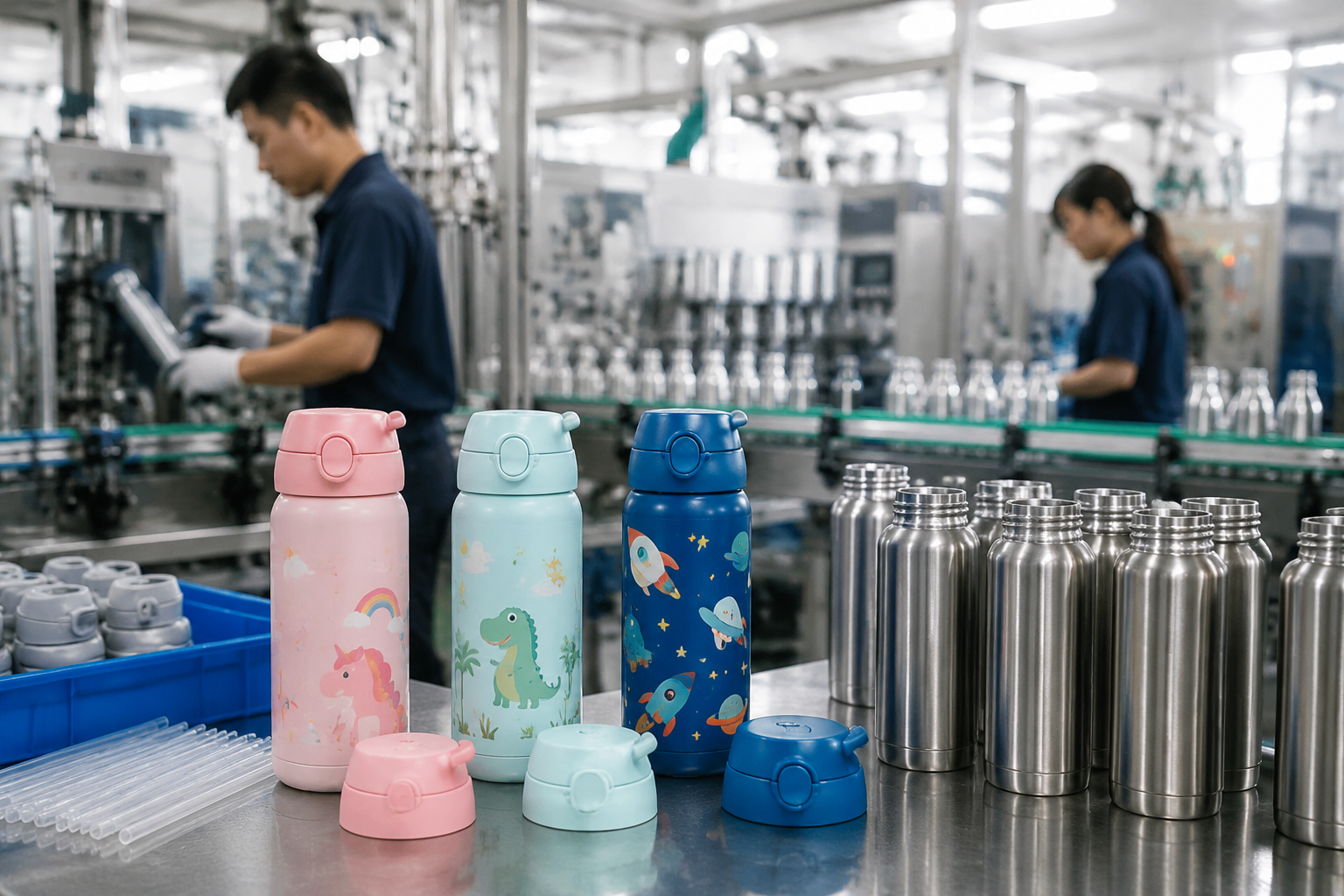
Key Takeaways
- A realistic MOQ for children water bottle custom orders is 1,000-3,000 pcs per design
- Typical FOB China pricing runs USD 1.45-5.20 depending on material, lid, and decoration
- New custom kids bottle projects usually need 35-60 days after artwork and deposit approval
- AQL 2.5/4.0 inspection and 8-12 spare lid parts per 1,000 pcs reduce after-sales claims
If you search for vendors children water bottle, you are not shopping for a cute catalog page. You need landed cost, child-safe materials, packaging choices, and a ship date that hits the school term or retail reset. Kids bottles look simple on a PDF. On the line, a 0.3 mm change in the silicone straw hole or switching from 1-color pad print to full-wrap heat transfer can move the quote by 15% to 35%. We’ve seen this go sideways when the buyer approved artwork but forgot carton drop-test requirements.
From our Hangzhou, Zhejiang export desk, buyers usually ask the same hard questions: What MOQ can we run for a custom kids water bottle? Are samples 7 days or 12 days? Is 304 stainless steel worth the extra USD 0.80 per piece? Can a children water bottle factory in China handle FNSKU labeling with 4 mixed colors in one master carton? QC pulled one sample last month because the lid torque measured 0.6 N·m below our spec, so these details are not paperwork. Here is the cost and lead-time breakdown we give serious buyers before we quote.
Start With The Real Buying Unit
For school district buyers and kids-product importers, the buying unit is not one bottle. It is one safe, usable bottle that arrives labeled, packed, and scannable. That means the bottle body, cap, straw or spout, carry loop, instruction insert, barcode, master carton, outer shipping mark, and sometimes an individual polybag or paper wrap. We see quotes split by USD 0.28-0.55 just because one vendor included a GS1 barcode sticker and 5-ply export carton while another quoted loose bulk packing. QC pulled the sample, then the buyer flagged the missing warning label. The math changes fast.
A basic PP or Tritan-style children bottle for a school giveaway may quote at USD 1.45-2.20 FOB China at 3,000 pcs. A double-wall stainless steel kids bottle with powder coating and a flip straw lid often sits around USD 3.20-5.20 FOB at the same volume. A bulk school water bottle project with one-color silkscreen is not priced like a retail-ready custom logo kids bottle with hangtag, color box, and warning label. On the line, one-color print runs through a flat silkscreen jig in about 18 seconds per bottle; color-box packing can add 6-9 seconds before carton sealing.
Ask each children water bottle supplier to quote from the same specification sheet. Keep it short and exact: capacity in ml, material, wall thickness, lid type, decoration area, print colors, packaging, test standard, and Incoterm. For stainless steel, ask for 304 inner wall, 201 or 304 outer wall, and 0.4-0.5 mm typical sheet thickness. For plastic, ask for BPA-free material declaration and the relevant EU or US food-contact test. This is the wrong question to ask: “What is your best price?” Send the spec instead; one PO typo like “500ml” instead of “350ml” can push tooling checks back 2 days.
At BottleForge Industrial in Zhejiang, our monthly kids bottle capacity is about 280,000 units across stainless steel, sports, and school bottle lines. Standard MOQ is 1,000 pcs per color for stocked shapes and 3,000 pcs per design when the lid or body color is produced from raw material. That is the difference between buying children water bottle wholesale from an existing mold and developing a children water bottle customized program. For stocked molds, we run color matching with a Pantone book and 2 kg trial resin before mass injection; for a new lid color, the line waits for raw material blending, and we have seen that add 12 days vs 18 days when approvals come late.
Material Choices Change Cost First
Material sets the price before artwork even comes up. It changes the mold steel, scrap rate, FDA/LFGB testing plan, carton weight, and the warranty talk after shipment. We had one buyer ask for the cheapest bulk children water bottle, then the PO added a leak-proof straw lid, soft-touch coating, and a 350 gsm color box. That is where the math breaks. On the line, QC pulled 32 lid samples from the first trial and found 3 slow leaks at the silicone vent, so the material and lid design mattered more than the logo print.
PP is the low-cost school and promo choice. It is light, usually dishwasher-tolerant depending on additives, and fits a children water bottle promotional campaign where the bottle only needs to survive one school year. A 400-500 ml PP bottle can sit around USD 1.20-1.80 FOB at 5,000 pcs with one-color print. We run PP bodies on multi-cavity injection tooling, and a 0.2 mm flash on the thread can still make the cap feel cheap. Tritan-style copolyester costs more, usually USD 1.90-2.80 FOB, but gives clearer walls and better drop resistance. For importers selling through children water bottle distributors, that shelf look often pays for the gap.
Stainless steel is not premium by default. If the wall is thin and the lid hinge is weak, parents will complain within 30 days. A proper custom kids water bottle should use 304 stainless steel on the food-contact inner wall. Vacuum insulation, powder coating, and a molded flip-straw cap push the landed price higher, but they also cut replacement requests. For a 350-500 ml insulated kids bottle, expect USD 3.20-5.20 FOB China depending on lid complexity and decoration. In our Hangzhou QC room, we check coating with a cross-hatch cutter and run vacuum samples through a 24-hour heat-retention check before packing.
Glass is a harder sell for younger children because breakage risk blocks many school approvals. If you need a glass bottle with silicone sleeve, budget for thicker dividers, corner-drop testing, and slower packing; we normally add 8-12% carton volume versus plastic bottles. For most school district programs, PP, copolyester, or stainless steel are the practical choices. This is the wrong question to ask if the brief only says “safe and cheap.” A good children water bottle manufacturer should push back when the material does not fit the age group, not just quote whatever lands in the inbox.
MOQ Tiers And Price Movement
MOQ is not a punishment. It is the break-even line. Below it, setup labor, Pantone color mixing, screen fixture changeover, lid assembly, and carton buying eat the order before the line even runs. For vendors children water bottle projects, the honest MOQ depends on 4 things: existing bottle or new mold, color change, logo process, and cap structure. Last month QC pulled a 350 ml PP sample because the buyer’s PO said “blue 2925C,” but the artwork file showed 2935C. That one digit delayed sampling 2 days.
For an existing shape with laser engraving or one-color silkscreen, 1,000 pcs is workable for custom children water bottle orders using stock caps and stock cartons. The unit price sits higher because the screen plate, jig setup, and first-piece inspection are spread over fewer bottles. At 3,000 pcs, the price often drops 5% to 12%. At 5,000-10,000 pcs, it may drop another 4% to 8%, especially for bulk kids water bottle orders with stable colors and shared packing. Above 20,000 pcs, resin purchase, carton cutting layout, and container loading matter more than hard bargaining. We run the math on kg of material, not just the sales sheet.
For custom made kids bottle development, a new plastic lid mold may cost USD 2,000-6,000. A more complex straw system with multiple cavities can be higher. A stainless steel body shape usually does not need full bottle tooling unless you need a unique silhouette, but special caps, handles, or silicone bumpers add tooling. This is where we’ve seen things go sideways: a supplier quotes a low unit price, then adds mold maintenance and cavity repair after deposit. Ask for mold ownership, maintenance responsibility, and replacement cavity cost before deposit. In our tool room, one small cap insert is checked with a 0.02 mm feeler gauge before trial run.
A normal children water bottle bulk order should also include spare parts. For straw bottles, we recommend 8-12 spare straws or silicone valves per 1,000 pcs. For school district use, spare caps can stop a small field complaint from becoming a full reorder problem. The buyer usually pushes back here because spare parts feel like dead cost, but the math doesn’t work if 30 missing valves trigger air freight. We ship spares in a separate inner box marked “SERVICE PARTS” so the warehouse team does not mix them with retail units.
If you are comparing children water bottle suppliers, do not chase a USD 0.05 difference while ignoring carton strength or cap leakage. This is the wrong question to ask. A weak 5-ply carton can collapse in mixed pallet handling, especially when the pallet stack passes 1.6 m. A cheap valve can fail after 300 open-close cycles. During one AQL 2.5 inspection, QC found 11 caps with slow seepage after a 45-degree tilt test. Those failures cost more than the original saving.
Decoration Costs Are Not Equal
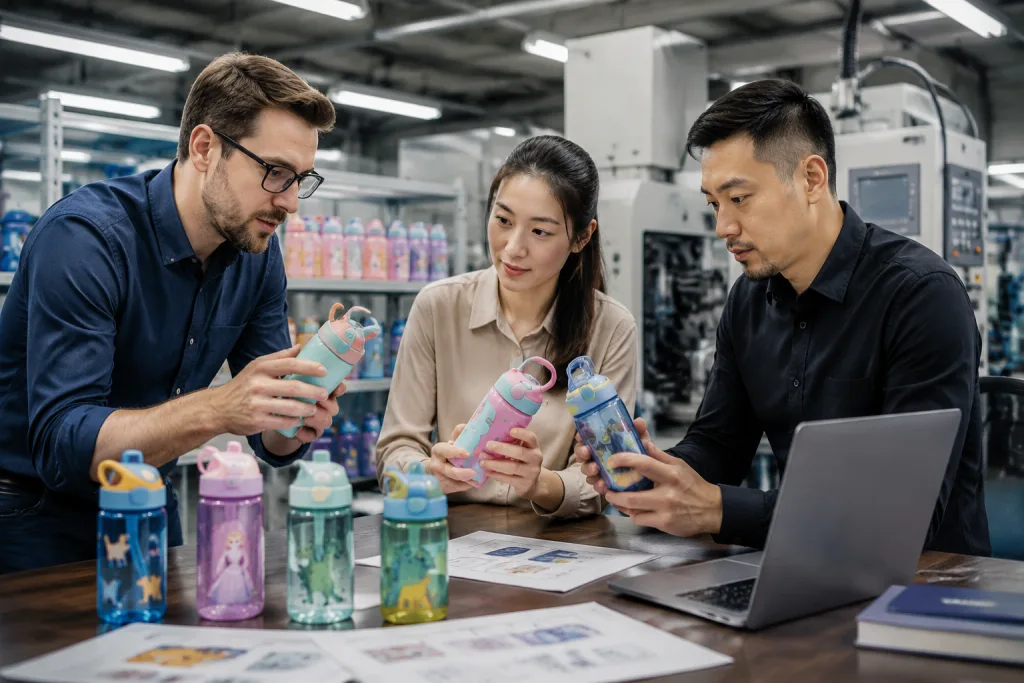
Logo method changes the unit price and the ship date. A custom logo kids bottle for a school program may only need a one-color district mark, 45 mm wide on the front body. A retail children water bottle customizable line is a different job: wraparound graphics, blank name panels, mascot artwork, and lids matched to Pantone chips. Same bottle shell, different line setup. We see buyers ask, “Why is the logo charge different?” Wrong question. Ask how many print passes and fixtures the factory must run.
Silkscreen is still the workhorse for simple logos. Setup is usually USD 35-80 per color per artwork, and production adds roughly USD 0.05-0.18 per print position depending on size and bottle surface. On 304 stainless powder coating, we run a curved screen jig and check the logo edge with 3M tape after curing. It works well on stainless steel powder coating and many plastic bottles, but curved bodies kill tiny text. Pad printing handles smaller curved logos, usually 25-40 mm, but the line moves slower. Heat transfer or full-wrap film gives brighter artwork and larger coverage, often adding USD 0.25-0.70 per unit.
Laser engraving is clean and durable on stainless steel. It usually adds USD 0.08-0.25 per unit and avoids ink compliance concerns. QC pulled the sample after 300 pcs last month because the engraving depth changed by about 0.03 mm when the bottle body was not seated tight in the rotary fixture. Laser has one catch: no color. For school district seals, it looks sharp. For younger kids retail artwork, it can look flat on the shelf.
UV printing can handle multiple colors and variable designs, but adhesion testing on the chosen coating is not optional. We run cross-cut tape tests and a 24-hour water soak before signing off. For children’s products, we stay conservative with surface coatings because kids chew lids, handles, and sometimes bottle bodies. The food-contact zone and mouth-contact zone need separate checks. A children water bottle manufacturer in China should separate body decoration testing from lid material testing and should not claim one certificate covers everything. We have seen this go sideways when a buyer used an FDA report for the bottle body to approve a printed straw lid.
Artwork approval also costs calendar days. Simple logo proofing may take 2-3 working days. A printed pre-production sample takes 7-12 days. If you need Pantone matching, add 2-4 days for lab dips or coated color panels. Small typo, big delay: one PO came in with Pantone 2925 C, but the AI file said 2955 C, and the buyer flagged it after we had already made the color panel. For importers coordinating with multiple children water bottle distributors, decide who has final artwork authority before the factory starts sampling.
Lead Time From Quote To Vessel
A realistic schedule keeps buyers out of trouble. If a children water bottle vendor promises 15 days for a new custom school water bottle with a printed sample, special Pantone color, and retail box, we would push back. Stocked blanks can move fast. True custom work still needs artwork check, sample room time, line scheduling, and QC sign-off. Last month QC pulled a 500 ml Tritan sample because the logo sat 3 mm too close to the grip line, and that small fix still cost 2 working days.
For an existing bottle with a simple logo, allow 2-4 working days for quote confirmation and artwork checking, 5-7 days for a blank or digital mock sample, 7-12 days if you need a physical printed sample, 25-35 days for mass production after deposit and sample approval, and 3-5 days for final inspection, packing release, and export paperwork. That puts a normal bulk kids bottle order at about 35-50 days before sailing. We run the schedule from the approved PI and deposit date, not from the first WhatsApp message. A common delay is a PO showing “blue lid” while the artwork file says PMS 2925C.
For new color plastic injection or custom lid components, add 10-20 days. For new mold development, add 25-45 days depending on complexity and testing. If you need EN 14350, LFGB, FDA food-contact, REACH, CPSIA-related review, or ASTM child-use checks through a third-party lab, budget 7-14 working days after samples are ready. Labs slow down before back-to-school and Christmas runs; we have seen 12 days become 18 days in September. The molding line also needs color purge time, and one wrong masterbatch ratio can leave 800 pcs looking half a shade off.
Sea freight from Ningbo or Shanghai to the US West Coast can be 18-28 days port to port in a normal market. East Coast and Europe are commonly 30-45 days port to port. Air freight works for urgent school launches, but a carton of stainless steel bottles is heavy. The math often does not work. Air can add USD 1.20-3.50 per bottle depending on volume weight and destination, and we have had buyers flag this only after seeing a 14.8 kg carton weight on the packing list.
Our Zhejiang team usually advises school buyers to lock specifications 90 days before the required handout date. For retail importers, 120 days is safer if packaging, lab testing, and sales samples are involved. China production is efficient, but it is not magic when artwork changes three times after sample approval. We ship better when the buyer freezes the logo size, carton mark, barcode, and color code before the deposit hits; otherwise the line waits while the merchandiser chases one missing digit on the EAN file.
Compliance And Inspection Budget
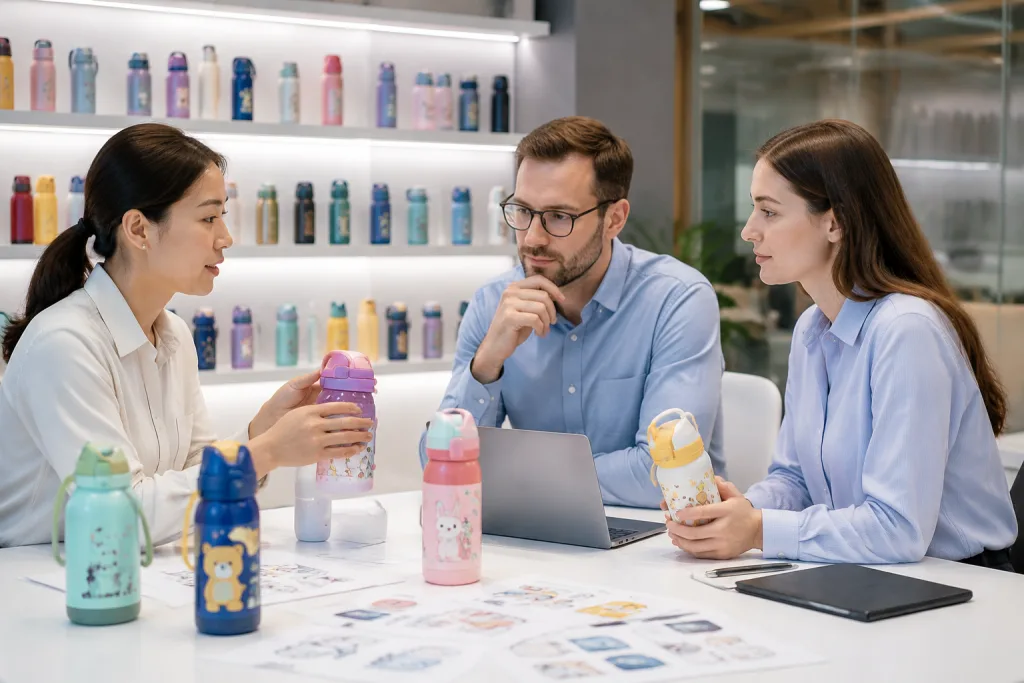
Kids bottles need tighter control than adult promo drinkware. A leaking tumbler gets a complaint email. A children’s bottle with a loose silicone valve, a 0.4 mm burr on the straw tip, or a coating that fails testing can turn into a recall call. We’ve seen this go sideways. The lowest children water bottle factory quote is sometimes just the quote with testing, rework, and inspection left out.
For the US, we ask buyers to confirm FDA food-contact requirements, CPSIA points for children’s products, lead and phthalate limits where they apply, plus tracking label rules if the bottle is sold for children under 12. For Europe, the file usually needs LFGB or EU food-contact testing, REACH SVHC screening, and packaging waste wording by market. If the bottle is for toddlers, EN 14350 can come into play. For a school-age sports bottle, the risk is different, but the mouth-contact parts still need clean material records. On one 20,000 pcs order, QC pulled the sample because the PO said “kids 6+” while the artwork showed a 3-year-old cartoon user; that mismatch matters.
A sensible QC plan starts with AQL inspection, commonly Critical 0, Major 2.5, Minor 4.0. For kids bottles, we run extra function checks on the line: 100% leak test for flip lids, lid torque with a digital torque meter, straw pull test at 15 kg, coating adhesion cross-hatch, print rub test after 50 cycles, capacity check, odor check, and carton drop check from 80 cm. On stainless steel vacuum bottles, we check insulation performance and vacuum failure rate after hot-water filling. A pre-shipment inspection usually costs USD 250-350 per man-day through a third party in China; for repeat orders under 3,000 pcs, factory-arranged inspection with timestamped photos and short videos can work if the buyer already trusts the line. The math doesn’t work if you save USD 180 on inspection and then air-ship 12 replacement cartons.
Do not leave labeling to the end. A bulk school water bottle order may need district asset labels, class pack labels, or carton marks by grade. An importer may need UPC, FNSKU, suffocation warning on polybags, bilingual warnings, country of origin, and age grading printed in the right place. Small typo, big delay. Last quarter, a buyer flagged “Made in Chine” on a carton side mark after packing had reached 68 cartons, so we had to relabel before the truck could leave Hangzhou. If you want children water bottle wholesale cartons ready for distribution, put every label line into the purchase order before mass packing starts.
How To Compare Factory Quotes
Put every children water bottle quote into one comparison sheet before you talk price. Match the same capacity, material, lid type, print method, retail packaging, MOQ, Incoterm, production days, sample charge, test charge, and payment terms. If one line is blank, price it as excluded. We learned this after a buyer’s PO said “500 ml Tritan” while the quote was for 450 ml PP, and QC pulled the sample with a 53 mm body diameter that did not match the approved drawing.
For FOB China pricing, check whether export cartons, inner polybags, logo setup, sample refund terms, and inland trucking to Ningbo or Shanghai port are inside the unit price. Some children water bottle suppliers quote EXW because it looks cheaper by USD 0.18 to USD 0.35 per pc. The math changes fast once you add pickup from Zhejiang, pallet handling, and port charges. EXW works if your forwarder already collects from factories in Hangzhou, Yongkang, or Ningbo, but it is not FOB. For school district buyers working through an importer, DDP is simpler on paperwork, yet you still need the factory FOB base cost so nobody hides margin in freight.
Ask for production-line photos, not showroom shelves with perfect lighting. Ask monthly capacity, current lead time, audit status such as BSCI or ISO 9001, and who signs the final inspection report. One buyer once sent us a supplier photo where the same carton tape dispenser showed up in 4 different “factory” shots. That was a trading office. BottleForge Industrial works as an export manufacturer partner from Hangzhou, Zhejiang, with a normal MOQ of 1,000 pcs for stocked kids bottles and 3,000 pcs for color-customized programs. That gives you room for a pilot order before a full school district or retail rollout.
A good children water bottle distributor or importer needs repeatability. Keep one golden sample, one locked artwork file, one packaging dieline, and one signed QC checklist with AQL 2.5 points written in plain language. Reorders should be boring. If the first order is children water bottle customized for a school launch and the reorder changes to a retail hanging box, treat it as a controlled revision. We run a new carton drop check from 76 cm when the pack structure changes, because retail boxes crush differently than bulk cartons.
The best children water bottle vendors push back on unsafe details, tight deadlines, and loose specs. Not bad service. It usually means someone on the line has shipped real bulk kids water bottle orders and handled the mess after cartons leave China. We have rejected cute straw caps with 2.8 mm loose silicone plugs because the choking-risk discussion is not worth saving USD 0.04 per pc. If a supplier says yes to every logo, every date, and every material claim in 5 minutes, we have seen that go sideways.
Send Your Kids Bottle Spec For A Factory Quote
Share capacity, material, logo method, MOQ target, delivery country, and required date. We will return a practical FOB China quote.
Frequently asked questions
What MOQ should I expect for a custom children water bottle order?
For a stocked bottle shape with one logo, expect 1,000 pcs per design as a practical starting MOQ. If you need custom body color, custom lid color, or a children water bottle customized retail set, 3,000 pcs is more realistic. New mold work can push the project to 5,000-10,000 pcs because tooling setup and material purchasing need volume. For school districts testing one campus, we sometimes suggest 1,000 pcs with two carton label versions rather than splitting the product into many colors. Too many small color lots increase cost and inspection risk.
How much does a bulk kids water bottle usually cost?
A simple PP bulk kids bottle can quote around USD 1.20-1.80 FOB China at 5,000 pcs with one-color printing. Copolyester clear bottles often run USD 1.90-2.80. A stainless steel insulated custom kids water bottle with straw lid, powder coating, and logo is usually USD 3.20-5.20 depending on capacity and cap construction. Packaging can add USD 0.08 for a plain polybag or USD 0.25-0.60 for a color box. Testing, inspection, and freight are normally quoted separately unless you request DDP pricing.
Can you make bottles for school district distribution?
Yes, but the specification should be built for rough handling. For a bulk school water bottle order, we recommend leak-proof lids, easy-clean straws, no tiny loose decorative parts, and carton packing by classroom or school if needed. Typical production is 25-35 days after sample approval for existing molds. Add 7-14 working days if third-party compliance testing is required. We can apply carton labels, district item codes, and basic distribution marks so pallets are easier to route after arrival.
What safety documents should kids-product importers request?
Ask for material declarations, food-contact test reports for the bottle and lid, and coating or ink compliance where decoration is used near mouth-contact areas. US buyers may need FDA food-contact support, CPSIA review, lead and phthalate screening, and tracking label information for products marketed to children under 12. EU buyers often request LFGB or EU food-contact testing plus REACH SVHC screening. Do not accept one old report for a different lid or coating. If the silicone valve changed, the test file should be checked again.
How early should I place an order for back-to-school delivery?
For an existing children water bottle wholesale model with simple logo, place the order 90 days before the required handout date. That allows 35-50 days for approval and production, then sea freight, customs, and local delivery. For a custom made kids bottle with new lid, special color, retail packaging, or lab testing, start 120 days ahead. If your artwork approval depends on a school board, retailer, or license holder, add another 1-2 weeks. The factory cannot recover time lost in approvals without using expensive air freight.