Key Takeaways
- A practical MOQ for custom borosilicate glass bottle orders is usually 1,000-3,000 pcs per color or sleeve design
- Borosilicate glass should pass 120°C thermal shock testing for normal hot-and-cold drinkware use
- FOB China pricing often ranges from USD 1.60-4.20 depending on cap, sleeve, capacity, and decoration
- Use AQL 2.5/4.0 inspection plus carton drop testing before balance payment
If you sell wellness products or run a sustainable retail range, glass bottles look simple until the first sample box lands. Then QC pulls the sample and finds a 0.4 mm cap wobble, a silicone sleeve that slips after 30 rubs on the test bench, cloudy logo ink, cartons under 9 kg crush strength, or an inspection report sent 2 days after the vessel cut-off. Breakage is only one problem. The bigger risk is a supplier quoting low and missing the same tolerance across 20,000 pieces.
Searching for vendors borosilicate glass bottle options is the wrong question to ask if you only compare unit price. We run the line by glass tube grade, annealing curve, thermal shock testing, AQL, packing drop tests, and export lead time, because those checks decide whether a 500 ml bottle ships clean or comes back as a claim. A capable borosilicate glass bottle factory in China should give those details without hiding behind “premium quality.” BottleForge Industrial is based in Hangzhou, Zhejiang, and we usually spot the trouble before the PO is issued, including the classic typo where a buyer writes 55 mm cap OD on the drawing but 54 mm on the order sheet.
What Are You Actually Buying?
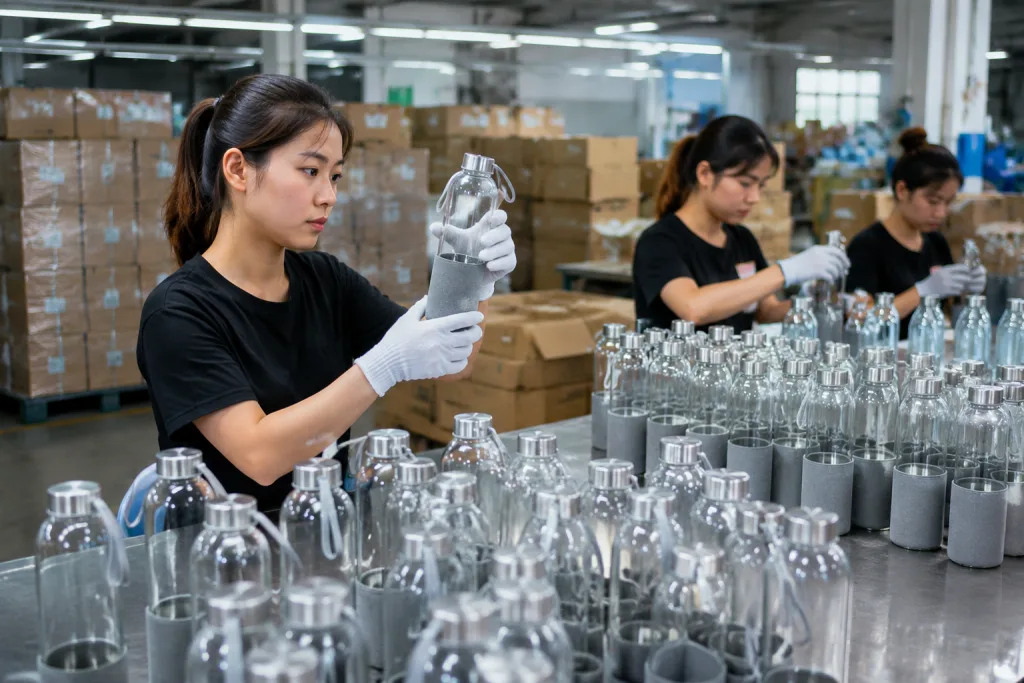
A borosilicate glass water bottle is not a glass tube with a cap. On a real PO, you are buying a matched set: bottle body, mouth finish, cap thread, sealing ring, sleeve, carry loop, printing, inner carton, master carton, sometimes a retail box. QC pulled one 500 ml sample last month where the silicone ring sat 0.3 mm proud; the cap still closed, but the buyer flagged the “cheap hand feel” in 6 seconds.
Good borosilicate glass has a low thermal expansion coefficient, typically around 3.3 x 10⁻⁶/K. That is why we ship it for tea bottles, infused water programs, office hydration sets, and wellness gifts. It handles temperature shock better than soda-lime glass, but it still breaks if a warehouse worker drops a full carton from 1.2 m. If a borosilicate glass bottle supplier says it “will not break,” push back. The math doesn't work.
For a wellness brand, the first buying decision is simple: stock bottle with logo decoration, or a true borosilicate glass bottle custom project. Stock shapes run faster and cost less. Custom tooling gives you shape control, but the line needs cleaner drawings, tighter sample sign-off, and a first order that does not change color codes twice. We have seen this go sideways from one typo on a PO: “Pantone 548C” became “Pantone 584C,” and 2,000 sleeves had to be held before packing.
- Stock bottle with logo: 1,000-3,000 pcs MOQ, 25-35 days after sample approval, usually with screen print or laser logo checked against a 30 cm visual standard.
- Custom sleeve color: usually 2,000 pcs per Pantone color, with a silicone color chip approved before the line cuts bulk material.
- New glass mold: often 8,000-20,000 pcs annual volume to justify tooling, because mold cost and trial loss need enough repeat orders.
- Retail packaging: 1,000 pcs MOQ is possible, but unit cost is higher below 3,000 pcs, especially when the buyer asks for 350 gsm paper and a molded insert.
At our Zhejiang facility network, monthly glass bottle output for export programs is about 180,000 units when running mixed capacities. That number matters. A borosilicate glass bottle vendor can look fine at 2,000 pcs and still struggle at 40,000 pcs when annealing oven slots, cap assembly, and carton packing all hit the same week. Ask for real monthly capacity by bottle size, not just a thick catalog and a showroom photo.
Questions To Ask Before Quoting
Most bad quotes start with a thin RFQ. “Please quote 500 ml glass bottle with logo” gives us almost nothing to cost. You may receive 10 prices, but they will not cover the same glass thickness, cap insert, carton spec, or print test. A serious borosilicate glass bottle manufacturer will ask more questions before pricing. Slow first reply, fewer surprises later. Last month QC pulled a 500 ml sample from the line and found the buyer’s PO said “matte black lid,” while the artwork file showed natural bamboo.
Start with the bottle use case
Tell the supplier where the bottle will sell: yoga studios, grocery shelves, corporate wellness kits, online subscription boxes, or premium spa retail. Parcel shipping is rough. A bottle going through UPS or FedEx needs stronger inner trays and usually a 5-layer export carton, while palletized distributor stock can often run a lighter pack. A borosilicate glass bottle distributor in North America may also need UPC labeling, FNSKU labels, suffocation warnings on polybags, or bilingual packaging. We ship Amazon cartons with a 32 ECT minimum unless the buyer’s test report says otherwise.
Give exact technical preferences
- Capacity: 350 ml, 500 ml, 550 ml, 750 ml, or 1,000 ml. Send the fill-line requirement too, not just the advertised size.
- Glass wall thickness: commonly 1.8-2.5 mm depending on shape. Straight bodies run cleaner on the annealing line than sharp shoulder designs.
- Mouth diameter: 38-55 mm for cleaning and infuser compatibility. The wrong question is “wide mouth or narrow mouth”; ask whether your tea infuser, ice cube, or bottle brush fits.
- Cap material: bamboo outer with PP insert, stainless steel, PP, or tritan-style plastic. We check the PP insert with a go/no-go thread gauge before leak testing.
- Sleeve: food-grade silicone, neoprene, felt, cork, or no sleeve. Silicone sleeve MOQ is usually higher because the mold and color matching cost need room to spread.
- Decoration: silkscreen, decal, laser on cap, sleeve debossing, or full-color box. For silkscreen, the buyer should confirm Pantone code and print height in mm.
If you need a borosilicate glass bottle promotional program, say whether the logo must survive dishwasher cycles. Plenty of “eco” buyers ask for water-based ink, but the math does not work if they expect cheap ink and dishwasher-proof branding. We normally test 3M tape adhesion and 50 hand-wash cycles for logo durability. Dishwasher claims need separate validation because alkaline detergent attacks the print layer; we have seen this go sideways after 12 wash cycles when the approved sample only passed hand-wash testing.
Checklist: send artwork as AI or PDF vector files, specify Pantone colors, confirm target market, define carton labeling, and state whether you need REACH, LFGB, FDA, or California Proposition 65 documentation. Also send the ship mark layout; one buyer flagged a carton because “borosilicate” was misspelled on the side panel.
How Custom Can It Be?
Custom gets stretched too far in drinkware quotes. In our Hangzhou sample room, “custom borosilicate glass bottle” can mean one pad-printed logo on a stock 500 ml bottle, or it can mean a new sleeve color with a revised color box. A full custom glass water bottle means a new glass profile, cap drawing, and sleeve tooling, so the quote moves from a simple artwork fee to real mold money. QC pulled one buyer sample last month because the logo sat 4 mm too close to the sleeve edge; that is the kind of detail that separates decoration from product development.
For most sustainable retailers, a new mold on the first order is the wrong question to ask. We usually run an existing 500 ml or 750 ml bottle first, then customize the parts shoppers notice fastest: sleeve grip, Pantone color, cap finish, logo position, and retail box. That gives the shelf its own look without tying up cash before sell-through data exists. We had a buyer push back on USD 1,600 tooling for a 1,200 pcs launch; the math did not work, so we moved the budget into kraft box printing and lifestyle photos.
Typical customization costs are easy to price if the PO is clean. Silkscreen logo setup is usually USD 50-120 per color, and our line checks the film with a 0.5 mm registration gauge before mass print. Laser engraving on bamboo or stainless caps adds USD 0.08-0.25 per unit. Silicone sleeve Pantone matching adds USD 80-200 setup, and MOQ is often 2,000 pcs per color. Full-color retail boxes commonly add USD 0.18-0.55 per unit depending on board grade and order quantity; one typo in a PO, “matte lamination” vs “gloss lamination,” can burn 3 days before carton proof approval.
If you need a borosilicate glass bottle customized with a new mold, plan for a slower path. Sampling takes 25-40 days after drawing approval; for one curved 750 ml body we saw 18 days for mold adjustment before the bottle passed the 1.2 m drop-pack test. Tooling can range from USD 800 to more than USD 3,000 depending on complexity. The first mass production order should include extra inspection because a new shape has not proven itself in packing and transit, and we have seen this go sideways when the shoulder radius looks fine on a 3D drawing but chips in a 24 pcs export carton.
- Low risk: stock bottle plus one-color logo, usually fastest to sample and easiest for AQL 2.5 inspection.
- Medium risk: stock bottle with custom silicone sleeve and printed box; color matching and box proof timing need control.
- Higher risk: new cap structure or new glass mold, where leak testing, carton fit, and transit breakage need extra checks.
A good borosilicate glass bottle manufacturer in China should tell you when customization is not worth the money. If your launch volume is 1,200 pcs, spend on packaging and photography before new tooling. We ship repeat orders faster when the first order stays simple, because the line already knows the bottle, cap torque, sleeve fit, and carton count.
Pricing, MOQ, And Lead Time
For borosilicate glass bottle bulk orders, the glass body is not what moves the price most. Caps, sleeves, printing, inner trays, and cartons do. A plain 500 ml bottle with PP cap can sit near USD 1.60-2.10 FOB China at 3,000 pcs. Add a bamboo-look cap, silicone sleeve, one-color print, and color box, and the same bottle can move to USD 2.40-3.40. A 750 ml bottle with thick sleeve and gift packaging may reach USD 3.20-4.20. Last month the buyer flagged a USD 0.38 jump on the PI; QC pulled the sample and the sleeve was 2.2 mm thicker than the RFQ drawing.
Low quotes usually cut one of 5 things: carton strength, cap insert quality, spare caps, inspection allowance, or sleeve material. The last one hurts. We have opened cartons after 48 hours in a closed warehouse and found silicone sleeves with a sharp smell, which a wellness retailer will reject on the spot. For wellness brands, the math does not work. A USD 0.12 better carton is cheaper than replacing broken units after a retailer chargeback, especially when the outer carton drops below 5-layer K=K board.
Normal order structure
- Sample time: 7-12 days for stock bottle with logo mockup; we run the logo film on a stock 500 ml body before opening anything custom.
- Pre-production sample: 10-18 days with custom sleeve or printed box; box artwork often slips 2 days because one Pantone code is missing on the PO.
- Mass production: 25-40 days after deposit and sample approval; the line books faster before Canton Fair and Christmas restock season.
- Payment: commonly 30% deposit, 70% before shipment after inspection; most buyers ask for AQL 2.5 on appearance and function.
- MOQ: 1,000 pcs for simple logo, 2,000-3,000 pcs for custom color components; custom silicone usually needs one full color run.
For borosilicate glass bottle wholesale buyers, quote by Incoterm from the start. FOB Ningbo or FOB Shanghai is clean for most EU and North American importers. EXW looks cheaper on paper, then you pay for local trucking, export declaration, and supplier chasing. DDP works for some small retailers, but we have seen this go sideways when duty and last-mile fees were hidden in one “all-in” line. Ask for the CBM, gross weight, and HS code before you compare quotes.
BottleForge Industrial ships from Zhejiang and nearby ports, so Ningbo is usually the better lane for us. For a 3,000 pcs bulk glass water bottle order, you may be in 6-10 CBM depending on packaging. That is often LCL, not a full container. We measure the master carton with a tape on the packing bench, not after production, because a 20 mm carton change can push the freight class up. Make sure your borosilicate glass bottle suppliers calculate carton size early.
Quality Checks That Matter
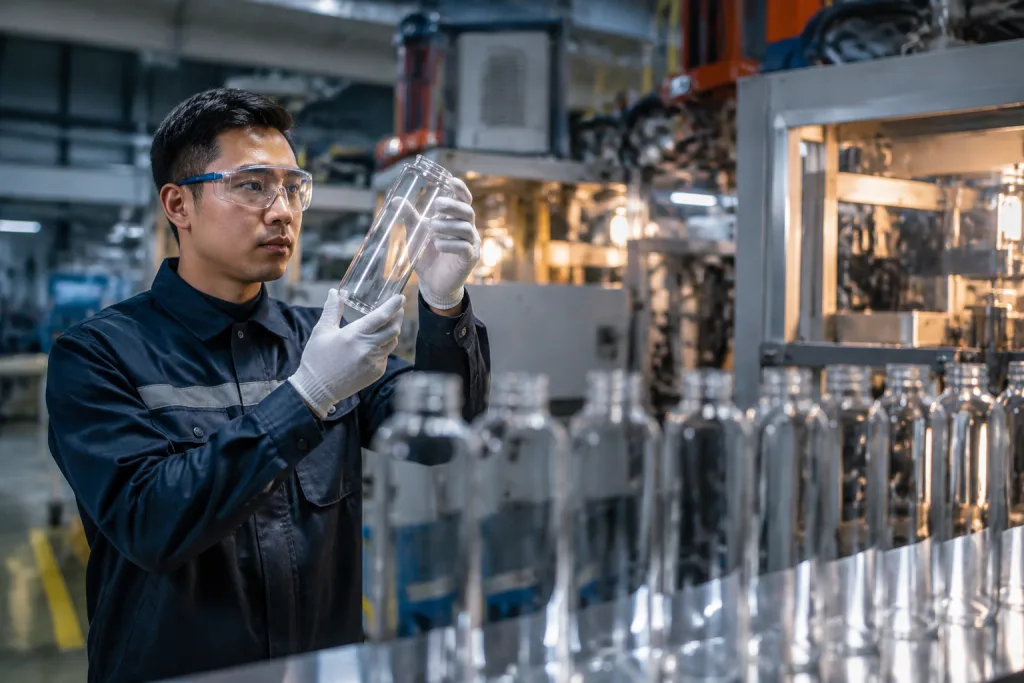
Glass bottle QC will not win applause, but it saves margin. For a custom borosilicate glass bottle, we start inspection on the line before workers close the color boxes. After 3,000 bottles are sealed into master cartons, checking cap fit with a torque meter and logo position with a 0.5 mm ruler takes 2 workers half a day instead of 40 minutes at the packing table.
Use AQL inspection. We usually run AQL 2.5 for major defects and AQL 4.0 for minor defects, with critical defects not accepted. Major defects include leaking cap, cracked glass, sharp edge, wrong logo, print shift over the approved limit, loose sleeve, or wrong barcode. Minor defects include small cosmetic marks within an agreed limit, slight sleeve color deviation, or minor carton scuffs. QC pulled one sample last month where the barcode on the color box had 1 wrong digit from the PO; the bottle was fine, but Amazon receiving would still reject it.
Testing checklist
- Leak test: fill bottle, close cap, invert for 30 minutes; we check around the silicone ring with dry tissue, not just by eyesight.
- Thermal shock: test from room temperature to 95-100°C water, or agreed 120°C differential where applicable; record 5 samples per style.
- Print adhesion: 3M tape pull test after curing; no ink lift on the logo edge.
- Cap torque: check closing feel across random samples with a torque meter, especially bamboo lids and PP flip caps.
- Carton drop: ISTA-style drop from 60-76 cm depending on carton weight; corners and bottom seam get checked first.
- Food contact: FDA, LFGB, REACH, or EU 1935/2004 documents as required; match reports to glass, ink, silicone, PP, and bamboo parts.
Do not accept a generic “SGS report” without reading the tested item line. This is where buyers get caught. A report for a PP cap does not cover the silicone sleeve. A report for clear glass does not prove the ink is compliant. If you sell distributor glass water bottle stock into Germany, France, Canada, or California, the documents need to match the actual materials in the shipped product. We had one EU buyer flag a LFGB file because the lab photo showed a plain bottle, while the order used a sprayed sleeve and 2-color logo.
One practical habit: approve a golden sample and seal it with date, signature, and PO number. The factory keeps one, you keep one, and the inspector uses photos plus measurements. Simple habit. It stops arguments about whether the sleeve should be matte, whether the logo sits 8 mm too low, or whether the cap color drifted from Pantone 7509C after the second production run.

Packaging For Retail And Transit
A glass bottle can pass annealing and still lose money in transit. We have seen this go sideways: 1,200 pcs packed clean from the line, then 37 breakages after the buyer’s 60 cm carton drop check. Some borosilicate glass bottle vendors save RMB 0.18 on the box and hand the risk to the importer. Retail buyers want a clean shelf face, sure, but protection comes first. The bottle has to handle factory carts, container vibration for 28-35 days, warehouse stacking, courier drops, and the store clerk cutting the carton open with a blade.
For individual retail units, an E-flute color box with internal paper support beats a thin folding carton alone. We usually run 1.5 mm E-flute for glass retail packs, then QC pulls 3 packed samples for shake and corner-drop checks before mass boxing. For e-commerce, add molded pulp, honeycomb paper, or a protective sleeve. If the bottle has a silicone sleeve, do not treat it as transit protection. That is the wrong question to ask. The shoulder, cap rim, and base still take the hit when a parcel lands on concrete.
- Inner box board: 300-400 gsm for normal retail, and 450 gsm or E-flute when the buyer sells online.
- Master carton: 5-ply corrugated is preferred for glass export, with B/C flute if the carton stacks above 1.6 m in the warehouse.
- Carton weight: keep under 15 kg where possible for manual handling; our packing team flags cartons above 16 kg because handlers start dropping them.
- Labeling: SKU, PO number, quantity, country of origin, barcode, and carton number; one PO typo on the side mark can stop receiving for 2 days.
- Amazon-style prep: FNSKU label, drop-test packaging, and no loose glass movement after a 10-second shake test.
If you are a borosilicate glass bottle distributor supplying multiple stores, ask for mixed carton planning before artwork starts. A retailer may want 6 pcs per inner carton, while your warehouse wants 24 pcs per master carton. We had one buyer flag this after the color box proof was approved, and the math did not work: new dieline, new barcode placement, new carton sample. Decide it before box printing. Changing carton structure after artwork approval can delay the order by 5-7 days.
Sustainable packaging can work, but the tradeoffs need a straight answer. Plastic-free packaging sounds good in a buyer deck, yet some all-paper builds add 8-12% carton volume and push freight cost up on a 40HQ. In Zhejiang, China, we can source recycled paperboard, soy-based ink, and molded pulp. We still run the packed bottle through a courier-style drop test and open the carton after 24 hours to check glass dust, cap dents, and base scuff marks before we recommend it for parcel shipment.
Choosing The Right Vendor
Do not rank borosilicate glass bottle manufacturers by FOB price alone. That is the wrong question to ask. Rank them by the problems they catch before the line starts: a 0.3 mm lip tolerance on the glass mouth, a silicone gasket that must match food-contact test reports, or a printed logo that shifts after 3M tape testing. A good vendor asks for the cap material, sleeve thickness, carton route, and retail channel before quoting. We also refuse lead times that do not work; 12 days for a new color sample is realistic, 5 days with decal firing is usually sales talk.
Use a vendor scorecard with 100 points. Give 20 points for sample speed with tracking photos, 20 for quote clarity by glass body, cap, sleeve, and packing, 20 for compliance documents such as FDA or LFGB where needed, 20 for defect handling under AQL 2.5, and 20 for export communication that does not hide details. If a supplier cannot explain AQL, cannot confirm whether the cap gasket is silicone or TPE, or cannot give a 48 x 36 x 28 cm carton size before deposit, treat it as a red flag. QC pulled one sample last month where the PO said “bamboo cap,” but the gasket line used PP by mistake.
For wellness brands, trust is part of the product. Buyers of a customizable glass water bottle expect clean glass, no chemical smell from sleeves, printing that survives 500 rubs, and packaging that does not look wasteful on a retail shelf. Sustainable retailers need repeat consistency because one bad 3,000 pcs shipment turns into returns, 1-star reviews, and staff hours. We have seen this go sideways. The cheapest bulk borosilicate glass bottle supplier is rarely cheapest after claims, especially when replacement caps ship by air at USD 0.18 to 0.35 per piece.
Buyer checklist: compare two approved samples from the same mold; confirm MOQ by glass body, cap, sleeve, and color box; lock the Pantone or physical color chip; approve a 76 cm carton drop test; review food-contact documents; book inspection before shipment; keep 1-2% spare caps or sleeves if your retail channel allows it.
BottleForge Industrial works from Hangzhou, Zhejiang, with export programs across North America and Europe. We are direct about limits because the math does not work otherwise. If a design needs 5,000 pcs to keep color spraying stable on the rack, we will say so. If a stock bottle can meet your launch goal at 1,000 pcs, we will not push a private mold just to raise the order value. That is how a borosilicate glass bottle factory should work with buyers who plan to reorder.
Send Your Glass Bottle RFQ For Review
Share capacity, logo artwork, target market, and order quantity. We will return a practical MOQ, FOB range, and packaging recommendation.
Frequently asked questions
What MOQ should I expect for a custom borosilicate glass bottle?
For a stock bottle with your logo, a realistic MOQ is 1,000 pcs. If you need a custom silicone sleeve color, custom retail box, or matching cap color, expect 2,000-3,000 pcs per design. A new glass mold normally needs a higher commercial commitment, often 8,000-20,000 pcs annually, because tooling, trial runs, and inspection time are more involved. If a supplier offers 300 pcs with full customization at a very low price, check whether they are using digital mockups rather than real production samples. For most wellness launches, 1,000-2,000 pcs is a better starting point than overbuying before sell-through data is proven.
Is borosilicate glass really better than regular glass for water bottles?
For drinkware, yes, when your buyers care about hot tea, fruit infusions, or temperature changes. Borosilicate glass has lower thermal expansion than soda-lime glass, so it handles hot-and-cold use better. A normal test target is 95-100°C hot water exposure, with thermal shock checks agreed by product design. That does not mean it is shatterproof. It can still break if dropped on tile or concrete. The practical benefit is better resistance to cracking from temperature change and a cleaner material story for wellness retail. You still need good cap sealing, safe edge finishing, and protective packaging.
Can I get a plastic-free custom glass water bottle package?
Usually yes, but you should test it before approving mass production. A plastic-free pack can use kraft paper, molded pulp, honeycomb wrap, paper tape, and soy-based ink. The issue is not whether it looks sustainable; the issue is whether it survives transit. For store pallet shipments, all-paper packaging is easier. For parcel delivery, you may need thicker pulp supports or a stronger E-flute box, which can increase carton volume by 10-25%. We recommend a 60-76 cm drop test on packed samples before final approval. If the bottle moves inside the box, the packaging is not ready.
What certifications should borosilicate glass bottle suppliers provide?
Ask for documents based on the destination market and every food-contact component. For the EU, buyers often request LFGB, EU 1935/2004, REACH, and sometimes packaging heavy metal compliance. For the United States, FDA food-contact documentation and California Proposition 65 review may be needed. If the bottle uses silicone, PP, stainless steel, ink, bamboo coating, or adhesive labels, reports should match those materials. Do not accept one generic test report as proof for the whole product. For factory standards, BSCI or ISO 9001 can help, but product-specific food-contact testing matters more for legal selling.
How long does a borosilicate glass bottle wholesale order take?
For an existing bottle with one-color logo, plan around 25-35 days after deposit and sample approval. If you add a custom sleeve color, printed box, or new cap finish, 35-45 days is safer. Sampling usually takes 7-12 days for simple decoration and 10-18 days when packaging or sleeve matching is involved. Sea freight to Europe or North America then adds several weeks depending on port and season. If you have a fixed retail launch date, work backward from the shelf date and add at least 10 days for inspection, booking, and customs documentation.