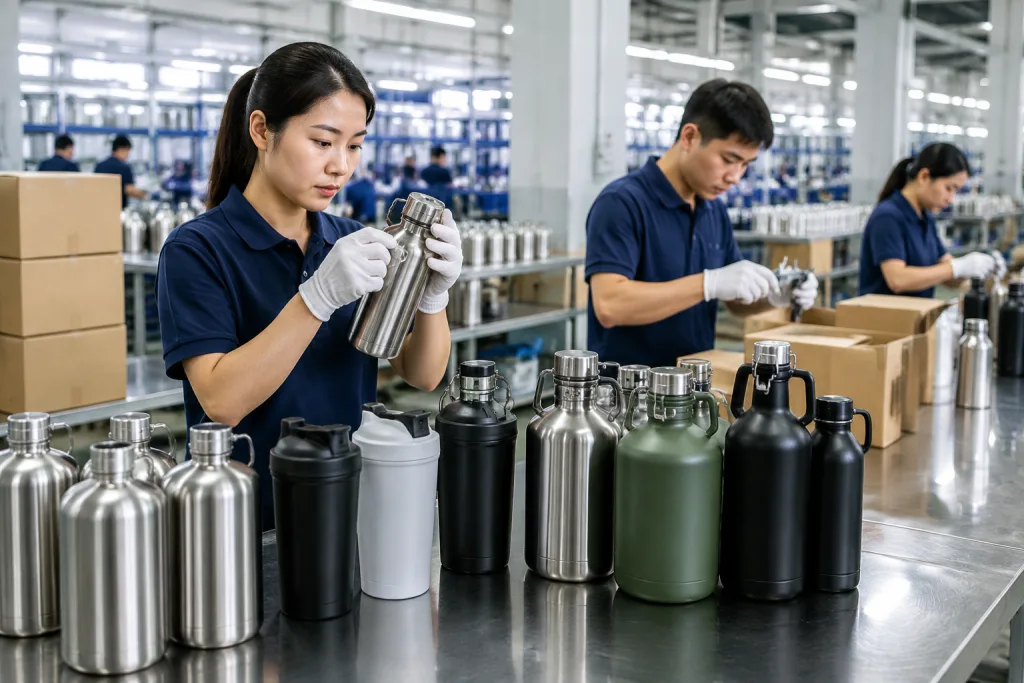
Key Takeaways
- A 500 ml stainless canteen usually lands at USD 2.40-4.20 FOB China at 1,000 pcs depending on lid and finish
- Blender-style shaker bottles work best for gyms, nutrition brands, and subscription kits where leak testing matters more than insulation
- Growlers need thicker stainless, usually 0.5-0.6 mm inner wall, because dents are more visible on large bodies
- For custom drinkware, expect 25-35 days mass production after sample approval and artwork confirmation
If you searched for vendors blender bottle, you are probably sourcing more than shaker cups. Most B2B buyers we quote each week compare 4–6 custom drinkware lines at the same time: stainless canteens, protein shakers, travel tumblers, and growlers for retail shelves, gym chains, outdoor brands, or distributor programs. Last Tuesday, QC pulled a 700 ml shaker sample from the line because the flip lid sat 0.8 mm off-center after assembly. Small issue. Big headache if your buyer expects a leak-test video before deposit.
The hard part is not finding a canteen vendor in China. It is matching the product type to your channel, price point, artwork method, compliance requirement, and shipping plan before the mold or logo film is confirmed. BottleForge Industrial is based in Hangzhou, Zhejiang, and we see the same mistake on about 3 new inquiries out of 10: buyers choose the shape first, then find out the lid tooling, powder coating, or 12 kg master carton does not fit their business model. We push back on that. The math does not work if a nice-looking bottle adds 18 days to lead time and kills your freight plan.
Start With The Buying Job
A buyer asking for vendors blender bottle is often mixing up 3 buying jobs on one RFQ. First: a shaker bottle with a wire ball, PP agitator, or fixed mixer for protein powder. Second: a custom canteen for outdoor retail, school teams, or corporate programs. Third: a customizable growler for beer, camping kits, or higher-ticket gift sets. Same column on the sourcing sheet. Different line setup. We have seen this go sideways when the PO says “blender bottle” but the artwork file shows a 64 oz beer growler.
A shaker bottle is judged by lid fit, thread tolerance, leak rate, odor retention, and whether the mixing insert rattles inside the carton after a 1.2 m drop test. A canteen customized for retail is judged by coating durability, logo position within ±1.5 mm, mouth diameter, and carton protection. A customized growler is judged by insulation performance, welding quality, and whether the cap seal survives pressure changes in transit. QC pulled one growler sample last season after the silicone gasket shifted 0.8 mm; the buyer only noticed because the cap felt “soft” when tightened.
For procurement, the first question is simple: where will the bottle be used, and who eats the warranty claim? A distributor canteen program for North America usually needs safer colors, repeatable SKU packaging, and barcode labeling that scans through a polybag. A canteen promotional order for a European event may push for a 20-day lead time and a low MOQ, but the math does not work if they also want 6 PMS colors and individual kraft boxes. A retail custom drinkware launch needs tighter surface control, stronger cartons, and pre-shipment AQL inspection. The buyer flagged this exact issue on a PO last month: “matte black” in the spec sheet, “gloss black” in the carton mark file.
At our Zhejiang facility, monthly capacity is about 600,000 stainless drinkware units across canteens, tumblers, and bottles, with typical MOQ at 1,000 pcs per color for stainless models. Plastic shaker styles can be lower, but it depends on mold availability, masterbatch stock, and whether we run the color on an open injection line. Ask early. A 500 pcs trial order is possible on some plastic shaker molds, while a custom-coated stainless canteen below 1,000 pcs usually burns too much setup time in spraying and laser positioning.
Spec Table For Fast Comparison
Do not compare SKUs only by milliliters. Compare where the order can fail. A 750 ml shaker, a 750 ml canteen, and a 750 ml vacuum bottle land in different tooling, leak testing, AQL 2.5 checks, and freight cube. Last month QC pulled 32 pcs from a shaker run and found 3 lids weeping after a 30-second upside-down test; the quote looked fine, but the line told the truth.
| Product type | Best use-case fit | Typical capacity | Common material | Usual FOB range | Main risk |
|---|---|---|---|---|---|
| Blender-style shaker | Gyms, nutrition kits, sports promos | 600-900 ml | PP, Tritan, stainless mix | USD 1.20-3.60 | Lid leakage and odor |
| Custom canteen | Outdoor, schools, corporate retail | 500-1,000 ml | 304 stainless steel | USD 2.40-4.80 | Coating scratches |
| Travel tumbler | Coffee, commuter, gift sets | 350-600 ml | 304 stainless steel | USD 3.20-6.50 | Lid complexity |
| Custom growler | Beer, camping, premium outdoor | 1.0-1.9 L | 304 stainless steel | USD 7.50-14.00 | Dents and seal pressure |
For a canteen manufacturer, stainless grade and wall thickness beat nice model names. Most export canteens we ship use SUS304 inside and outside, while price-driven POs sometimes ask for 201 stainless outside. I push back on 201 for North American retail because rust around a scratched logo is a warranty headache, not a sales feature. For vacuum canteens, common wall thickness is 0.4-0.5 mm. For a customized growler, 0.5-0.6 mm is safer because the bigger body shows dents after carton compression; we have seen a 12 kg top-load test mark the shoulder before the buyer even saw the gold sample.
If you are building a distributor growler line, ask for carton dimensions before approving the quote. Small point. Big money. A low unit price gets ugly when a master carton wastes container space, and we have seen buyers lose 18 days after changing from 12 pcs per carton to 8 pcs because the first CBM math did not work.
Canteen Beats Shaker When
A canteen customizable program wins when the buyer needs one bottle SKU for several accounts, not a gym-only product. A shaker is specific. A canteen sells into school bookstores, outdoor retail shelves, company stores with HR budgets, travel gift programs, and promo distributors that need repeatable stock. We ship this pattern often: one 750 ml body, two lid colors, carton mark changed by client. If you are a canteen distributor holding 3,000-5,000 pcs for mixed customers, this is the right question to ask. A blender bottle style can sit too narrow, and we have seen that go sideways when the buyer flagged slow sell-through after the first container.
The strongest canteen use-cases are still simple: 500 ml for corporate gifts, 750 ml for outdoor retail, and 1,000 ml for sports or camping. On custom canteen orders, we usually steer buyers toward powder coating when the bottle will be handled daily. It adds cost, often USD 0.25-0.45 per unit compared with plain stainless, but the grip is better and the shelf look is stronger. QC pulled the sample last month and measured coating thickness at 55-65 μm with a coating gauge before the tape test. Matte black and navy reorder cleaner than trendy gradients; forest green and white also work if your client can accept slightly tighter carton protection for scuff control.
Logo choice depends on where the bottle will sell. Laser engraving lasts and looks clean on powder coat, but it is the wrong pick for a full-color brand mark with small text under 1.5 mm. Silk screen is economical for 1-2 colors and works well for canteen promotional orders, especially when the buyer wants 2,000 pcs fast and accepts a Pantone match within normal tolerance. Heat transfer or UV printing handles gradients better, but the math changes because artwork setup costs more and abrasion testing needs more care. On the line, we run a 3M tape pull and a 500-cycle rub check before approving the logo sample.
For EU and North America, ask your canteen supplier for LFGB or FDA food-contact documentation, plus REACH for coatings when applicable. If the factory mentions BSCI, ISO 900 1, or Sedex, ask for the current audit report, not a logo pasted on the quotation. A serious canteen factory in China should be comfortable discussing AQL 2.5 for major defects and AQL 4.0 for minor defects. We once caught a PO typo that changed “304 stainless” to “201 stainless” before tooling confirmation; QC would have rejected it at incoming material inspection with the XRF gun, but catching it at the desk saved 12 days versus 18 days after rework.
Shaker Bottles Win When
The blender-style bottle earns its space when the buyer sells powder, not just water. For a 24-hour gym chain or a supplement brand launching 2 flavors of whey, shaker format beats a standard canteen because the user needs powder mixing and a lid that opens with one thumb. Buyers searching vendors blender bottle usually ask us 4 things first: mixing ball or grid, one-hand flip cap, printed ml/oz marks, and whether a 700 ml cup fits a gym bag side pocket. QC pulled one sample last month where the side-wall scale was 3 mm off after screen printing. The buyer flagged it fast.
For plastic shakers, PP keeps the price down and survives squeeze abuse on the line; Tritan gives clearer walls and a shelf-ready look. Tritan often costs USD 0.40-0.90 more per unit depending on capacity and lid structure. Stainless shaker bodies look premium, but the math does not always work: a 700 ml stainless body adds weight, hides the liquid level, and pushes freight up by carton. If you need a retail product, that tradeoff may be fine. If you need a canteen promotional giveaway at 10,000 pcs, it usually is not. We run weight checks on a 0.1 g scale because buyers notice when the hand feel changes between approval sample and bulk.
Leak testing is the non-negotiable issue. We recommend 100% water leak testing on shaker lids, not random inspection only, because threaded lids and flip caps fail before the cup body does. A 1.5% leak rate sounds small until you ship 20,000 pcs to a distributor drinkware client and receive 300 complaints. We have seen this go sideways. For mass production, ask for lid torque checks with a torque meter, drop tests from 1.0 meter, and carton drop testing based on ISTA-style handling. On our line, the operator flips each filled lid upside down for 30 seconds before packing.
Be careful with custom colors. A bright PMS lid can require new pigment matching, and the MOQ can rise to 3,000-5,000 pcs per color if the material supplier asks for a minimum batch. The wrong question is “Can you match this color?” The better question is “Will the same masterbatch run again in 90 days?” For repeat orders, keep masterbatch records and approved physical samples in both your office and the Zhejiang factory. We tape the signed lid chip to the production folder; one PO typo, PMS 186C instead of PMS 185C, already cost a buyer 12 days of back-and-forth.
Growlers Need Different Discipline
A custom growler is not a stretched bottle. The body is bigger, the vacuum zone is wider, and buyers expect it to feel closer to outdoor gear than promo drinkware. Cheap ones show their problems fast: dents on the shoulder, orange-peel powder coating, cap scratches around the thread. QC pulled 32 samples from a 1.9 L matte black run last year, and 5 failed because the bottom ring had visible wobble on a flat glass plate. Returns hurt too. Each unit eats carton space, so the math doesn't work like a 500 ml bottle claim.
For a customizable growler, we usually run 1.0 L, 1.2 L, 1.5 L, or 1.9 L. The 1.9 L size sells well for beer and camping, but it pushes freight cost up and punishes weak packing. We prefer EPE bag plus individual box plus 5-layer master carton for export orders; on one EU shipment, changing from a 3-layer to 5-layer carton cut corner crush findings from 11 cartons to 2 during AQL 2.5 inspection. For premium sets, use molded pulp or EVA insert when the growler ships with cups or a handle accessory.
Cap construction needs real checking. A simple screw cap costs less and cleans faster. A swing-top or handle cap looks better in photos, but it brings extra silicone, pins, torque checks, and leak risk. We run a 24-hour inverted leak test and a thread gauge check before sealing samples. If the buyer wants carbonated beverages, confirm the use case on the PO, not just in WeChat. Stainless growlers are often built for transport, not long-term pressurized storage. Do not let a sales photo become the technical claim.
For customized growler branding, laser engraving is the safer choice for small logos. Large full-wrap printing can look sharp, but it needs a clean cylindrical surface and tight curing control. Ask for a printed sample first. Then run 3M tape adhesion and wet rub tests before approving mass production; we have seen this go sideways when a 92 mm tall logo passed the photo review but rubbed off after 20 wet cycles on the line.
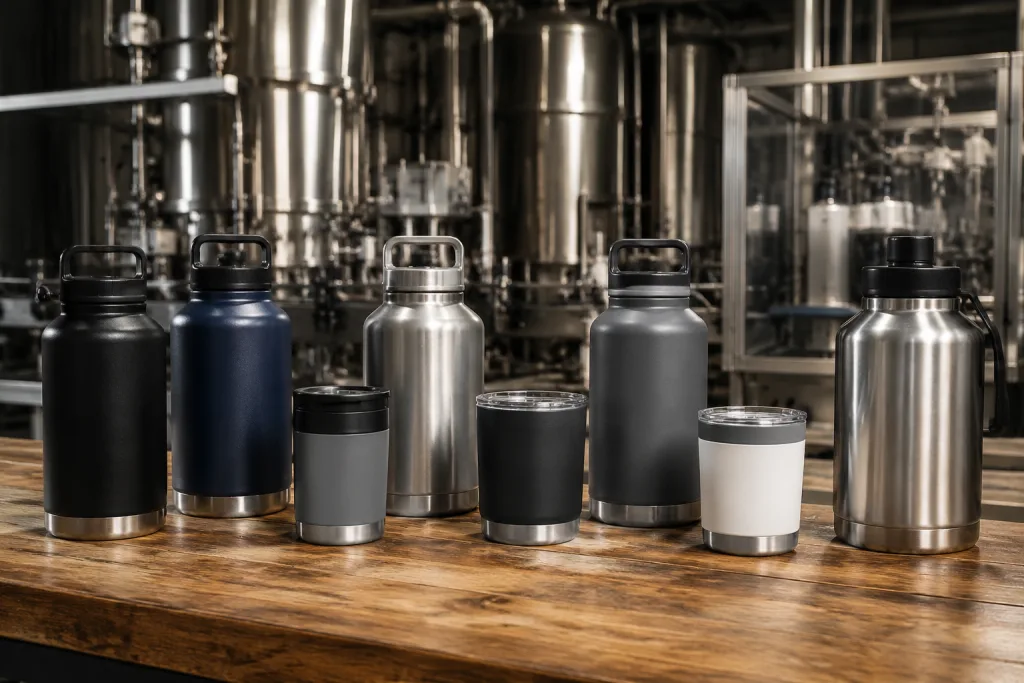
Supplier Checks Before Deposit
The gap between canteen suppliers usually shows after the 30% deposit lands, not during quoting. A neat PDF quote is easy. Running the line is not. Before you pay, ask the canteen manufacturer or canteen vendor for a real production file: material grade, capacity tolerance in ml, coating method, lid material, gasket material, logo method, packing method, MOQ, sample lead time, mass lead time, and Incoterm. We run this as a one-page spec sheet, and QC checks the first sample with a digital caliper for mouth diameter and wall thickness before sales sends photos.
For export buyers, FOB Ningbo or FOB Shanghai are common from Zhejiang and nearby China factories. If the quote is EXW, slow down and compare the math because local trucking, customs declaration, and port handling may sit outside the unit price. A USD 0.08 saving on paper can vanish after one 580 kg pickup from Hangzhou to Ningbo. We have seen this go sideways when a buyer’s PO said “EXW Shanghai,” but the forwarder expected FOB Ningbo.
Ask who owns the mold or tooling. About 7 out of 10 canteen manufacturers we see are working from public molds. That works for distributor canteen and canteen promotional orders. If you need an exclusive shape, budget tooling from USD 2,000 to USD 12,000 depending on body, lid, and handle complexity. Tooling usually takes 25-45 days before production sampling. This is where the buyer often pushes back, but the math does not work if the order is only 1,000 pcs and the handle needs a new injection mold.
Factory audits matter, but they do not replace shipment control. BSCI helps with social compliance. ISO 9001 shows process discipline. AQL inspection protects you shipment by shipment. For first orders, we suggest pre-production sample approval, mid-production photos at 30% completion, and final inspection when at least 80% of goods are packed. QC pulled one blender bottle sample last month where the logo was 3 mm too low on the body; that is cheap to fix at 30% completion and painful after 86 cartons are sealed.
How BottleForge Quotes It
Send BottleForge Industrial in Hangzhou a short RFQ, not a 9-page brief. We need capacity in ml or oz; material target such as 304 stainless or Tritan; lid style with straw, flip, or screw cap details; logo artwork in AI or PDF; order quantity split by color; destination country; retail shelf or promotional handout use; compliance items such as LFGB, FDA, REACH, ASTM, or Prop 65. If the job needs FNSKU labels or Amazon carton rules, put that in the first email. We had one PO last month with “white box” typed as “wihte box,” and QC pulled the packed sample only after the carton mark file came in late. Packaging is not a small line item.
For a stainless customized canteen order at 1,000 pcs, sampling takes 5-7 days with an existing mold and standard color. Mass production runs 25-35 days after sample approval. For a custom drinkware order with PMS powder coating, plan 7-10 days for color panel confirmation because the line checks the sprayed panel under a D65 light box before we release bulk coating. Custom growler projects with new accessories take 12-18 days for sampling, not 5-7 days, because lid fit, thread bite, and 6-hour insulation tests slow the job down. Rushing this part is where we’ve seen orders go sideways.
We quote FOB China, with Ningbo and Shanghai as the practical ports we ship through. First-order payment terms are 30% deposit and 70% before shipment after inspection. For canteen distributors, we run neutral cartons, barcode labels, FNSKU labels, and master carton marks, but carton weight still has to stay workable, usually under 15 kg for mixed color packs. For brand owners, we can handle retail box design files. Dieline approval must land before mass packing starts, or the packing team sits on finished cups while everyone argues over a 2 mm flap change.
A clean RFQ cuts quote revisions. If you are unsure whether the project should be a shaker, customizable canteen, or customized growler, ask for a side-by-side quote with the same MOQ, logo method, and carton spec. That is the right question to ask. Forcing one bottle to cover gym mixing, outdoor insulation, and retail gifting makes the math messy, and the buyer usually flags it after the first sample anyway.
Send Your Drinkware RFQ For A Straight Comparison
Share quantity, artwork, destination, and use-case. We will quote shaker, canteen, tumbler, or growler options side by side.
Frequently asked questions
What MOQ should I expect from vendors blender bottle and canteen suppliers?
For existing molds, a realistic MOQ is 1,000 pcs per color for stainless canteens and 2,000-3,000 pcs for many plastic shaker bottles if you need custom colors. If you accept standard black, white, or stainless, some canteen suppliers in China can support 500 pcs, but the unit price usually rises by 10-25%. For a custom growler with special lid or handle, plan around 1,000 pcs minimum. Tooling projects can push the practical first order to 3,000 pcs because the factory needs enough volume to stabilize setup cost.
Is a custom canteen cheaper than a blender-style shaker bottle?
Not always. A simple PP shaker bottle can be USD 1.20-2.20 FOB China at 3,000 pcs, while a 750 ml stainless custom canteen is more often USD 2.80-4.80 depending on vacuum insulation, coating, and lid. But the canteen may have a higher perceived retail value and longer use life. If you are buying for canteen promotional distribution, a single-wall stainless model can narrow the price gap. If you need powder coating, laser logo, and retail box, the canteen will usually cost more.
Which logo method is best for customized drinkware?
Laser engraving is the safest for durability, especially on powder-coated stainless canteens and growlers. Silk screen is cost-effective for 1-2 color logos and large promotional runs above 1,000 pcs. UV printing or heat transfer works better for full-color artwork, but you should approve a physical sample and run adhesion testing before mass production. For retail custom drinkware, we normally recommend laser for premium minimalist branding and UV or heat transfer only when color accuracy is central to the product.
What compliance documents should a canteen manufacturer provide?
For Europe, ask for LFGB food-contact test reports and REACH information for coatings or painted surfaces. For the United States, ask for FDA food-contact documentation and Prop 65 assessment if selling in California. If the product is for children, additional testing may apply under ASTM or CPSIA rules depending on design and market. A responsible canteen manufacturer in Zhejiang or elsewhere in China should also provide material declarations for SUS304 stainless steel, silicone gaskets, PP lids, and any coating used.
How long does a customized canteen or growler order take?
For existing molds, plan 5-7 days for a printed or laser sample and 25-35 days for mass production after approval. PMS powder coating can add 5-10 days because color panels need confirmation. A customized growler with new lid parts, handle tooling, or gift-box packaging may need 45-60 days total from RFQ to finished goods. Add ocean freight time separately: roughly 25-35 days to many North American ports and 30-40 days to many European ports depending on route and season.