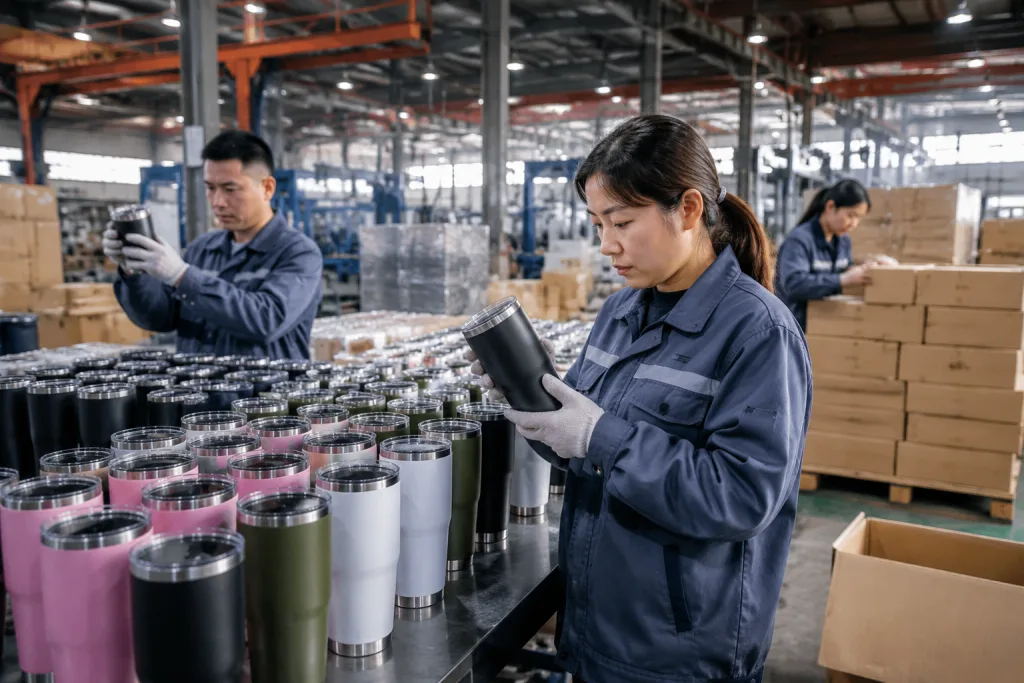
Key Takeaways
- Set the core spec first: 18/8 stainless, 0.4-0.5 mm inner wall, 0.5-0.6 mm outer wall, and leak test requirement
- Typical MOQ is 1,000-3,000 units per color for customized drinkware depending on finish and lid tooling
- Laser engraving suits 1-color logos; powder coating plus silkscreen is better for retail-facing artwork
- Plan 25-35 days production after deposit and artwork approval, plus 18-32 days ocean transit to Europe or North America
If you search for vendors beer tumbler, you are not buying 1 cup. You are trying to lock a canteen supplier, approve artwork, keep freight on schedule, and still land a retail or promo price that works. The risk is not finding a factory in China. The risk is sending 5 factories a loose brief, then comparing quotes built on different steel grades, lid molds, carton burst strength, and AQL 2.5 inspection assumptions. We see this go sideways when a PO says “black lid” but the sample room made matte black while the buyer expected glossy black.
A practical buying decision starts with 4 calls: construction, branding method, order math, and compliance route. BottleForge Industrial manufactures custom drinkware in Hangzhou, Zhejiang, with stainless steel bottle and tumbler lines running up to 420,000 units/month. On the line, we run calipers on rim diameter, check vacuum loss after the hot-water hold test, and QC pulls the sample before artwork approval. For most vendors beer tumbler projects, the cheapest quote is the wrong question to ask. The better quote is the one with fewer surprises.
Start With The Buying Decision
A vendors beer tumbler project should not start with color charts. Start with the job. Brewery shelf item? Festival merch cup? Distributor drinkware line? Corporate gift? Reusable venue tumbler? Each one changes the target FOB, lid choice, finish, packing, and QC limit. Last month a buyer sent us 7 PMS colors before confirming whether the cup needed a lid; the line could not price the mold insert until we knew that.
For brewery retail, buyers pay for perceived value: double-wall vacuum insulation, 304 stainless steel, powder coating, laser logo, gift box, and a clean care card. We run 16 oz and 20 oz tumblers around USD 3.20-5.80 FOB Ningbo depending on finish, lid, packaging, and order quantity. For event giveaways, a single-wall stainless cup or lighter double-wall tumbler fits a tighter USD 1.80-3.20 FOB target. QC pulled the sample on one 20 oz job because the powder coat edge at the rim measured 0.35 mm thicker than the approved sample, and the buyer flagged the mouthfeel right away.
The next choice is dedicated beer tumbler or broader custom canteen family. If you sell to retail chains or breweries, a matching set can include a tumbler, custom growler, customized growler, and canteen customized with the same color and logo system. That gives canteen distributors and distributor growler buyers a line, not one lonely SKU. We’ve seen this go sideways when the tumbler uses matte black, the growler uses gloss black, and the PO says “same black” with no PMS code.
Be careful with vague RFQs like “quote 20 oz beer cup with logo.” This is the wrong question to ask. A canteen factory can quote that 10 different ways, and the math will not match. Ask vendors to quote against one written spec: capacity tolerance, steel grade, wall thickness, lid material, coating, logo size, packing, AQL level, and Incoterm. Only then can you compare canteen manufacturers in China fairly; our merchandiser once caught “FOB Ningbo” typed as “FOB Shenzhen” on a PO, which changed inland freight by 2 days and about USD 0.06 per unit.
Choose Construction Before Decoration
Construction moves the price before decoration does. For stainless vendors beer tumbler orders, lock the body first: single-wall, double-wall air insulated, or double-wall vacuum insulated. Single-wall is light and cheap, but it sweats on the table and beer warms fast. We’ve seen buyers spend 3 days arguing over logo size while the real USD 0.42 gap sat in the wall structure. Wrong question. On our line in Hangzhou, QC can spot a weak single-wall sample quickly because the rim ovality runs past 0.8 mm after polishing.
A practical mid-range spec is 304 stainless steel inside and outside, 0.4 mm inner wall, 0.5 mm outer wall, copper-free vacuum insulation, and a press-fit Tritan or PP lid. For a premium line, we run 0.5 mm inner and 0.6 mm outer wall to give the body more stiffness. The difference adds USD 0.18-0.35 per unit, but it cuts dent complaints during distributor drinkware handling. Last season, QC pulled the sample after a 1.2 m carton drop and found 7 dents on the lighter body versus 2 dents on the heavier wall set.
For a canteen custom program, decide if the body shares components with existing tooling. Existing molds reduce risk and keep MOQ lower; for our common 16 oz beer tumbler body, we can usually start from 1,000 pcs per color. New body tooling for a unique silhouette can cost USD 1,200-4,500 depending on complexity, with 20-35 days added before mass production. If you are testing a market, use existing tooling. If you are building a protected retail range, custom tooling can make sense, but we’ve seen this go sideways when a buyer approved the shape on a PDF and later flagged the cup holder fit by 3 mm.
Ask the canteen manufacturer for real performance numbers, not catalog talk. A vacuum tumbler should pass a hot water insulation test and a vacuum failure check; we run 95°C water for 6 hours and reject units with a shell temperature jump over the control limit. For drink contact parts, ask for LFGB or FDA food-contact test reports, depending on your market. Europe often requires REACH attention for coatings and components. North American programs need California Proposition 65 review for painted finishes and packaging inks, and the buyer flagged this twice for us after a PO typo listed “matte black spray” while the approved sample was powder coating.
Match Branding To The Channel
Decoration is where 6 out of 10 buyer quotes go off track: too much spend, or a logo spec that will not survive use. Match the branding method to the channel, artwork file, and handling. Simple rule. A canteen promo order for a 3-day beer festival does not need the same finish as a retail customized drinkware line sitting on a shelf for two seasons, and this is the wrong question to ask if the buyer starts with “what is the fanciest logo option?” Our prepress desk still sees AI files with 0.2 mm strokes that disappear after laser engraving.
Laser engraving is durable and clean on stainless or powder-coated tumblers. It suits 1-color logos, block text, and artwork with at least 0.35 mm line width. The unit cost is usually around USD 0.08-0.25 depending on logo size and run time; on the line, a 45 x 35 mm brewery mark takes longer than a small 18 mm lid logo. Silkscreen printing costs less for simple color logos on flat or gently curved areas, often USD 0.05-0.18 per color. Heat transfer or water transfer handles complex artwork, but QC pulled the sample more than once after 3M tape testing and 50-cycle abrasion checks. The math doesn't work if the order is only 500 pcs and every design needs separate film, setup, and color matching.
Powder coating is the common choice for customizable drinkware because it gives solid color depth and a grippy finish. For beer tumblers, matte black, navy, white, olive, and stainless are stable choices. Metallic and gradient finishes sell well in photos, but rejection risk goes up if the approved sample is treated like a lab standard. We’ve seen this go sideways: one buyer flagged a 0.5 shade difference on matte navy after the tumblers passed the signed sample range. Agree on color tolerance before production, ideally against a Pantone reference and a signed physical sample, then let the coating room run one controlled batch instead of chasing impossible perfection.
If you are buying for canteen vendors or distributor canteen programs, plan logo versioning before the PO is typed. A canteen customizable body can use one base color with different laser logos for 8 breweries or 12 regional distributors. That keeps factory production efficient while giving each customer their own branding. At BottleForge in Zhejiang, we usually recommend grouping logo versions under one coating batch when possible, because separate coating batches create avoidable color variation and setup cost. We once had a PO typo that split “matte white” into “milk white” for 2,000 pcs; the buyer flagged it only after the pre-production sample, so now we run color names against the signed sample label before coating.
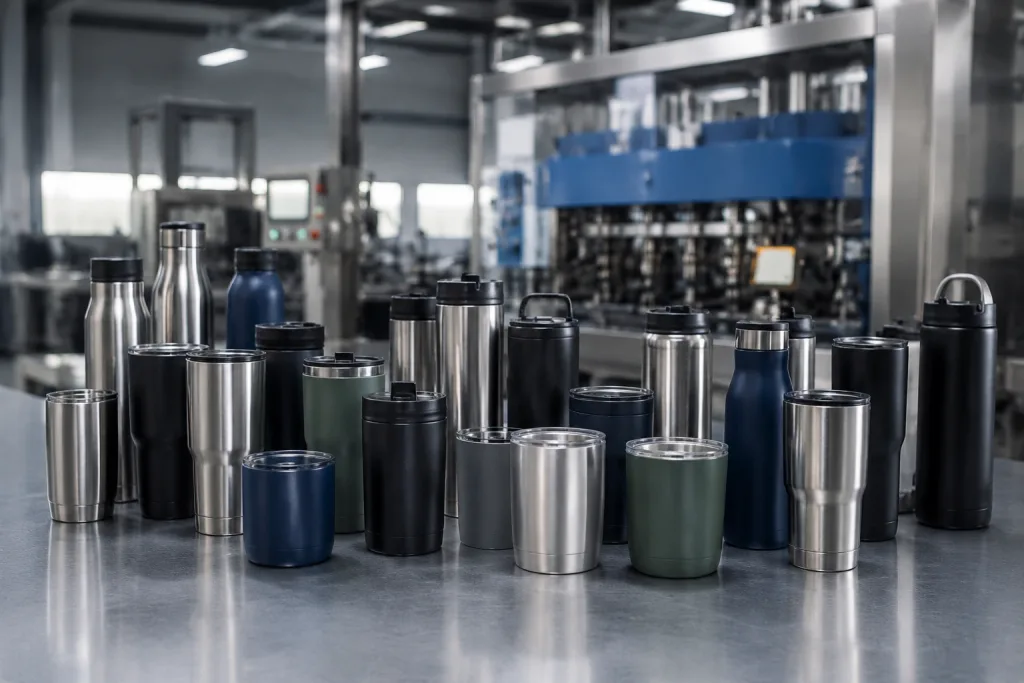
Price The Whole Landed Unit
FOB price is a useful line on the quote sheet, but it is not your final cost. Price a vendors beer tumbler program as one landed, sellable unit: cup body, decoration, packaging, export carton, inspection, inland freight from Hangzhou to Ningbo, ocean or air freight, duty, customs clearance, warehouse receiving, and any relabeling your channel needs. We run this in a costing sheet with carton size in mm and gross weight in kg; last month QC pulled a carton at 13.8 kg and the buyer flagged it because their DC limit was 12 kg.
A typical 20 oz vacuum beer tumbler with powder coating, laser logo, PP lid, individual white box, and 24 pieces per export carton may cost USD 3.60-5.20 FOB Ningbo at 3,000 units. Add gift packaging and the range may move to USD 4.20-6.40. Air freight can wreck the math on heavy stainless steel. Use it for samples, urgent replenishment, or launch quantities below 300 units. For regular distributor drinkware orders, ocean freight is usually the only sensible route; we have seen 3 cartons sent by air for approval, then 126 cartons shipped by sea once the buyer signed the pre-production sample.
MOQ is the trade-off buyers push back on first. Around 8 out of 10 canteen suppliers advertise low MOQ, but the real limits sit in coating, logo setup, and carton efficiency. For standard colors, 1,000 units per color is often workable. For custom Pantone powder coating, expect 2,000-3,000 units per color. For a canteen customized gift box, the box MOQ may be 1,000-2,000 pieces, but offset printing gets cheaper at 3,000+ pieces. On the line, the powder booth does not like 200-piece color changes; we lose time cleaning the gun, mesh screen, and hanging racks.
Ask how pricing changes at 1,000, 3,000, 5,000, and 10,000 units. Do not ask only for the “best price”; that is the wrong question. A reliable canteen vendor will show where the cost drops. Sometimes 5,000 units saves only USD 0.12 each; sometimes it saves USD 0.45 because coating, carton, and logo setup spread better across the order. We once caught a PO typo showing 10,00 units instead of 10,000, and the packing plan changed from 417 cartons to 42 cartons before production noticed. That price ladder tells you whether to consolidate SKUs or keep a smaller first order.
Control Quality Before Shipment
Put quality control in the PO before we cut steel, print film, or book cartons. Do not wait until 420 cartons are stacked by the loading door; the math doesn't work once rework means unpacking every master carton. For vendors beer tumbler orders, spell out the inspection standard, defect categories, test methods, and replacement terms before deposit. We usually see AQL 2.5 for major defects and AQL 4.0 for minor defects, general inspection level II. For higher-end retail, some buyers require AQL 1.5 major, and QC pulls the sample against that table, not against someone’s memory.
Major defects should cover leaking lids, failed vacuum insulation, sharp edges, rust spots, wrong logo, wrong color, severe dents, and incorrect capacity. Minor defects can include coating dust under 0.5 mm, logo shift inside the approved limit, light carton scuffs, or small cosmetic marks on the back side. Write the tolerances down: logo position ±2 mm, capacity ±5%, carton weight tolerance, and acceptable color variance against the approved sample. We had one PO typo last season calling for “matte balck,” and the buyer flagged the shade only after the first 3,000 pcs were sprayed.
Factory testing should cover vacuum retention checks, 100% visual inspection on decorated goods, random lid fit testing, coating adhesion cross-hatch test, and drop test for packed cartons. On the line, we run the 3M tape cross-hatch after coating cure, then check lid fit with the actual gasket batch, not a clean sample from the sample room. For reusable drinkware sold in Europe, ask for LFGB food-contact testing where relevant. For the United States and Canada, FDA food-contact material declarations and heavy metal screening are common buyer requirements.
A serious canteen manufacturer will accept clear inspection rules because they cut arguments before the truck arrives. BottleForge’s Hangzhou, Zhejiang facility runs inline checks before decoration and final random inspection before shipment. Standard production lead time is usually 25-35 days after deposit and approved pre-production sample. If a canteen supplier promises 12 days for a new custom color, new logo, and printed packaging, ask which step they are skipping; we have seen this go sideways when the carton drop test fails at 18 kg and nobody left time to remake packaging.
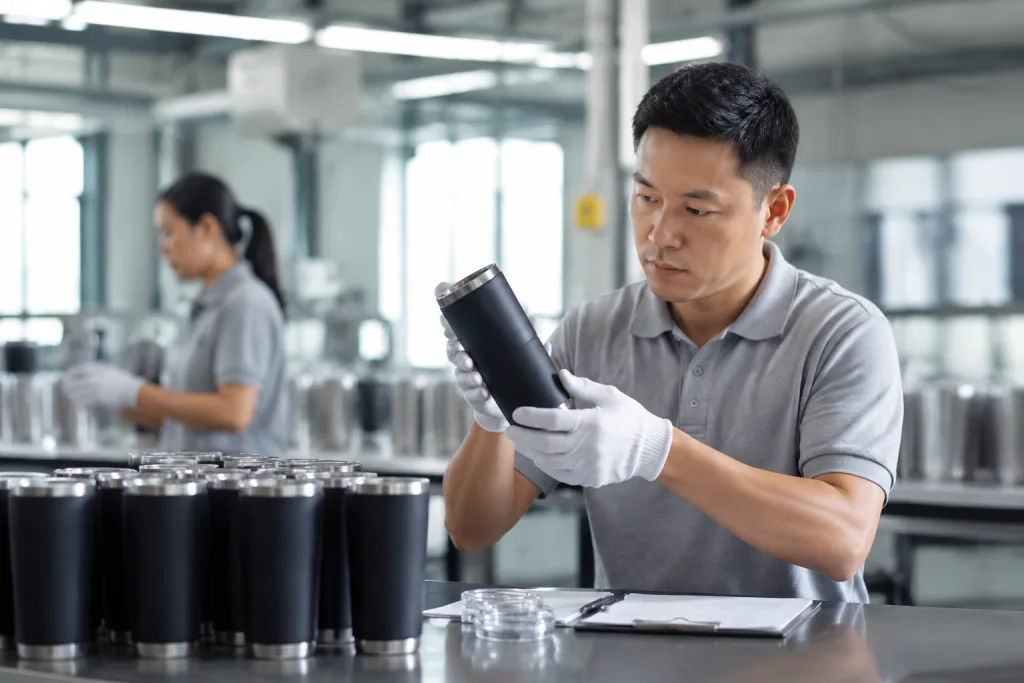
Decide Supplier Type Carefully
Plenty of suppliers call themselves a factory, but only part of them actually make the cup body. In China, we usually see 5 layers behind one beer tumbler order: body forming plants, trading offices, laser or silk-screen workshops, color-coating shops, and carton vendors. A trading company is not a sin. The wrong question is “factory or trader?” The better question is who controls the mold room, argon welding, 800-grit polishing, powder coating, and AQL 2.5 final inspection.
If you are a beer tumbler distributor or brand owner, a direct tumbler factory gives tighter control when the line needs a change. We can pull the lid gauge, check a 0.20 mm tolerance issue, and compare the failed sample against the golden sample on the same morning. A trading company may show 60 catalog shapes, but the math does not work when you need a rim adjusted before the next 3,000 pcs repeat order. Factory access saves days: 12 days for an engineering answer beats 18 days of messages passed through 3 desks.
Ask blunt questions. Where is the vacuum line? Who owns the mold? Is powder coating in-house or outsourced? What is monthly capacity? Can you provide BSCI, ISO 9001, or social audit documentation? Can you support FNSKU labeling for Amazon or mixed carton marks for distributors? Can you share past test reports for similar stainless drinkware? A real beer tumbler supplier should answer cleanly, and if QC pulled the sample from the vacuum rack, they should know whether the leak rate last week was 0.3% or 3%.
For beer tumbler manufacturers and beer tumbler vendors, communication quality is a production metric. Short version: test the team. If your PO says matte black but artwork says glossy black, the supplier should stop and ask before the coating line runs 1,200 pcs. We have seen this go sideways when a buyer flagged the color only after FBA labels were applied. If the carton drop test fails because the gift box board is 1.2 mm instead of 1.8 mm, the supplier should tell you before shipment, not after your warehouse reports crushed packaging.
Build A Repeatable Sourcing Brief
The quickest quote fix is a tighter brief. Keep it to one page plus artwork files; anything past that gets missed by the merchandiser on a busy Monday. List product type, capacity, fixed dimensions, material, finish, logo method, packaging, certification market, order quantity, target FOB port, required delivery date, and inspection standard. Attach AI or PDF artwork, Pantone references, and retail packaging dielines if the buyer already has them. We run the first check with a caliper and a Pantone book on the sample table, so “same as photo” is not enough.
For a vendors beer tumbler brief, a clean baseline reads like this: 20 oz double-wall vacuum beer tumbler, 304 stainless steel, matte powder coating, laser logo 45 x 35 mm, clear PP press lid, individual kraft box, 24 pieces per export carton, AQL 2.5/4.0, FOB Ningbo, 3,000 units, delivery 35 days after sample approval. That is enough for canteen suppliers to quote without padding the price. Last month QC pulled a sample where the PO said 45 x 35 mm, but the artwork file was 55 x 38 mm. Small typo. Big argument.
If you are building a larger custom drinkware range, spell out the family logic. Say whether the tumbler must match a custom canteen, customizable canteen, or distributor growler in color, lid shape, carton mark, and logo height from the base. A shared design style makes the line easier to sell and easier to produce. It also gives you room to negotiate across SKUs because we can group powder coating batches by Pantone code and pack them on the same inspection schedule.
Do not hide your target price if it is real. The math either works or it does not. A good China factory can suggest changes: standard lid instead of custom lid, laser instead of 2-color print, white box instead of rigid gift box, or 0.5 mm outer wall instead of 0.6 mm. We have seen this go sideways when a buyer asks for premium retail packaging at a promo tumbler budget. Those trade-offs are normal. The best supplier relationship is built on controlled decisions, not guessing across 6 rounds of email.
Send Your Beer Tumbler RFQ For Factory Review
Share quantity, logo, target price, and market. BottleForge will return practical specs, MOQ, FOB pricing, and lead time options.
Frequently asked questions
What MOQ should I expect for a vendors beer tumbler order?
For a standard stainless beer tumbler using existing tooling, expect 1,000 units per color as a realistic starting MOQ. If you need custom Pantone powder coating, 2,000-3,000 units per color is more practical because coating line setup and powder purchase have minimums. For multiple logo versions on the same color body, some factories can split 3,000 units into three 1,000-unit logo runs. New tooling, unusual lids, or customized growler-style shapes may push MOQ to 5,000 units. Always ask whether the MOQ is driven by the body, coating, packaging, or logo process.
How long does a customized drinkware order take from China?
For a normal customized drinkware order, allow 7-10 days for sampling after artwork confirmation and 25-35 days for mass production after deposit and pre-production sample approval. Ocean freight from Zhejiang or nearby Ningbo/Shanghai ports usually takes about 18-32 days to North America or Europe, depending on destination port and season. If you require LFGB, FDA, REACH, or Prop 65 testing, add 5-12 working days unless valid existing reports cover the exact materials and coating. A safe launch calendar is 8-10 weeks door to warehouse.
Is laser engraving better than printing for beer tumblers?
Laser engraving is usually better for durability and a clean premium look, especially on powder-coated stainless steel. It removes the coating and exposes the stainless layer underneath, so it will not peel like poor printing can. The trade-off is artwork limitation: gradients, small color details, and multi-color brewery graphics do not work well. Silkscreen printing is better when you need a specific logo color and can accept normal abrasion risk. For retail programs, we often recommend powder coating plus laser for 1-color marks, and heat transfer only when complex artwork is commercially necessary.
What certifications should canteen distributors request?
For Europe, canteen distributors should request LFGB food-contact testing for drink-contact parts and REACH review for coatings, inks, and plastic components. For the United States, FDA food-contact compliance and California Proposition 65 screening are common. If the product is for children, ASTM and CPSIA considerations may apply, but most beer tumblers are adult products. Factory documents such as BSCI or ISO 9001 help assess management systems, but they do not replace product testing. Ask for test reports that match the material, coating, lid, and gasket used in your actual order.
How do I compare canteen manufacturers fairly?
Send every canteen manufacturer the same RFQ sheet and require the same Incoterm, usually FOB Ningbo or FOB Shanghai for Zhejiang production. Compare steel grade, wall thickness, lid material, coating method, logo process, carton packing, sample cost, MOQ, lead time, and AQL level. A quote at USD 3.20 may be worse than USD 3.55 if it uses thinner steel, cheaper lid plastic, no gift box, or vague inspection terms. Ask for pricing at 1,000, 3,000, and 5,000 units so you can see whether the supplier understands production economics.