Key Takeaways
- A realistic vendors beer growler MOQ is 1,000 pieces per color for custom logo and 3,000 pieces for new color coating
- 304 stainless steel at 0.5-0.6 mm outer wall thickness suits most customized growler programs
- Vacuum insulated growlers usually add USD 1.80-3.20 per unit versus single-wall steel
- Plan 30-45 days production after artwork approval, plus 28-38 days ocean freight to Europe or North America
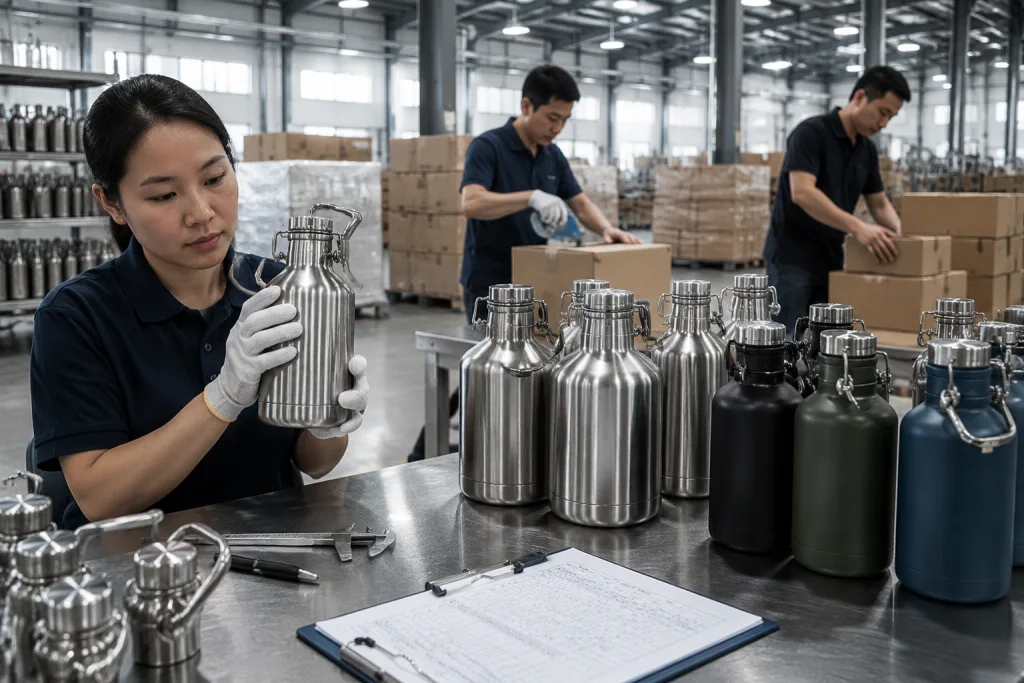
If you are comparing vendors beer growler options, finding a canteen supplier in China is the easy part. The real job is locking the spec before any price has meaning. Same PDF, different product. A 64 oz stainless growler can look identical on screen, then vary in 304 stainless grade, 0.5 mm vs 0.6 mm wall thickness, silicone lid compression, powder-coat cross-hatch results, and 5-layer carton strength. QC pulled one sample last month where the lid passed a desk check but leaked after 3 minutes in our vacuum leak tester.
At BottleForge Industrial in Hangzhou, Zhejiang, we’ve seen buyers lose 12 days chasing “best price” before they confirm the basics. This is the wrong question to ask first. We run the quote from target use, material and insulation, branding method, compliance level, and logistics model, then the math starts to work. Our factory output is 420,000 drinkware units/month, with typical custom growler MOQ from 1,000 pieces per color. The line also checks artwork against the PO; one buyer flagged a missing Pantone code after pre-production, and that small typo held the order for 4 days.
Start With The Use Case
The first decision is simple: is this growler a refill workhorse, a gift item, or a retail SKU? They are not the same build, even when the buyer calls all of them custom drinkware on the RFQ. For a brewery refill program, we care about leak resistance, hand-cleaning space, and cap thread feel more than a shiny gift box; QC pulled one 64 oz sample last month after the silicone gasket sat 0.6 mm proud and left beer smell in the thread after rinsing. For retail shelves, the buyer will flag coating shade, barcode position, and whether the carton survives a 1.2 m drop test. For event promotion, a lighter gauge body can work if the product only needs to run 3-6 months.
For vendors beer growler sourcing, write the use case before asking any canteen manufacturer for price. Put the basics on one spec sheet: capacity, insulation, lid type, color code, logo method, packing, target market, and required compliance documents. We run into this every season: one supplier quotes a bulk-packed 32 oz single-wall body, another quotes a 64 oz vacuum growler with a printed box, then the buyer asks why the gap is USD 2.40. The math doesn't work because the question was too loose. Even a PO typo like “matte back” instead of “matte black” can stop the line for 2 days while the coating room waits for confirmation.
- Brewery refill: 64 oz or 2 L, wide mouth for brush cleaning, robust screw cap, brushed steel or powder coating, individual kraft box optional when the bar counter sells direct.
- Retail gift: 32 oz, 40 oz, or 64 oz, vacuum insulated body, printed retail box, UPC or EAN barcode with 8-10 mm quiet zone, cleaner coating finish for shelf display.
- Corporate promotion: 32 oz or 64 oz, standard color from the factory chart, silkscreen logo, bulk pack or white box packing to hold the unit cost down.
Do not assume every canteen vendor is comfortable with beer-related products. Some canteen vendors mainly make sports bottles and school bottles; they treat a growler like a large water bottle, and we've seen this go sideways. A proper custom growler factory should understand carbonation pressure is different from still water storage, even if the item is not sold as a pressure vessel. On our line, the engineer checks cap engagement with a thread gauge before the sample goes to leak testing. Growlers are normally for transport and short-term storage, so your instruction sheet should say “for transport and short-term storage” instead of suggesting sealed fermentation for 18 days.
Choose Steel Before Styling
Material choice comes second. For food-contact parts, we run 304 stainless steel as the safe default for B2B growler programs. 201 stainless can cut a few cents, but the math doesn't work if the buyer later asks about rust spots, metallic taste, or LFGB/FDA file wording. We have seen this go sideways on a 2,000 pcs brewery PO where the buyer wrote “stainless steel growler” and the supplier quoted 201 without saying it. Be specific.
For a standard customized growler, we usually recommend 304 inner and outer steel, 0.5-0.6 mm outer wall thickness, and a PP or stainless-lined cap with food-grade silicone gasket. QC checks the wall with a digital thickness gauge at the mouth, shoulder, and lower body because deep drawing can thin the steel near the curve. If the product sells near the sea, carries acidic beverages, or sits in a premium gift set, ask for 316 stainless on the inner wall. It adds cost, often USD 0.45-0.90 per unit depending on size and market steel price, but the technical story is cleaner.
Single-wall steel is cheaper and lighter. It also sweats with cold beer and gives no temperature protection. Vacuum insulated construction adds cost, weight, and more steps on the line, including vacuum pumping, copper plating, and a 24-hour heat-retention check. For a 64 oz vacuum growler, expect a finished weight around 780-950 g depending on shape and cap. A single-wall version may be 380-520 g. Freight cost moves fast when we ship 3,000 units; one buyer flagged a carton weight jump from 13.8 kg to 18.6 kg after changing the cap design.
Ask your canteen manufacturer to state steel grade, wall thickness, vacuum test method, and sample retention policy on the quotation. “Food grade stainless” is not enough. For custom canteen and custom growler orders, vague material language is where cheap quotes hide. You do not need an over-engineered military canteen customized for camping if your channel is brewery merchandise, but you do need traceable steel coils, stable laser welding, and a retained golden sample with the PO number taped to the box.
Match The Lid To Risk
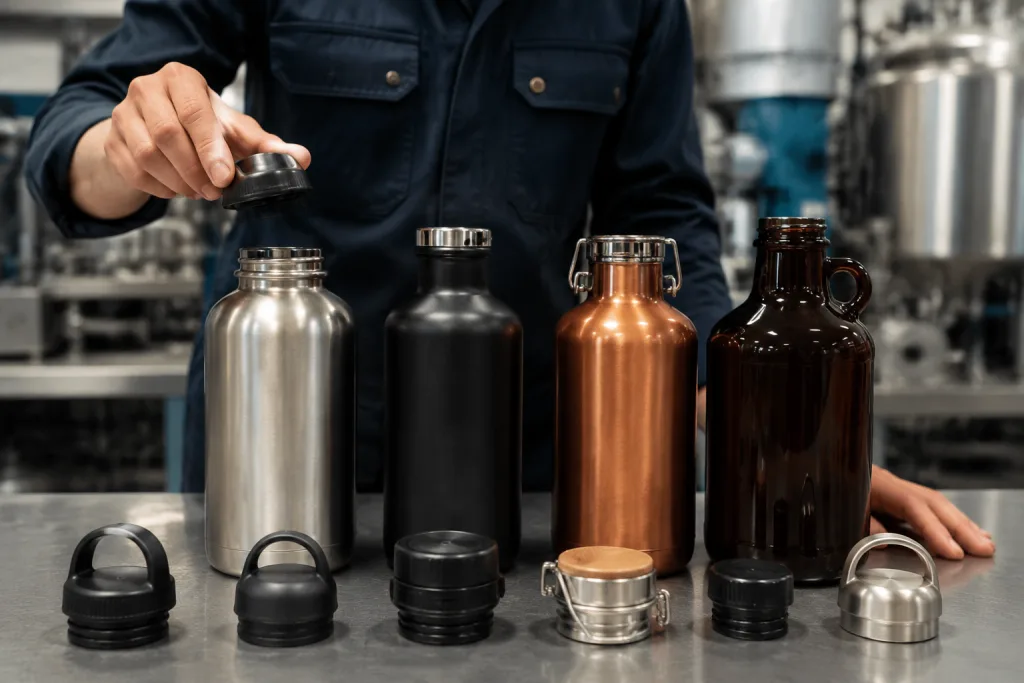
The lid is where 7 out of 10 growler complaints start on our side. Buyers spend 2 hours on Pantone and logo size, then approve a cap that leaks in a backpack or smells like low-grade plastic when QC opens the polybag. For vendors beer growler projects, match the lid to the sales channel risk. A screw cap with a silicone gasket is the normal starting point; we check gasket compression with a 0.2 mm feeler gauge on the line. A swing-top cap looks traditional, but it brings wire bails, ceramic or plastic stoppers, and hinge tolerance headaches. A stainless cap with inner PP thread is often the better middle ground for cost and field use.
For beer transport, write the leak test into the PO. We run 100% visual inspection for thread damage and gasket seating, then pull random water-fill samples for inversion testing; major defects stay under AQL 2.5 and minor cosmetic defects under AQL 4.0. If the order is going into a retail chain, add a carton drop test from 76 cm on 1 corner, 3 edges, and 6 faces. Boring test. It saves the real claims: wet cartons, dented shoulders, and the buyer sending photos with a chargeback form attached.
Do not overclaim pressure performance. Standard drinkware growlers are not certified pressure tanks, and the math does not work if someone expects them to behave like kegs. If you need a container for active fermentation or high-pressure carbonation, that is a different engineering discussion with different wall thickness, valve design, and test equipment. For normal brewery takeaway use, the target is short-term sealing, no off-odor after a 60°C rinse, easy brush cleaning, and threads that do not cross after 50 openings; QC pulled one sample last month where the first thread picked up after 18 cycles.
For canteen promotional programs, the lid can be simpler because the user is not carrying carbonated beer. For a customizable canteen sold through outdoor channels, buyers ask for tethered caps or a carabiner loop, and the buyer flagged textured grip on one 5,000 pcs order because wet hands slipped during a trail-use demo. For a distributor canteen or distributor growler line, fewer SKUs win. One reliable cap shared across 32 oz and 64 oz bodies cuts spare-part mistakes, reduces packing-line changeovers by about 12 minutes per batch, and keeps the PO from turning into a typo trap.
Price The Decoration Honestly
Branding is the third decision, and we price it as a separate line. Bundling logo cost into the unit price makes the sample quote look tidy, then the margin sheet turns into a fight. Ask your canteen supplier to show base unit, logo charge, mold or screen fee, packaging, and inland freight to port. For our Hangzhou, Zhejiang line, FOB Ningbo and FOB Shanghai both work; last month a buyer flagged a USD 0.12 gap because the PO said “logo included” but the carton label fee was sitting inside the unit price.
For a customized canteen or customized drinkware order, the main decoration choices are silkscreen printing, laser engraving, heat transfer, UV print, and powder coating with logo. Silkscreen works for 1-2 colors, often USD 0.08-0.18 per print position at 1,000 pieces, but the operator still checks the screen mesh and logo height with a 0.5 mm ruler. Laser engraving is durable and clean, usually USD 0.15-0.35 depending on logo size. Full-wrap heat transfer looks good on shelf, but QC pulled the sample twice last week because the seam missed center by 2 mm. Powder coating is not just decoration; it changes hand feel, scratch resistance, and production lead time.
For a canteen promotional order, do not pay for a complicated finish if the giveaway budget is USD 5 landed. The math does not work. Use a stock color, one-color logo, and bulk carton. For premium customized growler programs, powder coating plus laser logo is worth quoting because the perceived value is higher and the logo will not peel. If your customer wants Pantone-matched coating, expect MOQ around 3,000 pieces per color and a 7-10 day color approval loop; we run the test panel first, then the buyer signs off under a D65 light box.
Artwork files should be AI with outlined fonts, EPS with vector paths, or high-resolution PDF with the logo size stated in millimeters. If you are selling on marketplaces, plan FNSKU labeling, suffocation warnings for polybags if used, and master carton labels before mass production. Small stuff. Still painful. We have seen this go sideways when a PO typo changed “FNSKU” to “SKU,” and the warehouse held 126 cartons until the labels were reworked.
Check Compliance By Market
Compliance is the fourth decision, and it changes by market. A canteen distributor shipping 2,400 pcs into Germany needs different files than a brewery buying 500 local merch growlers in Canada. For food-contact stainless steel drinkware, we usually check FDA food-contact expectations for the U.S., LFGB for Germany, and EU Framework Regulation EC 1935/2004. Coatings and inks need REACH screening when the order uses colored powder coating, decals, or soft-touch finish; last month QC pulled a black matte sample from the line because the coating thickness read 92 μm on the Elcometer, while the approved panel was 70–80 μm.
For children’s drinkware, ASTM F963 or CPSIA may enter the conversation, but most beer growlers are adult products. Still, your buyer may ask about BPA, phthalates, lead, cadmium, and migration testing. We keep 304 stainless material declarations on file and can arrange third-party testing through SGS, Intertek, TÜV, or BV. Do not accept a five-year-old report for a different bottle and a different coating as proof for your order; we have seen this go sideways when the buyer flagged one PO line that said “silver powder coat” while the test report covered bare stainless only.
Factory audits matter when you sell to larger chains. BSCI, Sedex/SMETA, ISO 9001, and sometimes ISO 14001 are common requests. BottleForge Industrial works from Zhejiang, China with export documentation built into the order process, but we still ask buyers which final market they serve before we run pre-production samples. On our side, the export pack list and HS code check happen before carton sealing; China export paperwork is not the same as product compliance in your destination market.
For canteen manufacturers, compliance cost depends on SKU count. Testing one 64 oz growler in two colors is cheaper than testing six capacities with three lid materials; the math does not work if your first MOQ is only 1,000 pcs. If you are launching a distributor drinkware range, cut variables at the start. Use one steel grade, one gasket material, and two core finishes. Add more canteen customizable options after the first purchase order proves sell-through, and only after the line has held the same lid fit within a 0.3 mm tolerance for at least 3 pilot cartons.
Set MOQ And Lead Time
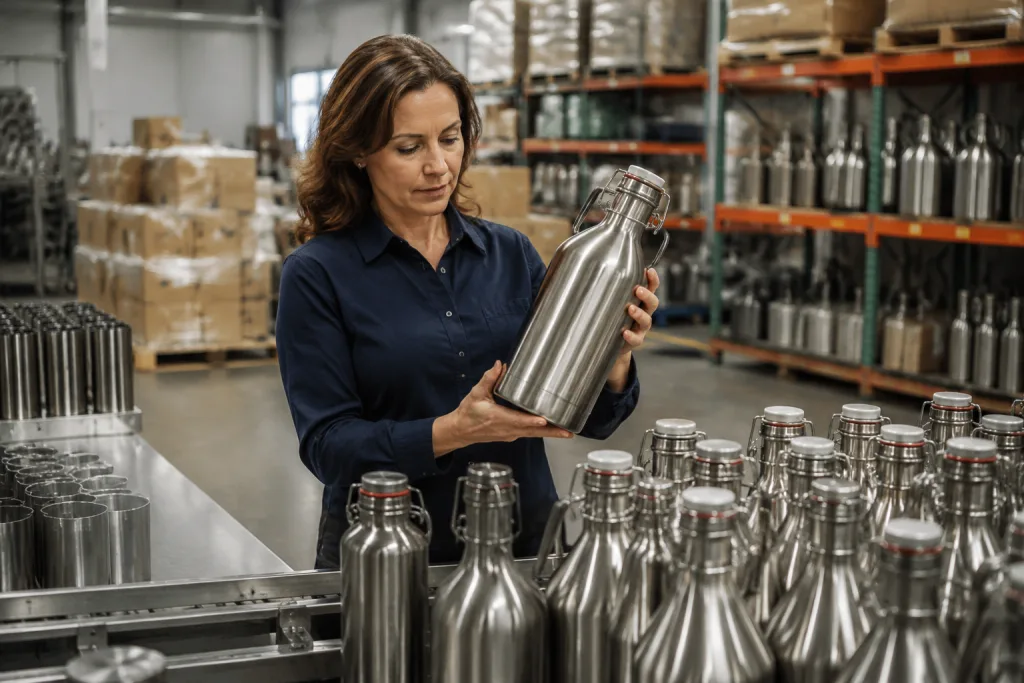
MOQ is not a factory rule; it is the cost sheet. A canteen vendor can sometimes print 500 units from stock if the blank growler body is already on the rack, but that is not the same as a fully customized growler order. For stock bodies with a laser logo, 500-1,000 pieces is realistic; we run those on a fiber laser jig, 12 pcs per tray. For custom color powder coating, plan 3,000 pieces per color because the spray booth changeover and oven purge eat time. For a new mold, custom cap, or proprietary body shape, 10,000-20,000 pieces is the honest starting point. Tooling, sampling, and 2-4% scrap have to be paid for somewhere. The math doesn't work below that.
Normal sampling takes 7-12 days for logo samples using existing bodies. Pre-production samples with custom color or packaging usually take 12-18 days, especially when the buyer asks us to match Pantone on curved 304 stainless. Mass production is commonly 30-45 days after deposit and sample approval. Peak season before Q4 can add 10-15 days. Last September, QC pulled a 64 oz sample because the powder coat measured 0.06 mm too thin near the handle weld. Small issue. Still delayed approval by 3 days. If a canteen supplier promises 15 days for a custom 64 oz vacuum insulated growler in four colors, ask what is already in stock and what inspection step is being skipped.
Payment terms for first orders are typically 30% deposit and 70% balance before shipment. FOB pricing is cleaner for comparison; DDP suits smaller buyers without a forwarder. We have seen this go sideways when a buyer compared one FOB Ningbo quote against one DDP Dallas quote and missed USD 0.42/pc in duty assumptions. DDP quotes hide freight assumptions, fuel surcharges, and duty classifications. For HS codes, most stainless steel vacuum drinkware falls in a different classification than plastic bottles or glass items, so confirm with your broker before the PO is locked. One PO typo, “glass growler” instead of “stainless vacuum growler,” can create a customs headache.
A reliable canteen factory will also talk about yield. Powder coating rejects, dented bodies, and failed vacuum tests are normal in manufacturing. The right question is not “will there be defects?” The right question is whether the factory has process controls and enough capacity to replace rejects before shipment. On the line, we check vacuum retention after 24 hours, then AQL 2.5 before carton sealing. At 420,000 units/month, we can buffer common custom canteen programs, but unusual colors and caps still need disciplined approval timing. If the buyer flags the cap gasket after production starts, nobody wins.
Compare Vendors With A Scorecard
After the four big decisions are written down, compare vendors with a scorecard, not a cheap-price sheet. Send every beer growler supplier the same spec pack and require the same reply format: FOB unit price; MOQ by size, for example 500 pcs or 1,000 pcs; sample time in calendar days; production lead time, such as 12 days for blank stock vs 18 days for powder coating; steel grade; lid material with gasket type; decoration cost by logo process; packaging dimensions; carton weight; compliance reports; audit status; warranty handling. We run this off a one-page RFQ form, and our merchandiser checks it against the PO line by line because one buyer once typed “mat balck” on the PO and the line made 300 wrong lids before QC caught it.
A practical scorecard can put price at 30%, quality system at 25%, lead time at 15%, compliance at 15%, and communication at 15%. For a canteen distributor booking repeat seasonal programs, communication should beat the first quote price. This is where the math doesn't work: saving USD 0.12 on the body is gone after one late artwork approval or one unclear carton mark that forces relabeling at USD 0.08 per carton. Last month QC pulled 20 cartons from a growler run because the outer box mark missed the buyer’s item code by 1 digit.
Ask for a golden sample and keep it sealed. Simple rule. The factory should keep the same sample in China, labeled with the PO number, Pantone code, logo size in mm, and approved lid torque. That shared reference stops arguments about color drift, logo placement, gasket fit, and coating feel. For custom drinkware, the approved sample beats a 26-email chain. If possible, require pre-shipment photos, carton label photos, and an inspection report before final balance payment; our QC table usually checks logo height with a digital caliper and records coating scratches under 600 lux light.
The best canteen suppliers will push back when your specification is risky. Good sign. If you ask for matte white coating, full-wrap print, rush lead time, and low MOQ, an experienced canteen manufacturer should warn you about scratch visibility, seam tolerance, and unit price before tooling starts. We’ve seen this go sideways when a buyer insisted on 300 pcs with four-color wrap printing, then rejected samples over a 1.5 mm seam overlap that was already in the proof. You are not buying agreement; you are buying controlled production. That is the difference between a one-time canteen promotional order and a stable distributor growler program.
Send Your Growler Spec For A Factory Quote
Share capacity, color, logo, packaging, MOQ, and destination market. We will return a practical FOB China quotation with lead time.
Frequently asked questions
What MOQ should I expect from vendors beer growler factories?
For existing stainless steel growler bodies, expect 500-1,000 pieces for laser engraving or one-color silkscreen printing. For custom powder coating, 3,000 pieces per color is more realistic because the coating line, color setup, and reject rate must be controlled. For a new mold, custom handle, or proprietary cap, plan 10,000-20,000 pieces. Some China suppliers will accept lower MOQ, but check whether they are using mixed stock, subcontracted coating, or limited QC. A lower MOQ is useful for testing, but it usually means less control over color consistency and delivery schedule.
Is a vacuum insulated custom growler worth the extra cost?
It depends on channel and retail price. A 64 oz vacuum insulated customized growler usually costs USD 1.80-3.20 more than a single-wall version at factory level, depending on steel price, coating, and lid design. For brewery refill programs where the product is mostly transport packaging, single-wall may be enough. For retail, corporate gifting, or premium distributor drinkware, vacuum insulation gives a clearer value story. It also reduces condensation and improves user experience. The trade-off is higher weight, larger carton volume, longer production time, and stricter vacuum testing before shipment.
Which logo method is best for a customized canteen or growler?
For durability, laser engraving is usually the safest choice on powder coated stainless steel. It does not peel, and the cost is often USD 0.15-0.35 per unit depending on logo size. Silkscreen printing is cheaper, usually USD 0.08-0.18 for a simple one-color logo, but it can scratch under rough use. Heat transfer works for large graphics but requires good seam control. For canteen promotional orders, silkscreen often makes sense. For retail customized drinkware or a premium custom growler, powder coating plus laser engraving is the better long-term option.
What testing should I request before shipment?
At minimum, request material confirmation, leak testing, visual inspection under AQL, and carton drop testing. A common inspection plan is AQL 2.5 for major defects and AQL 4.0 for minor defects. For vacuum insulated growlers, ask whether the factory performs 100% vacuum performance screening before packing. For EU sales, consider LFGB or EU food-contact migration testing. For U.S. sales, request FDA food-contact related documentation. If you use colored coating or printed artwork, REACH screening may be relevant. Testing should match the exact SKU, lid, gasket, and coating used in your production order.
How long does a custom drinkware order take from China?
For an existing growler body with standard color and logo, plan 7-12 days for samples and 30-40 days for mass production after approval. Custom color, retail packaging, or new lid components can push production to 45-60 days. Ocean freight from Ningbo or Shanghai to Europe or North America often takes 28-38 days port-to-port, longer with inland delivery and customs. Air freight is faster but expensive for stainless steel growlers because of weight and volume. Buyers in Zhejiang-facing supply chains should lock artwork and carton marks early to avoid losing a production slot.