Key Takeaways
- A 6 oz flask usually needs 0.4-0.5 mm 304 stainless steel; growlers need thicker walls around 0.6-0.8 mm.
- MOQ for custom flask and canteen projects typically starts at 1,000-3,000 units per SKU.
- Laser engraving is safer for alcohol flask branding; powder coating works better on custom canteen and growler bodies.
- Lead time from approved sample is normally 30-45 days for Zhejiang, China drinkware production.
If you search for vendors alcohol flask, you are probably not buying one pocket flask. You may be checking 6 oz hip flasks against 750 ml canteen programs, 64 oz stainless growlers, or branded outdoor drinkware for retail shelves, hotel gifting, event kits, and distributor catalogs. Different job. Different risk. Products can look close in a PDF, but we have seen QC pull a sample with 201 stainless marked as 304 stainless, a cap thread off by 0.25 mm, and powder coating that failed a 3M tape test; that is how a clean-margin order turns into chargebacks.
At our drinkware factory in Hangzhou, Zhejiang, buyers mix these categories 8 or 9 times out of 10 during first RFQ. A 6 oz alcohol flask, a 750 ml custom canteen, and a 64 oz custom growler are not interchangeable, and this is the wrong question to ask if the brief only says “send flask price.” The line sets different jigs, leak-test pressure, carton drop specs, and MOQ math for each item; last month one buyer flagged a PO typo where “matte black flask” became “matte black growler,” and the math did not work. The table and notes below compare them head-to-head, so you can brief a China supplier clearly before sampling.
Flask versus canteen versus growler
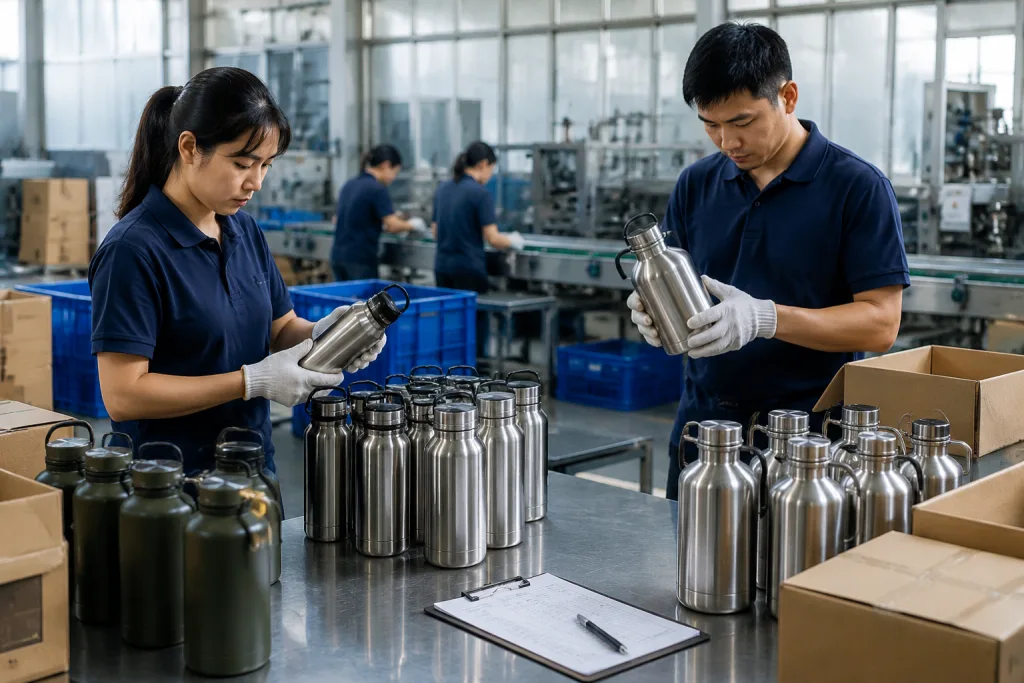
Buyers throw around “flask” loosely. On the factory side, we separate it before quoting. A vendors alcohol flask project usually means a small stainless hip flask for spirits, most often 5 oz, 6 oz, or 8 oz, with a curved stamped body and a cap thread checked by go/no-go gauge. A canteen is a wider outdoor bottle, from 500 ml to 1,200 ml, with a screw cap, loop cap, or military-style profile. A growler is a larger beer or beverage container, commonly 32 oz or 64 oz, sometimes vacuum insulated.
Here is the practical comparison we use with new distributor drinkware buyers after they send the first RFQ. QC pulled the sample once because the PO said “canteen flask,” but the reference photo was a 64 oz beer growler.
- Alcohol flask: 5-8 oz, 304 stainless steel, single wall, curved body with a logo area usually under 45 mm wide, laser logo or embossing, compact gift packaging for barware sets.
- Custom canteen: 500-1,200 ml, single-wall or double-wall stainless, powder coating matched against a Pantone chip, carry strap, outdoor or promotional positioning.
- Customizable growler: 32-64 oz, thicker stainless body, leak-resistant cap with silicone gasket, optional vacuum insulation, built for beer, cold brew, or camping retail use where cap failure gets returned fast.
If you are a canteen distributor or distributor growler buyer, forcing one factory mold to serve every sales channel is the wrong question to ask. We have seen this go sideways. A retail alcohol flask needs clean welds, food-contact safety, and a flat enough logo area so laser marking does not bend around the shoulder. A canteen promotional order needs lower cost, stable powder color, and carton packing that survives courier handling; our line uses a 1.2 m drop test before mass packing. A customized growler needs better sealing and tougher pressure checks because buyers fill it with carbonated drinks.
At our Zhejiang facility, monthly output across stainless drinkware lines is about 450,000 units, but capacity is split by process. Flask stamping, growler welding, and powder coating hit different bottlenecks. Ask your canteen manufacturer where the actual constraint is before you promise delivery dates to your customer. Last April, a buyer pushed for 12 days instead of 18 days on 8,000 powder-coated canteens, and the math did not work because the coating oven was already booked for two export orders.
Spec table buyers should use
A clean spec table stops bad quotations before they hit your inbox. Ask 5 canteen suppliers for “customized drinkware with logo” and you will get 5 different guesses; last month we saw one PO say “mat black” while the artwork file said “matte black,” and the line nearly ran the wrong coating. Send the table below instead. Make every canteen vendor quote the same material grade, capacity, coating spec, logo process, carton pack, and test standard.
Head-to-head sourcing benchmark:
- 6 oz vendors alcohol flask: 304 stainless steel; 0.4-0.5 mm wall checked with a digital thickness gauge; brushed finish for lower fingerprints or mirror finish for a gift set; 1-color silk screen for flat logos or laser engraving for barware buyers; individual white box; FOB Ningbo target often USD 1.20-2.20 at 3,000 units.
- 750 ml canteen customized bottle: 304 stainless for EU and US retail, 201 stainless only for tight promo budgets; 0.5-0.6 mm wall before forming; powder coating for better chip resistance or matte paint for lower cost; leakproof PP cap with silicone ring; kraft box for retail shelf or egg-crate bulk pack for giveaways; FOB Ningbo often USD 2.80-5.20 at 2,000 units.
- 64 oz customized growler: 304 inner and outer steel for insulated type; 0.6-0.8 mm wall before forming; swing cap for beer-shop style or threaded cap for outdoor retail; pressure test on the cap area and vacuum test on the body; FOB Ningbo often USD 7.50-14.00 at 1,000 units.
For Europe and North America, do not let a canteen factory quote 201 stainless steel unless the buyer signs off on the trade-off. 201 can reduce cost by 8-15%, but the math does not work when 2 cartons come back with rust spots after a salt-spray complaint. Acidic beverages, salt air, and dishwasher abuse expose the weakness fast. For an alcohol flask, 304 is the safer default. For a low-budget canteen promotional program, 201 can pass if the product is short-term giveaway stock and the limitation is written into the PI.
Specify the test level on the RFQ, not after the deposit. We run AQL 2.5 for major defects and AQL 4.0 for minor defects on customized canteen and flask orders; QC pulled a sample last week for one 1.5 mm coating dust spot on the front face, and the buyer flagged it before we shipped. For premium distributor drinkware, tighten visible surface defects because scratches and coating dust are what customers notice first.
Use-case fit beats catalog photos
Catalog photos skip the real question: where will this item be sold, carried, dropped, and complained about? We can polish a sample under the light box in Hangzhou and make it look fine, but if the format is wrong for the sales channel, QC will not save it. Last month QC pulled 12 photo samples that looked clean, then found 3 with cap wobble over 0.4 mm after a basic shake check.
For spirits brands, event gifting, cigar clubs, wedding favors, and hotel minibar accessories, the vendors alcohol flask format is usually the cleanest choice. Small pack size matters. We ship 6 oz and 8 oz flasks at lower carton weight than most canteens, so air freight quotes do not scare the buyer as fast. The logo area is limited, so we run laser engraving or a simple 1-color print more often than full-wrap artwork. Big artwork on a curved flask is the wrong place to get ambitious; our pad-printing jig allows about 1 mm movement, and the seam can bend a straight line into a cheap-looking curve.
For outdoor retail, museum stores, schools, tourism, and corporate campaigns, a custom canteen usually sells better. A canteen customizable program gives buyers more printable space and more daily-use value, which helps it sit between low-cost promo bottles and higher-margin insulated drinkware. If you are a canteen distributor selling across 4 or 5 verticals, keep two base models: one 600-750 ml single-wall option for price-sensitive bids, and one 750-1,000 ml double-wall option for retail. We run this split often because the math does not work when a school tender asks for FOB under USD 3.20 and the buyer still wants vacuum insulation.
For breweries, camping brands, specialty coffee, and refill programs, use a custom growler or customizable growler. Capacity and sealing beat decoration here. A distributor growler buyer should ask for cap torque testing, upside-down leak testing for at least 4 hours, and carton drop testing from 76 cm. If the product is intended for carbonated beer, tell the China factory before tooling or sampling. A normal water bottle cap is not the same as a growler cap designed for pressure and repeated opening; we have seen this go sideways when the PO said “sports cap” but the buyer flagged leaking after filling 1,000 ml with beer.
Branding methods under real production
Branding is where about 6 in 10 customized drinkware projects get overbuilt before we even open the artwork file. A rendering can show five colors, metallic gradients, and 0.8 mm compliance icons, but the line has wet ink thickness, a 180°C curing oven, 0.5 mm masking drift, and a reject rate to pay for. The body shape decides the method. This is the wrong question to ask if the buyer starts with “which logo looks richest?”
For alcohol flasks, laser engraving is usually the safest call. It will not peel, it holds small text better than silk screen, and it works cleanly on brushed stainless steel. For a 6 oz flask, keep the main logo inside about 45 x 55 mm unless the body mold has a larger flat panel; our QC pulled one sample last month where a 58 mm logo ran into the shoulder radius. Silk screen costs less for one-color logos, but curved bodies raise alignment risk. Embossing or debossing looks premium, but the tooling math usually only works above 5,000 units.
For canteen custom and canteen customized orders, powder coating plus laser logo is the mid-range setup we run most often. Powder coating adds grip and color, while laser cuts through to the steel below. Cleaner than printing on texture. If you need Pantone matching, expect Delta E 1.5-2.5 for well-controlled batches, not the same shade across every shipment under every light box. A canteen supplier should keep retained color chips for reorders; we label ours with PO number, batch date, and powder supplier code because one typo on a PO can send the wrong green to the coating room.
For customized growler programs, screen printing and laser both work, but keep decoration away from weld lines, base curves, and cap contact areas. For full-wrap artwork, use a straight-wall growler body and confirm the printable height in millimeters; on a 64 oz growler, 110 mm printable height is not the same as 135 mm body height. Do not approve only a 3D mockup. Ask your canteen vendors or growler factory for a physical pre-production sample, packed in the final box, before mass production. It adds 7-10 days, but we have seen this go sideways: one buyer signed off on a mockup, then flagged the real sample because the logo sat 12 mm too low after shrink bag packing.
Compliance and material checks
For B2B buyers in Europe and North America, compliance is not decoration for the file folder. It decides customs release, retailer setup, and who pays if a flask fails a complaint check. We had QC pull a 6 oz hip flask sample last month because the lab report showed the right steel grade but the wrong lid photo. Small mistake. Big delay. A responsible canteen manufacturer in China should tell you which test fits which product, not forward a 2022 PDF from a different SKU.
For stainless alcohol flasks and custom drinkware, ask for food-contact testing by selling market, not by guesswork. For the EU, buyers commonly request LFGB or EU food contact migration testing plus REACH screening for coatings and components. For the United States, use FDA food-contact expectations and, where relevant, California Proposition 65 review. We run the lab request sheet with item code, coating color, cap material, and contact area marked before samples leave Hangzhou, because one missed black powder coating can add 7 to 10 days. For children’s bottles, ASTM and CPSIA become more important, but most alcohol flask and growler orders are adult products.
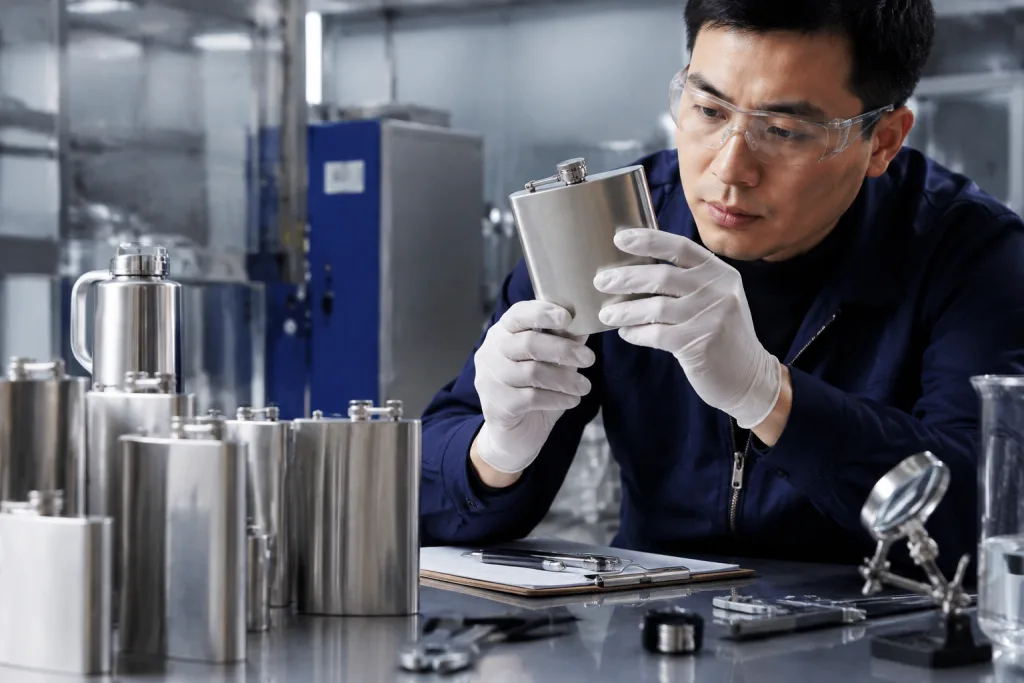
Material declaration should be specific. “Stainless steel” is not enough, and this is where the math goes sideways on cheap quotes. Ask whether the inner food-contact surface is SUS304, 18/8 stainless, or another grade. Our line checks incoming coil with an XRF gun, then records wall thickness, often 0.4 mm to 0.6 mm on flask bodies depending on the model. On insulated growlers, both inner and outer wall grades matter for cost, but the inner wall matters most for beverage contact. For caps, request PP, PE, silicone, or TPE identification, and ask whether the sealing ring is removable for cleaning.
Factory audits also matter. BSCI, Sedex, ISO 9001, or a buyer-specific audit will not guarantee perfect quality, but they cut basic risk. At BottleForge Industrial in Hangzhou, Zhejiang, we normally prepare material traceability, inspection records, and production photos for export orders. For a 3,000 pcs flask PO, we usually keep incoming material records, line inspection sheets, and final packing photos tied to the batch number. If a canteen supplier refuses to share batch-level inspection data, treat that as a warning sign. You do not need a 40-page report for every PO, but you do need enough evidence to defend your product when a retailer asks questions.
MOQ pricing and lead time reality
MOQ is not just a sales number. It comes from 304 sheet coil buying, powder-coating line changeover, laser logo jig time, printed carton MOQ, and the defect buffer QC has to hold back. For vendors alcohol flask orders, we usually price a realistic custom MOQ at 3,000 units per design if the buyer wants competitive pricing. We can run 1,000 units. The math gets ugly. Last month QC pulled 46 scratched samples from a 1,000-piece matte black run, and the buyer still asked why the logo charge did not drop by two-thirds; screen setup, packing labor, and AQL 2.5 inspection time do not shrink that way.
For canteen customizable and customizable drinkware projects, expect 1,000-2,000 units per color when we use standard molds. If you need a private mold, budget 25-40 days for tooling and USD 1,500-6,000 depending on structure. A custom growler or distributor canteen with a new cap design costs more when the silicone gasket, thread depth, or hinge pin changes. We check the first cap fit with a 0.02 mm feeler gauge and a water-pressure test tank; if the lid seeps after 8 hours, the mold shop revises it before we open mass production.
A normal production calendar from a Zhejiang, China factory looks like this: 5-7 days for quotation and artwork confirmation, 7-12 days for pre-production samples, 30-45 days for mass production after sample approval and deposit, and 7-14 days for booking and local export handling. Sea freight to the US West Coast may add 18-28 days port-to-port; Europe is often 30-40 days depending on route and congestion. Book early. We have seen this go sideways when a PO says “Pantone 186C” in the artwork file but “Pantone 185C” on the order sheet, then the line waits 2 days while the buyer confirms red.
Payment terms affect bargaining room. New buyers usually work on 30% deposit and 70% balance before shipment. Established distributors with repeat POs can negotiate better terms after 2-3 clean orders, meaning no late artwork, no carton mark changes after printing, and no surprise barcode file at final packing. If you are a canteen distributors group or distributor drinkware importer consolidating SKUs, put inspection standards and packing rules into one purchase manual. We quote from that. A 6-page manual with carton size, drop-test height, inner polybag spec, and AQL 2.5 rules prevents the final-inspection argument nobody has time for.
How to brief the factory
A good RFQ is short, exact, and a little boring. Good. The line needs fewer guesses, not more adjectives. For a vendors alcohol flask program, send capacity, steel grade, finish, logo method, logo size in mm, packing, destination market, target quantity, and target ship date. If your target is USD 1.85 FOB Ningbo for 3,000 pcs, say it. We can then check the BOM against 0.5 mm body sheet, gift box cost, laser time, and carton CBM instead of quoting a fake number that falls apart after sampling.
Use this format when contacting canteen manufacturers or canteen vendors:
- Product: 6 oz 304 stainless alcohol flask, brushed finish, laser logo within 35 x 28 mm, individual black gift box.
- Quantity: 3,000 units first order, repeat forecast 10,000 units per quarter.
- Market: US and Canada, adult promotional use, no dishwasher claim.
- Inspection: AQL 2.5 major, 4.0 minor, 100% leak test before packing.
- Shipping: FOB Ningbo, carton mark with SKU and PO number, pallet optional.
For a customized canteen or customized growler, add cap type, insulation requirement, coating color, test requirement, and whether the product will hold carbonated beverages. For Amazon or marketplace orders, add FNSKU labeling, master carton limits, and drop-test expectations. We ship these. Around 7 out of 10 labeling problems we see come from missing placement rules, not from the label machine. QC pulled one sample last month where the barcode scanned Grade C because the buyer sent a 22 mm code for a curved flask face; fix the file before packing starts.
Do not ask every supplier for their “best price” before you define the product. This is the wrong question to ask. You will get cheap guesses. Shortlist 2-3 canteen suppliers, compare samples side by side, inspect one production batch, then scale. Price matters, but the cheapest canteen vendor is rarely cheap after rework, air freight recovery, or retailer penalties. We have seen this go sideways over a PO typo too: “matte black” became “black box,” and 3,000 pcs waited 6 days while the buyer approved the corrected coating chip.
Send your flask or canteen RFQ for review
Share capacity, quantity, logo, market, and target price. Our Zhejiang team will reply with practical specs, MOQ, and FOB options.
Frequently asked questions
What MOQ should I expect for a custom alcohol flask order?
For a standard 6 oz stainless alcohol flask, a practical MOQ is 3,000 units per logo if you want stable FOB pricing. Some China vendors can accept 1,000 units, but setup costs for laser fixtures, screen plates, cartons, and inspection push the unit price up by 10-25%. If you need a custom body mold, embossed logo, special cap, or retail gift box, expect 5,000 units or more. For first orders, we suggest using an existing mold, 304 stainless steel, and one branding method. That keeps sampling around 7-12 days and mass production around 30-45 days after approval.
Is 304 stainless steel necessary for vendors alcohol flask products?
For alcohol flasks, 304 stainless steel is the safest default because spirits sit in direct contact with the metal and buyers may store liquid longer than intended. 201 stainless can reduce cost by roughly 8-15%, but corrosion resistance is weaker. For Europe and North America, most serious B2B buyers specify 304 for the inner surface and request food-contact testing. If the project is a short-term promotional giveaway, 201 may be discussed, but we recommend documenting the limitation clearly. For premium custom drinkware, the cost saving is usually not worth the complaint risk.
Can one supplier make flask, canteen, and growler products together?
Yes, but ask what is made in-house and what is subcontracted. A canteen manufacturer may own stamping, welding, polishing, and powder coating lines, but outsource gift boxes or silicone parts. That is normal in Zhejiang and other China drinkware clusters. What matters is control: incoming material checks, line inspection, leak testing, and final AQL inspection must stay under one quality system. If you order alcohol flasks, custom canteen bottles, and custom growler items together, align the finish standards and carton labeling before production. Mixed-category orders need more careful scheduling because coating and welding capacity may not peak at the same time.
Which logo method is best for customized drinkware?
For alcohol flasks, laser engraving is usually best because it is durable, clean on brushed steel, and handles small logos well. For a custom canteen with powder coating, laser engraving or 1-color silk screen are both practical. For a customized growler, choose laser for a premium retail look or screen printing for larger artwork. Full-wrap printing needs a straight wall and a confirmed printable height, not just a mockup. For quantities under 3,000 units, avoid complex multi-color artwork unless your margin supports higher reject rates. Always approve a physical pre-production sample before mass production.
What quality checks should distributors require before shipment?
For distributor drinkware orders, require incoming material confirmation, logo position check, coating adhesion check, 100% leak test, and final AQL inspection. A common standard is AQL 2.5 for major defects and AQL 4.0 for minor defects. For flasks, check cap thread fit, inner cleanliness, weld marks, and logo alignment. For canteens and growlers, add drop testing, coating cross-hatch adhesion, torque testing, and upside-down leak testing for at least 4 hours. If the product ships to Amazon or retail DCs, confirm FNSKU labels, carton weight, and barcode scan quality before the final balance payment.