Key Takeaways
- A 12 oz vendor wine tumbler usually uses 0.4-0.5 mm 304 stainless steel with vacuum insulation
- Custom canteen styles fit outdoor and corporate kits better than stemless wine tumblers
- Laser engraving works well from 500-1,000 units, while full-color wrap usually needs higher setup discipline
- FOB China pricing often shifts by USD 0.35-0.90 per unit based on lid, coating, and carton spec
A vendor wine tumbler looks easy on the quote sheet until it sits next to a custom canteen, travel tumbler, or small growler. Then the real buyer questions start: which SKU keeps margin, which one passes a 10 kg carton drop, which one prints without ghosting, and which one your retailer accepts without a second packing run? We’ve seen this go sideways when a PO says “wine cup” but the artwork file is built for a straight-wall tumbler.
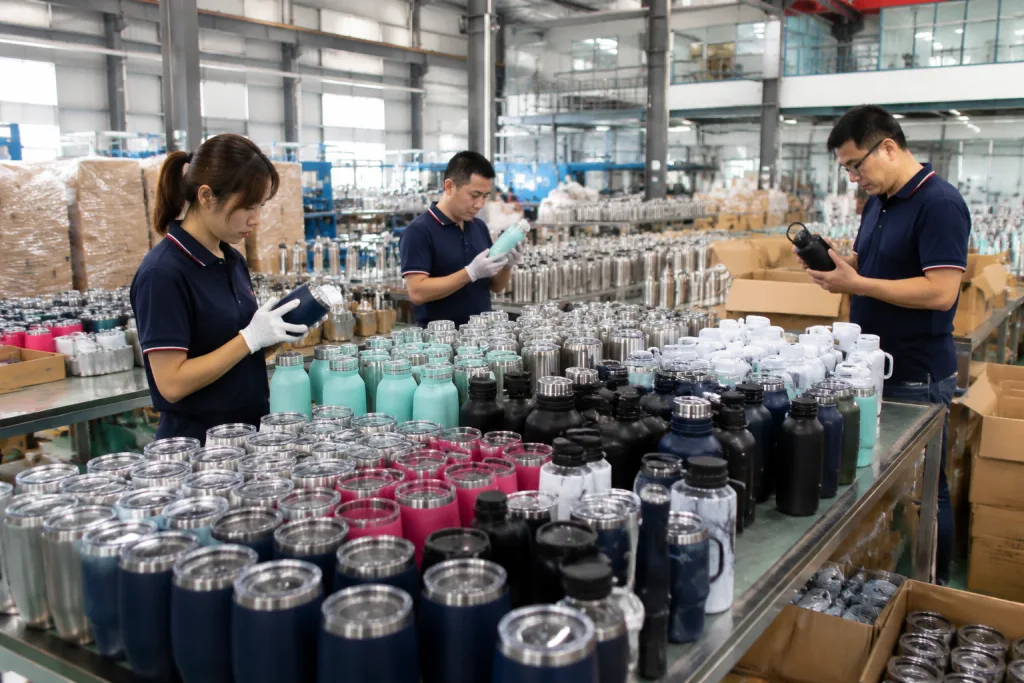
If you buy custom drinkware for promotions, retail, or distributor programs, compare function, decoration, MOQ, and landed risk before you chase the lowest EXW price. The math doesn’t work if QC pulls 38 scratched samples at final inspection. BottleForge Industrial in Hangzhou, Zhejiang runs stainless drinkware lines in China with practical export limits: typical MOQ starts at 1,000 units per color, sample lead time is 7-10 days, and mass production is usually 25-35 days after artwork approval.
Spec Table Buyers Actually Need
8 out of 10 buyer guides spend too much time on shape. Wrong question. For B2B sourcing, we compare wall gauge, lid fit, coating loss after tape test, print window, carton cube, and the paperwork the consignee will ask for at customs. We check the sample with a 0.01 mm digital caliper before quoting, because a vendor wine tumbler is usually a 10-14 oz stemless stainless cup for events, wineries, subscription boxes, and corporate gifts. A canteen custom project is more often a 16-32 oz bottle with a screw lid, carry loop, or flat side panel for retail branding.
| Item | Vendor wine tumbler | Custom canteen | Custom growler |
|---|---|---|---|
| Common capacity | 12 oz / 350 ml | 18-32 oz / 530-950 ml | 32-64 oz / 950-1,900 ml |
| Typical steel | 304 inner, 201 or 304 outer | 304 inner, 201 or 304 outer | 304 inner and outer preferred |
| Wall thickness | 0.4-0.5 mm | 0.45-0.6 mm | 0.6 mm or above |
| Best decoration | Laser, pad print, or 1-color screen print under 45 mm wide | Laser, silkscreen, powder coat, or UV print with full artwork proof | Laser or emboss; screen print only on straight areas |
| Use-case fit | Wine, gifting, hospitality | Outdoor, schools, brand stores | Beer, camping, premium bundles |
| Carton risk | Low to medium | Medium | High due to weight and cube |
If you are a canteen distributor or a distributor drinkware buyer, do not buy by capacity alone. The math doesn't work. We had one buyer flag a 32 oz canteen after seeing the carton cube jump from 0.062 cbm to 0.118 cbm per master carton, even though the unit price looked better on the PO. The vendor wine tumbler wins when the program needs a compact gift with lower freight pressure. A canteen customizable design wins when the brand wants daily carry value, a larger logo area, and a product that does not feel tied to wine season.
Where Wine Tumblers Win
The strongest case for a vendor wine tumbler is controlled gifting. For winery clubs, hotel welcome packs, festival sponsor kits, and corporate holiday campaigns, a 12 oz tumbler is simple to brief and simple to pack. No one has to explain hydration claims or sports-cap compatibility. It just works. On a desk, patio, or tasting bar, a decent vacuum body with a PS lid will hold a cold drink for about 6-9 hours, depending on lid fit, room temperature, and vacuum quality. On our line, QC usually checks the lid gap with a 0.2 mm feeler gauge before we sign off the pre-production sample.
From a Zhejiang factory point of view, the shape is forgiving. A stemless wine tumbler has a lower center of gravity than a tall bottle, so it survives mixed handling better. It dents less in transit than a large customized growler, too. Inner boxes can stay tighter, and that matters when the buyer is calculating a distributor growler or tumbler program by container loading, not just FOB unit price. We normally see a 12 oz stainless wine tumbler packed 24 pieces per master carton; a 64 oz custom growler often drops to 6-12 pieces because the dividers need to be thicker. The math changes fast when the forwarder charges by cbm, and buyers flag that after the first freight quote.
The weak point is perceived function. A wine tumbler is not a daily hydration item for most users, so don’t sell it like a gym bottle. That is the wrong question to ask. If your retailer needs a broad shelf item, a customized drinkware bottle or custom canteen usually gets more repeat use over 12 months. If the project is a canteen promotional campaign for an outdoor brand, the tumbler can feel off-brief; we have seen this go sideways when the PO even called it a “camp mug” and the artwork showed a vineyard logo. If the customer wants a premium, compact, event-friendly product with clean logo visibility, the wine tumbler is usually the safer vendor item.
Where Canteens Beat Tumblers
We point buyers to a canteen when the user needs carry capacity, not just a cup. Think 600 ml or 750 ml bodies with a wide mouth, bamboo cap, carabiner lid, paracord handle, or a 45 mm flat print panel for a school crest. For schools, employee onboarding, outdoor retail, and wellness programs, the canteen gives the buyer a better story on the shelf. QC pulled one 750 ml sample last month where the paracord knot sat 6 mm too high and rubbed the cap during carton drop testing. Small thing. The buyer noticed.
The trade-off is complexity. More lid parts mean more places to fail. A canteen supplier should check thread fit, silicone ring compression, lid torque, coating adhesion around the shoulder, and leak performance after drop simulation. At BottleForge, a normal pre-shipment inspection uses AQL 2.5 for major defects and AQL 4.0 for minor defects unless the buyer asks for a stricter plan. For a canteen customized with powder coating and laser engraving, ask for a 3M tape test, cross-hatch adhesion check, and 24-hour water leak hold on random samples. We run the torque check with a digital torque meter; if the cap closes under 0.7 N·m, we stop the line.
Use canteen suppliers when the sales channel values utility. A distributor canteen order for outdoor retail can justify a USD 0.60 higher FOB cost if the product supports better retail pricing. The math does not work for every channel. Use a vendor wine tumbler when the order is event gifting and you need lower cube, faster assembly, and cleaner artwork setup. On one 5,000 pcs PO, the buyer flagged that 18 cartons of canteens took 12% more pallet space than the same volume of tumblers, so freight ate the margin. A canteen vendor should not pretend one format fits every job. The right call depends on who handles the product after delivery: warehouse team, retailer, event staff, or end user.
Logo Finish Head-to-Head
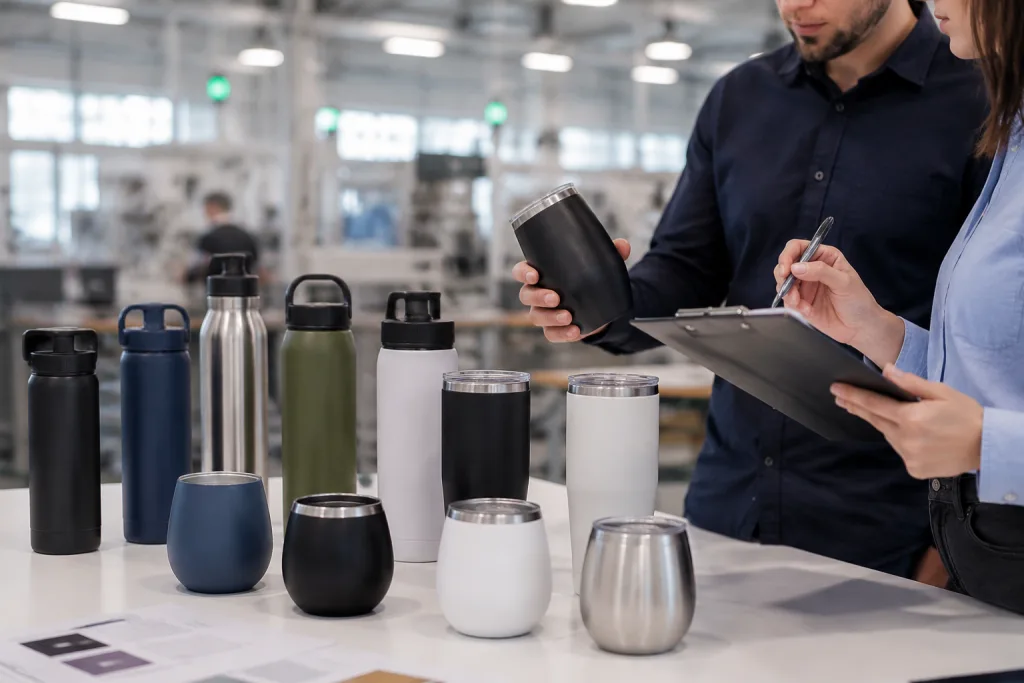
Decoration is where at least 6 out of 10 custom drinkware projects burn schedule. We see it on the line: the buyer signs off a clean render, QC pulls the first laser sample, then the logo is sitting across the shoulder curve or the white ink looks weak on matte black powder coat. For vendor wine tumbler programs, we usually push laser engraving or one-color silkscreen because the risk is easier to control. The print area is usually 45-60 mm wide by 35-55 mm high, depending on taper. Full wrap can work, but on a curved cup the registration jig needs tighter setup, and one 1.5 mm shift is enough for the buyer to flag it.
For canteen customizable bodies, you normally get taller print space. A flat-sided custom canteen can take a larger logo without the oval stretch we see on tapered tumblers. That matters for distributor drinkware catalogs, where a buyer is judging the item from a 300 px thumbnail and not holding the sample. UV printing allows multicolor art, but it brings curing checks, tape tests, and scratch checks after packing. If the product will sit in retail trays or get handled by sales reps, laser engraving on powder coat is the safer call; we have seen big UV logos go sideways after carton rub, especially when the inner polybag was too loose by 8-10 mm.
- Laser engraving: best for durable marks and low color risk; we run it often for corporate logos from 500-1,000 units, especially when the buyer wants repeat orders with the same artwork file.
- Silkscreen: works for one or two spot colors, but it needs vector artwork, a clean Pantone callout, and stable bottle positioning in the print fixture.
- UV print: fits photo-color branding, but request rub testing, 3 packed samples, and a check after 24 hours of curing.
- Powder coating: gives retail value, but expect a 2-4% coating rejection allowance during production; pinholes and dust spots still show up under the inspection lamp.
For a canteen promotional order, ask the canteen factory to send physical color chips instead of trusting screen images. Pantone matching on stainless coating is close, not magic. The wrong question is “Can you match this color?” The better question is “What Delta E will you hold on mass production?” A practical tolerance is Delta E under 2.0-3.0 for controlled colors, but many promotional projects accept visual match under standard lightbox conditions. We check chips in a D65 lightbox, and last month one PO even had “Panton 186C” typed wrong, so the buyer had to confirm the color before we opened coating powder.
Price, MOQ, And Lead Time
FOB China pricing moves more than buyers expect. A basic 12 oz vendor wine tumbler with 201 outer steel, 304 inner steel, clear lid, one-color logo, and white box may sit around USD 2.10-3.20 FOB Ningbo or Shanghai at 3,000 units. Switch that same cup to full 304 stainless, 80-micron powder coating, laser engraving, slider lid, and 350 gsm color box, and we usually see USD 3.10-4.60. A customized canteen in the 20-24 oz range often lands around USD 3.80-6.20 depending on cap type, coating yield, and whether the carton spec is 5-ply K=A or standard export B=C. QC pulled one 12 oz sample last month because the laser logo was 1.5 mm off-center; that small miss still adds rework cost if the buyer wants retail-grade finish.
MOQ is not only a sales rule. It is tied to coating line setup, printing fixtures, carton production, and component purchasing. For BottleForge Industrial in Hangzhou, Zhejiang, a normal MOQ is 1,000 units per color for existing molds, 3,000 units for custom color coating efficiency, and 5,000-10,000 units if you need a private mold or unusual lid. Monthly capacity for stainless tumblers and canteens is about 450,000 units across regular production lines in China, but urgent capacity still depends on coating queue and lid inventory. The wrong question is “Can you do 300 pcs?”; the better question is whether the line can run that color without dumping 18 kg of leftover powder and resetting the spray gun twice.
Lead time is usually 7-10 days for samples, 25-35 days for mass production, and 5-7 days for final inspection, booking, and export paperwork. For a canteen distributor with a fixed retail launch, add 10-14 days for artwork revision and packaging proofing, especially if the PO has mixed Pantone codes or a lid SKU typo. We’ve seen this go sideways: the buyer approved the cup body in 2 days, then spent 9 days arguing over “matte sand beige” versus PMS 7528 C on the color card. Cheap is not cheap. If the shipment misses the FBA appointment, retailer compliance window, or event date, the math doesn’t work.
Compliance And Packing Risks
For Europe and North America, don’t stop at “is it food safe?” That is the wrong question to ask. For a stainless wine tumbler order, we usually prepare LFGB or EU food contact declarations for Europe, FDA-related food contact material support for the United States, REACH checks on powder coating and accessories, plus Prop 65 review when the buyer sells into California. Kids items can pull in CPSIA, ASTM, and small-parts checks; our QC once used a small-parts cylinder on a sample lid puller and stopped a 3,000 pcs shipment before packing. A vendor wine tumbler for adult gifting is simpler than a kids bottle, but lid plastics and silicone rings still need batch documents, material names, and supplier test reports.
Packaging needs the same discipline. Wine tumblers are short and stable, but glossy coating still rubs when the polybag is only 0.025 mm or the paper insert has 3 mm of play. We’ve seen this go sideways. QC pulled the sample after a carton vibration check and found black scuff marks near the bottom curve, which the buyer flagged as “used-looking goods.” Canteen vendors must watch lid pressure inside the carton. A tall customized canteen with a carry loop can scrape the next unit if the inner box is undersized by 2–4 mm. A customizable growler is worse: heavier body, larger cap, more leverage during drops.
For export orders, request an ISTA 1A-style drop test or at least a practical carton drop sequence before shipment; we run 10 drops from 76 cm for cartons under 21 kg when the buyer has no written standard. A reasonable master carton should use 5-ply corrugated board for heavier canteen or growler orders, with edge-crush strength matched to the carton weight. For Amazon FBA, add FNSKU labeling, suffocation warning on polybags where required, carton weight control under 50 lb unless pre-approved, and barcode scan checks on 100% of outer labels. One PO typo on an FNSKU can hold 48 cartons at the warehouse gate. A canteen factory that ignores packing will create chargebacks faster than a USD 0.08 unit-price saving can cover.
Best Fit By Sales Channel
Each sales channel catches a different mistake. Winery gift programs usually hit us on delivery dates and logo finish; one Napa PO last April had “matte gold” typed as “matt gold,” and QC pulled the sample before mass print. Retail distributors care more about shelf box crush and color drift between cartons. Outdoor brands ask us to fill 12 pcs, shake them on the leak tester for 3 minutes, then check lid threads. Amazon sellers are less forgiving: FNSKU misprint, 16 kg carton overweight, or 1-star reviews on leaking lids can kill the reorder. Pick by channel first. Product photos come second.
Choose a vendor wine tumbler when the order needs a compact gift, tasting-room retail piece, or event item with a premium feel under USD 5 FOB. We usually see these run at 1,000 to 3,000 pcs per color with laser logo or 1-color silk print. Choose a custom canteen when the buyer wants daily carry, outdoor positioning, or a wider logo area on the body. Choose a customized growler only when the audience values capacity and accepts weight; this is the wrong question to ask if the buyer just wants a cheap giveaway. A distributor growler fits breweries and camping brands, but for a new account, we’ve seen this go sideways when freight jumps because the carton hits 18 kg.
If you are comparing canteen manufacturers, do not ask only for catalog photos. Ask for wall thickness in mm, steel grade, lid material, coating method, print size, MOQ by color, AQL level, sample lead time, and carton dimensions. Good canteen suppliers answer fast because they know the line; our sales sheet, for example, lists 0.5 mm inner wall, 304 stainless, powder coating, and 12-day sample timing before artwork proof. Weak canteen vendors reply with “any logo is possible” and avoid numbers. That is the warning sign.
For most B2B buyers, the practical shortlist is simple: wine tumbler for gifting, canteen for daily carry, growler for premium capacity where the buyer accepts the weight and carton cost.
BottleForge can quote all three, but the better project starts with use case, target FOB, compliance market, and delivery date. Give us those 4 points and we can check mold stock, lid inventory, and the packing spec before quoting. The product choice gets less emotional once the math is on the table.
Send Your Tumbler Or Canteen Spec For Review
Share capacity, target FOB, logo method, market, and delivery date. We will flag cost, compliance, and packing risks before sampling.
Frequently asked questions
What MOQ should I expect for a vendor wine tumbler order?
For an existing 10-14 oz stainless vendor wine tumbler mold, expect 1,000 units per color as a practical MOQ. If you need custom powder coating, 3,000 units gives better coating efficiency and lower unit cost. Private mold changes, unusual lids, or exclusive body shapes usually start from 5,000-10,000 units because tooling, fixtures, and component purchasing must be justified. For first orders, many B2B buyers test with 1,000-2,000 units and one decoration method before expanding into multiple colors.
Is a custom canteen better than a wine tumbler for distributors?
A custom canteen is often better for distributor canteen and distributor drinkware programs that need year-round utility. It has higher perceived daily-use value and more print area, especially in 20-32 oz sizes. A vendor wine tumbler is better for wineries, hospitality, gift boxes, and events where the drinking occasion is obvious. If your distributor sells into outdoor, school, or employee wellness channels, choose a canteen customized with a leak-resistant screw lid. If the channel is celebration gifting, the wine tumbler usually sells faster.
What certifications should I request from a canteen supplier in China?
For China export production, request material declarations for 304 stainless steel, food-contact test reports for plastic lids and silicone rings, and coating compliance support for REACH or Prop 65 where relevant. For Europe, LFGB or EU food contact documentation is commonly requested. For the U.S., FDA food-contact support and retailer-specific requirements may apply. Also ask whether the canteen factory has BSCI, ISO 9001, or similar audit documentation if your customer requires social or quality management evidence.
Which decoration method lasts longest on customized drinkware?
Laser engraving is normally the most durable because it removes or marks the coating rather than sitting on top of it. On powder-coated stainless steel, laser logos can survive normal washing and handling better than large UV prints. Silkscreen is economical for simple one-color logos, but it depends on ink, curing, and surface prep. For a canteen promotional order above 3,000 units, request a scratch test, 3M tape adhesion test, and dishwasher guidance before approving mass production.
How much lead time should I allow for custom drinkware?
Plan 7-10 days for samples, 25-35 days for mass production, and another 5-7 days for inspection, booking, and export paperwork. Add 10-14 days if your artwork, color box, barcode, or retailer packing rules are not final. Sea freight to North America or Europe can add several weeks depending on port and season. If you need canteen customizable items for a fixed event date, approve artwork and packaging before paying the production deposit, not after.