Key Takeaways
- Start vendor water bottles with a written spec sheet before quoting 3,000-10,000 units
- A realistic custom canteen MOQ is 1,000 pcs per color for powder coating
- Use AQL 2.5/4.0 inspection plus 100% leak testing before shipment
- Plan 30-45 days production after artwork and deposit approval
You are not buying a bottle. You are buying 5,000 units that must land on the booked vessel, match the approved PP sample, pass a retail buyer’s inspection, and survive 1.2-meter carton drop tests without leaking. On our Hangzhou line, QC pulled 32 samples last month because one silicone ring sat 0.4 mm proud after assembly. That is where vendor water bottles turn into an operations job, not a catalog choice.
We’ll run a real order from spec sheet to final QC. Assume you are a distributor drinkware buyer in Europe or North America sourcing from a canteen manufacturer in Zhejiang, China. Simple target: no loose quotes, no weak 5-ply cartons, no logo approval stuck for 6 days, and no ugly surprise where the buyer flags scratches after production. Ask only “what is your best price?” and the math doesn’t work.
The buyer brief starts the order
A good vendor water bottles order starts with a brief that is boring, specific, and hard to misread. Send one photo and ask for “best price,” and 6 canteen suppliers will quote 6 different bottles. One prices 201 stainless steel, one uses 304 stainless steel, and another trims the wall from 0.5 mm to 0.42 mm to win the inquiry. Looks cheap on the sheet. Then QC pulls the sample with a caliper, and the comparison falls apart.
For this order, you need 5,000 pcs of 750 ml single-wall stainless canteens for an outdoor retailer’s summer promotion. The end customer wants matte black finish, one-color logo, retail box, and delivery to Hamburg under FOB Ningbo. That already narrows the job. Last month, a buyer flagged the same brief because the PO said “mat black” in one line and “gloss black” in another, which cost 2 days before artwork approval.
Your RFQ should state capacity and material grade first, then spell out the lid, coating, logo process, packaging, compliance market, inspection requirement, and target ship date with numbers. Example: 304 stainless steel body, 0.5 mm wall thickness, PP lid with silicone seal, matte powder coating, silkscreen logo at 60 mm width, individual kraft box, 24 pcs export carton, REACH and LFGB documentation for EU sale. Do not ask every supplier to “recommend the best option.” That is the wrong question to ask when the buyer will later inspect by AQL 2.5 and reject mixed wall thickness.
At BottleForge Industrial in Hangzhou, Zhejiang, we run this as a custom drinkware project, not a stock bottle inquiry. Our normal MOQ for this customized canteen is 1,000 pcs per color, with practical production capacity around 300,000 stainless units/month across bottle and tumbler lines. If your launch quantity is below 1,000 pcs, we can still ship, but the math changes: stock colors, fewer logo processes, and a higher unit cost. The line setup still needs the same powder-coating gun cleaning, screen plate check, and carton drop-test sample.
Choosing the canteen platform
The first real decision is the bottle construction: single-wall, double-wall vacuum, or a heavier growler-style build. A single-wall custom canteen costs less, weighs less, and works for water, events, fitness kits, and canteen promotional campaigns. It will not hold temperature. If your retailer puts “keeps cold 12 hours” on the artwork, we run double-wall vacuum bodies, and both price and lead time change. QC also checks this at the water bath station; weak vacuum usually shows up before packing.
For a 750 ml single-wall canteen customized with powder coating, a normal FOB China price range is roughly USD 2.10-3.20 depending on steel gauge, cap design, coating quality, and packaging. A 750 ml double-wall vacuum bottle may sit closer to USD 4.20-6.50 FOB. A custom growler or customizable growler in 1.9 L size can move from USD 8.00 to USD 14.00 FOB because steel weight, vacuum testing time, and carton strength all increase. The line feels that weight fast; one recent 1.9 L order needed a 5-layer export carton after drop test corners crushed at 76 cm.
Do not choose by capacity alone. This is the wrong question to ask. Check body diameter for cup holders, mouth opening for ice, and lid threading for leak resistance, then match those details to the sales channel. For EU and North American buyers, 304 stainless steel is the safe default for food-contact surfaces. Some canteen vendors quote 201 stainless for lower price, but we have seen this go sideways when consumers add electrolyte drinks or leave bottles wet; QC pulled samples with rust spots around the inner weld after 48 hours in a salt-spray cabinet.
A canteen factory should confirm steel grade with incoming material records, not just a line in a quotation. Ask whether the body is made from 0.4 mm, 0.5 mm, or 0.6 mm sheet. That small number changes dent resistance and perceived quality. If you are building a long-term distributor canteen program, saving USD 0.12 on thinner steel can cost more in returns and complaints. The math does not work; one buyer flagged 23 dented bottles in a 500-piece trial order after choosing 0.4 mm to hit a target price.
Artwork is where delays hide
Most production delays do not start on the welding line. They start with artwork. On 8 out of 10 delayed bottle orders we see, the first problem is a low-resolution PNG, no Pantone number, or a placement note like “logo on front.” That can burn 5-7 days before the line pulls 304 stainless tube from the rack. For vendor water bottles, lock artwork before the deposit. After deposit is too late.
For this order, the retailer wants a white logo on matte black. Silkscreen is the practical choice if the logo is one or two solid colors, and our screen room will check film output against the coated sample under a D65 light box. Laser engraving looks cleaner and survives abrasion better, but it cuts through the coating and shows the stainless underneath, so the mark comes out silver-grey, not white. Heat transfer or full-wrap printing fits complex graphics, but the math does not work on small runs once you add film, jig setup, and 3M tape abrasion testing.
Send the canteen manufacturer a vector file in AI, EPS, or PDF format. Specify logo size in millimeters, not “medium.” A workable note reads: front logo, centered opposite seam, 60 mm wide, white Pantone White, 110 mm from bottle base. QC pulled the sample on one PO last month because the buyer wrote “near bottom,” and our operator set it 95 mm from the base while the buyer expected 120 mm. For a canteen customizable program with multiple customer logos, make one placement template and reuse it, so each 500 pcs reorder does not turn into a fresh engineering call.
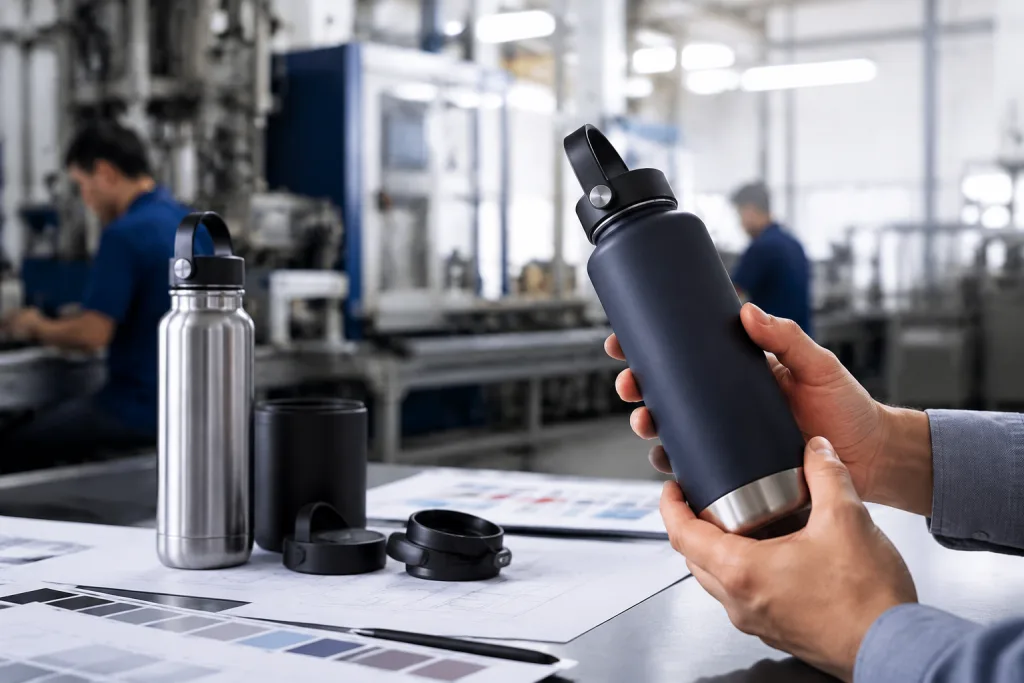
Pre-production sample timing is usually 7-10 days after artwork confirmation for standard materials. If you need a custom Pantone powder coat, add 5-7 days for color matching and approval, because the coating line needs a spray-out panel before we run bottles. Photograph the approved sample from front, side, lid, bottom, and carton view, then attach those images to the purchase order. We ship smoother when the PO has the same photos the inspector uses 30 days later at AQL 2.5; we have seen this go sideways over one missing lid angle.
Quote the landed reality
A low unit price only matters when the selling terms are clean. For vendor water bottles, line up each quote on the same basis: material grade and wall thickness, capacity, logo method, packaging, inspection level, incoterm, and quote validity period. FOB Ningbo or FOB Shanghai is normal for Zhejiang and eastern China factories; we run both ports depending on vessel space. EXW looks cheaper on paper, but then you own the Yiwu-to-Ningbo truck, export handling, customs timing, and the 4 p.m. cutoff that the buyer flagged last March.
For the 5,000 pc order, a realistic cost model might be: USD 2.65 FOB Ningbo per 750 ml single-wall powder coated canteen, USD 120 screen setup, USD 180 pre-production sample and courier, and USD 280 for third-party inspection if you appoint your own inspector. Carton quantity at 24 pcs means about 209 export cartons. If each carton is roughly 45 x 34 x 28 cm, the shipment is around 6.0-6.5 CBM before palletization. QC pulled one packing sample last week with a 3 mm gap in the color box insert, and that small miss changed the carton fit, so carton data needs checking before booking.
Payment terms are usually 30% deposit and 70% before shipment for new customers. If you are a canteen distributor placing repeat programs, terms can improve after 3 or 4 clean orders with no chargebacks, no late artwork, and no PO changes after tooling starts. Be careful with any canteen vendor offering 60-day or 90-day credit before a trading relationship exists. The math doesn't work. Someone pays for that risk, usually through price padding, thinner powder coating, slower line priority, or a shipment pushed from 12 days to 18 days when capacity gets tight.
Check whether the quote includes compliance documents before you approve the PI. For EU buyers, REACH and LFGB food-contact testing may be needed depending on market and retailer policy. For the US, buyers often ask for FDA food-contact declaration and sometimes California Proposition 65 assessment. If the bottle is for children, ASTM or CPSIA-related checks may apply. Do not wait until goods are packed to ask for documents; we have seen this go sideways when a PO had “LFGB needed” typed in the remarks, but the test cost was missing from the signed quote.
Production controls beat promises
After deposit, artwork, and sample approval are signed off, the order stops being a promise and turns into a production schedule. For this scenario, our standard lead time in Hangzhou, China is 30-35 days after sample approval for 5,000 pcs using existing tooling and standard powder coating. Peak season, custom color, or mixed SKUs can push that to 40-45 days. We run the plan from the line capacity sheet, not from a sales guess, and a 750 ml bottle usually needs its own coating slot if the buyer wants a matched Pantone finish. If your retailer launch date is fixed, build in a 10-day buffer. We have seen this go sideways when a PO says “matte black” but the approved sample tag says “black sand texture.”
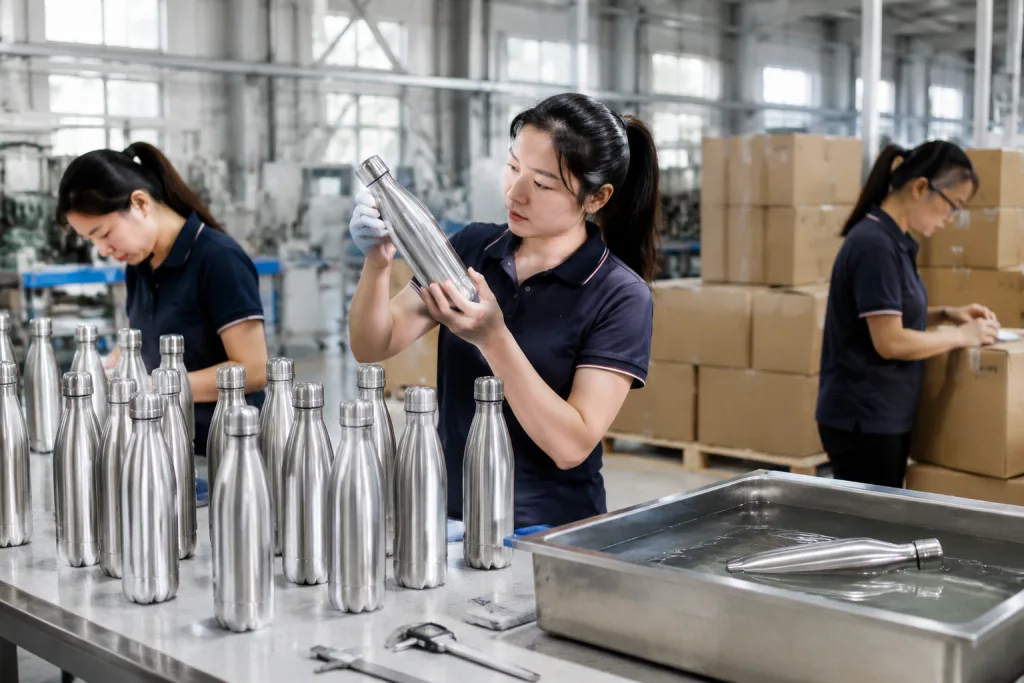
A serious canteen factory controls the order in stages: incoming steel inspection, body forming, welding or spinning, polishing, coating, logo application, assembly, leak testing, packing, and final inspection. Ask where defects are caught. Short question. Big answer. If all checking happens at the end, you are gambling with cartons already packed and palletized. On our line, QC pulled the sample after welding last month because the mouth roundness was off by 0.6 mm, before powder coating hid the problem. For leak-sensitive drinkware, 100% leak testing is the minimum, not an upgrade.
For powder coating, confirm adhesion and abrasion checks. A simple cross-hatch tape test is useful, and we usually cut it with a 1 mm grid cutter before applying 3M tape. Retail buyers with shelf-display programs sometimes ask for alcohol rub, dishwasher simulation, or salt spray testing for coated components, so price that before the PI is issued. Not every promotional order needs a lab report for every item, but every distributor drinkware order needs a written QC checklist. The math doesn't work if you save USD 0.03 per pc and then replace 300 scratched bottles after delivery.
Use AQL correctly. A common final inspection plan is General Inspection Level II, AQL 2.5 for major defects and 4.0 for minor defects. Critical defects, such as leakage, sharp metal burrs, contamination, or wrong material, should be zero tolerance. Major defects include wrong logo color, obvious dents, bad coating peel, or non-functioning lids. Minor defects include small specks, slight carton scuffs, or tiny coating dots within agreed limits. We ship only after the inspector opens cartons by the sampling table, checks the barcode label against the PO, and records bottle weight on a 0.1 g scale when material risk is on the checklist.
Packaging protects your margin
Packaging is not decoration. It protects margin. On a 30-35 day move from Ningbo to a U.S. warehouse, a loose inner box can turn 3,000 good vendor water bottles into 180 scuffed units and a claims argument. For retail or distributor canteen orders, we specify the pack plan before sample approval because carton L x W x H changes CBM, pallet height, and the freight quote. The wrong question is “Can you make the box nicer?” Ask whether the bottle arrives saleable after the line runs the carton through a 76 cm drop check.
For this order, an individual kraft box with a polybag or paper sleeve is enough if the bottle has a durable powder coat; QC pulled the sample and checked rub marks around the shoulder with a white cotton cloth. For glossy paint or mirror finish, add tissue wrap or a molded insert, because those finishes show ring scratches after 8 hours in a truck. The master carton should normally be 5-ply corrugated for export, with no more than 18-22 kg gross weight if warehouse staff hand-load. For 750 ml bottles, 24 pcs per carton is common; for a customized growler, 6-12 pcs per carton is more realistic.
If you sell through e-commerce or ship to fulfillment centers, the pack spec gets tighter. Amazon-style FBA preparation may require FNSKU labels, suffocation warnings on polybags over 5 inches opening, carton weight limits, and packaging that passes the buyer’s drop-test file. Ask your canteen suppliers whether they can apply barcode labels during packing, not after cartons are sealed; we run this at the packing table with a Zebra scanner before the tape machine closes the box. Rework at the factory costs about USD 0.03-0.06 per label, while relabeling in Rotterdam, Los Angeles, or a third-party warehouse can wipe out the margin on a small PO.
Carton markings should show item number and quantity on one line, then gross weight, net weight, carton dimensions, and country of origin when required. If your customer requires “Made in China” on the product or packaging, decide placement before production and put it on the artwork file, not in a late email. We have seen this go sideways when a buyer flagged a missing origin mark after final inspection; the line had to add stickers by hand, 4 workers for half a day, and shipment moved from Friday to Monday.
Final inspection before shipment
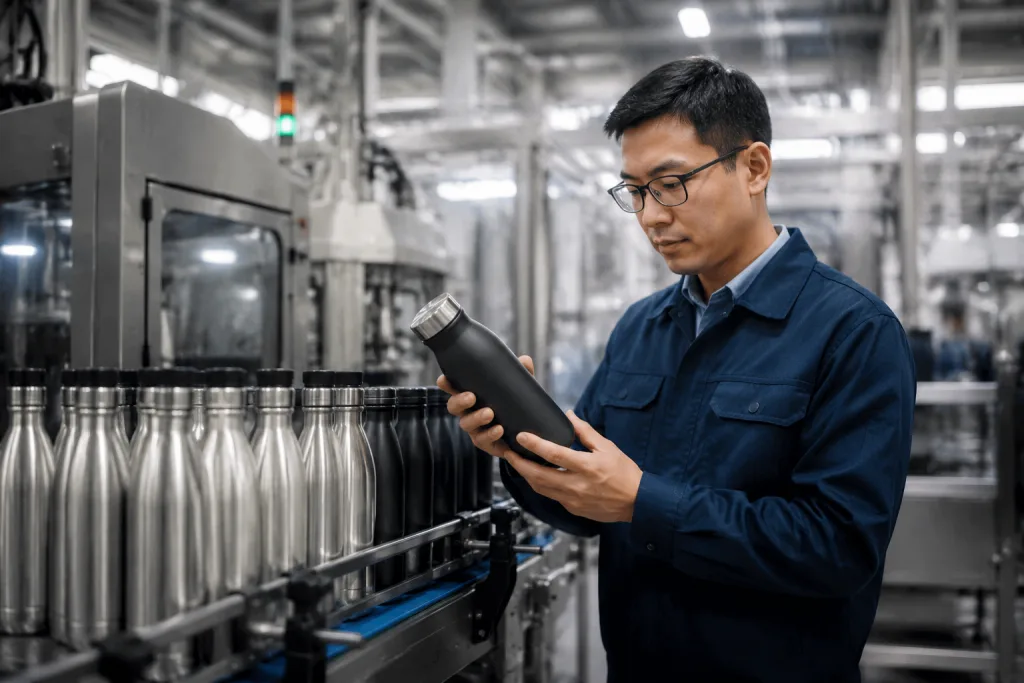
Do not release the 70% balance just because production photos look clean. Photos hide too much. Final inspection is the point where you decide whether the order can ship. For a 5,000 pc vendor water bottles order, we run inspection when at least 80% of goods are packed and 100% of goods are finished. That gives the inspector real export cartons to cut open with a knife, check inner bags and dividers, and still leaves 1–2 days for rework if QC pulls a bad carton.
The inspection checklist should match the approved sample and purchase order. Measure capacity with a graduated cylinder, then check height, diameter, weight, wall thickness where practical, logo size, color, lid fit, gasket placement, barcode readability, carton strength, and packing quantity. Do random leak testing from 8–12 cartons, not only from the top layer near the loading door. For vacuum products, include thermal retention checks and vacuum failure screening. For a custom growler, pay extra attention to handle strength and cap torque; we have seen buyers flag a 0.8 mm handle gap because it felt loose in hand.
If defects exceed AQL, the canteen manufacturer should sort, rework, and give a reinspection date. No shortcuts. A small number of minor coating specks may be commercially acceptable for a canteen promotional order, especially on a low-budget giveaway run. Leakage, wrong steel grade, wrong logo, or mixed colors are not. Be clear before production which defects are critical, major, and minor, because arguing this after QC finds 37 leaking lids is the wrong time to start.
After inspection passes, collect the packing list, commercial invoice, bill of lading draft, certificate of origin if needed, and test documents. Zhejiang has efficient access to Ningbo and Shanghai ports, but port efficiency cannot fix missing paperwork or a PO typo like “matte black” on the order and “gloss black” on the carton mark file. A controlled finish is simple: documents checked, balance paid, vessel booked, cartons loaded, tracking shared before your customer starts asking where the goods are.
Send your vendor water bottle spec for review
Share capacity, quantity, logo method, market, and target delivery date. We will return a practical FOB quote and QC plan.
Frequently asked questions
What MOQ should I expect for vendor water bottles?
For custom drinkware from China, a realistic MOQ is usually 1,000 pcs per color for a standard stainless bottle or custom canteen using existing tooling. If you need a new mold, custom lid, or special Pantone powder coating, 3,000-5,000 pcs is more practical because setup loss and line cleaning time increase. Stock-color logo orders can sometimes start at 500 pcs, but the unit price is higher and branding options are limited. For a distributor growler or customized growler program, MOQ often depends on carton size and cap tooling, not just bottle capacity.
How do I know if a canteen supplier is a factory or trader?
Ask for production photos tied to your process, not generic showroom pictures. A real canteen factory should explain forming, polishing, coating, logo printing, leak testing, and packing flow. You can also request a live video call from the workshop, business license details, BSCI or ISO audit documents if available, and recent inspection reports with sensitive customer names removed. Traders can still be useful, but you should know who controls QC. If a canteen vendor cannot answer wall thickness, coating method, daily output, or AQL process, treat the quote carefully.
What is a normal lead time for customized drinkware?
For a standard customized canteen or vendor water bottles order, plan 7-10 days for pre-production sample and 30-45 days for mass production after approval and deposit. Existing colors and simple silkscreen logos are faster. Custom powder coating, new mold work, mixed SKUs, or retail packaging can add 7-20 days. Ocean freight to Europe or North America can add another 25-45 days depending on port and season. If your promotion date is fixed, place the purchase order at least 90 days before the required warehouse date.
Which logo method is best for canteen promotional orders?
For canteen promotional orders, silkscreen is usually the best balance of price and visibility for 1-2 color logos. Laser engraving is more durable and gives a premium look, but it does not print color. Heat transfer works for full-color artwork or larger graphics, though it costs more and needs abrasion testing. For 5,000 pcs, screen setup cost is usually small compared with the total order, often USD 40-100 per color. Always approve a physical sample because logo scale and placement look different on a curved bottle than on a PDF.
What QC checks matter most for distributor drinkware?
The non-negotiable checks are leakage, material, logo accuracy, coating adhesion, lid function, packing quantity, and carton strength. For stainless vendor water bottles, use 100% leak testing during production and final random inspection under AQL 2.5 for major defects and 4.0 for minor defects. For food-contact markets, verify 304 stainless steel for the body and compliant PP, silicone, or Tritan components where used. Distributor drinkware also needs barcode readability, correct country-of-origin marking, and carton labels that match the packing list. These checks prevent warehouse disputes and retailer chargebacks.