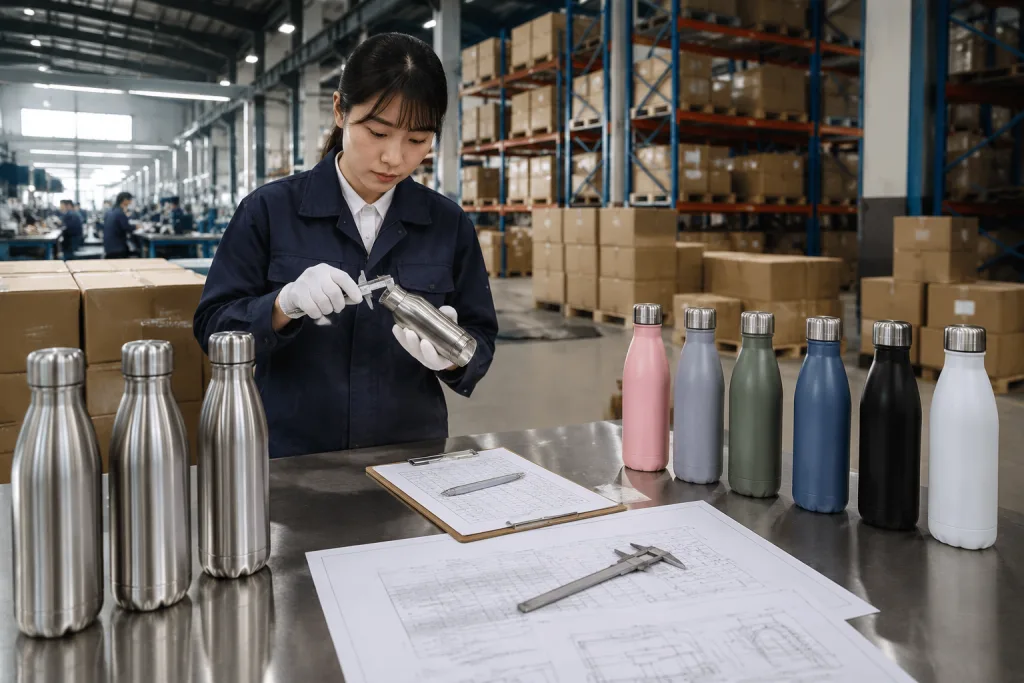
Key Takeaways
- For most vendor water bottle projects, 1,000-3,000 units is the realistic MOQ range for custom color and logo
- 304 stainless steel with 0.4-0.5 mm inner wall is the normal baseline for insulated bottles
- AQL 2.5/4.0 inspection catches more sourcing problems than a polished pre-production sample
- Logo, coating, lid tooling, and packaging choices can move lead time by 7-20 days
A vendor water bottle looks simple until the first quote sheet lands in your inbox. Then the buyer is staring at 304 versus 316 stainless steel, 70–90μm powder coating, 1.2m carton drop tests, laser versus screen logo, FOB Ningbo terms, and a 3,000-piece MOQ that may not match the launch calendar. We see this at sample stage: QC pulled one matte black bottle last week with a 0.4mm logo shift, and the buyer flagged it before the PO was even signed.
If you buy custom drinkware for retail, events, online distribution, or corporate programs, the spec sheet is where margin gets protected. Not the mood board. BottleForge Industrial in Hangzhou, Zhejiang works with B2B buyers who need China production with clear numbers, line checks, and shipment dates they can defend to their boss. Our current stainless bottle capacity is about 420,000 units/month, with normal custom MOQ from 1,000 units per color for standard molds; for one 24oz mold we run, that usually means 42 cartons per color at final packing.
Start with the use case
The first line of a vendor water bottle spec should not be capacity. Start with the sales channel and the job the bottle has to do. A gym chain bottle, a school fundraiser bottle, an outdoor distributor bottle, and a corporate onboarding bottle may all be 750 ml, but the line should not build them the same way. We see this mistake on about 6 RFQs each month, and QC usually catches the problem later with a caliper, not in the email thread.
For retail and distributor drinkware, we run for repeatable shelf presentation and barcode labels that scan after carton packing. Mixed cartons need tighter cosmetic control; AQL 2.5 still applies, but the inspector will pull more pieces for color drift under the light box. For canteen promotional orders, the buyer often cares more about logo height in mm and Pantone match than 12-hour ice retention. For an outdoor custom canteen, the math doesn't work if you pay for a fancy gift box but use a weak lid hinge.
Tell your canteen supplier the intended use before asking for the lowest FOB price. This is the wrong question to ask first. A practical China factory will match the mold, coating, wall thickness, and packing method to the order, then quote it. Last quarter, one buyer pushed for the cheap 0.4 mm body on a sports order; QC pulled the sample after the drop test because the shoulder dented on the second hit.
- Retail: individual box, barcode placement, consistent color under a D65 light box, stricter cosmetic inspection.
- Corporate gift: clean logo finish, gift-ready packaging, and carton packing that survives courier handling.
- Outdoor or sports: stronger lid, thicker body, leak testing on the line with 100% water fill checks.
- Amazon or marketplace: FNSKU labeling, master carton weight limits, drop-tested packaging.
This is where canteen vendor, canteen manufacturer, and canteen distributor stop meaning the same thing. A vendor may trade finished goods from 3 factories. A canteen factory controls molding, polishing, coating, and inspection, so when the buyer flagged a 2 mm logo shift, the print jig could be adjusted the same day. A distributor canteen program needs stock planning and reorder discipline. If you are building a long-term line, ask who controls production in Zhejiang or elsewhere in China, not just whose name is on the PI.
Material grade and wall thickness
For stainless vendor water bottle production, we usually run 304 stainless steel on both the inner wall and outer shell. Some buyers ask for 316 stainless for salty drinks, marine gift sets, or a premium retail claim. Fair request. But for plain water, tea, or coffee, the math often doesn’t work; on one 5,000 pcs PO last quarter, the buyer flagged the 316 upcharge after sampling and moved back to SUS304 before we cut steel.
Wall thickness causes more trouble than new buyers expect. A common insulated bottle structure is 0.4 mm to 0.5 mm on the inner wall and 0.5 mm to 0.6 mm on the outer wall before drawing. Go too thin and you may save USD 0.08-0.18 per unit, then QC pulled the sample after the drop test showed a shoulder dent near the laser-weld seam. Go too thick and you pay extra in steel and cartons; for a corporate giveaway, 18.5 kg per master carton instead of 15.8 kg is not a small freight difference.
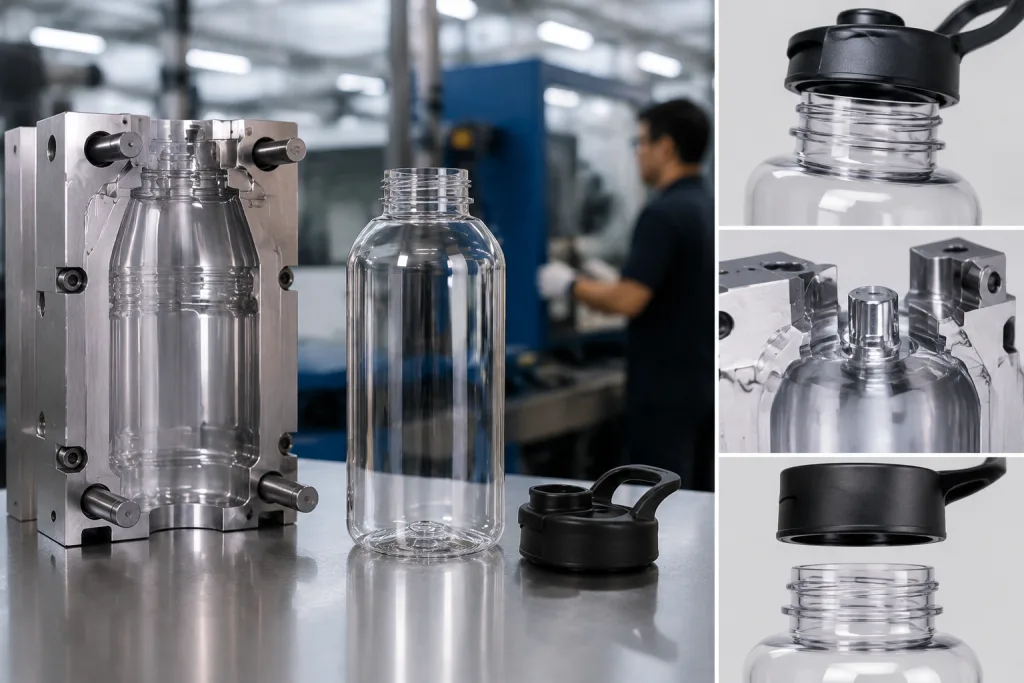
For plastic lids, get PP, Tritan, or food-grade silicone specs written into the file before tooling starts. For Europe, request LFGB or EU food contact compliance where applicable. For North America, ask about FDA food-contact suitability and ASTM-related physical safety expectations for kids or sports products. REACH also belongs in the discussion for coatings, colorants, silicone parts, and packaging inks; we’ve seen this go sideways when a buyer tested only the bottle body and missed the soft-touch paint.
If you are sourcing canteen customized products, do not accept vague phrases like “food grade stainless.” Your purchase order should name the material: SUS304, SUS316 if needed, PP lid, silicone seal, Tritan straw, and any coating chemistry. Good canteen manufacturers attach material declarations and test reports from previous production batches. Better ones push back when the spec is overbuilt for the target price; one PO even had “SUS306” typed in the material line, and the line stopped it before the supplier contract went out.
Capacity, mold, and lid fit
Capacity is not just a marketing number. A 500 ml, 750 ml, 1,000 ml, or 1.9 L custom growler each needs its own tooling setup, carton insert, vacuum hold time, and lid torque target. We run the 750 ml body at 0.72 L usable fill in our test room, because liquid above the thread line will wet the gasket during a drop test. If you are comparing quotes from 3 canteen suppliers, confirm brimful capacity versus usable capacity. A “750 ml” bottle may only hold 720 ml safely below the thread line.
Standard molds are usually the safest starting point for a vendor water bottle program. At BottleForge Industrial, common molds for sports bottles, travel tumblers, and insulated canteens can run at MOQ 1,000 units per color, depending on coating and logo method. A private mold normally starts around USD 3,000-8,000 for simpler stainless shapes, and more for complex handles, flip lids, or multi-part caps. The wrong question is “Can we make it different?” Yes, we can. The better question is whether the line can keep the shoulder height within 0.3 mm after polishing and powder coating.
Lid fit deserves its own approval step. A lid that looks correct in photos can still fail leak testing after heat cycling or shipping vibration. Ask for 100% leak testing on water bottles, especially straw lids and flip lids. Last month QC pulled the sample after 6 hours at 60°C and 3 cartons on the vibration table; the silicone gasket had shifted 1.2 mm and left a slow drip. For insulated customized growler orders, check lid gasket compression because large-volume bottles face higher internal pressure when filled with hot liquid.
For canteen customizable programs, mixing lids, bodies, handles, sleeves, and colors feels easy on a catalog page. We’ve seen this go sideways. A canteen vendor may show ten lid options, while the canteen factory knows only four have stable thread engagement on your selected body. Before you print a catalog or open pre-orders, ask for a fit matrix with body code, lid code, gasket size, thread turns, and leak-test result; one buyer flagged a PO typo where lid “L32” became “L23,” and 2,000 units would have shipped with the wrong cap.
Decoration lines that change cost
Logo decoration is the line item that makes custom drinkware quotes hard to compare. We run a 1-color silkscreen logo at 45 x 28 mm on one side, and that is a different job from a 360° heat transfer sleeve or laser engraving on a curved tumbler wall. The setup charge, reject risk, and line speed all move. Last month QC pulled 32 samples because a buyer’s PO said “black logo,” while the artwork file used Pantone 426C.
For a simple canteen promotional order, silkscreen still works well. Fast job. Lower screen cost, steady output, and clean results on smooth powder coating, usually 1,800-2,400 pcs per shift on our semi-auto print line. Laser engraving suits premium custom drinkware and removes ink adhesion risk, but it cuts through the coating and shows the 304 stainless underneath, so the logo turns silver instead of matching the brand palette. UV printing handles gradients better, but we check surface dust with an ion air gun and run curing checks because one weak pass under the UV lamp can fail a tape test.
Powder coating thickness is often around 60-90 microns. Below that, scratch resistance drops; above that, lid fit, thread clearance, and logo edge sharpness start to drift. We measure with a coating thickness gauge at 3 points around the body, and the cap thread is the first place the line tells on you. Pantone matching on powder coat is possible, but the math doesn't work if the buyer expects a paper chip match under every light source. On production metal, Pantone 186C can look 1-2 shades darker under warehouse LED lighting.
For a canteen customized project, put decoration details directly into the spec sheet: logo size in mm, distance from base or rim, color code, print method with artwork file name, tolerance, and dishwasher-test requirement. I would cut nothing from this part. For canteen vendors selling through distributors, we have seen this go sideways when the brand approves “logo_v3.ai,” the importer sends “final-final.pdf,” and the factory receives a PO with a typo in the size field. The line follows the signed spec, not the nicest mockup.
Practical rule: if the logo is the reason the buyer is paying a premium, approve a physical pre-production sample, not only a PDF mockup.
Packaging, labels, and cartons
Packaging is not an afterthought for decoration. It controls damage rate, warehouse handling, shelf presentation, and chargebacks. We have seen a good powder-coated bottle fail the shipment because the B-flute inner box crushed at the corners. Bad math. The master carton has to take stacking, humidity swings, truck vibration, and rough parcel handling; QC pulled samples last month after a 60 cm drop test left 3 caps rubbing through the polybag.
For standard export cartons, we run 5-ply corrugated board for heavier stainless orders. A 500 ml bottle might pack 24 units per master carton, while a 1.9 L custom growler may pack 6 or 12 units depending on box size and gross weight. Keep master cartons under 15-18 kg when possible. Warehouse teams in Europe and North America move 2,000-8,000 cartons in a receiving week, and once a carton reaches 21 kg, the buyer usually flags labor complaints or crushed bottom flaps. We check this on the line with a platform scale, not by guessing from the packing list.
If you sell through Amazon or similar channels, packaging specs should include FNSKU labels, suffocation warning where needed, carton labels, country-of-origin marking, and drop-test expectations. For retail, give us the barcode position in mm from the box edge, hangtag material, instruction leaflet, and recycling marks. A canteen distributor may care more about mixed SKU carton rules than a luxury gift box; we have had a PO typo list “12 colors per carton” when the warehouse actually needed 12 pieces per SKU.
Buyers often ask whether customized canteen packaging increases MOQ. Yes. A custom color box may require 1,000-3,000 pieces per artwork depending on the print supplier. Insert cards can run lower, often 500 pieces if the paper stock is shared. Molded pulp trays or custom EVA inserts can add tooling and 10-15 days, and the math does not work on a 300-piece trial order. If your first purchase order is small, start with a neutral white box plus sticker, then move to full custom packaging after sales prove stable.
Compliance and inspection settings
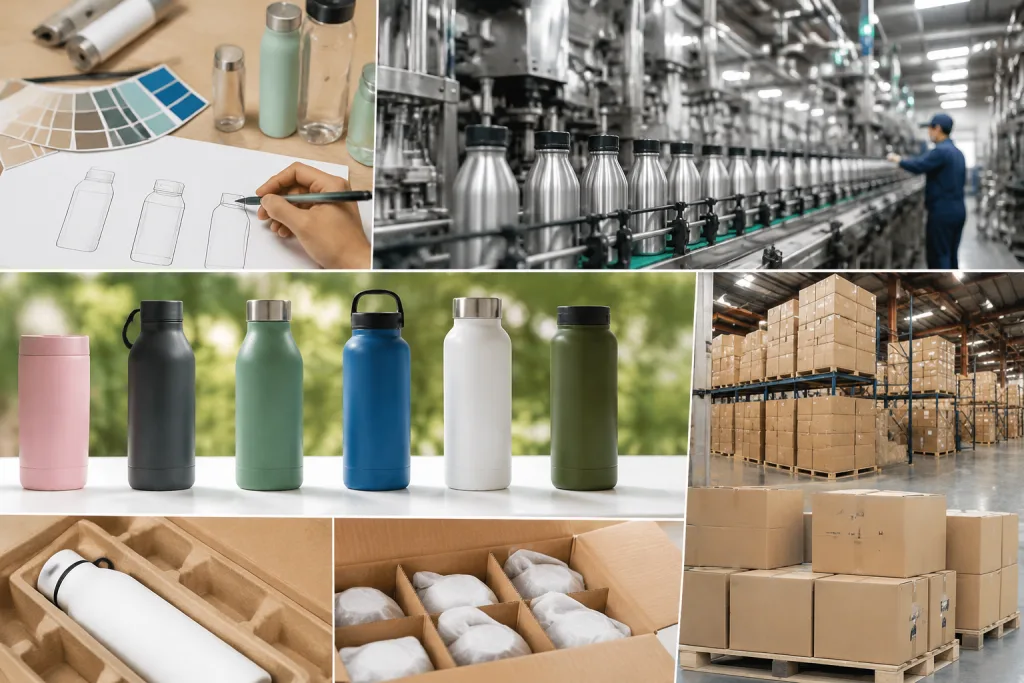
A serious vendor water bottle spec sheet should lock inspection rules before we cut steel or book coating capacity. Don’t wait until 62 cartons are sealed to argue about scratches, Pantone drift, or a slow leak at the silicone ring. Put AQL terms, defect definitions, and test methods directly in the purchase order; we’ve seen one PO typo turn “matte black” into “mate black,” and QC still had to decide what the buyer meant.
For most B2B custom drinkware orders, AQL 2.5 for major defects and AQL 4.0 for minor defects is a workable baseline. Critical defects are zero tolerance. Major defects include leaking, wrong logo, unsafe sharp edges, failed vacuum insulation, missing parts, and coating peel larger than 3 mm on the visible body. Minor defects include small cosmetic marks inside the approved limit sample, slight color variation, or packaging scuffs that do not hurt saleability; on our line, QC pulled 8 samples last month because a lid gasket sat 1 mm proud after assembly.
Factory audits matter for European and North American buyers, especially when the retailer asks for traceability after shipment. If your brand needs BSCI, Sedex, ISO 9001, or other social and quality documents, ask before price negotiation starts. Some canteen manufacturers have current audits at the actual production site; some canteen vendors show borrowed files from another facility. The math doesn’t work if your order is 3,000 pcs and the buyer later demands a matching audit address, business license, and production photos from the packing line.
For insulated bottles, vacuum performance testing belongs in the control plan. We run hot-water checks with a calibrated probe and record the temperature drop over 6-12 hours, depending on the product claim. Leak testing should be 100% for screw caps and straw lids, not just a carton-top spot check. Coating adhesion can be checked with cross-hatch tape testing. For kids bottles, check small parts, straw security, and age-grade requirements under relevant ASTM or EU expectations; one buyer flagged a straw plug that pulled loose at 4.8 kg, so the mold had to be adjusted before mass production.
China production can be reliable when inspection rules are written, measured, and signed off. It goes sideways when the buyer approves a shiny sample but leaves the production standard unwritten. We ship cleaner orders when the golden sample, defect board, and carton drop-test result sit on the QC table before the first 500 pcs leave the line.
Price, MOQ, and lead time
A usable vendor water bottle quote needs four numbers on the first pass: unit price, MOQ, sample time, and mass production lead time. We ask buyers to put them in the RFQ table, not in a WeChat note, because one missing line on a PO can turn a clean canteen supplier comparison into two hours of guessing.
For a standard 500-750 ml stainless insulated bottle with one-color logo, FOB China pricing commonly ranges from about USD 3.20-6.80 depending on steel thickness, lid design, coating, packaging, and order quantity. Larger custom growler and distributor growler items can move into USD 8.00-16.00 or more. Cheap quotes usually remove something. We see it on the scale: 0.38 mm body steel instead of 0.45 mm, a lighter PP lid, thinner powder coating, 5-layer carton changed to 3-layer, or inspection cut from AQL 2.5 to a quick visual check.
At our Zhejiang facility, normal sample time is 7-12 days for existing molds with logo decoration. Mass production is usually 25-40 days after sample approval and deposit for standard custom drinkware. Add 7-20 days for new mold work, complex UV print, custom color boxes, or unusual accessories. Before Q4, book 2-3 weeks earlier. The line does not speed up because a promotion date is already printed on your catalog; we have seen this go sideways when the buyer approved artwork on day 11 but still wanted shipment on day 25.
MOQ should match the production reality. A canteen factory can sometimes run 500 units for a trial order, but the unit price rises and color control gets harder because the coating room still needs a full setup and spray-gun cleaning. For stable pricing, 1,000 units per color is a practical starting point. For fully canteen customizable programs with private packaging and multiple SKUs, plan 3,000-5,000 units across the project. That gives the manufacturer enough volume to buy 304 stainless coil cleanly, hold one powder batch, and assign QC for incoming lids, vacuum testing, and carton drop checks.
The best buying habit is simple: lock the spec first, then negotiate. Asking ten canteen vendors for “best price” without a controlled spec sheet is the wrong question to ask; QC pulled one sample last month where the buyer thought “same bottle” included a silicone base, but the PO left that 22 mm part out.
Send your vendor water bottle spec for review
We will check material, MOQ, decoration, packaging, and lead time before you issue a China purchase order.
Frequently asked questions
What MOQ should I expect for a vendor water bottle order?
For existing molds, a practical MOQ is 1,000 units per color for stainless vendor water bottle projects with one logo. Some canteen suppliers may accept 500 units, but the price is usually higher and decoration choices are limited. If you need custom powder coating, retail color boxes, or several lid colors, expect 1,000-3,000 units per SKU. Private mold work normally needs a larger commercial plan, often 3,000-5,000 units after tooling, because the factory must recover setup, testing, and material costs.
How do I compare quotes from different canteen manufacturers?
Compare the same spec line by line: capacity, steel grade, wall thickness, lid material, coating, logo method, packaging, inspection level, and FOB port. A USD 3.90 quote and a USD 4.40 quote may not be comparable if one uses 0.4 mm steel and 5-ply cartons while the other uses thinner material and plain bulk packing. Ask each canteen manufacturer to confirm AQL level, sample time, production lead time, and whether testing reports cover the actual materials used.
Which logo method is best for customized drinkware?
For simple corporate or canteen promotional projects, one-color silkscreen is usually the best balance of cost and speed. Laser engraving is better when you want a premium, permanent mark and can accept the stainless color showing through. UV print is useful for gradients or multi-color art, but it adds process control and may increase lead time by 3-7 days. For high-volume customized drinkware, approve a physical sample and define logo size, placement tolerance, and adhesion test requirements before mass production.
Can I use one supplier for bottles, growlers, and canteens?
Yes, if the canteen supplier controls enough molds and QC systems. Many B2B buyers prefer one source for custom canteen, customizable growler, and travel bottle programs because color matching, packaging rules, and inspection standards stay consistent. The risk is assuming every factory is strong in every category. A good supplier should show production records, sample history, and realistic lead times for each item. For distributor growler programs, check carton strength and lid sealing separately from normal water bottles.
What documents should I request before placing a China order?
Request a formal quotation, technical spec sheet, material declaration, available food-contact test reports, factory audit documents if required, and a pre-production sample approval form. For Europe, ask about REACH, LFGB, and relevant food-contact compliance. For North America, ask about FDA food-contact suitability and ASTM considerations where applicable. Your purchase order should also name AQL 2.5/4.0, packaging requirements, barcode or FNSKU rules, FOB port, payment terms, and the agreed production lead time in days.