Key Takeaways
- For most custom thermos orders, 304 stainless at 0.45-0.55 mm wall thickness is the practical baseline
- A realistic MOQ is 1,000 units per SKU for stock molds and 3,000-5,000 units for custom tooling
- Vacuum performance should be checked at 6 hours and 12 hours, not only claimed as 24 hours
- Retail packaging, FNSKU labeling, and AQL inspection should be locked before deposit
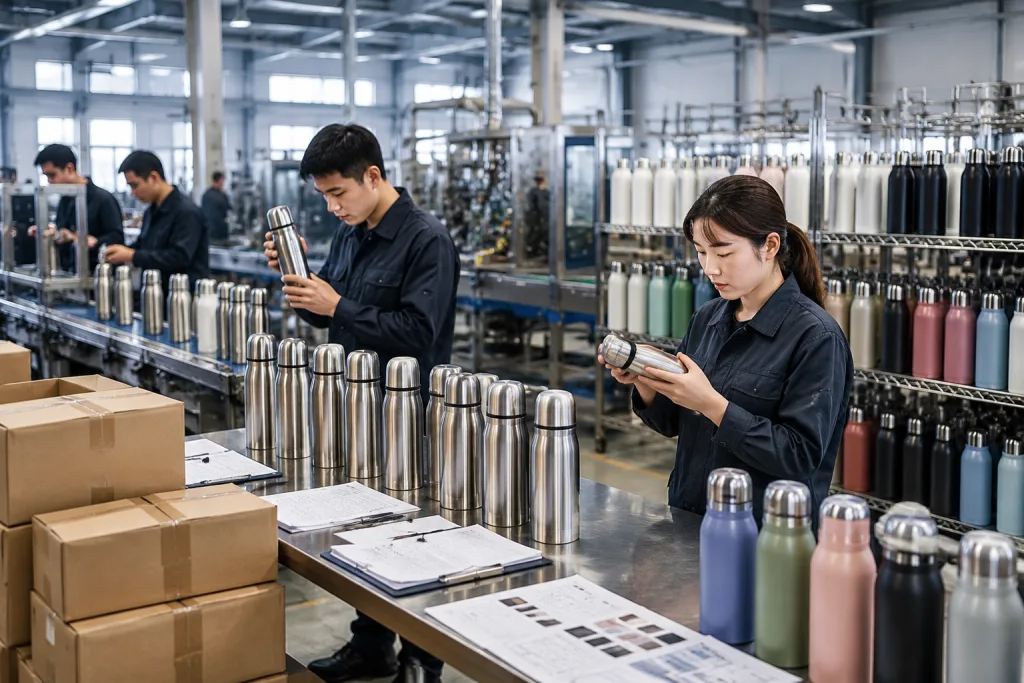
A vendor vacuum flask looks simple on a quotation sheet: capacity, color, logo, carton size, price. That is where programs go sideways. Outdoor retailers ask for a bottle that passes a 1.2 m drop test and still holds heat on a cold shelf demo. Promotional brands care about laser logo position within 1 mm, clean gift boxes, and no FDA or LFGB surprise when the container reaches port.
If you buy bulk thermos programs from China, the spec sheet protects margin, or it eats it. BottleForge Industrial in Hangzhou, Zhejiang runs stainless drinkware projects at 300,000 units/month, with standard MOQ from 1,000 units per SKU and sample lead time of 7-10 days. We see buyers chase a $0.08 cheaper lid, then QC pulled the sample for loose thread fit on the torque gauge. Wrong question. Each spec line changes cost, performance, and risk.
Capacity and mold selection
The first spec line usually says 350 ml, 500 ml, 750 ml, or 1,000 ml. Don’t treat it like a catalog tick box. Capacity changes mold availability, carton weight, shelf footprint, sea freight cost, and hand feel. We run the 500 ml vendor vacuum flask most often for promo orders because it fits office desks and standard car cup holders; last month QC checked one with a 74 mm lower diameter using a digital caliper after the buyer flagged “too fat for cup holder” on the sample report. For outdoor retail, 750 ml and 1,000 ml move better because the buyer is selling trail time, not desk convenience.
For a factory thermos project, ask one question early: is this capacity from an existing mold, or are we cutting new tooling? Existing molds keep MOQ near 1,000 units per color and hold development time to roughly 25-35 days after sample approval. A new body mold can push MOQ to 3,000-5,000 units and add 20-30 days, depending on shape, lid interface, and surface finish. The math doesn’t work for a first test order unless the brand already has shelf pull; we’ve seen this go sideways when a PO typo changed “500 ml straight body” to “500 ml curved body” and the line had to stop before polishing.
Check usable volume too. Some suppliers thermos quotations show nominal capacity, while actual fill volume may be 20-40 ml less after the stopper and vacuum gap are counted. If your retail label says 17 oz, the bottle should hold close to 503 ml, not 460 ml. Ask for a water-fill video or pre-production sample measurement; our QC team usually weighs the empty flask, fills to the thread line, then checks the gain on a 0.1 g bench scale. Small request. It prevents a retailer claim later.
Steel grade and wall gauge
The material line should never stop at “stainless steel.” That line is too loose. For a vendor vacuum flask going to Europe or North America, we normally run 304 stainless steel for the inner liner, then 201 or 304 for the outer shell based on the target FOB. Premium outdoor orders should use 304 inside and outside. For price-driven promotional thermos orders, 304 inner plus 201 outer can pass, but the buyer needs to accept the risk: 201 loses corrosion resistance faster, especially after a powder-coat chip near the bottom ring or shoulder. We’ve had QC pull a salt-spray sample after 48 hours and the 201 exposed edge already showed rust dots.
Wall thickness gets underestimated by buyers. Common outer wall gauge is around 0.45-0.55 mm. Inner liner thickness is often 0.35-0.45 mm. Thin steel can cut FOB by USD 0.05-0.10 per piece, but the math doesn’t work if 3% of cartons arrive with dent complaints. It feels cheap, too. On the line, a 0.38 mm outer shell will show shoulder dents after a rough vacuum chuck adjustment, while 0.50 mm holds its shape better during polishing and packing. For distributor thermos channels selling into outdoor stores, saving USD 0.08 on steel and then fighting returns is the wrong question to ask.
Ask the thermos supplier to print the steel grade on the proforma invoice and keep mill material records. Check the PO wording. We once saw “304 inside/204 outside” typed by a buyer’s assistant, and production stopped for 6 hours until the merchandiser confirmed it meant 201. For EU buyers, REACH and LFGB food-contact expectations are common. For the US, FDA food-contact expectations and ASTM-related packaging checks apply when the buyer’s manual calls them out. A serious thermos manufacturer in Zhejiang or elsewhere in China should talk through heat numbers, coil records, and traceability without acting surprised, even if third-party testing is ordered per batch only when the MOQ reaches 3,000-5,000 pcs.
- Good baseline: 304 inner and 304 outer, 0.45 mm minimum outer wall, mill record kept with the production lot.
- Budget baseline: 304 inner, 201 outer, powder coating, carton drop test agreed before mass production.
- Avoid: unspecified “stainless” with no grade, no sample cutting record, no test plan tied to the PO.
Vacuum performance claims
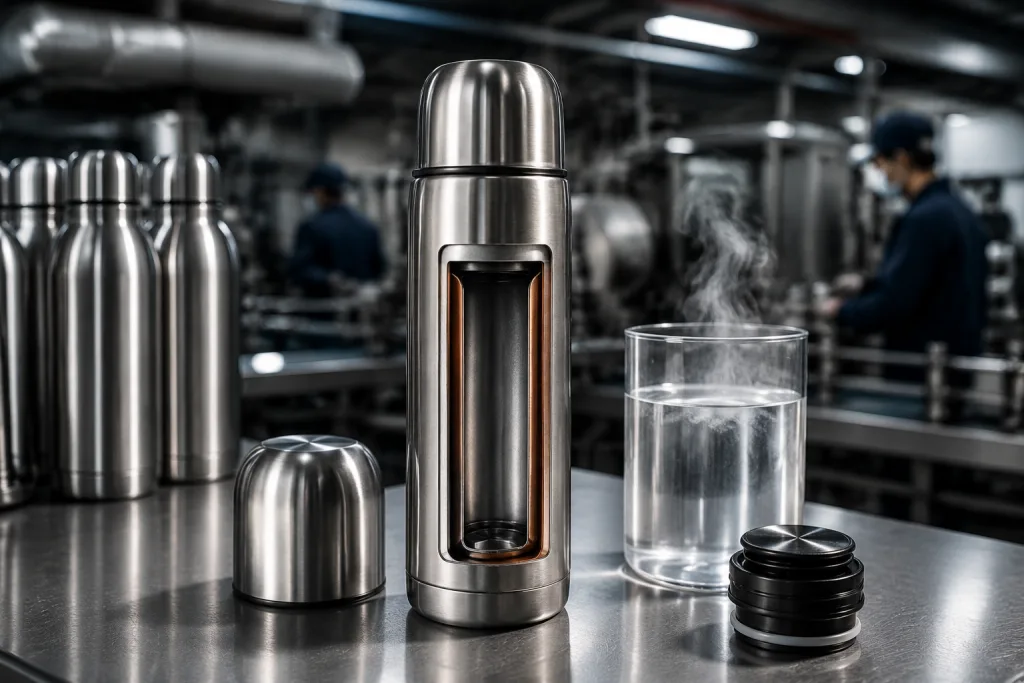
Most quotations say “keeps hot 12 hours, cold 24 hours.” That line is sales copy unless the test method is written down. We run hot tests with water filled at about 95°C, room temperature logged at 20-25°C on a wall thermometer, lid closed, no opening halfway. For hot tests, our QC records the reading after 6 and 12 hours with a probe thermometer; last month QC pulled the sample because one lid gasket sat 0.4 mm high. Cold tests vary more by factory, so lock the method before comparing suppliers thermos offers.
The buyer impact is direct. Poor vacuum does not show during inbound inspection unless you run a temperature test or use a vacuum detector. A bottle can look perfect, pass logo inspection, and still lose heat because of a micro leak near the weld or base seal. We have seen this go sideways: the buyer flagged 3 cartons after a showroom demo, even though the print, color, and carton marks all passed. For thermos bulk orders, we normally recommend sampling 8-13 units from production for vacuum performance, depending on order size, and combining that with standard AQL visual inspection.
Do not overpay for unrealistic claims. A slim 350 ml flask with a small vacuum gap will not perform like a wide 1,000 ml outdoor bottle. That is the wrong question to ask if the use case is a hotel gift or conference handout. Copper lining can improve heat retention, but the math does not work for every promotion; on a 3,000 pcs run, the buyer often pushes back once the unit price moves by USD 0.18. If your brand promise is “all-day heat,” spend on better vacuum processing and controlled welding. If the item is a thermos promotional giveaway for a two-day conference, a stable 6-hour hot result may be enough.
Buyer rule: ask for the test chart, not the slogan. A temperature table is more useful than a big “24H” icon on a PDF.
Lid system and leak risk
The lid line causes more returns than the body line. We see it in QC. Screw cap, push-button lid, cup lid, straw lid, and handle lid each fit a different buyer brief, so lumping them together is the wrong question to ask. Outdoor retailers usually push us toward screw caps or cup lids because fewer moving parts survive drops better; last April, QC pulled 32 samples after a 1.2 m drop test and the screw caps still sealed. Promo buyers often pick push-button or one-hand lids because the gift feel is stronger, but the parts count jumps fast: silicone gasket, spring, button, hinge, stopper, and sometimes a secondary lock.
For a customized thermos, ask for the lid material and gasket spec before artwork starts. Food-contact PP is common for plastic parts, and silicone is common for seals. The gasket needs a firm seat in the groove; if a 2.4 mm gasket twists after 20 dishwasher cycles, we reject it before packing. Leak testing should cover upright, inverted, and side-position checks. Side-position matters for e-commerce and distributor thermos channels because the end user will throw the bottle in a backpack or on a car seat, then blame the brand when coffee reaches the laptop.
Talk about replacement lids before the PO. We have seen this go sideways. If you sell a distributor thermos range for multiple seasons, keep the lid interface stable; a nice custom body loses value if lids cannot be reordered after 6 months. At BottleForge in Zhejiang, we advise buyers to keep at least one shared lid platform across 500 ml and 750 ml SKUs where possible. On the line, that means fewer spare-part bins, fewer carton picking mistakes, and less chance that the second production run looks 1 mm off from the first.
One more practical point: lid weight changes FOB and freight. A heavy cup lid can add 25-45 g per unit. On 10,000 units, that is 250-450 kg of extra shipped weight, or roughly half a pallet once we add inner boxes. The math may still work for retail value, but it should be a clear choice on the spec sheet, not a surprise after the buyer flagged the freight quote.
Coating and logo process
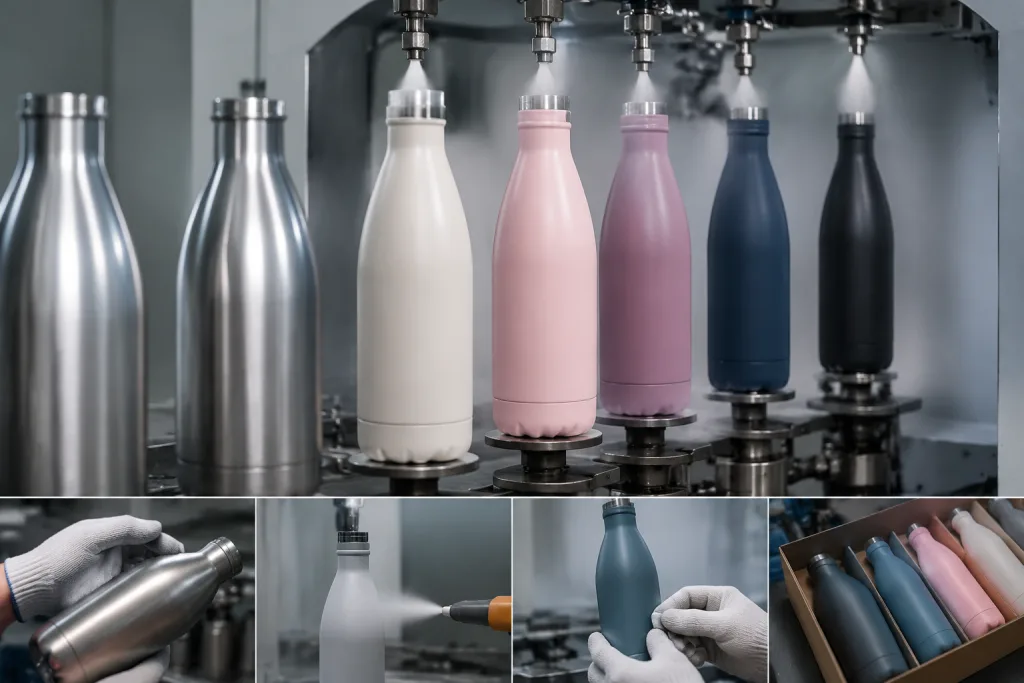
Surface finish is where a customizable thermos starts looking like a sellable brand SKU. We run powder coating, spray painting, polished steel, brushed steel, rubberized coating, and ceramic-style coating on the line, but I would not treat them as equal. Powder coating is the safer workhorse for outdoor and promotional programs; on a 750ml bottle body, our coating thickness usually sits around 60-80μm when checked with a film thickness gauge. It gives better scratch resistance than basic spray paint and takes laser engraving cleanly. Matte black, navy, white, and army green are the colors we trust for repeat orders because the color drift stays easier to control across 3 production batches.
Logo method should follow the sales channel, not the buyer’s first mood board. Laser engraving is durable, clean, and suitable for stainless or powder-coated bodies; QC pulled the sample last month because the engraving sat 2mm too close to the bottom curve, and the buyer flagged it in lifestyle photos. Silk screen is cheaper for simple one-color artwork, but it scratches when ink viscosity or oven curing is off. Heat transfer and full-wrap printing give stronger shelf impact, but they need tighter artwork control and a higher reject allowance. For a thermos custom project with retail packaging, approve a real decorated sample, not only a digital mockup. We have seen this go sideways.
For logo placement, give the factory a measured artwork file, usually AI or PDF vector, with Pantone color references if printing is used. “Put logo in the middle” is not a spec. State logo size, distance from base, side orientation, and whether the seam line should be hidden or centered. A useful note looks like this: logo 45mm wide, bottom edge 85mm from base, front side opposite seam. The line can follow that. This matters for thermos customized orders where photos must match online listings, especially when Amazon or retail buyers compare 12 product images side by side.
Typical decoration cost ranges from about USD 0.05-0.12 for simple silk screen, USD 0.10-0.25 for laser engraving, and USD 0.30-0.80 for full-wrap or multi-color processes, depending on size and quantity. If a thermos vendor quotes far below that, ask what inspection level and reject handling are included. The math does not work if they promise full-wrap printing at USD 0.12 and still include AQL 2.5 checking, carton drop test, and replacement for 3% print defects. On one PO, the buyer typed “laser logo” but attached a 4-color gradient file; we stopped it before mass production because those are two different processes.
Packaging and compliance paperwork
Packaging is not a decoration afterthought. It decides breakage rate, retail acceptance, warehouse handling, and landed cost. For a supplier thermos program, lock the pack type first: white box, kraft box, color retail box, gift box, or mailer box. A simple white box may cost USD 0.10-0.18. A printed retail box often lands around USD 0.25-0.55 depending on board grade, coating, and insert structure. Mailer-ready packaging costs more, but it cuts damage when the bottle goes through 6 courier touches instead of one pallet move. We run a 0.6 mm caliper check on board thickness before mass packing; QC pulled one sample last year where the PO said “350g grey board” but the box mill sent 300g.
Carton strength should be written into the packing spec, not guessed on the line. For heavy thermos bulk shipments, use export cartons with the right flute strength and do a carton drop test if the bottles will ship by courier or FBA-style small parcel networks. The math doesn't work if a buyer saves USD 0.08 on a weak carton and then loses 2% of the shipment to dented lids. If your program needs FNSKU labels, suffocation warnings, country-of-origin marking, or barcode stickers, put them into the packing spec before deposit. Adding labels after production is slower and usually costs more than printing or applying them during packing. We ship mixed-color cartons with a 12 kg gross-weight limit when the buyer’s warehouse uses hand unloading.
Compliance documents depend on market and buyer type. About 7 out of 10 European customers ask for LFGB, REACH, and sometimes BSCI factory audit documents. North American buyers may ask for FDA food-contact declarations, Prop 65 review, ASTM packaging checks, and general product safety paperwork. Not every order needs every test. This is the wrong question to ask; the better question is which report must match the exact material, coating, and lid structure. A 304 stainless body report will not cover a PP lid or silicone ring. We keep test files by SKU and material sheet, and QC checks the BOM against the lab report before we send paperwork to the buyer.
For private label or promotional tenders, ask for packaging dielines early. Artwork approval often takes 18 days vs 12 days for bottle sample approval, especially when legal text needs three languages. We have seen 30-day production schedules lose a week because a buyer had not confirmed barcode size or legal text. Small issue, big delay. On the factory floor, the box supplier will not open the cutting die until the dieline is signed, and one typo on a PO, like “matte lamination” instead of “gloss lamination,” can stop the carton line for 2 days.
MOQ price and inspection terms
Read the price line with the MOQ, Incoterm, payment term, and inspection level beside it. A manufacturer thermos quote of USD 3.20 FOB Ningbo for 5,000 units is not the same as USD 3.20 EXW Hangzhou for 1,000 units with no packaging included. We had one PO last year that said “FOB Hangzhou”; the buyer meant FOB Ningbo, and our merchandiser caught it before the PI went out. For exports from Zhejiang factories, FOB Ningbo or FOB Shanghai is the normal base. CIF and DDP can be quoted, but FOB gives a cleaner product-cost comparison when you line up 3 thermos suppliers.
For stock mold custom logo orders, a realistic MOQ is 1,000 units per SKU. For a new powder-coat color, 1,000-2,000 units makes more sense because the line loses paint during color change, and our coating supervisor usually counts 18-25 trial cups before the shade settles against the Pantone card. For new molds or custom thermos structures, expect 3,000-5,000 units. If someone accepts 200 units for a fully custom thermos at a factory price, ask where the setup cost went. The math doesn't work. They are probably using leftover stock, trading company inventory, or loose setup control.
Inspection terms should be written, not assumed. Common AQL settings are Critical 0, Major 2.5, Minor 4.0 for general consumer goods, though some retailers require tighter levels. Define major defects clearly: leak failure, vacuum failure, wrong logo color, sharp edge, exposed rust, broken lid, or wrong barcode. QC pulled the sample from a 24-carton lot last month because the barcode was off by 1 digit, even though the cup itself passed the 6-hour hot-water check. Minor defects can include small dust marks, light coating specks, or carton scuffing within a signed limit sample.
Payment is usually 30% deposit and 70% before shipment for first orders. For repeat thermos distributor and outdoor retail programs, we can schedule monthly releases if the forecast has real dates and SKU split, not just “many containers in Q3.” Our Hangzhou production team can usually hold 25-35 day lead time after artwork and sample approval for standard stainless thermos models. Peak season before September is different. Book earlier, because one delayed 304 stainless steel coil delivery can push a line from 12 days to 18 days before assembly even starts.
Send your thermos spec sheet for review
Share capacity, logo, packaging, target price, and market. We will return a practical FOB quote and sample plan within 2 working days.
Frequently asked questions
What MOQ should I expect for a vendor vacuum flask with my logo?
For an existing stainless thermos mold, 1,000 units per SKU is a normal starting MOQ in China. That usually covers one size, one body color, and one logo setup. If you need two colors, treat them as two SKUs unless the factory agrees to split a coating run. For custom body tooling, expect 3,000-5,000 units because mold cost, trial production, and QC setup are higher. Very small runs under 500 units are possible only with stock goods, limited colors, and simpler decoration. They are fine for event testing, but they rarely produce a strong FOB price.
How much does a custom thermos cost FOB China?
A practical FOB China range for a 500 ml stainless custom thermos is about USD 2.60-4.20 depending on steel grade, coating, lid type, logo method, and packaging. A basic 304 inner and 201 outer model with silk screen may sit near the lower end. A 304 inner and outer bottle with powder coating, laser engraving, retail box, and stronger lid can be USD 3.60-5.20. Prices move with steel cost and exchange rate, so compare quotes using the same spec sheet. FOB Ningbo and FOB Shanghai are common for Zhejiang manufacturers.
Can one thermos factory handle both retail and promotional orders?
Yes, if the factory has flexible decoration and packing lines. Retail orders need stable color, shelf packaging, barcodes, carton marks, and sometimes lab testing. Promotional orders often need faster logo approval, mixed artwork, and event deadlines. The production process is similar, but the risk points are different. For outdoor retailers, we focus on vacuum performance, coating durability, and replacement lid continuity. For promotional brands, we focus on logo accuracy, individual boxes, and shipment timing. Ask your thermos supplier for photos of both packing formats before you approve the order.
Which logo method is best for a stainless vacuum flask?
Laser engraving is the safest option for durability, especially on powder-coated bottles. It will not peel, and the cost is usually around USD 0.10-0.25 per unit depending on logo size and order quantity. Silk screen is cheaper for one-color logos, often USD 0.05-0.12, but it needs good ink curing and is less abrasion resistant. Full-wrap printing is better for retail graphics but costs more and has higher setup risk. For a first order, approve a physical decorated sample and run a tape test, rub test, and dishwasher-related warning review before mass production.
What quality checks should I require before shipment?
Use AQL inspection with Critical 0, Major 2.5, Minor 4.0 unless your retailer specifies another level. Check appearance, coating, logo position, capacity, lid fit, leakage, carton marks, barcode scans, and packaging count. For vacuum flasks, add a heat-retention test on pulled samples: fill with hot water near 95°C, close the lid, and record temperature after 6 and 12 hours. Also inspect gaskets and threads because lid defects cause most returns. For orders above 5,000 units, a pre-shipment inspection plus production sample retention is worth the cost.