Key Takeaways
- A 1,000-unit MOQ is realistic for most custom thermos colors and logo methods
- 304 stainless steel at 0.4-0.5 mm wall thickness is the usual export baseline
- Vacuum insulation claims should be checked at 6 hours, 12 hours, and 24 hours
- FOB Ningbo or Shanghai pricing must include packaging, testing, and spare lids
A vendor vacuum bottle looks simple until the PO says 5,000 pieces, logo on two sides, retail box, Pantone-matched powder coat, carton marks, and a ship date tied to a launch week. The trouble usually starts before the line runs: loose capacity tolerance, 72 dpi artwork, insulation claims nobody tested, or a quotation that leaves out the drop-test carton and LFGB report fee. We have seen this go sideways.
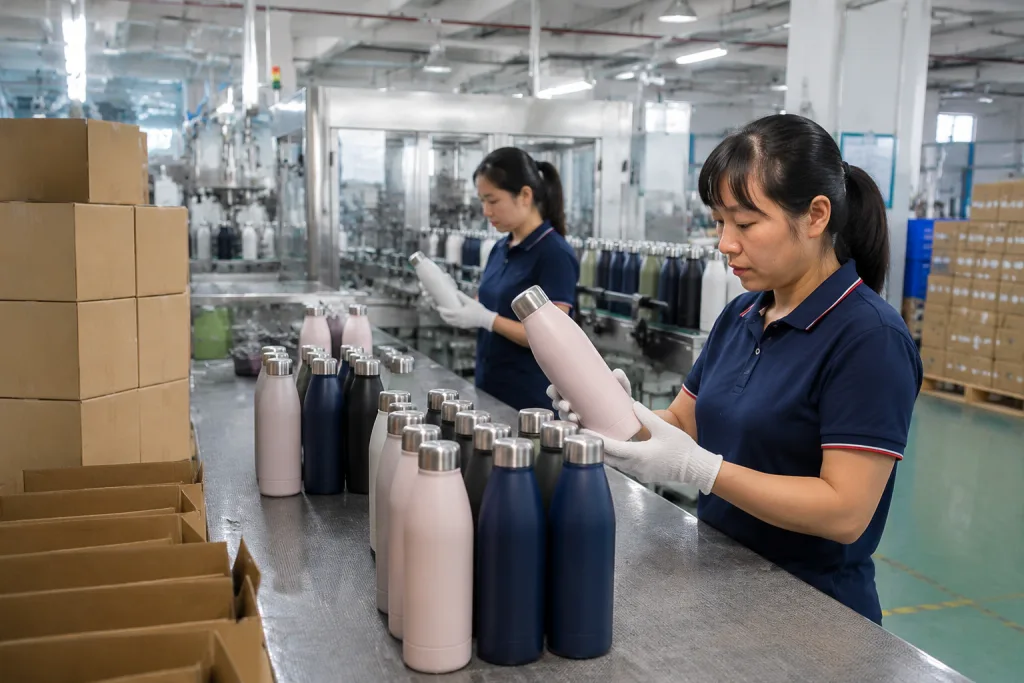
If you buy for an outdoor retailer or a promotional brand, the wrong question is “how cheap can you make it?” You need a factory thermos program that repeats cleanly from sample to reorder. BottleForge Industrial works from Hangzhou, Zhejiang, with stainless drinkware production partners in Zhejiang and other China clusters. Our standard MOQ starts at 1,000 units per SKU, sample lead time is 7-10 days, and normal bulk lead time is 30-45 days after deposit and artwork approval. QC pulled one pre-production sample last month because the laser logo sat 3 mm off center; catching that before bulk saved the buyer from a 38-carton problem.
What should you specify first?
Start with the bottle spec, not the logo. A usable vendor vacuum bottle RFQ should lock capacity, lid type, steel grade, coating, insulation target, packaging, and sales market before unit price comes up; better yet, attach a 2D drawing with mouth diameter in mm and carton drop-test requirement. If you send one photo and write “similar, with our logo,” we run five sample-room interpretations and the quotations won’t line up. We saw this last March: one PO said “matte black,” the buyer meant powder coating, and two factories priced spray paint. Wrong question first.
For outdoor retail, the common range is 350 ml, 500 ml, 750 ml, and 1,000 ml. Promotional thermos orders often land at 500 ml because it gives enough gift value without pushing carton CBM too hard; on our line, 24 pcs of 500 ml usually fit one export carton, while 1,000 ml can cut that to 12 pcs. For a bulk thermos program, write the capacity tolerance clearly. A 500 ml bottle may measure 480-520 ml depending on shoulder shape and fill line, and QC will check it with a graduated cylinder, not by eye. That matters if your retail label promises exact capacity.
Material should usually be food-contact 304 stainless steel for inner and outer walls. Some budget supplier thermos offers use 201 stainless on the outer shell. It can pass a quick visual check, but rust risk goes up when powder coating gets scratched or the goods sit 45 days in a humid Ningbo warehouse. For Europe and North America, 304/304 is the safer baseline. If you need a lower price, cut the color box insert or EVA tray first; reducing steel quality is where we’ve seen this go sideways.
- Wall thickness: 0.4-0.5 mm is typical for stainless vacuum bottles; 0.35 mm saves cost but dents more easily when the line does carton drop checks.
- Inner finish: electrolytic polishing helps cleaning and reduces odor complaints; QC pulled samples with black polishing dust in the neck on one rushed order.
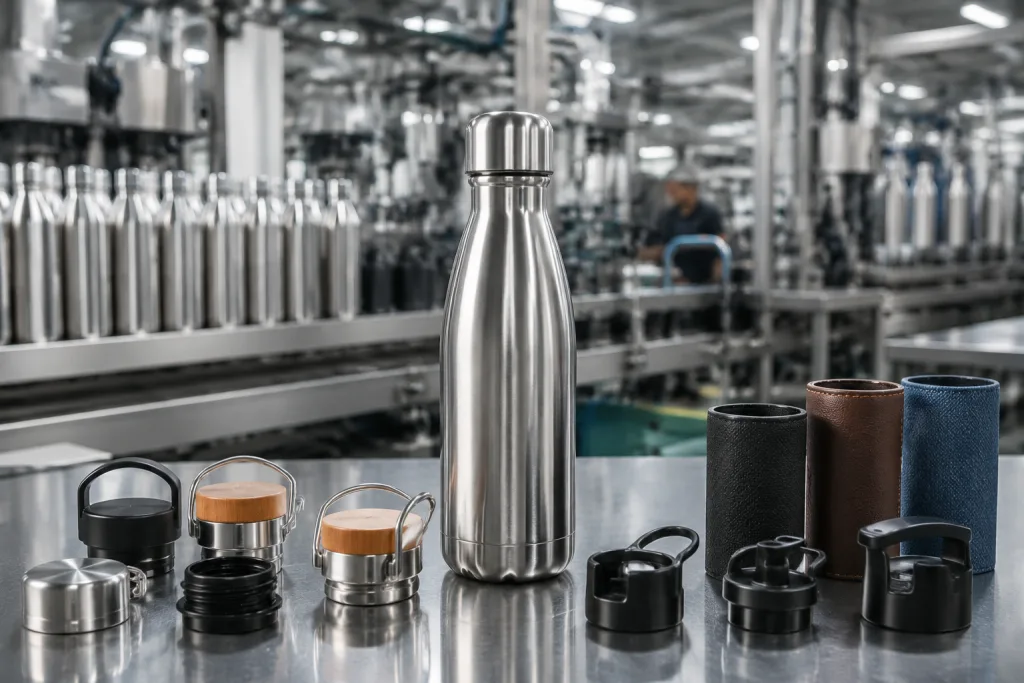
- Lid material: PP is common; Tritan or stainless cap inserts raise cost by a few cents but give the buyer a stronger shelf impression.
- Seal: food-grade silicone should be removable for cleaning on outdoor products, with spare rings listed on the BOM.
For a custom thermos, decide whether you are buying a retail-grade SKU or a campaign giveaway. A customized thermos for a one-month promotion can use simpler packaging, such as a white box with a 1-color label. A distributor thermos going into repeat wholesale channels needs tighter color consistency, spare lids planned at 1-2%, and packaging that survives pallet handling; we ship these with corner protectors when the buyer’s warehouse uses clamp trucks. The math doesn’t work if you price it like a giveaway and expect retail returns to stay low.
How do insulation claims hold up?
Insulation is where 7 out of 10 thermos manufacturer calls get sloppy. “Keeps hot for 12 hours” is almost useless unless the start temp, room temp, fill volume, and test method are written on the spec sheet. For a vendor vacuum bottle, we run the check with water at about 95°C at filling, a lab room at 20°C ± 2°C, bottle filled to rated capacity, lid tightened with the same torque jig the line uses, then readings at 6, 12, and 24 hours.
A solid 500 ml stainless thermos should hold above 65°C after 6 hours and above 45°C after 12 hours under those conditions. Bigger bottles usually win because the volume-to-surface-area math is better. Simple physics. A 1,000 ml model can still feel warm after 24 hours, but the result moves with neck diameter, lid stack, copper plating, and vacuum consistency; last month QC pulled a 52 mm wide-mouth sample that lost 6°C more than the 38 mm version by hour 12.
Do not buy from the hero sample only. The math doesn't work. Samples get handpicked and babied, while mass production shows whether the process is under control. Ask your thermos factory how they catch vacuum failure: we use temperature rise testing, hot water aging, and 100% vacuum detection by thermal response, then QC marks rejects with red tape before packing. For high-value outdoor retail orders, keep 2-3 sealed cartons from production, because field complaints 9 months later are easier to settle when both sides test the same lot.
Our practical rule: if a manufacturer thermos quote is 8-12% cheaper than the market and claims better insulation, ask what changed. Usually it is steel thickness, lid structure, copper layer, or inspection time.
For compliance, insulation performance is usually not the regulated part; food-contact safety is. EU buyers should ask for LFGB or EU food-contact test reports, plus REACH screening when coatings or painted parts are used. For the US, FDA food-contact expectations and California Proposition 65 may apply depending on the sales channel. A suppliers thermos report must match the actual material and color family; we have seen buyers flag a PO because the report said black powder coating while the order was Pantone 7527C beige.
Which customization options are worth paying for?
A customizable thermos gives you a few decoration routes, and the cheapest quote is not always the best buy. For promotional brands, we usually run laser engraving on powder-coated bottles when the order is 1,000 units or above. Clean result. The laser head burns through the coating and shows the stainless steel under it, so the logo survives normal handling better than ink. QC pulled a black 500 ml sample last month and measured the logo at 42 mm wide against a 40 mm artwork file; that 2 mm stretch came from the curved wall, not the laser. Full-color artwork is the wrong question to ask for engraving. It cannot do it.
Silkscreen printing still carries most thermos promotional orders with one or two spot colors. The usual cost sits around USD 0.08-0.25 per position, depending on print size and color count. We run a curved bottle jig on the line, and fine lines under 0.3 mm often need thickening before the screen is made. Heat transfer and water transfer can wrap graphics around the body, but we see more rejects at the rim area and seam line; one buyer flagged silver cracking after a tape test on 80 pieces from a pilot run. Setup is not just longer. It can be 18 days vs 12 days for a normal silkscreen job. UV printing fits short-run full-color logos, but ask for an abrasion test if the bottle will sit in bike cages, backpacks, or outdoor retail displays.
Color customization costs more than logo customization. Standard factory colors can often run at 1,000 pieces per SKU because we already keep powder stock near the coating booth. Pantone-matched powder coating normally needs 2,000-3,000 pieces because coating loss, line cleaning, and color approval take real time. The line wastes about 8-12 kg of powder during changeover on some colors, and nobody likes seeing that hidden in the unit price. If you need four colors at 1,000 units each, ask whether they can share the same body and lid inventory so the thermos bulk program does not turn into 12 small POs with mismatched cartons.
Procurement checklist before artwork approval
- Send AI, EPS, or vector PDF files, not low-resolution PNG from a presentation. We once received a 96 dpi logo pasted into a deck, and the screen maker refused it.
- Confirm print size in millimeters, not “same as mockup.” Put 35 mm x 28 mm on the PO.
- Approve one physical pre-production sample for new colors. A photo under office light is not enough for Pantone disputes.
- Confirm logo position tolerance, usually ±1.5-2.0 mm on curved bottles. QC checks this with a caliper and positioning sleeve.
- Check whether retail barcode, FNSKU, or carton SKU labels are required. One missing FNSKU can hold 50 cartons at the forwarder.
For thermos custom programs sold through outdoor retailers, the best result is usually restrained: powder coating, one strong logo method, and packaging that explains use and care. We ship better orders that way. Over-customization looks good in a rendering, but we have seen it go sideways during mass production when a buyer adds gradient artwork, four lid colors, and a last-minute carton label change on the same PO.
What does a real quotation include?
A real vendor vacuum bottle quotation should be built line by line. “USD 4.20, FOB China” is not a quote we would accept from our own costing desk. FOB Ningbo and FOB Shanghai both fit Zhejiang production, but the line must say if logo, powder coat, color box, inner PE bag, master carton, barcode label, spare gasket, inspection support, and 5-layer export carton are included. Last month QC pulled a 500 ml sample where the PO said “white box,” but the buyer expected a printed sleeve; that one word changed the packing cost by USD 0.22.
For reference, a 500 ml stainless customized thermos with 304 inner/outer steel, powder coating, laser logo, and white box may sit around USD 3.20-4.80 FOB depending on lid complexity and order volume. A retail color box can add USD 0.18-0.45. A stainless cup lid, handle lid, or tea infuser can add USD 0.25-0.90. These are not promises; steel prices, exchange rates, and coating specs move. Still useful. If another factory quotes USD 2.85 for the same bottle with 304 stainless and a 2-color box, the math doesn’t work unless something has been cut, usually steel thickness, carton grade, or logo process.
MOQ also changes by component. Your thermos vendor may accept 1,000 units for a standard bottle body, but the custom color coating supplier may prefer 2,000 units, and a molded gift box supplier may ask for 3,000 units. Ask for the “binding MOQ” by part, not just the finished-bottle MOQ. We run into this on the line when 1,000 bottle bodies are ready, then the coating shop refuses to mix a custom Pantone under 2,000 pcs because the spray booth loss is too high.
- Sample cost: USD 50-150 for existing shape with logo; more if custom mold or new lid tooling is needed. For laser logo, we usually need an AI file and a 30 x 40 mm marking area confirmed on the sample.
- Tooling: USD 800-3,000 for a simple lid or silicone part; higher for complex injection molds. A new PP lid mold can take 18-25 days before the first T0 sample.
- Payment: 30% deposit and 70% before shipment is common for new buyers. If the buyer asks for OA terms on the first PO, we usually push back.
- Lead time: 30-45 days for bulk after approval; 50-60 days during peak Q3 orders. One late color approval can turn 30 days into 42 days because the coating line is already booked.
A serious thermos manufacturer should quote carton dimensions and gross weight early. Freight can kill the saving. A 500 ml bottle commonly packs 24 pieces per carton, often around 47 x 32 x 27 cm depending on lid height and box style. If your packaging is oversized by 15%, you pay for air from China to your warehouse, and we’ve seen buyers flag this only after the forwarder sends the CBM calculation.
How should quality be controlled?
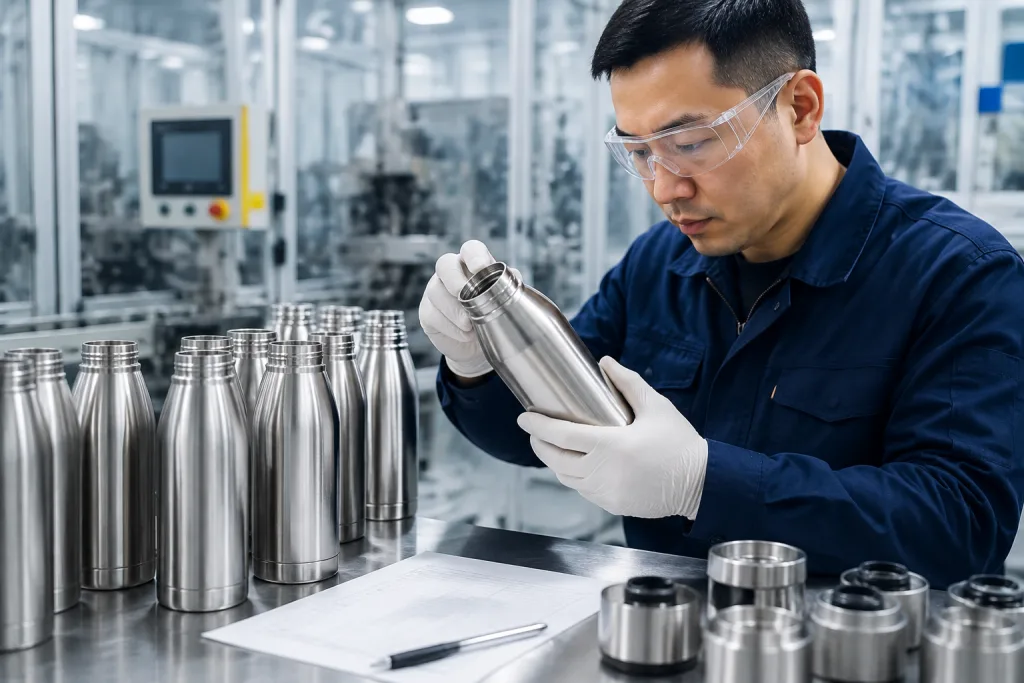
Quality control on a manufacturer thermos order has to start before the line opens, not on the last packing day. Stainless vacuum bottles fail in predictable places: vacuum loss, lid leakage, coating scratches, weak logo adhesion, dented bodies, silicone odor, and wrong carton labels. We run the first check at pre-production sample stage, then again when about 20% of bulk goods are off the line. AQL inspection helps, but this is the wrong question to ask if it stands alone; a 500 ml bottle with a slow lid leak can still pass a visual table check.
For normal export orders, about 7 buyers out of 10 use AQL 2.5 for major defects and AQL 4.0 for minor defects under ISO 2859-1 sampling. Critical defects should be zero. A leaking bottle, wrong food-contact material, sharp metal burr, or wrong customer logo is not a minor issue. QC pulled one sample last year with a 0.4 mm burr inside the drinking rim; the carton looked fine, but the order stopped until polishing was corrected. For outdoor retailers, we add drop tests on packed units, usually 1 corner, 3 edges, and 6 faces from 80 cm, because bottles can leave the thermos factory clean and still arrive with dented shoulders after domestic trucking.
The inspection checklist should include capacity check, weight check, lid torque or closure feel, 180° and 360° leak tests, coating cross-hatch adhesion where appropriate, logo rub test, color comparison against approved sample, barcode scan, carton mark verification, and random insulation test. For powder coating, a 3M tape test is a simple screen, but it does not replace coating cure control. We also weigh random units on a 0.1 g digital scale and compare them with the approved golden sample, because a 15 g weight gap often points to thinner steel or a changed bottom part. Small miss, big claim.
Factory audits are worth discussing if you plan repeat programs. BSCI, Sedex, ISO 9001, or similar documentation can reduce channel risk, but documents alone do not ship good products. BottleForge Industrial works from Hangzhou, Zhejiang and manages production with partner lines capable of roughly 300,000 stainless bottles per month across standard models. That capacity helps only when the production window is booked early and inspection standards are agreed before deposit; we have seen this go sideways when a buyer asked for new carton marks 2 days before loading and the PO had one digit wrong in the SKU.
Red flags during approval
- The supplier refuses to send a sealed golden sample with date, signature, and logo position marked in mm.
- Carton labels are “confirmed later” after production starts, then the warehouse asks for 12,000 stickers by air.
- The quotation uses 304 steel but the test report does not identify the model or item code on the PO.
- The vendor cannot explain how vacuum failure is detected, such as hot-water aging, temperature drop check, or an infrared reading after 4 hours.
How do you plan repeat orders?
A distributor thermos program needs reorder control from day one. The first order proves the cup; the second order proves whether the line can repeat it. Lock the BOM: 304 stainless thickness at 0.5 mm, lid mold number, silicone hardness, powder-coating code, logo size, 350 gsm color box paper, carton spec, and master carton marks. Small changes without a revision note cause ugly claims later. We have seen this go sideways when a buyer approved a matte black sample, then the repeat PO only said “black”; QC pulled the sample and the gloss level failed against the first shipment.
Ask your thermos suppliers to keep a control file with approved sample photos, Pantone or coating code, artwork file version, carton layout, instruction sheet, and inspection checklist. Simple folder. Big value. For a thermos distributors network, this keeps Germany, Mexico, and the U.S. from mixing barcodes or language stickers on the same SKU. If you sell through marketplaces, FNSKU or item labels need the same placement every run, not “close enough.” A missed label can cost more than a USD 0.08 unit-price saving; we had one PO where “FNSKU” was typed as “FNSK,” and the buyer flagged it before carton printing.
Forecasting matters. Stainless drinkware demand tightens before spring outdoor launches and Q4 promotional campaigns. If you need 20,000 pieces across five colors, do not send the purchase order 25 days before the required ship date. The math does not work. A realistic schedule is 7-10 days for sample, 3-5 days for sample freight, 3-7 days for internal approval, 30-45 days for production, 3-5 days for inspection and booking, then ocean or air transit. China holidays, especially Chinese New Year, can add 2-4 weeks if you cut it close; after CNY we run 2 shifts, but coating ovens and laser machines still have fixed hourly output.
For a thermos supplier relationship, ask for clear engineering notes instead of brave promises. If the factory says a new leakproof straw lid needs 35 days for tooling and testing, that answer is better than a fast yes. Outdoor retailers and promotional brands make money when the product arrives as approved, not when the first quote looks aggressive. We ship better repeat orders when the buyer accepts one hard truth early: a lid with a new vent plug needs a mold trial, 24-hour leak test, and drop test before mass production.
Send your thermos RFQ for engineering review
Share capacity, logo method, target market, quantity, and delivery date. We will return a practical FOB quotation with risks flagged.
Frequently asked questions
What MOQ should I expect for a vendor vacuum bottle with my logo?
For an existing stainless bottle shape, 1,000 units per SKU is a realistic MOQ for laser engraving or one-color silkscreen printing. If you need Pantone-matched powder coating, plan for 2,000-3,000 units per color because the coating line has setup loss and cleaning time. Retail color boxes often become the binding MOQ if the print supplier requires 3,000 pieces. For mixed-color promotional thermos orders, ask whether the factory can combine production under one total PO while keeping each color at a lower quantity.
How much does a custom stainless thermos cost FOB China?
A standard 500 ml custom thermos with 304 stainless steel inside and outside, powder coating, laser logo, and simple white box often ranges from about USD 3.20 to USD 4.80 FOB Ningbo or Shanghai. A more complex lid, stainless cup, carry handle, infuser, or retail color box can add USD 0.25-0.90 per unit. Testing, spare gaskets, barcode labels, and stronger export cartons should be priced clearly. Be careful with quotations that are 10% below the market but do not state wall thickness, packaging, or inspection standard.
Can I use one thermos design for both retail and promotional channels?
Yes, but plan packaging and labeling separately. The bottle body can stay the same while retail uses a color box, instruction sheet, barcode, and maybe hang tag. Promotional channels may only need a white box or kraft box with the campaign logo. If you use one shared bottle, lock the material, coating, lid, and logo position so repeat orders stay consistent. For distributors thermos programs, separate SKU labels and carton marks by channel. This avoids warehouse confusion when 5,000 retail units and 5,000 event units ship together.
What tests should I require before approving bulk thermos shipment?
Use AQL inspection, usually AQL 2.5 for major defects and AQL 4.0 for minor defects, with zero tolerance for critical issues such as leakage, wrong logo, unsafe burrs, or wrong food-contact material. Add product-specific checks: 360° leak test, coating adhesion, logo rub test, capacity check, carton drop test, barcode scan, and insulation readings at 6 and 12 hours. For EU orders, request food-contact documentation such as LFGB or EU 1935/2004 related test reports. For US orders, confirm FDA food-contact suitability and any Proposition 65 requirements.
How long should I allow from sample to shipment?
For an existing manufacturer thermos model, allow 7-10 days for logo sample production, 3-5 days for courier delivery, and 30-45 days for bulk production after deposit and artwork approval. Add 3-5 days for final inspection, booking, and export handling. New lids, custom molds, or special packaging can push the timeline to 60 days or more. Before Chinese New Year or Q4 promotional season, add 2-4 extra weeks. Zhejiang and other China production clusters get heavily booked, so late approval usually costs more than early planning.