Key Takeaways
- A practical MOQ for custom Tritan bottles is usually 1,000-3,000 units per color, depending on cap and print method
- Tritan bodies should pass food-contact checks such as FDA, LFGB, and REACH migration requirements for your market
- A new mold can take 25-35 days before mass production, while existing molds usually ship in 30-45 days
- AQL inspection, leak testing, and carton drop testing matter more than a USD 0.08 cheaper quote
A vendor Tritan water bottle looks simple on a quote sheet: 650 ml, PMS color, logo size, carton size, FOB price. Then the real problems show up. Last month QC pulled 32 bottles from a pre-shipment lot and found 3 flip caps weeping after a 1.2 m carton drop test; the buyer had only asked about unit price, not cap torque or gasket material.
If you buy custom drinkware from China for Europe or North America, a catalog photo is not enough. You need to ask the canteen factory for REACH files, check whether mixed colors fit the MOQ, and compare canteen suppliers on tooling tolerance in mm, not just price. We run this from Hangzhou, Zhejiang, and we have seen a USD 0.06 cheaper cap turn into a 2,400-piece rework because the buyer flagged leakage at inbound inspection.
Start With The Real Buying Question
The first question is not “Who is the cheapest vendor Tritan water bottle supplier?” That is the wrong question to ask. Ask this instead: “Can this vendor hold the same bottle shape, cap fit, Pantone color, logo position within ±1 mm, and 5-ply carton strength across repeat orders?” Your procurement team needs stable specs, your sales team needs fewer complaints, and your warehouse needs cartons that do not crush on pallet level 3.
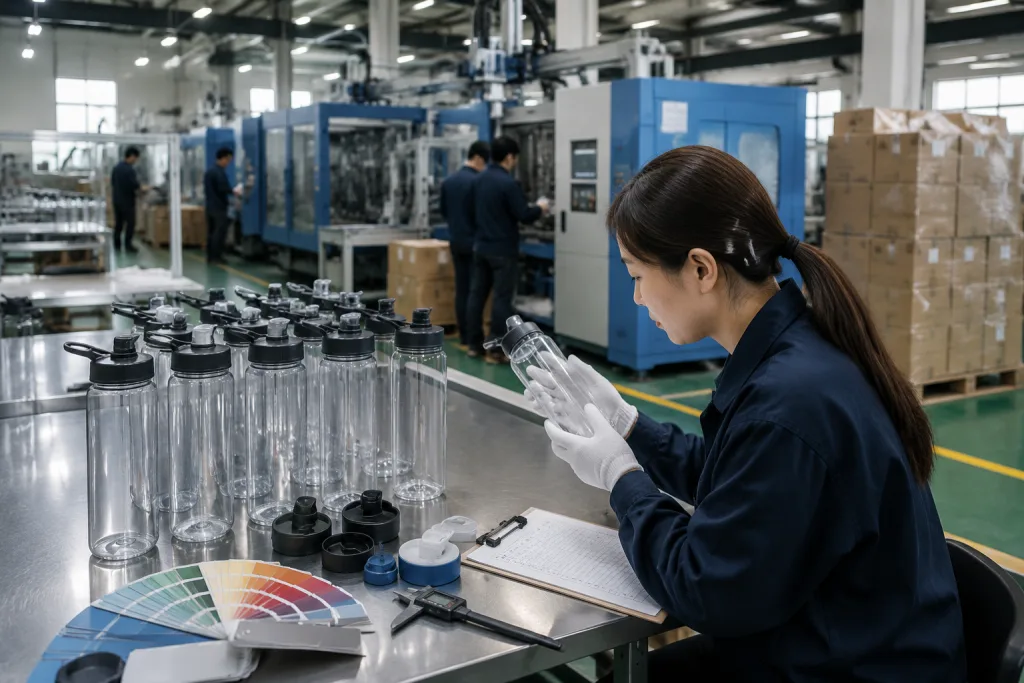
Tritan sells well because it is clear, lightweight, impact-resistant, and BPA-free. For sports, school, office, and canteen promotional programs, it sits between low-cost PP and heavier stainless steel. Still, 6 out of 10 new buyer complaints we see on Tritan are not about the material itself. They come from process control. Poor drying before injection can create haze; we run resin through a dehumidifying dryer before the line starts. Bad gate design leaves stress marks near the base. Loose thread tolerances cause slow leaks that never show up in a beauty photo, but QC pulled the sample after a 30-minute inverted leak test.
When you speak with a canteen manufacturer in China, ask for the production route. Is the body injection molded in-house or sent to another shop 40 km away? Is the lid made in the same workshop? Are silicone seals food-grade and removable with a normal cleaning pick? At BottleForge Industrial in Zhejiang, our monthly drinkware capacity is about 600,000 units across plastic, stainless steel, and glass lines, but we still check each Tritan project against mold availability, color demand, and assembly labor before we put 35 days or 45 days on a PI.
For a custom canteen order, your RFQ should include the intended sales channel, target FOB price, annual forecast, packaging style, and compliance market. A bottle for a gym distributor drinkware program is not the same as a kids’ school bottle or an Amazon FBA launch. We have seen this go sideways when a PO says “blue” but the artwork file calls out Pantone 2925C, then the buyer flags the bulk color after 8,000 bodies are already molded. If the supplier treats all three channels the same, keep asking questions.
Checklist Before You Request Quotes
A loose RFQ gives you loose pricing. Ask 5 canteen vendors for “750 ml Tritan bottle with logo” and the quotes will not line up. One factory may price a 1.8 mm body, one may include a nicer flip lid, and one may leave out the color box. We see this every month. The buyer flagged it only after QC pulled the pre-production sample with a digital caliper. Control the spec first. Then talk price.
Use this RFQ checklist before requesting pricing:
- Capacity: 500 ml, 650 ml, 750 ml, 1,000 ml, or custom cavity volume. State fill line and brim-full volume if your PO uses both.
- Body material: Tritan copolyester, not generic PC or PETG unless approved. Ask for the resin grade on the material sheet.
- Wall thickness: usually 1.8-2.5 mm for common sports bottles. We check the shoulder and base, not just the straight wall.
- Lid type: screw lid, flip straw, push button, carry loop, or shaker insert. The lid decides half the complaint rate.
- Seal: food-grade silicone ring, replaceable if possible. A 0.3 mm loose ring can leak in carton drop testing.
- Logo: silkscreen, heat transfer, UV print, pad print, or laser on metal parts. Send artwork in AI or PDF, not a blurry JPG from WhatsApp.
- Packaging: bulk pack, white box, color box, kraft box, or retail sleeve. Confirm carton quantity and gross weight before booking freight.
- Compliance: FDA, LFGB, REACH, California Prop 65 if required. Tell us the target market before the test lab is booked.
- Inspection: AQL 2.5 for major defects and AQL 4.0 for minor defects. Put it on the PO, not only in email.
If you are a canteen distributor or distributor canteen buyer, state whether you need mixed SKUs. Example: 3,000 units split into 3 colors does not cost the same as 3,000 units in one transparent blue. The math doesn't work. Pigment changeover, print setup, and packing segregation eat line time; on our floor, a color change can add 45-60 minutes before the first good shot is approved.
For canteen customized projects with a new body shape, tooling is the bigger issue. A basic bottle mold may cost USD 3,000-8,000, while complex lids with buttons, springs, and locking parts can cost more than the body mold. Existing mold customization is usually the better first order unless your brand already has confirmed volume. We have seen this go sideways when a buyer paid for a new lid tool, then cut the order from 20,000 pcs to 5,000 pcs after the T1 samples came back.
Material, Compliance, And Claims
Tritan gets sold as “BPA-free,” but that line is too thin for B2B buying. Ask for documents tied to the resin lot, not a generic PDF from last year. For Europe, our buyers usually ask for LFGB and REACH. For the United States, FDA food-contact compliance is standard, and 3 of our retail accounts also ask for California Prop 65 review before artwork approval. Children’s bottles bring ASTM and CPSIA questions into the room. QC pulled one sample last season where the COA lot number did not match the carton label. That stops a shipment fast.
A reliable canteen supplier should state the resin grade, keep incoming material records, and separate approved Tritan from cheaper PC or PETG substitutes on the line. Clear bottles can pass a quick visual check even when the wrong material was fed into the hopper. We run lot labels on each 25 kg resin bag and log them before drying at the injection workshop. Ask for a material declaration and third-party test reports less than 12 months old. For large orders, request pre-shipment testing from SGS, Intertek, TÜV, or Bureau Veritas, with the test sample sealed from bulk production, not hand-picked from a showroom shelf.
Be careful with sustainability claims. Tritan is durable and reusable, but it is still plastic, so “eco-friendly” is the wrong question to ask unless your legal team has evidence behind the claim. If you want customizable drinkware with a stronger sustainability angle, compare the actual brief: Tritan for lightweight clear bottles, stainless steel for insulation, glass for premium retail, recycled-content options only when the food-contact trail is clean. If you ask for recycled Tritan, confirm whether the recycled source is food-contact acceptable in your target market. We have seen this go sideways when a buyer approved green leaf artwork first, then legal rejected the claim 2 days before pad printing.
For customized drinkware programs in Zhejiang and wider China, compliance timing belongs before production, not after the container is booked. A lab migration test can take 7-10 working days after samples arrive, and courier pickup from Hangzhou to the lab can add 1 day if samples miss the 4 p.m. cutoff. If your launch date is fixed, build that into the schedule. We usually reserve 12 bottles from the first-shot sample run for lab submission, buyer retention, and factory QC records. The math does not work if testing starts only after mass production is packed.
Logo And Packaging Decisions
Logo method changes the look and the reject rate. Silkscreen is the cheapest clean choice for one or two solid colors; we run it with a 200-mesh screen on straight or lightly curved Tritan bodies. Pad printing reaches uneven shoulders, but the print field is small, so a 45 mm logo is often the safe limit. Heat transfer gives better shelf graphics, then QC pulls the sample for 3M tape testing after 24 hours. UV printing handles full-color designs, but the math doesn’t work unless the buyer accepts the higher unit cost and a proper abrasion test before approval.
For canteen promotional orders, buyers often ask for the largest logo area. Wrong question. We’ve seen a 120 mm wraparound print on a tapered Tritan bottle distort near the parting line, then scratch during a 500-cycle rub test. A smaller 60 x 80 mm logo on the flattest panel looks cleaner and cuts rejections; last month QC rejected 37 bottles from a 1,000-piece pilot run because the artwork crossed a 1.5 mm curve. If you are building a canteen customizable line for distributors, keep artwork zones consistent across 500 ml, 750 ml, and 1,000 ml sizes so your sales team can reuse templates without redrawing every PO.
Packaging needs the same discipline. Bulk pack is cheapest, often 24-48 units per export carton, with each bottle in a polybag or paper wrap; our line usually checks carton weight under 14 kg so warehouse staff do not complain. Retail color box can add USD 0.18-0.45 per unit depending on paper weight, printing, and inserts. Amazon FBA brings FNSKU labeling, carton limits, and drop-test preparation, and the buyer will flag it fast if the label is 2 mm off the scan zone. A distributor growler or custom growler program needs heavier dividers than Tritan bottles, so copying one carton spec across categories is how we’ve seen shipments go sideways.
Ask for a packaging dieline before mass printing. Simple step. Check barcode size, country of origin wording, recycling marks, choking warnings if applicable, and importer address requirements; one PO typo on “Made in China” forced a buyer to reprint 5,000 boxes. A canteen manufacturer that catches these details before the CTP plate is made saves you from reworking 5,000 printed boxes.
MOQ, Price, And Lead Time
For an existing vendor Tritan water bottle mold, we usually run MOQ at 1,000-3,000 units per color. Some canteen suppliers will take 500 units on stock colors with a one-color logo, but the price moves up because the pad-printing jig, ink mixing, and line change still take about 2 hours. For a private color body, 3,000 units is the cleaner number. For a new lid color with matched silicone ring and retail packaging, expect the supplier to push for 5,000 units or more, since QC will pull color chips from the lid, gasket, and box before mass production.
FOB Ningbo or FOB Shanghai pricing for a common 750 ml Tritan sports bottle usually lands around USD 1.60-3.20. The spread comes from lid complexity, wall thickness, print process, and packaging spec. A simple screw-cap bottle in bulk pack sits near the low end. A flip straw lid with locking button, carry handle, color box, and full-color print sits higher because the line adds spring assembly, leak testing at the cap, and a separate box-packing station. If a quote is USD 0.40 below the market, ask what changed: Tritan resin grade, wall thickness in mm, silicone seal quality, AQL inspection level, or 5-layer carton strength. We have seen this go sideways when the buyer only compared the unit price.
Lead time from Zhejiang or nearby China production hubs is usually 30-45 days after deposit and artwork approval for existing molds. Add 7-14 days if you need lab testing before shipment. Add 25-35 days for new tooling before production samples. Peak season before summer and Q4 promotions can stretch schedules by another 10-15 days because cap assembly and printing lines get crowded; last May, one straw-lid order waited 6 extra days because the UV printer queue was full and QC pulled the first sample for a crooked logo.
Payment terms for new B2B buyers are commonly 30% deposit and 70% before shipment. Larger repeat accounts may negotiate different terms after several clean orders, usually after 3-5 shipped POs with no overdue balance or carton claim. If you are a canteen distributors group consolidating orders, tell the factory your annual forecast. The math does not work if every branch sends a separate 600-unit PO with different artwork files and a typo in the color code. Factories plan resin purchasing and mold time better when they can see more than one PO.
Factory Checks Buyers Should Not Skip
A clean pre-production sample is not proof that the line can repeat it. It is one bottle made while everyone is watching, often with the senior technician standing beside the injection machine. The real test is whether 10,000 pieces come out within the same color, logo, and fit range. Put those limits on the purchase order before the deposit. We have seen this go sideways when the PO only said “same as sample” and QC later had no mm tolerance to hold against.
For Tritan bottles, we check body clarity, color tolerance, odor, logo position, lid torque, silicone seal placement, straw length, thread smoothness, and leakage. On our line, QC fills the bottle to 95%, inverts it on a white tray for 30 minutes, then checks the cap thread and silicone ring with a 0.1 mm feeler gauge if seepage appears. A tougher test adds shaking, side pressure, and hot-water exposure if the product claim allows warm drinks. Do not print boiling-water resistance on the carton unless the lid, seal, and body all passed that test. The math doesn’t work if marketing promises 100°C and the cap deforms at 85°C.
Use AQL inspection for finished goods. Common settings are General Inspection Level II, AQL 2.5 major, AQL 4.0 minor, with critical defects not accepted. Major defects include leaking, wrong logo, cracked body, missing seal, sharp burrs, and non-scannable barcode. Minor defects include small scuffs, light print dust, or slightly uneven packaging within agreed limits. Last month QC pulled the sample from a 5,000 pcs run and found 7 cartons with barcodes that scanned on WeChat but failed on the buyer’s Zebra scanner, so define the scanner standard early.
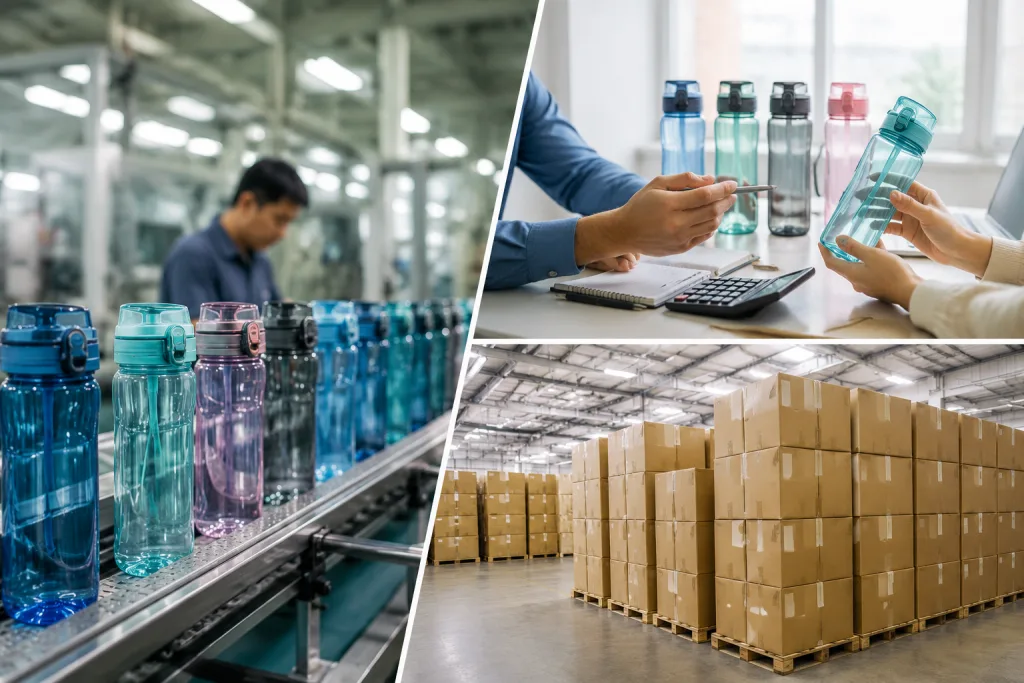
If you cannot visit China, request a factory audit or at least a video walk-through of injection molding, printing, assembly, and packing. Ask them to show the dryer temperature panel, the printing jig, the torque test, and the packing table, not just the showroom wall. BSCI, ISO 9001, or Sedex documents help, but they do not replace product-specific control. A canteen factory may be socially compliant and still weak at Tritan drying, printing adhesion, or cap assembly. We have had buyers flag this after seeing moisture streaks near the bottle shoulder on first-shot samples.
Cheap inspection only feels expensive before the shipment leaves Ningbo. A third-party final inspection on a 5,000-unit customized canteen order often costs less than one rejected pallet in your warehouse.
How To Compare Supplier Answers
Compare canteen manufacturers by the way they answer, not by the lowest FOB line. This is the wrong question to ask first. A serious canteen supplier will ask your sales channel, FDA or LFGB target, carton style, annual volume, and logo process before quoting; last week we held a quote for 2 hours because the buyer’s PO said “Tritan” but the artwork file called out “PC.” A weak supplier sends a price in 10 minutes, then tries to fix the mold line, color tolerance, and packing spec after the sample is already on the table.
Ask each canteen vendor for the same six items: product drawing or spec sheet, material declaration, recent test report, MOQ by color, sample lead time, and mass production lead time. Then ask what they exclude. Good question. We have seen quotes miss inner boxes at USD 0.18 each, spare straws, FNSKU labels, 1.2 m drop testing, and AQL 2.5 inspection support; QC pulled one sample where the silicone ring was 0.4 mm too thin, and nobody had priced the replacement gasket. Those “small” gaps become surprise costs after your buyer has approved the line.
If you also source customizable canteen, customized growler, customizable growler, custom growler, or distributor growler products, check whether the factory makes those categories on its own line or buys them from 2 or 3 outside workshops. Trading is not a crime. You just need to know who owns the mistake when a powder-coated growler scratches at 500 cycles on the abrasion tester or a Tritan bottle cap fails torque at 18 kgf·cm. For mixed custom drinkware programs, one coordinated supplier can keep carton marks and QC files consistent, but the math does not work if a general trader cannot read a mold drawing or spot a bad ultrasonic weld.
BottleForge Industrial works from Hangzhou, Zhejiang with China-based partner workshops for processes we do not keep under one roof. We say that up front. On our side, we run Tritan injection, logo sampling, and packing checks through one project file, then assign outside jobs like special coating only when the spec needs it; the buyer still gets one carton layout, one inspection standard, and one shipping plan. Choose canteen suppliers who explain limits before production starts, not after 3,000 pcs are sitting in the warehouse with defects.
Send Your Tritan Bottle Specs For Review
Share capacity, logo, quantity, market, and target FOB price. We will flag cost risks before you place the purchase order.
Frequently asked questions
What MOQ should I expect for a vendor Tritan water bottle?
For existing molds, expect 1,000-3,000 units per color for most Tritan bottles. If you use a stock transparent body and one-color logo, some suppliers can do 500 units, but the price may increase by USD 0.20-0.50 per unit. Private PMS body colors, custom lids, or retail color boxes usually need 3,000-5,000 units. New mold projects should be planned around higher volume, often 10,000 units or more over several orders, because tooling costs can run USD 3,000-8,000 for a body and more for complex lids.
Is Tritan better than stainless steel for promotional canteen orders?
Tritan is better when you need clear appearance, light weight, lower freight cost, and a lower FOB price. A 750 ml Tritan bottle may price around USD 1.60-3.20 FOB, while stainless vacuum bottles usually cost more because of double-wall construction and 304 stainless steel. Stainless steel is better for hot or cold insulation, premium gifting, and long-term durability claims. For canteen promotional programs, Tritan works well for gyms, schools, events, and outdoor campaigns where cold water use is the main function.
How long does sampling and production take from China?
For an existing mold, plain samples can be ready in 3-7 days. Custom logo samples usually need 7-12 days after artwork confirmation. Mass production is commonly 30-45 days after deposit and sample approval, depending on color, lid complexity, packaging, and order quantity. If you need third-party testing, add 7-10 working days after samples reach the lab. New tooling adds about 25-35 days before you can approve the first production sample, so do not schedule a fixed retail launch around an untested new mold.
What tests should I require before shipment?
At minimum, require food-contact documentation for your market, a functional leak test, print adhesion test, barcode scan check, and final AQL inspection. For Europe, ask about LFGB and REACH. For the US, ask about FDA food-contact and Prop 65 if your channel requires it. During final inspection, use AQL 2.5 for major defects and AQL 4.0 for minor defects under General Inspection Level II. If the bottle claims dishwasher safety or warm-water use, test those claims before printing them on packaging.
Can one supplier handle Tritan bottles, custom canteen, and growlers?
Yes, but ask whether the supplier manufactures each item or coordinates with partner factories. A canteen manufacturer may be strong in Tritan injection molding but outsource stainless custom growler production. That can still work if responsibility, QC standards, and shipment consolidation are clear. For a mixed customized drinkware order, ask for separate spec sheets, separate AQL defect lists, and a combined packing plan. Do not assume a supplier good at plastic bottles automatically controls stainless welding, powder coating, or glass bottle annealing to the same standard.