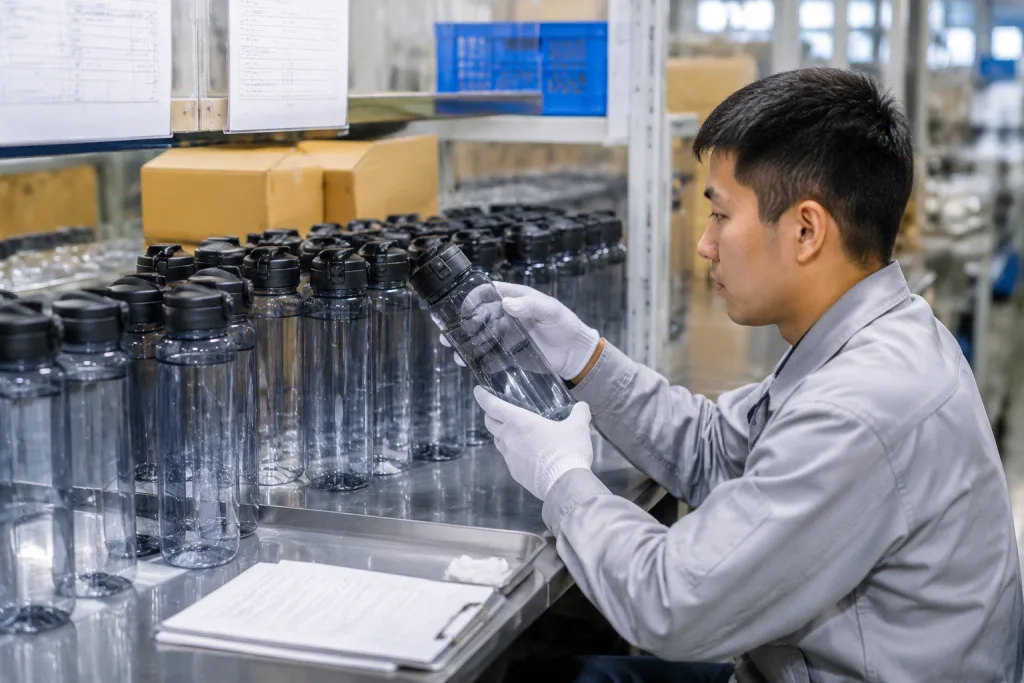
Key Takeaways
- Set Tritan bottle MOQ expectations at 3,000 pieces per color for stable pricing and color control
- Require 100% leak testing on flip lids, straw lids, and push-button caps before carton packing
- Use AQL 2.5/4.0 inspection with drop, torque, print adhesion, and odor checks written into the PO
- Specify Eastman Tritan grade, REACH/LFGB/FDA test scope, and logo process before paying mold or deposit
A vendor tritan bottle project looks simple on the quotation sheet: capacity, lid type, color, logo, carton size, FOB port. Then the first production run shows where the spec was thin. Lids seep after air shipment because the silicone ring sits 0.3 mm proud. The printed logo scratches when a buyer’s merch team rubs it with a coin during retail handling. Color lots miss the approved sample under a D65 light box. The carton fails a 76 cm drop test before your distributor drinkware order leaves China.
Asking for a “good quality bottle” is the wrong question to ask. Write down the failure modes. At BottleForge Industrial in Hangzhou, Zhejiang, we treat Tritan bottles as engineered promotional products, not catalog toys. Our Zhejiang production partners run 180,000 to 260,000 plastic drinkware units per month, with typical MOQ from 3,000 pieces per color and 30-45 day mass production lead time after approval sample. QC pulled the sample on one 5,000 pcs order last quarter because the PO said “blue lid,” while the approved sample used Pantone 2925C; that kind of small typo is how projects go sideways.
The material fails before the brand does
The first failure mode is often invisible. A buyer asks for a clear canteen custom bottle, gets a clean pre-production sample, then treats every transparent copolyester as equal. Wrong starting point. Tritan is a branded copolyester family, and we still see China quotes using “Tritan-like” resin when the buyer pushes the target down by USD 0.08-0.12 per piece. On the line, QC pulled a 750 ml sample last year that looked fine under the light box, but the hot-water odor check failed after 2 hours at 70°C. That kind of swap brings odor complaints, weaker impact results, cloudy walls, or failed EU food-contact testing.
Your purchase order should name the resin grade or at least state “Eastman Tritan, BPA-free, no recycled content unless approved in writing.” Put it in the PO, not only in the email thread. We have had a buyer send a PO with “Titan bottle” typed in the material field, and the supplier used that typo to argue later. For Europe, ask for LFGB, EU 10/2011 migration, and REACH SVHC documentation. For the United States, FDA food-contact compliance and California Proposition 65 screening depend on the sales channel. A generic “BPA free” PDF from three years ago is not proof; the math does not work if one rejected container costs more than the resin upgrade.
Wall thickness matters. For a 650-750 ml vendor tritan bottle, we normally run 1.8-2.3 mm body wall thickness depending on bottle geometry, checked with a digital thickness gauge at the shoulder, waist, and base. Below 1.5 mm, the bottle can pass a quick hand squeeze but crack around the shoulder or base after a 1.2 m drop test. If you are buying customized drinkware for schools, gyms, or outdoor retail, specify drop testing at room temperature and after 4 hours at 0-5°C. Cold impact is where cheap resin and thin walls stop pretending.
The practical rule is simple: if the canteen supplier cannot state resin source, wall thickness range, and test standard on the quotation, the attractive unit price is not a real price yet. We ship bottles, not excuses.
Lids leak for boring reasons
About 7 of 10 Tritan bottle complaints we see start at the cap, not the bottle body. Flip lids and straw lids fail in different ways; screw caps and push-button lids have their own weak spots. A flip lid can pass the counter sample, then seep after the silicone gasket takes a set during 20 days in a container. QC pulled one 650 ml sample last season where the vent hole leaked only when the bottle sat flat for 15 minutes. A push-button lid is worse. If the spring tolerance is loose by 0.2 mm or the lock tab is too soft, the buyer finds it open inside a backpack.
Do not ask a canteen vendor if the bottle is “leakproof.” That is the wrong question. Ask how they test it on the line. For mass production, we run 100% water leak testing on assembled bottles, not a few random checks from a carton. The operator fills each bottle to 80-90% capacity, tightens it to the approved torque with a torque meter, turns it upside down, shakes it for the set time, and bins any cap with seepage. For retail programs with a hangtag and barcode, we add a vacuum or pressure test on samples by lot.
Torque gets skipped because it sounds boring. Then the math doesn't work. A screw lid that needs too much force feels cheap to consumers, while a loose thread leaks in transit. Your spec can state a cap closing torque range, for example 8-12 kgf·cm for a mid-size screw lid, adjusted by lid diameter and gasket design. We confirm this with production samples using the same PP cap, same silicone ring, and the actual mold cavity, because mold polish and gasket hardness can shift the final feel after the first 3,000 shots.
Name the gasket material on the PO. Food-grade silicone is the safe default; TPE shows up in lower-cost lids but needs separate migration testing. We have seen this go sideways when a buyer approved “same as sample” but the PO typo left the gasket blank, and the subcontracted lid supplier changed material to save cost. For a canteen promotional order going to supermarkets or corporate wellness programs, a 2-cent gasket saving is not worth a 3% return rate.
Decoration breaks the illusion first
Logo decoration is usually the first place a custom Tritan bottle starts looking cheap. Photos hide it. Shelf handling does not. Tritan has a smooth, slightly springy surface, so ink bite is tougher than on powder-coated stainless steel. On our line, QC once pulled 32 samples after the logo flaked near the thumb grip during carton drop handling. A retail canteen should not lose its mark after 7 days on a warehouse rack or one dishwasher cycle, unless the hangtag and PO both say hand wash only.
The main choices are silk screen printing, pad printing, UV printing, heat transfer, and sleeve inserts. Silk screen works for 1-color or 2-color logos on straight walls; we run a 120T mesh for most Tritan jobs. Pad printing is better for small curved panels, like a 35 mm logo under the shoulder. UV printing gives sharper gradients, but pretreatment, lamp power, and belt speed need to be locked before mass production. Heat transfer looks nice in a sample room, but we have seen edges lift when the bottle radius drops below about 45 mm. The buyer flagged it after only 18 hours in a warm display box.
Put the print test in the order. Do not leave it as “logo must be durable.” That line is useless during inspection. Use clear checks: 3M tape adhesion test after 24 hours, 50 rubs with a dry cloth, 20 rubs with 75% alcohol if the use case requires it, and dishwasher testing only if the factory claims dishwasher safety. For race-event customized canteen units, hand-wash-only can pass if the buyer accepts it in writing. For a national retailer, the math does not work. Returns on 5,000 bottles cost more than the print upgrade.
Color matching causes another quiet failure. Pantone matching on translucent plastic is not the same as printing on white paper. For transparent smoke, blue, amber, or frosted bottles, ask for resin color chips and set the production color tolerance under a D65 light box. For orders above 10,000 pieces, we advise sealing one approved color plaque and one assembled golden sample. Keep that sample at the canteen factory until final inspection. We have seen this go sideways when the “approved” bottle disappeared into a salesperson’s drawer, then the final batch came out 2 shades warmer.
Molds punish vague drawings
A custom canteen or customizable growler usually needs more than a logo. The buyer asks for a new waist curve, soft grip ribs, 50 ml graduation marks, a carry loop, or their own lid thread. This is where loose sketches get expensive. A Tritan injection or blow mold is not a style board. It is a steel tool we run on the line, and it has to survive shrinkage, parting lines, ejector pin marks, thread fit, and the 1.2 m drop test QC will ask for before shipment.
For a new bottle body, ask the canteen manufacturer for 2D drawings and 3D files before tooling. Confirm capacity to the fill line and brim capacity as two separate numbers. A “750 ml bottle” could mean 750 ml usable capacity or 750 ml to the very top. The buyer flagged this on a Walmart-style spec sheet once because the PO said 750ML, but the artwork file said 700ml fill line. Bad start. Consumers get angry when powder, ice, and water overflow on the first shake.
Graduation marks need special attention. Molded marks last, but they can disappear on smoke gray Tritan. Printed marks read better, but MEK rub testing can pull weak ink in 30 seconds. If the bottle is for fitness, nutrition, or kids’ use, ask for a legibility check after decoration and after carton packing. QC pulled the sample under a 600 lux inspection lamp last month, and the 100 ml line was half-hidden by the sleeve seam. For a custom growler or customized growler in Tritan, confirm cold beverage use only. Hot-fill use can deform plastic, and this is the wrong place to gamble with liability.
Tooling cost varies widely. A simple modified lid insert may cost USD 800-2,000. A new bottle body mold can run USD 6,000-18,000 depending on cavities, size, texture, and steel. Lead time is usually 20-35 days for tooling plus sample adjustment; on our floor, first T1 samples take about 12 days for a lid insert versus 28 days for a full 2-cavity body mold. If a canteen vendor promises a complex new mold in 7 days at a suspiciously low cost, the math does not work. You are likely getting a soft trial tool, not a production-ready mold.
Packaging damage is still your defect
Buyers sometimes relax once the bottle passes AQL 2.5, then the damage shows up in the carton. Wrong question. The bottle is only one part of the delivered product. We had QC pull 32 Tritan samples after a 4-hour vibration test on the carton shaker; the bodies were fine, but 7 flip lids had rub marks and 3 printed logos were scuffed from straw spouts pressing through thin bags. Tritan takes impact well. Lids, carry loops, silicone straws, and printed panels do not like compression during 18 days on the water.
Lock the packing method before the sample sign-off, not after mass production starts. We run the usual export pack as 1 bottle per polybag or tissue wrap, with an egg-crate insert or inner box when the lid has a raised loop, then 24 or 48 pieces per master carton. For retail, use an individual color box with 250-350 gsm paperboard for most mid-size bottles; 230 gsm looks cheaper on the quote sheet, but it crushes when 5 cartons are stacked on the pallet. For heavier shipments, we spec 5-ply corrugated master cartons and confirm edge crush strength if the buyer’s warehouse stacks pallets above 1.8 m.
Drop testing has to match the sales channel. For e-commerce and Amazon-style fulfillment, we use a 76 cm carton drop on faces, edges, and corners, then QC checks lid opening force, surface scuffing, and whether the barcode still scans on a Zebra handheld scanner. If FNSKU labels are required, confirm the exact placement and the scan rate, and write whether the label goes on the color box, polybag, or master carton. We have seen this go sideways: one distributor drinkware order needed 12,000 units relabeled by hand because the PO said “label on box” and the buyer meant the color box, not the outer carton.
Carton marking is part of the product handover, not decoration. PO number, SKU, color, quantity, gross weight, net weight, carton size, country of origin, and handling marks all reduce receiving mistakes; one typo in the SKU on a master carton can stop a full pallet at the buyer’s DC. If we ship FOB Ningbo or Shanghai from Zhejiang, we align carton dimensions with the pallet plan before production starts. Oversized cartons can turn a 12-day air shipment into ugly math when dimensional weight is billed at 167 kg per CBM.
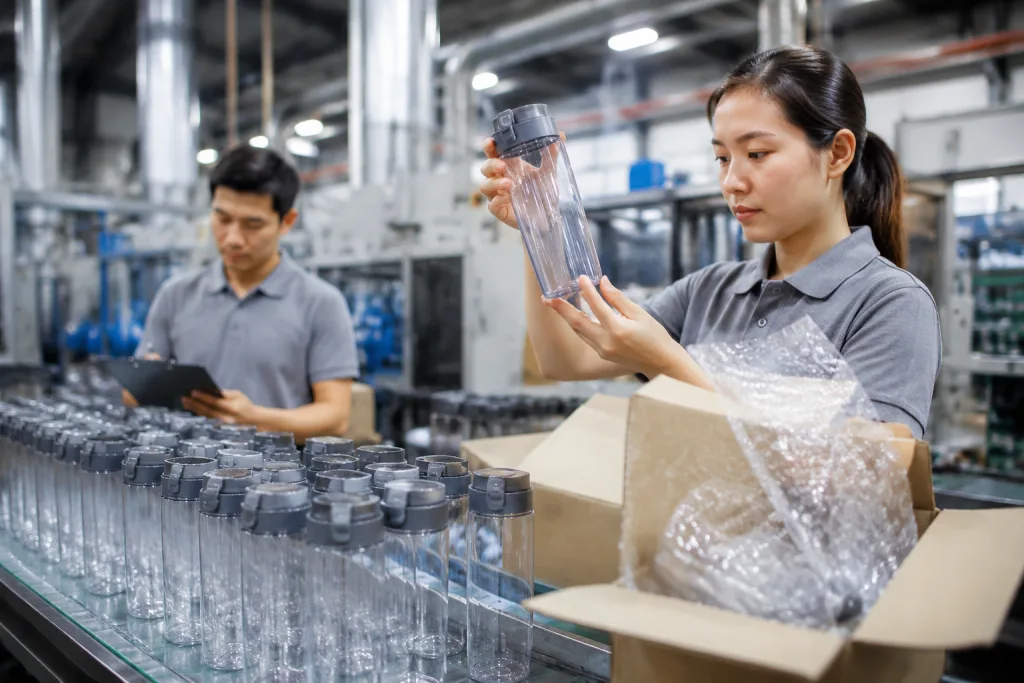
Inspection must chase real risks
A final inspection that only counts cartons is just carton counting. For a vendor tritan bottle order, we run the checklist against the defects that actually cost money: resin mix-up, leaks, lid bite, color drift, weak print, loose assembly, odor, crushed export cartons, and wrong paperwork. QC pulled a sample last month where the PO said “clear smoke” but the color board was marked “smoky grey”; AQL would not catch that unless the inspector checks documents against the signed sample.
For most B2B custom drinkware orders, AQL 2.5 for major defects and 4.0 for minor defects is a practical baseline. Critical defects should be zero tolerance. Critical means sharp plastic flash within 3 mm of the drinking mouth, black specks inside the bottle, wrong material, a 30-second inverted leak test failure, or broken parts that can cut a user. Major defects include a logo shifted 2 mm outside the approved artwork position, cap malfunction, serious scratches, wrong Pantone family, or unreadable barcode. Minor defects include small flow marks, slight carton scuffs, or color shade variance if the signed tolerance card allows it. The wrong question is “Did it pass AQL?” Ask which defects were found, where they were found, and whether the line already corrected them.
Do not wait until final inspection to find the mess. Ask for inline photos at resin drying, molding, lid assembly, printing, and packing. For orders above USD 20,000, we advise at least one during-production check when 20-30% of goods are completed. At the molding machine, a resin dryer set 10°C too low can leave moisture marks that look small at first and spread across 8,000 bottles before lunch. That check gives the canteen suppliers time to adjust barrel temperature, gasket seating, or pad-print pressure before every unit is sealed in a polybag.
Factory audits matter, but read them like a buyer, not like a certificate collector. BSCI, ISO 9001, or Sedex reports are useful, especially for European and North American brand owners. They do not prove your gasket will hold after the cap has been opened 50 times. A good canteen factory in China should match compliance documents with product-specific QC records: leak test logs, 3M tape print adhesion records, incoming material checks, and final inspection reports. We have seen this go sideways when the audit was clean but the lid torque was off by hand feel on the packing table. Compliance keeps you eligible to sell; process control keeps consumers from returning the bottle.
Quotations hide expensive assumptions
The lowest quote for canteen customizable products is often the one with 6-10 blank assumptions hiding inside it. Before you compare canteen manufacturers, put every quotation on the same spec sheet. We run this check line by line: Tritan resin grade, actual brim-full capacity in ml, lid structure, silicone gasket hardness, wall thickness in mm, logo process, color count, inner bag and carton packing, test items, certificates, incoterm, payment terms, and production lead time. Small details bite. Last month QC pulled a 650 ml sample that measured 612 ml on the beaker, while the PO said “600-750 ml assorted,” which is not a spec a factory can price cleanly.
Typical FOB China pricing for a 600-750 ml Tritan bottle with standard lid and one-color logo may range from USD 1.20-2.40 depending on resin, lid complexity, order quantity, and packaging. Add USD 0.15-0.60 for retail color box packaging. A straw lid with 5 molded parts, a time marker print, a silicone boot, or a stitched carry strap pushes cost up because the line needs extra assembly and 100% visual checking at packing. For a customized drinkware launch, sample cost is usually USD 50-150 for existing molds and more if special printing plates, color matching, or prototype tooling is needed. The math doesn't work when a buyer asks for a 750 ml Tritan bottle, Pantone-matched lid, color box, LFGB test, and USD 0.95 FOB on a 1,000 pcs trial order.
Payment terms shape risk on both sides. A common structure is 30% deposit and 70% balance before shipment after passed inspection. For repeat canteen distributors with stable volume, terms can improve after 2-3 clean shipments, but first orders should stay disciplined. If you are a canteen distributor building a seasonal program, lock the approval sample, carton artwork, AQL 2.5 inspection standard, and shipment date before deposit. We have seen this go sideways: the buyer changed the carton barcode after mass production started, 86 cartons needed re-labeling, and shipment moved from 12 days to 18 days.
A strong canteen supplier will push back on unrealistic specs. That is not bad service. If your target is a dishwasher-safe, full-color, retail-boxed, certified Tritan bottle at USD 0.85 FOB, the honest answer from Zhejiang, China should be “not at that quality level.” We ship containers out of Ningbo every week, and failed assumptions are more expensive than honest pushback. You want that answer before your purchase order, not after 3,000 bottles come back with cracked lids and a buyer flagged it in a store audit.
Send us your Tritan bottle spec before RFQ
BottleForge will review resin, lid, logo, packaging, MOQ, and QC risks before you commit to a production schedule.
Frequently asked questions
What MOQ should I expect for a vendor Tritan bottle order?
For an existing mold, a realistic MOQ is usually 3,000 pieces per color, with better pricing from 5,000-10,000 pieces. Some canteen suppliers will accept 1,000 pieces, but expect higher unit cost, limited color options, and less leverage on custom packaging. If you need a special resin color, Pantone-matched lid, silicone boot, or retail box, 3,000 pieces is a safer starting point because material batching and printing setup become more stable. For a new custom canteen mold, the MOQ often moves to 10,000 pieces or more because tooling, sampling, and production setup need to be amortized. Ask whether MOQ is per color, per lid style, or per total order; this is where many quotations become misleading.
Can Tritan bottles be dishwasher safe?
Some Tritan bottle bodies can tolerate top-rack dishwasher use, but the complete product may still fail because of the lid, gasket, print, or strap. You should not claim dishwasher safe unless the assembled bottle passes testing under realistic conditions. A practical test is 20-50 dishwasher cycles with checks for warping, cracking, odor, lid fit, and logo adhesion. Heat transfer and some UV prints may deteriorate faster than molded parts. Straw lids with small components are also more vulnerable. If your product is canteen promotional merchandise for short-term use, hand-wash-only labeling may be acceptable. If it is retail customized drinkware, make the factory prove the claim before you print it on the box.
How do I compare canteen vendors when all samples look similar?
Cut one sample apart and test the rest. Measure wall thickness at the body, shoulder, and base. Weigh the bottle and lid separately; a 15-25 g difference can reveal material savings. Fill it, invert it, shake it, and leave it on its side for 4 hours. Do a 1.2 m drop test on the base, shoulder, and lid area. Rub the logo with tape and alcohol if decoration durability matters. Ask each canteen vendor for resin documentation, AQL standard, leak test method, and production lead time. Similar-looking samples can come from very different process controls. The best canteen manufacturer is not always the one with the nicest sample; it is the one that can repeat that sample 10,000 times.
What certifications do European and North American buyers usually need?
For Europe, buyers commonly request LFGB food-contact testing, EU 10/2011 migration, and REACH SVHC documentation. For North America, FDA food-contact compliance is the baseline, and Proposition 65 review may be needed for California sales. If the bottle is for children, ask about relevant child safety requirements, age grading, and small parts review; some programs may require ASTM-related checks depending on product design and market. Factory-level audits such as BSCI, Sedex, or ISO 9001 help with responsible sourcing and process control, but they do not replace product testing. For each canteen customized project, define the exact test scope by market before production, because testing after shipment is too late.
How long does a customized Tritan canteen order take?
For an existing mold with standard logo printing, plan 7-12 days for sampling after artwork confirmation and 30-45 days for mass production after sample approval and deposit. Add 5-10 days if you need Pantone resin matching, retail box proofing, or several lid color combinations. A new mold can add 20-35 days for tooling and first samples, plus time for adjustments. Sea freight to Europe or North America often adds 25-40 days depending on port and season. If you are buying as canteen distributors for a promotion date, work backward from the event and keep at least 15 days of buffer for inspection, rework, customs, or vessel delays.