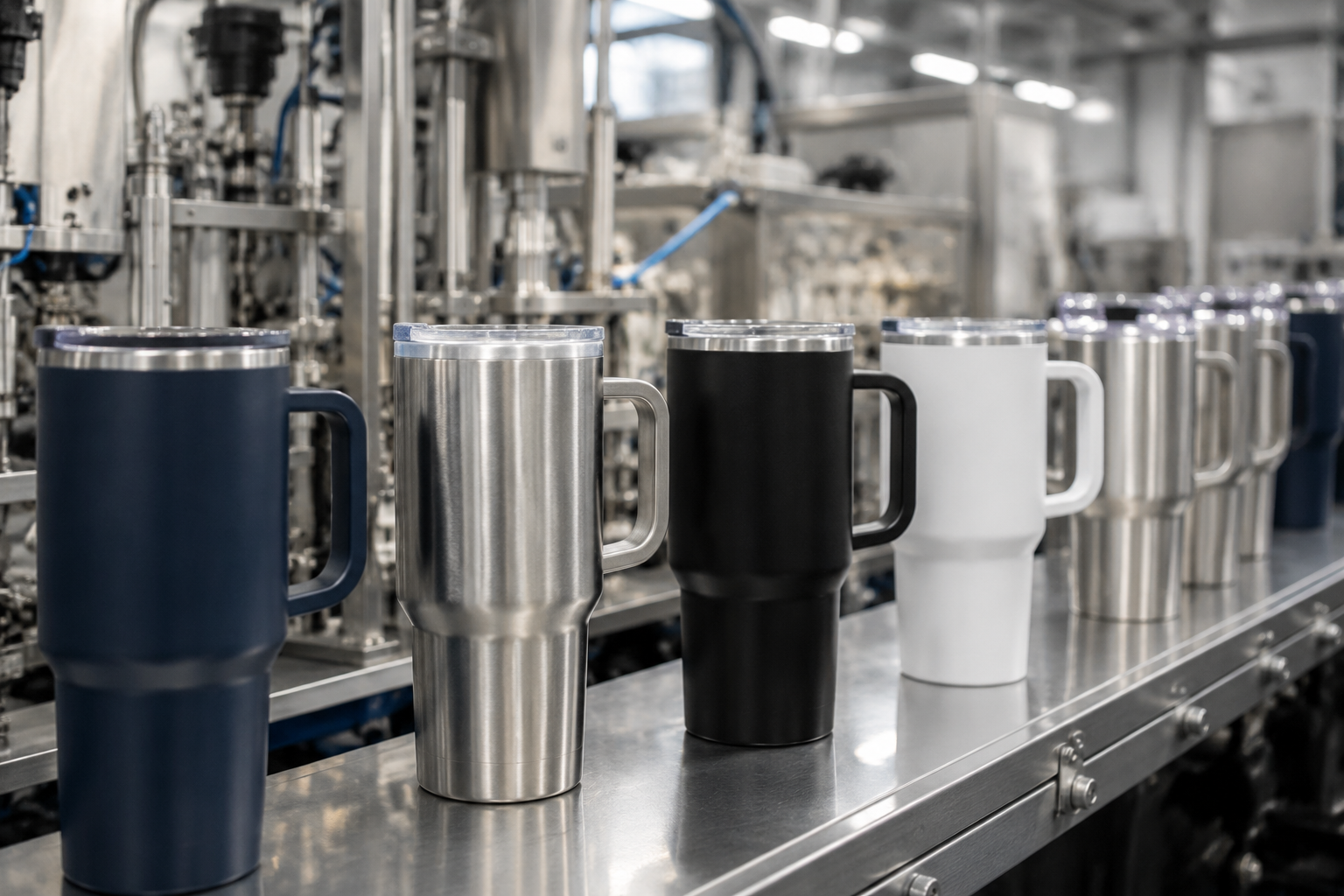
Key Takeaways
- A practical MOQ for a custom 20 oz vendor travel tumbler is usually 3,000 units per color
- 304 inner stainless, 0.45-0.55 mm wall thickness, and 6-12 hour heat retention are realistic commercial specs
- Laser engraving is stable for 3,000-unit logo runs; full-wrap print needs tighter artwork control
- AQL 2.5/4.0 inspection and 25-35 day production lead time should be written into the PO
A vendor travel tumbler looks simple on a quote sheet: capacity, stainless steel, logo, carton size, FOB price. That is where orders get messy. A 20 oz tumbler can mean 201 stainless outside, 304 inside, 0.38 mm thin-wall body, powder coat that chips after 48 hours in a cross-cut tape test, and a weak 300 gsm white box. Or it can be built clean enough for a coffee brand to sell beside roasted beans without the buyer sending us 37 photos of scratched lids.
If you buy for corporate gifts or coffee retail, read the spec sheet like the line will read it. BottleForge Industrial in Hangzhou, Zhejiang works with buyers sourcing from China who need 3,000 to 80,000 units per order, not one polished sample that falls apart when we run 12,000 pcs on mass production. We’ve seen this go sideways: the PO says “black lid,” the sample room made smoke gray, and QC pulled the sample before packing because the buyer flagged it on the approval PDF.
Capacity is not just ounces
The first spec line is usually capacity: 12 oz, 16 oz, 20 oz, 24 oz, or 30 oz. For a coffee brand, that number decides shelf height, cup-holder fit, master-carton size, freight cost, and whether the buyer gets returns after launch. A 20 oz vendor travel tumbler is still the safer North America choice because it works for drip coffee and iced coffee without looking like a protein shaker. In Europe, 12 oz and 16 oz usually sell better for commuters; last quarter one buyer flagged a 24 oz sample because it stuck 38 mm above their retail shelf divider.
Ask whether capacity is measured to the brim or to a practical fill line. This is the wrong question to skip. A 600 ml tumbler filled to the absolute rim is not a 600 ml drinking experience. We run 20-30 mm headspace for hot liquid, especially when the lid uses a sliding closure, and QC checks it with a simple depth gauge before the pre-shipment sample is sealed. If your product page says 20 oz but customers can only carry 17 oz safely, complaints will land fast.
For bulk coffee mug programs, carton efficiency matters. A tapered 20 oz tumbler may pack 24 pcs per master carton, while a straight-wall model may only pack 20 pcs because the belly diameter eats space. That difference can move ocean freight by 8-15% on a full container, which wipes out a cheap unit price faster than buyers expect. We have seen this go sideways when a distributor approved a 91 mm base without checking the carton drawing, then asked why the CBM jumped on the PI.
For BottleForge Industrial projects in Zhejiang, our standard MOQ for a new color on a travel tumbler is 3,000 pcs, with trial orders sometimes starting at 1,000 pcs for existing stock colors. If you are comparing a coffee mug supplier list, make every vendor quote the same usable capacity, not just the same marketing ounce size. On one PO, the buyer typed “20 oz” in the item name but 580 ml in the spec table; we stopped the line before powder coating because the math did not match.
Steel grade and wall thickness
The stainless line needs a real grade, not just “stainless.” For a coffee mug custom made for retail or corporate gifts, we usually spec SUS304 on the inner wall, also written as 18/8 stainless steel. It holds up better against coffee acidity, milk residue, and repeated dishwasher-style washing in our 60°C rinse test tank. The outer wall can be SUS201 when the buyer is chasing cost, and we run plenty of those orders. For premium private label jobs, 304 inside and 304 outside is the cleaner choice; last month QC pulled 6 samples from a 3,000 pcs pilot run and the buyer flagged the 201 outer as “too light” before we even packed the cartons.
Wall thickness is where cheap quotes hide. For a bulk travel tumbler, 0.45-0.55 mm stainless steel is common for the inner liner and outer shell. Go thinner and you might save USD 0.08-0.18 per unit, but dent resistance drops fast; our line has seen 0.38 mm shells pick up flat spots from a normal drop into the assembly bin. Not worth it. Go heavier and the tumbler feels more retail, but carton weight and material cost climb. If your target is a promotional giveaway, 201 outer / 304 inner with 0.45 mm wall may be acceptable. If your target is coffee shop retail at USD 18-25, 304/304 with 0.50 mm or higher is safer.
Vacuum performance depends on forming, welding, cleaning, and vacuum sealing, not steel grade alone. A decent double-wall travel tumbler should keep water above 50°C after 6 hours when tested from a 95°C starting temperature at room temperature. We test with a digital probe, 3 pcs per color, after the vacuum oven and before final packing. Some shapes can reach 8-12 hours, but the big-number claims get buyers into trouble. Wide-mouth tumblers lose heat faster than narrow-neck bottles; this is the wrong spec to compare by brochure headline only.
As a coffee mug factory in China, we write the exact steel grade, thickness range, and heat-retention test method into the quotation. It prevents the classic argument where the buyer expected retail-grade goods and the factory quoted a thin promotional shell. We have seen this go sideways over one missing line on a PO: “304 inner” was written, “outer 201” was not, and the buyer’s incoming inspection used a handheld XRF gun on 20 pcs before releasing payment.
Lids decide complaint rates
The lid is usually where a vendor travel tumbler program starts leaking money. Buyers spend 40 minutes approving PMS color and logo size, then sign off a stock lid after one photo. Bad move. For coffee use, we run food-grade PP or Tritan lids with a removable silicone gasket, normally checked with a simple pull test and caliper on the gasket groove. If the gasket is glued in, buried under the slider, or molded too soft, QC pulled samples will smell sour after 3 rounds of latte testing.
Say the leakage grade clearly. This is the wrong question to ask: “Is it leakproof?” Ask whether it passes upright splash testing or sideways bag testing. A sliding lid on a 20 oz tapered tumbler works for a desk, car cup holder, or conference tote kept upright. It should not be sold as safe for a backpack with hot coffee. We’ve seen this go sideways: one buyer used “100% leakproof” on Amazon, then got 27 complaints in the first week because the lid was splash-proof, not sealed.
For corporate-gift buyers ordering coffee mug promotional products, lid consistency matters because recipients throw away care cards. We test lids for fit, opening friction, gasket seating, and visual defects during pre-shipment inspection; the line uses a go/no-go sample and QC checks slider force by hand when the port feels loose. AQL 2.5 for major defects and AQL 4.0 for minor defects is a realistic standard. For higher-risk lids, add a functional check on 100 pcs per batch, especially if the buyer already flagged lid wobble on the PP sample.
If you plan repeat orders, ask whether the same lid mold will stay available for at least 12 months. A coffee mug private label program looks messy when the second order has a 1 mm wider drinking port or a lid shade that reads grey instead of black under warehouse lights. Factory-direct sourcing from Zhejiang can control this, but the spec sheet must name the lid code, material, color, and gasket hardness. We also write the lid code on the PI; one PO typo turned LID-23B into LID-23R, and the math did not work after 3,000 pcs were packed.
Surface finish changes the job
Powder coating, spray painting, mirror polishing, matte polishing, and electroplating do not run the same on the line. For a coffee mug customizable for brand retail, we usually push powder coating over basic spray paint: better hand grip, cleaner shelf feel, and laser engraving comes out sharper. But powder coating is less forgiving. If the pretreatment tank is dirty or the cup leaves the ultrasonic washer with oil near the weld seam, QC will pull samples for pinholes, orange peel, or peeling around the rim.
For a bulk coffee tumbler, standard powder thickness is often around 60-90 microns. Go too thin, and the stainless edge starts showing after 2-3 handling tests with a cotton glove and tape pull. Go too thick, and a push-on lid can feel tight once coating creeps into a 0.2 mm rim tolerance. Mask the rim. Control it. If your brand color is a Pantone matte beige or dark forest green, ask for a pre-production sample under D65 light; approving from a screen image is the wrong shortcut, and we have seen it go sideways.
Laser engraving is the cleanest logo option for 304 powder-coated tumblers. It holds up, runs fast, and the math works from 500 pcs upward because the laser jig only needs one setup. Single-color silk screen works for simple coffee mug promotional logos, especially 1-position marks under 55 mm wide. Full-wrap heat transfer or UV print can look sharp for corporate gifting, but tapered bodies need corrected artwork; the buyer flagged this last March when a straight logo file wrapped onto a 20 oz cup and looked 3 mm off at the bottom.
For coffee mug customized orders, we ask for AI or PDF vector artwork, Pantone references, logo placement in millimeters, and a signed digital mockup before sampling. Send the placement as “logo center 78 mm from bottom,” not “middle of cup.” A proper coffee mug oem manufacturer should push back on these details. If they do not, the print operator is making the call at 9:00 p.m. on production day, and that is not a quality plan.
Packaging affects landed cost
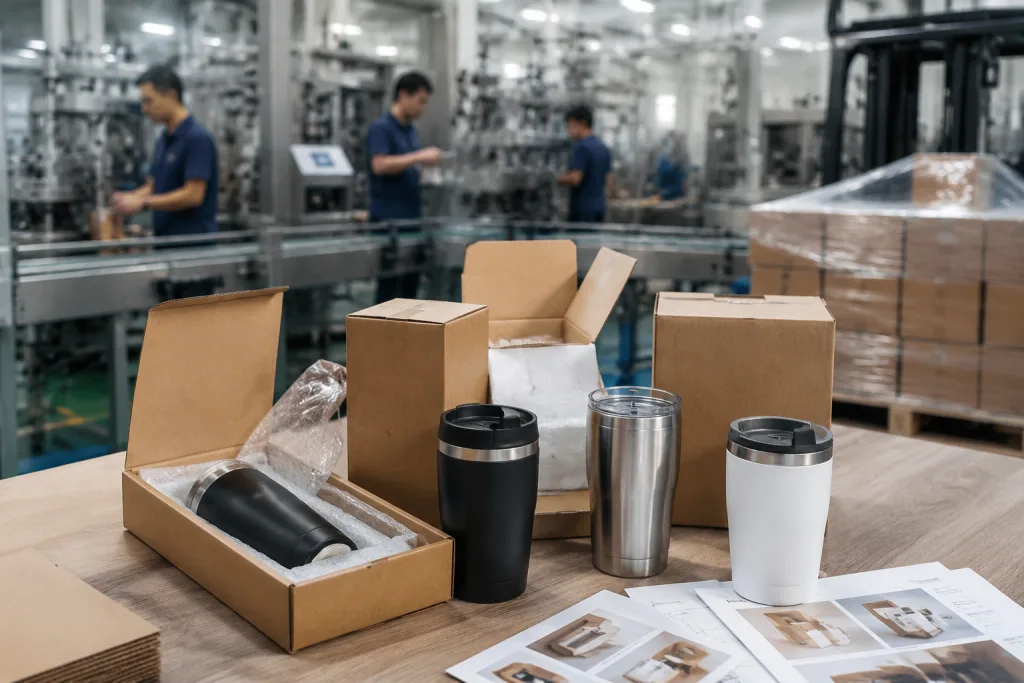
Packaging is not a decorative afterthought. For a bulk coffee travel mug sold online, the box has to survive courier drops from 80 cm and the ugly corner hits we see after parcel sorting. For a corporate-gift kit, the lid gap, tissue paper, and foam insert matter because one recipient opens one set, not a pallet. For a coffee shop retail shelf, we need room for the barcode, care text, country of origin, plus recycling marks if the buyer’s artwork calls for them. Same tumbler, 3 packaging specs. We run this check at the packing table with a steel ruler and a barcode scanner before the line starts.
A basic white box may cost USD 0.12-0.25. A printed kraft box can run USD 0.25-0.45. A rigid gift box can add USD 0.70-1.50 before freight. Inserts and manuals need their own line item; stickers, hang tags, FNSKU labels, and master carton marks do too, because the packing team has to apply each one by hand or on a labeling jig. When a quote says "gift box included," ask for paper gsm, flute type, dimensions, and drop-test expectation. We had one PO say 350 gsm, while the approved sample used 400 gsm, and the buyer flagged the softer corners during pre-shipment inspection.
For coffee mug in bulk shipments to Europe and North America, master carton strength should match the shipping route. A 5-ply export carton is safer than a thin 3-ply carton for ocean freight and warehouse handling, especially when the carton sits 18 days in transit instead of 12 days on a faster sailing. Carton weight should normally stay under 15 kg when possible; once it reaches 17 kg, we see more corner crushing and the warehouse guys hate moving it. QC pulled the sample carton last month and found the bottom tape split after a 1.2 m edge drop. The math doesn't work if you save USD 0.08 on carton board and lose 2% of units to dents.
Compliance labeling also belongs here. For the EU, 6 out of 10 retail buyers we deal with ask for LFGB or REACH-related material declarations, depending on the product and market. For the US, FDA food-contact expectations and California Proposition 65 review may apply. If the tumbler is sold to children, ASTM and CPSIA discussions become more serious, but most adult travel tumblers do not fall into that category. A serious coffee mug manufacturer checks packaging, labeling, and compliance together before mass production; we’ve seen this go sideways when the warning label was approved after cartons were already printed.
Price lines need boundaries
FOB price only means something when the quote has fence lines. A vendor travel tumbler quote should state model, capacity, steel grade, finish, logo method, packaging, carton quantity, MOQ, payment terms, port, sample fee, sample time, mass production lead time, and inspection standard. We run into this often: one buyer sent a PO with “20oz SS tumbler” and no lid code, then QC pulled the sample and found a 0.35 mm inner wall instead of the 0.40 mm sample we approved. Without those lines, you are not comparing vendors. You are comparing assumptions.
For reference, a 20 oz double-wall stainless steel tumbler from a China coffee mug factory direct program may land at roughly USD 3.20-5.80 FOB Ningbo or Shanghai, depending on steel grade, lid, coating, logo, and packaging. A basic promotional tumbler can sit below that if it uses a simpler push lid and plain white box. A premium retail unit with 304/304 steel, powder coating, laser logo, and printed gift box can price higher, especially when the buyer asks for 5-layer export cartons over 12 kg gross weight. If one quote is 25% below the others, ask what changed: wall thickness, steel grade, coating quality, carton strength, or QC time. The math doesn’t work otherwise.
BottleForge Industrial can produce about 600,000 drinkware units per month across stainless bottles, travel tumblers, and sports bottles, with typical custom tumbler lead time of 25-35 days after sample approval and deposit. For repeat orders, stable materials and approved tooling can cut 4-7 days because the line already has the welding jig, lid fit gauge, and color panel on file. For new molds, add 25-45 days depending on complexity. We’ve seen this go sideways when a buyer approves artwork fast but waits 9 days to confirm the 2D lid drawing.
Payment is commonly 30% deposit and 70% before shipment, with inspection before balance payment. Some coffee mug distributors request 20/80 or credit terms after 3-5 orders, but factories in Zhejiang usually reserve that for established buyers. If you are building coffee mug private labeling from zero, expect normal deposit terms until order history proves reliable. One buyer flagged this last month; we showed the material purchase sheet, 304 stainless coil booking, and carton deposit, then the 30/70 term made more sense.
Quality control before shipment
Do not wait until cartons land in your warehouse to learn what you bought. For a bulk travel mug order, we lock the approved pre-production sample before the line opens: gross weight in grams, Pantone color under a D65 light box, logo centerline measured with a digital caliper, lid torque feel, inner box artwork, and barcode scan result. Keep one signed sample at your office and one sealed at the factory QC desk. Simple works. When QC pulled the sample last month, the buyer flagged a 3 mm logo shift because both sides were holding the same physical cup, not arguing from phone photos.
During production, we check the stages where travel tumblers usually go wrong: stainless forming and welding first, then vacuum testing before coating, then printing, assembly, and packing. Vacuum failure is tricky because the cup can look perfect; we run hot-water temperature checks or use a vacuum detector on the line, and weak cups get separated before coating. Coating is easier to see but harder to judge, so write the limits on the inspection sheet: no exposed steel on the main body, no logo scratches over 1 mm, no dents on the front display area, and no dirty marks inside the cup. We have seen this go sideways when a buyer only wrote “good coating” on the PO.
For a standard 3,000-10,000 pc coffee mug bulk order, final random inspection under ANSI/ASQ Z1.4 with AQL 2.5 major and 4.0 minor is common. Critical defects need zero tolerance: sharp drinking edges, contamination inside the cup, broken lids, or wrong material. No debate there. If you ship to Amazon or a 3PL, add carton label checks and FNSKU verification; one wrong digit on an FNSKU label can hold 120 cartons at receiving for days. Our QC team scans labels with a handheld barcode reader and checks carton marks against the packing list before sealing the master cartons.
A coffee mug supplier directory or coffee mug supplier list gives you names, not behavior under pressure. The real test is what happens when 2% of lids are loose and the ship date is 6 days away. Ask for QC records, sample inspection reports, and photos from current production, including the defect tray on the packing table. The best coffee mug manufacturers in China are not the ones who promise zero defects; the math does not work in stainless drinkware. They define defects clearly, sort them before shipment, and show you the rework result with batch numbers.
Send your tumbler spec sheet for factory review
We will check capacity, steel, lid, logo, packaging, MOQ, and FOB assumptions before you commit to production.
Frequently asked questions
What MOQ should I expect for a custom vendor travel tumbler?
For a custom vendor travel tumbler, expect 3,000 pcs per color for a stable factory-direct order. Existing shapes and stock powder colors may allow 1,000 pcs, but logo, packaging, and freight cost per unit will be less efficient. New Pantone colors, new lids, or full-wrap artwork usually push MOQ back to 3,000-5,000 pcs. If you need only 300 pcs for an event, you are usually buying from a domestic decorator, not a coffee mug factory in China. For coffee brands planning retail, 3,000 pcs is a more realistic starting volume because it gives enough room for sampling, launch inventory, distributor tests, and replacement stock without paying excessive unit cost.
What is a normal FOB price for a bulk coffee travel mug?
A normal FOB China price for a 20 oz bulk coffee travel mug is roughly USD 3.20-5.80 when using double-wall stainless steel, a PP or Tritan lid, powder coating, one logo, and export carton packing. The lower end usually means simpler packaging, thinner steel, or a stock color. The higher end may include 304/304 steel, premium coating, laser engraving, printed gift box, and tighter inspection. FOB Ningbo or Shanghai does not include ocean freight, duty, customs clearance, inland trucking, or local warehousing. Always compare quotes using the same steel grade, wall thickness, logo method, packaging spec, and AQL level.
Is laser engraving or printing better for coffee mug custom orders?
Laser engraving is better when you need durability, clean branding, and fewer production variables. It works especially well on powder-coated stainless tumblers and is stable for 1,000-50,000 pcs runs. Silk screen printing is cheaper for simple one-color logos on smooth surfaces, but adhesion must be tested, especially around curved bodies. UV print and heat transfer are better for multi-color artwork, but they require more careful artwork templates and scratch testing. For coffee mug custom orders sold as retail merchandise, I usually recommend laser for premium minimalist branding and full-wrap print only when the visual design is central to the product.
Can one tumbler design serve both corporate gifts and coffee retail?
Yes, but you should specify the retail version first. Corporate gift buyers often accept simpler packaging and splash-resistant lids, while coffee retail customers judge the product harder because they paid for it directly. A good shared spec is 16 oz or 20 oz, 304 inner steel, 0.50 mm wall, powder coating, removable silicone gasket, and a printed kraft box. You can change the logo and packaging insert for different channels. If the same coffee mug private label design will go to distributors, online retail, and events, keep the body shape consistent and adjust decoration rather than changing the mold every order.
How long does production take after sample approval?
For a standard custom travel tumbler order from Zhejiang, production usually takes 25-35 days after sample approval and 30% deposit. Sampling is commonly 7-10 days for existing molds and colors, or 12-18 days if custom coating and packaging are involved. New molds can add 25-45 days before normal sampling. Inspection, balance payment, booking, and loading may add another 5-10 days before the vessel departs. If you need delivery for a fixed event date, work backward from that date and include ocean freight time, customs clearance, and domestic delivery. Rushed orders are possible, but coating and printing defects rise when schedules are squeezed too hard.