Key Takeaways
- 304 stainless steel with 0.4-0.5 mm wall thickness is the safer baseline for a vendor travel mug
- Realistic MOQ is 1,000 pcs for stock color logo orders and 3,000 pcs for custom powder coating
- Vacuum insulation should be checked at 6 hours, not just claimed as 12 or 24 hours
- AQL 2.5/4.0 inspection catches logo, leakage, and carton failures before FOB shipment
A vendor travel mug looks easy until the quotes land. One factory writes 201 steel, another writes 304 stainless, one flip lid leaks after 30 minutes in a backpack test, and the low-price K=K carton crushes at 18 kg stacking before it reaches your distributor warehouse. For coffee brands and corporate-gift buyers, finding a supplier is the easy part. The wrong question is “who is cheapest?” The better question is which spec line keeps complaints, rework, and air-freight fixes out of your margin.
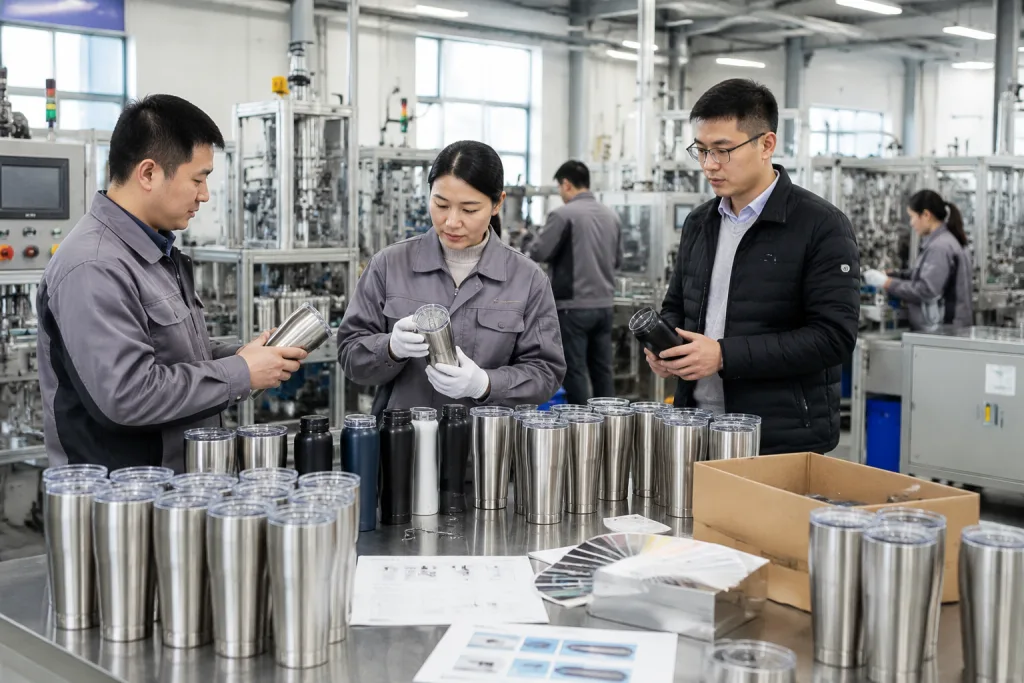
At BottleForge Industrial in Hangzhou, Zhejiang, we run purchase orders every month for 3,000 to 30,000 pcs of bulk travel tumbler or bulk coffee travel mug stock, made for campaigns, retail shelves, and employee gift kits. QC pulled one 500 ml sample last week and found the actual fill at 486 ml, which is the kind of small miss that turns into buyer pushback fast. Smarter buyers do not start with Pantone color. They start with steel grade, capacity tolerance in ml, insulation target, lid structure, and inspection terms such as AQL 2.5.
Start with the base model
The first spec line on a vendor travel mug quotation is usually the model number, capacity, and shape. Don’t skim it. That base model sets the tooling charge, carton cube, lid match, and whether your logo still looks clean after we scale it from a 52 mm proof to the cup body.
For coffee brands, we see 3 sizes most often: 12 oz, 16 oz, and 20 oz. A 12 oz travel tumbler fits espresso-based drinks and premium retail bundles; on our line, it usually packs 48 pcs per master carton without pushing the carton past 15 kg. A 16 oz bulk coffee tumbler is the safer office-gift size. A 20 oz bulk travel mug looks better on a buyer’s comparison sheet, but the math can go sideways: shipping volume often rises by 12-18% compared with a 16 oz body, and one buyer flagged that after seeing the CBM jump on the proforma invoice.
Ask for two numbers: actual filled capacity and practical drinking capacity. A mug marked 16 oz may hold 480 ml to the brim, but only 430-450 ml safely with the lid installed. QC pulled the sample, filled it on a digital scale, and the lid splash line sat 18 mm below the rim. That gap matters if your campaign copy promises a precise drink size.
Shape affects decoration. Straight-wall tumblers are easier for wraparound silkscreen and heat-transfer artwork because the screen sits flat and the print gap stays stable. Tapered mugs feel better in the hand and fit more cup holders, but large logos can stretch near the lower curve; we’ve rejected proofs where a round coffee bean icon turned oval by 3 mm. If you need coffee mug custom made artwork across 180 degrees, ask the factory for a printable area drawing in millimeters before approving the quote.
For factory-direct projects from China, we normally lock the model first, then quote 3 decoration options on that same body. Comparing 5 body shapes against 5 prices is the wrong question to ask. That is how buyers choose the wrong bulk travel tumbler for the right budget, and we’ve seen it start with something as small as a PO typo: “TM-16S” instead of “TM-16T.”
Steel grade and wall thickness
Material is where 6 out of 10 cheap coffee mug in bulk programs fail quietly. The buyer sees “stainless steel” on the quote. The end user tastes metal, QC pulls rust dots near the rolled rim, or the tumbler comes back dented after one desk drop from about 750 mm.
For a travel tumbler used with coffee, 304 stainless steel should be the baseline for the inner wall. It holds up better against acidic drinks than 201 stainless steel, especially after 24-hour coffee soak checks in the lab cup. Some factories run 304 inside and 201 outside to shave cost by roughly 3% to 6%. That can work for a price-sensitive coffee mug promotional campaign, but put it on the spec sheet. If a quote only says “stainless steel,” ask again.
Wall thickness matters more than the brochure admits. A typical double-wall vacuum tumbler uses 0.4 mm to 0.5 mm stainless steel. Below 0.35 mm, dent risk climbs, especially during sea freight and warehouse handling; we have seen cartons pass the drop test but still show 11 dented outers after loose pallet stacking. Above 0.6 mm, the mug feels stronger in hand but the math doesn’t work for every program because weight and raw material cost both rise. For corporate gifting, 0.45 mm inner and 0.5 mm outer is a practical target.
Food-contact compliance should be written, not assumed. For Europe, ask for LFGB or EU food-contact migration testing and REACH documentation for coatings where relevant, with the report tied to the same coating code on the PO. For North America, FDA food-contact expectations and California Prop 65 review may apply depending on sales channel. If you sell to children or school programs, ASTM and CPSIA requirements can enter the conversation, even if the product looks like a normal coffee mug customized for adults. We have seen this go sideways when the buyer flagged “matte black” on the artwork but the factory tested glossy black instead.
A serious coffee mug manufacturer in Zhejiang should provide material declarations, recent test reports, and steel grade confirmation before mass production. Ask before the line starts. If the supplier avoids the question, or sends a blurry mill certificate with the heat number cropped off, the low FOB price is probably doing the talking.
Insulation numbers worth believing
Insulation claims are easy to print and hard to hold on the line. “Keeps hot 12 hours” can mean 6 test setups: boiling water at start, room temperature at 20°C, lid closed, no opening, and a final temperature that is too low for drinking. We’ve had buyers flag this after QC pulled the sample with a probe thermometer and found the carton claim did not match the lab sheet. For a vendor travel mug, ask for the test method behind the claim.
A practical hot-water test is simple. Fill the tumbler with water at 95°C, close the lid, keep it at 20-25°C room temperature, and measure after 3 hours and 6 hours with the same digital probe, inserted to the same depth. For a 16 oz double-wall vacuum tumbler, a reasonable 6-hour result is often 55-65°C depending on lid design and body geometry. Wider mouths lose heat faster. Slider lids lose more heat than sealed screw lids; we see it when the silicone plug gap runs 0.3 mm loose.
Cold performance is easier to oversell because ice makes every product photo look safe. If your product is positioned as a bulk coffee travel mug, hot retention matters more than 24-hour cold claims. Coffee brands should prioritize a comfortable drinking window for 90 minutes to 4 hours. Corporate-gift buyers often care about all-day desk use and no condensation on the outside wall; one buyer rejected 2 cartons after finding wet rings under samples during a 4-hour desk test.
Vacuum failure rate belongs in the factory discussion. During production, vacuum insulation is affected by welding, copper plating or polishing quality, and the evacuation process. At BottleForge Industrial in Hangzhou, Zhejiang, our travel tumbler lines run up to 450,000 units/month, and every vacuum item goes through a basic thermal check before packing. That does not replace buyer inspection, but it cuts the risk of a whole pallet of weak insulation reaching your warehouse. We run the check before inner-box sealing, because finding a cold wall after master carton packing is the expensive way to learn.
If you are comparing a coffee mug supplier list, ask each supplier for the same 6-hour test format. Different marketing claims are noise; same test conditions give you usable data. This is the wrong place to accept “our mug keeps hot longer” as an answer—put 95°C, 20-25°C room temperature, and the 6-hour reading on the PO so the line and QC read the same target.

Lid, gasket, and leak claims
The lid decides whether your customer calls the mug useful or cheap. We see this on the line every month: the 304 stainless body passes vacuum testing, then QC pulls 32 finished samples and finds two lids that weep at the sip slot. For a vendor travel mug, write the lid type on the PO in plain words: push-on slider, screw lid with flip cap, straw lid, or 360-degree drinking lid.
Push-on slider lids work well for coffee mug promotional products because the tooling is simple and the drink opening feels familiar. They are splash-resistant, not leakproof. Say it that way. If the mug will ride inside a commuter bag, pick a screw lid with a 1.8 mm silicone gasket and a locking closure. It adds USD 0.25-0.60 per unit, but the math works better than paying for 600 wet-backpack complaints after delivery.
Gasket material should be food-grade silicone, not low-grade rubber with a strong smell after hot-water testing. Ask whether replacement gaskets are available, especially for retail or coffee mug private label programs. We usually pack 1% spare gaskets for retail orders over 5,000 pcs when the buyer asks for it. A small gasket issue becomes a big after-sales mess if your distributor has no spare parts.
Leak testing should be written down. A basic factory test is simple: fill with room-temperature water, close the lid, invert for 30 seconds. A stricter buyer test shakes the mug for 10 seconds, inverts it for 5 minutes, then checks the lid seam with a dry tissue. If you want that test, put it in the purchase order and confirm the sample size, such as 3 pcs per carton or 80 pcs per batch. Verbal agreements go sideways.
Lid color matching is another detail buyers underestimate. Black lids hide small material variation. White, beige, and translucent lids show molding marks, gate shadows, and color drift faster, especially under a D65 light box. For a coffee mug customizable program with brand colors, approve lid resin color chips under daylight and office lighting before production. Plastic does not match powder coating perfectly, and pretending it will is not engineering.
Logo method and surface finish
Decoration is where a bulk coffee mug turns into your SKU. It is also where delays start; last month QC pulled the sample because the buyer approved a 0.25 mm line logo that filled in after powder coat and laser.
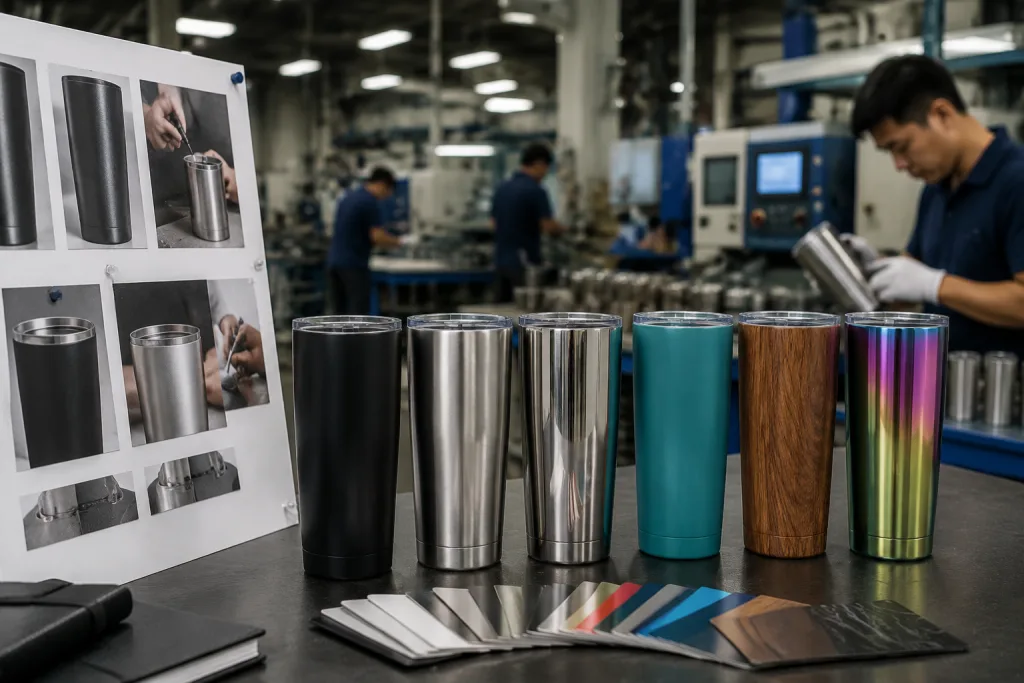
Laser engraving is clean and durable on 304 stainless or powder-coated bodies. Best use: simple logos, staff names, and corporate marks with lines above 0.3 mm. It will not print full-color artwork. Silkscreen printing costs less for one or two colors on straight walls; we usually set the screen jig after checking body taper with a caliper. On curved or tapered cups, wraparound registration moves by 1-2 mm, and the buyer flags it fast. Heat transfer handles more color, but scratch resistance depends on film grade and curing time; cheap film looks fine on day 1 and fails after 20 rubs with the 3M pad.
Powder coating is the finish we run most for coffee mug customized projects. It gives a matte or semi-matte hand feel and better grip than polished steel. Standard coating thickness is often 60-90 microns. Too thin, chips show at the bottom edge after carton drop testing. Too thick, lids or silicone bottom pads may not seat; we have seen a 0.6 mm pad gap stop a shipment. For high-use corporate gifts, ask for a cross-hatch adhesion test and a 3M tape pull test on pre-production samples.
Color MOQ is where buyers need real numbers. Stock colors with logo can often start at 1,000 pcs per design. Custom powder coating usually starts at 3,000 pcs per color because the coating line setup and powder waste are real costs; one color change can burn 8-12 kg of powder during cleaning and trial spray. If a coffee mug oem manufacturer offers 300 pcs in custom Pantone powder coating at factory-direct pricing, push back. The math does not work unless they are hand spraying, using leftover powder, or pulling from trading-stock bodies.
For coffee mug private labeling, define bottom marks, care instructions, barcode labels, and retail insert cards before the PO is locked. Small stuff bites. We had one order delayed 3 days because the PO said FNSKU on “right carton side,” while the packing drawing showed the short side. A beautiful front logo will not save the shipment if the FNSKU label sits on the wrong carton panel or the care card says dishwasher safe when your coating test says otherwise.
Packaging, cartons, and channel rules
Packaging is not decoration. It is logistics insurance. We have seen a travel tumbler pass coating check on the line, then arrive unsellable because the inner box rubbed a matte powder coat during a 1.2 m drop test. QC pulled the sample and found a grey scuff ring exactly where the lid touched the box wall.
For a standard 16 oz bulk coffee tumbler, we usually pack 1 pc in a polybag or tissue wrap, then into a white box, kraft box, or printed retail box. Master cartons often hold 24 pcs, but the right carton count comes from mug diameter, lid height, and target carton weight. For export from China to Europe or North America, we try to keep master cartons under 15 kg for manual handling; once a carton hits 17 kg, warehouse staff start complaining, and corner crush shows up faster. The tape gun tells the truth.
Corporate-gift buyers often ask for individual gift boxes with logo, instruction cards, and co-packed coffee sachets. Coffee brands usually need retail packaging with EAN/UPC labels and shelf-facing artwork. Marketplace fulfillment is less forgiving: confirm FNSKU labels, carton labels, suffocation warnings for polybags, and drop-test rules before the packaging supplier prints 3,000 boxes. We had one PO with “FNSKU” typed as “FNSK,” and the buyer flagged it during pre-shipment photo review.
Carton strength should be specified by material, not guessed. A 5-ply K=A or K=K carton is stronger than a basic 3-ply carton and may add USD 0.08-0.20 per unit depending on size. The math works. It is cheaper than writing off 6 cartons of dented goods after unloading. For LCL shipments, stronger cartons matter more because your goods may be moved 8-10 times before reaching the buyer’s warehouse, and a thin carton will not forgive rough forklift forks.
Ask your coffee mug distributor or warehouse team what they need before you finalize packaging. Some coffee mug distributors want plain cartons for easy relabeling. Others want case packs aligned to retail replenishment, such as 12 pcs per carton. We can build either plan, but changing it after mass production starts is the wrong question to ask; carton die-lines, barcode placement, and packing SOPs are already locked, and we’ve seen this burn 4 days on a 5,000 pc order.
Price, MOQ, and inspection terms
FOB pricing for a vendor travel mug comes down to the bill of materials: 304 stainless thickness, lid structure, powder coating, logo process, packing style, and carton loading. For reference, we run a 16 oz double-wall 304 stainless travel tumbler with stock powder color, one-position laser logo, and white box packaging at about USD 3.20-4.80 FOB Ningbo or Shanghai at 3,000 pcs. Custom coating, retail box, or an upgraded leakproof lid can move it above USD 5.50. QC pulled one 0.5 mm rim sample last month because the buyer wanted a thinner lip, and the polishing labor changed the math fast.
MOQ should be split by component. A factory may accept 1,000 pcs for a stock body color with laser logo, but require 3,000 pcs for custom coating, 5,000 pcs for a custom molded lid, and 10,000 pcs for exclusive tooling. Normal factory talk. The wrong question is “What is your MOQ?” because that answer does not cover every version of coffee mug custom work. We had one PO typo read “matte black lid” instead of “matte black body,” and the line stopped for 6 hours while sales, tooling, and spraying checked the spec sheet.
Lead time needs stages, not one loose promise. A typical China factory schedule is 7-10 days for sampling after artwork confirmation, 25-35 days for mass production after deposit and sample approval, and 7-14 days for inspection booking and vessel cutoff depending on season. Before Lunar New Year, add at least 15-25 days of buffer. Zhejiang factories move fast, but they cannot bend port congestion or coating-line capacity; our powder line can clear about 18,000 pcs per shift only when color changeover stays under 45 minutes.
Inspection terms protect both sides. For most orders, use AQL 2.5 for major defects and AQL 4.0 for minor defects. Major defects include leakage, sharp edges, wrong logo, failed insulation, and serious coating damage; for leakage, we usually invert the filled cup for 30 minutes on kraft paper so there is no debate. Minor defects include small dust points, slight color variation within approved tolerance, and carton scuffs that do not affect saleability. We’ve seen this go sideways when the buyer flagged 1 mm dust specks after shipment but had never approved a defect limit.
A good coffee mug factory direct partner should welcome clear inspection criteria because it prevents arguments. Vague PO, vague responsibility. If you are building a coffee mug supplier directory or comparing a coffee mug supplier list, rank suppliers by how clearly they answer spec questions, not by who replies fastest. Ask for wall thickness, lid material, gasket hardness, carton drop-test standard, and logo position tolerance; if the sales team cannot answer within 24 hours without asking the line, the quotation is probably not tied to production reality.
Send your travel mug spec for factory review
Share capacity, logo, quantity, packaging, and target market. BottleForge will return a practical FOB quote and production risk notes.
Frequently asked questions
What MOQ should I expect for a vendor travel mug order?
For a normal vendor travel mug with stock body color and one logo, 1,000 pcs is a realistic MOQ at many China factories. For custom powder coating, plan on 3,000 pcs per color. If you need a custom molded lid, exclusive shape, or special handle, the MOQ may rise to 5,000-10,000 pcs because tooling and component setup costs are higher. Coffee brands testing a new retail SKU should start with a stock mold and custom logo first. Corporate-gift buyers with fixed campaign dates should avoid new tooling unless they have at least 60-75 days before shipment.
Is laser engraving better than printing for coffee mug custom orders?
Laser engraving is usually better for durability, especially on powder-coated stainless steel. It will not peel, and it handles dishwashing abuse better than most printed marks, although many coated tumblers are still recommended for hand wash. Silkscreen printing is better when you need a solid brand color, large artwork, or lower cost on 1-color logos. Heat transfer is useful for full-color coffee mug promotional artwork, but you should test scratch resistance before mass production. For 3,000 pcs, laser may add roughly USD 0.10-0.25 per unit depending on logo size and position.
Can I use one tumbler for both retail and corporate gifting?
Yes, but the spec should be built for the stricter channel. Retail usually needs better packaging, barcode control, color consistency, and a clearer care label. Corporate gifting often needs name personalization, gift boxes, and deadline reliability. A 16 oz 304 stainless tumbler with stock powder coating, laser logo, and printed kraft box can serve both channels if the artwork is planned correctly. If you also sell through marketplace fulfillment, add FNSKU labeling rules and carton-drop expectations early. Changing packaging after production can add 5-10 days and extra repacking cost.
How do I compare quotes from different coffee mug manufacturers?
Put every quote into the same spec table. Include capacity, inner and outer steel grade, wall thickness, lid type, leak test, insulation test, coating method, logo method, packaging, carton quantity, MOQ, lead time, FOB port, and payment terms. A USD 3.10 quote and a USD 4.20 quote may not be comparable if one uses 201 steel, a splash-only lid, and a 3-ply carton. Ask each coffee mug manufacturer to confirm the same 6-hour heat test and AQL inspection standard. The best supplier is usually not the cheapest line; it is the clearest line.
What lead time should coffee mug distributors plan for?
For repeat orders using an existing mold and approved artwork, plan 25-35 days for mass production plus shipping time. First orders need more time: 7-10 days for samples, 3-5 days for sample review and comments, then production after deposit and final approval. Sea freight to Europe or North America can add 25-45 days depending on port and service. Coffee mug distributors should build a 60-90 day planning window for seasonal campaigns. Before Chinese New Year, book earlier because Zhejiang and broader China supply chains can lose 2-4 effective production weeks.