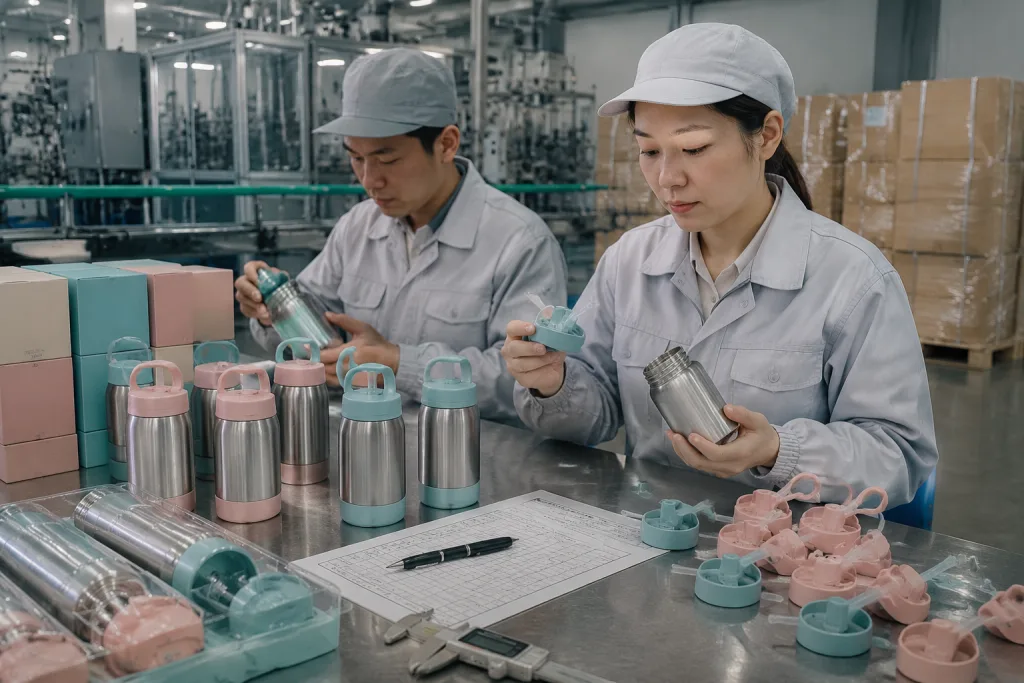
Key Takeaways
- For toddler bottles, ask for 304 stainless steel at 0.40-0.50 mm wall thickness and food-contact silicone at 50-60 Shore A
- A realistic custom MOQ is 1,000-3,000 units per color for most bottle bodies and lids
- Plan 35-50 days production after artwork approval, plus 7-10 days for pre-production samples
- Use AQL 2.5 for major defects and AQL 4.0 for minor defects on final inspection
A vendor toddler bottle looks simple until QC pulls 20 lids from the line and 3 leak at the thread, or a straw pops loose at 2.5 kg in a pull test. For retail, daycare, promotion, and distributor drinkware programs, the risk sits in small specifications: 55–60 Shore A silicone, thread fit within 0.2 mm, wall thickness, print rub resistance, 5-layer carton drop strength, and the paperwork your importer needs at customs.
We manufacture custom drinkware in Hangzhou, Zhejiang, and we see the same mistake every season: buyers compare FOB prices before they check the spec sheet. Wrong question. A toddler bottle is not a generic canteen promotional item; it is a child-use product, so the vendor decision in China should start with compliance, repeatable assembly, and a lead time that matches real production, not a sales promise. Last month a buyer flagged 12 days on a PO, but the math was 18 days after mold polishing, print curing, and AQL 2.5 inspection.
Start with intended use
The first line on a vendor toddler bottle spec sheet should not be capacity or color. It should say intended use. Retail shelf? School kit? Daycare supply? Canteen distributor order? Promotional campaign? We quote these five channels differently because the lid, insert card, barcode position, test plan, and spare-part bag all change. Last month QC pulled a straw-lid sample where the buyer had approved retail packaging, but the PO said “bulk pack”; that one word changed the carton layout and added 2 days on the line.
For toddlers, we usually see 280 ml, 350 ml, and 400 ml as the practical range. A 500 ml bottle may look better in a cost-per-milliliter comparison, but a filled 500 ml stainless bottle can be too heavy for a 2-4 year old. This is the wrong question to ask. Ask what a child can carry without dropping it at daycare pickup. If your buyer brief says “kids” but the artwork shows toddler positioning, stop and clarify the age grade. A 3+ mark, a 6+ mark, and a general family bottle are not the same product in the eyes of a test lab. We run this check before sample cutting because a 6 mm straw, a flip lid spring, and a silicone valve can trigger different lab comments.
A good canteen factory in China should ask how the product will be sold before quoting. A retail toddler bottle may need a hang tag, barcode label, color box, warning copy, and carton drop testing. A distributor canteen order for corporate gifting may use bulk packing with a 1-color logo and a plain inner bag. Amazon-style fulfillment may need FNSKU labeling, suffocation warnings on polybags, and tighter master carton weight control, usually under 15 kg. We ship those cartons on a scale before sealing; if the master carton lands at 16.2 kg, the buyer flags it and the repack cost eats the margin.
At BottleForge in Zhejiang, our monthly stainless drinkware output is about 450,000 units across toddler bottles, travel tumblers, sports bottles, and custom growler lines. That capacity matters, but it does not replace a clear product definition. If the intended use is vague, the canteen supplier will quote the cheapest safe-looking configuration, and you will discover the missing requirements after tooling, printing, or inspection. We have seen this go sideways: 12 days into mold work, a buyer added “retail ready” after the dieline was locked, and the schedule moved from 18 days to 26 days.
Body material and wall gauge
For stainless toddler bottles, the body material line should name the steel grade, not hide behind “stainless steel.” We run 304 stainless steel, also called 18/8, for the inner contact wall on child-use bottles. For 201 stainless budget single-wall items, the math looks tempting, often shaving USD 0.12-0.18 per unit on a 5,000 pcs order, but this is the wrong question to ask if the bottle will hold juice, milk, or warm water. QC has pulled 201 samples after a 48-hour salt-spray check with small rust dots around the rolled mouth.
Wall thickness is where quotes get slippery. A typical toddler bottle body uses 0.40-0.50 mm stainless sheet before forming; our caliper check is done on incoming coil before the deep-drawing line starts. Too thin, and the bottle dents in a carton drop or after one week in a preschool bag. Too thick, and unit weight jumps fast, sometimes 18 g higher on a 350 ml body. For vacuum insulated toddler bottles, confirm whether both inner and outer walls are 304, or whether the outer wall is 201. Some buyers accept 201 outside for cost control, but the spec sheet must say it in plain text.
If you are comparing a custom canteen, customized canteen, or customizable canteen from several canteen vendors, ask each one to list steel grade and wall gauge first, then add net weight tolerance and capacity tolerance with test method. A fair capacity tolerance is usually ±5%. Net weight can vary by about ±5-8 g depending on lid assembly and coating; last month one PO had “304 inner / 210 outer” typed by mistake, and the buyer flagged it before sample approval. Good catch.
Surface finish changes how the bottle survives real toddler use. Powder coating gives better hand feel and stronger color coverage, but it must pass cross-hatch adhesion and abrasion checks with a 3M tape pull and 500-cycle rub test. Spray paint costs less, but we have seen it go sideways after drop testing from 1.2 m onto concrete, with chips near the shoulder radius. For food-contact areas, keep coating outside the drinking path. Sounds basic, but low-cost offers still show painted mouth rims. Do not put that on a child-use SKU.
Lid, straw, and bite parts
The lid is where toddler bottle projects usually fail. The stainless body is rarely the reason for a return; the buyer flags leaks, snapped push buttons, loose straws, mold sitting under the hinge, or a lid that parents cannot clean with a small brush. On our line in Hangzhou, QC pulled 32 failed samples last year, and 24 were lid-related. Split the spec sheet clearly: PP or Tritan lid body, silicone straw or spout, gasket, hinge pin, carry handle, and lock structure.
For toddler bite valves and straws, we usually run food-grade silicone at 50-60 Shore A. Softer silicone feels nicer in the mouth, but we have seen it tear at the slit after the buyer asked for a wider opening. Harder silicone survives more biting, but a 2-year-old may struggle to drink. Ask your canteen manufacturer for bite valve tear resistance data, or at minimum a retained sample after 500 open-close cycles and 300 straw pull cycles. Our practical straw pull test is 15-20 N for 10 seconds, repeated across 8-12 units with a digital force gauge.
Write the leak test into the purchase order. Not later. We use water fill, inverted storage, side-position shaking, and pressure checks based on the lid structure; a flip straw lid and a screw cap do not behave the same in a carton drop test. If you ask for “leakproof,” define it: room-temperature water, 30 minutes inverted, no visible droplets on white tissue. The math does not work if sales promises leakproof performance with carbonated drinks or hot liquids while the lid has no pressure vent.
Small parts cause big arguments. Removable silicone plugs make cleaning easier, but a loose plug becomes a child-safety problem if the retaining groove is shallow by even 0.3 mm. We had one PO typo call the plug “removable” in English and “fixed” in Chinese, and the buyer flagged it at pre-production sample approval. If the product is for North America, discuss ASTM F963 where applicable. For Europe, review EN 14350 for child drinking equipment and REACH requirements for restricted substances. Serious canteen manufacturers and canteen suppliers set these points before tooling starts, because they change resin choice, silicone hardness, and mold design.
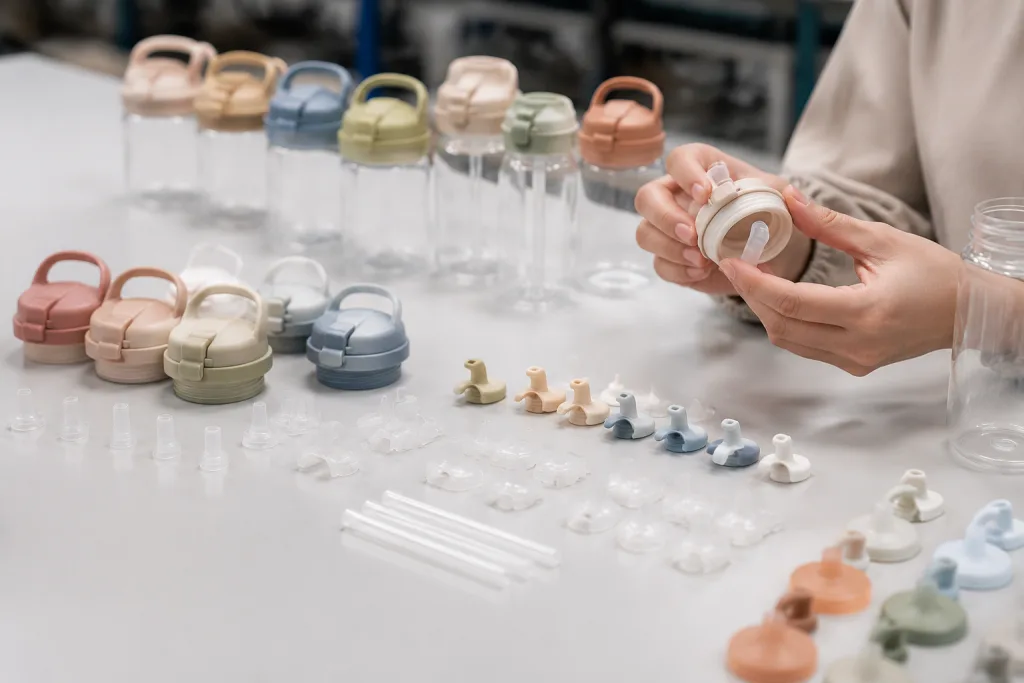
Decoration that survives toddlers
Custom artwork on toddler bottles has to take wet hands, lunch bags, wrong dishwasher loading, and drops from a high chair. We’ve seen a cheap print pass the buyer’s showroom review, then come back with scratches after 23 days of preschool use. QC pulled one 350 ml sample from the line last May and dropped it from 1.2 m onto vinyl tile; the bottle survived, the logo didn’t. For a vendor toddler bottle, pick the decoration by abuse level. Visual style is the second question.
Silkscreen printing works for 1-3 spot colors on smooth powder-coated surfaces, especially when we run a 120T mesh and keep the logo away from the shoulder curve. Heat transfer is better for detailed characters or a full-wrap graphic, but check the film edge under a 10x loupe; if the edge lifts by 0.2 mm, toddlers will find it. Laser engraving lasts on stainless or coated surfaces, though it cuts away color, so it suits brand marks more than cartoon artwork. UV printing gives bright multi-color images, but the math doesn’t work if curing is rushed to save 6 seconds per piece on the line.
For customized drinkware and customizable drinkware programs, we normally ask for a pre-production sample using the final coating, final logo size, and the same curing process planned for bulk. Do not approve artwork from a flat paper proof only. A logo that sits nicely on a 600 ml sports bottle can look loud on a 350 ml toddler bottle; we had one PO typo list “530 ml,” and the buyer flagged the artwork only after the sample looked wrong in hand. Curved walls bend small text near the shoulder, so we measure the live print area with a flexible ruler before plate making.
Decoration testing should be simple, but not casual. We run a cross-hatch adhesion cut with a 1 mm blade, a 3M 600 tape pull, a 50-cycle wet rub using a 500 g load, then an alcohol wipe check for soft ink. Dishwasher-safe claims need a named test, such as 20-50 cycles at 65°C, not a quick “yes” from sales. If you are buying canteen custom, canteen customizable, or canteen customized products for a brand launch, keep retained golden samples at your office and at the factory in Zhejiang. We’ve seen this go sideways when mass production shifted half a shade and nobody had the approved sample under the same D65 light box.
Compliance paperwork line by line
Do not park compliance until after the buyer accepts the price. For toddler drinkware, the test plan changes the BOM, the line schedule, and the quote; we have seen a straw material swap add 12 days to a 30-day production slot. A responsible canteen vendor asks the destination market before locking the final number. The United States, Canada, EU, and UK each ask for a different paperwork pack, and the buyer will flag the gap fast if the PO says “EU + US” but the quote only carries FDA.
For the EU, buyers often request food-contact testing under LFGB or EU 1935/2004 framework expectations, plus REACH screening for restricted chemicals. For North America, FDA food-contact expectations, CPSIA where child-use positioning applies, ASTM F963 where relevant, and California Proposition 65 review may be needed. Plastic lids, silicone straws, paints, and printed graphics all need their own check if a toddler can touch or mouth them; last month QC pulled a pink silicone straw sample because the lab needed the exact color masterbatch code, not just “food grade silicone” on the spec sheet.
Factory social and quality audits may also sit on the spec sheet. BSCI, Sedex, ISO 9001, and retailer-specific audits do not make a weak bottle pass drop testing, but they reduce sourcing risk. Ask whether the canteen factory owns production steps or outsources them. Stainless forming, welding, polishing, coating, printing, and lid assembly may happen in different workshops. In China, this is normal. The part that matters is traceability: we run batch cards from 304 stainless coil intake through lid assembly, and a missing polishing workshop stamp is enough for our QC manager to stop carton sealing.
Test reports should match the actual construction. A report for a 500 ml adult bottle does not automatically cover a toddler bottle with a different lid and straw. A report for clear silicone does not always cover colored silicone. When comparing canteen suppliers, ask for report numbers, issue dates, tested materials, and the model reference; if the report says “TB-350” but the PO says “TB-350S straw lid,” the math doesn't work. Old reports are useful background, not a substitute for order-specific testing when the SKU is new, especially before we book the 1,000 pcs MOQ pilot run.

MOQ, pricing, and production timing
MOQ is not a moral position; it is a setup calculation. For a vendor toddler bottle using our existing mold, we usually quote 1,000-3,000 units per color for standard powder coating and logo printing. The line still needs color changeover, mesh screen setup, and first-piece checks with a 3M tape test. For a new lid mold, custom handle, or unique straw structure, plan on 5,000-10,000 units so the tooling, gasket trial, and assembly scrap have somewhere to sit. We had one buyer push for 200 units with full custom Pantone, low price, and full testing. The math doesn't work. If a canteen manufacturer accepts that order, ask which step is missing.
FOB pricing depends on steel grade, insulation, lid complexity, coating, decoration, packing, and testing, but each item needs a line-by-line cost sheet, not a guess from a catalog photo. As a working reference, a 350 ml stainless toddler bottle with standard flip straw lid may land around USD 2.60-4.80 FOB China for normal B2B quantities. A premium insulated version with better lid, powder coating, color box, and multi-color artwork may move into the USD 4.50-7.50 range. On our last toddler bottle quote, QC pulled the sample because the silicone straw was 1.5 mm short against the drawing, which changed both fit and rework cost. These are sanity-check numbers for early budgeting, not promises.
Lead time should be split into stages. Artwork proofing usually takes 1-3 days, assuming the logo file is clean and the PO does not say “matte black” in one line and “Pantone 426C” in another. Pre-production samples take 7-10 days after artwork confirmation. Mass production is commonly 35-50 days, depending on season and coating capacity; in September, powder coating can be 12 days vs 18 days when the oven schedule is full. Final inspection and booking can add another 3-7 days. If you need delivery before a school season or retail reset, work backward from vessel ETD, not from factory completion.
For distributor drinkware, distributor canteen, and distributor growler programs, mixed SKUs make timing harder. A custom growler, customizable growler, or customized growler may share coating lines with toddler bottles, but the forming die, polishing wheel, and leak-test fixture are not the same. Bundle production only when it helps freight or shelf launch timing. We have seen this go sideways when a growler dent issue gets tied to a toddler bottle inspection lot with straw-leak risk. Do not force unrelated SKUs into one inspection lot if the defect risks are different.
Packaging and inspection details
Packaging sits on the BOM, not beside it, for toddler bottles. A thin white box works for B2B bulk distribution when the buyer repacks locally; for retail and e-commerce, the paper grade and inner support matter. We usually run one bottle in a PE bag or 17 gsm tissue wrap, then a color box, then 24 units per export carton. Keep export carton gross weight practical, often 10-15 kg, and confirm carton dimensions before artwork is released if you are trying to hit a pallet plan. Last month QC pulled a 45 mm crushed corner from a 5-ply K=A carton after the line stacked it too high. Small miss. Big complaint.
For e-commerce, ask for barcode placement, FNSKU or SKU labels, carton labels, suffocation warnings, and master carton drop testing. A 60 cm drop test on one corner, three edges, and six faces is a reasonable shop-floor check for 8 out of 10 shipments we see, though Amazon, Target, or club-store protocols can be tougher. If the bottle includes spare straws or cleaning brushes, lock down where they sit in the package; do not leave this to the packing girls at the end of the line. Loose accessories cause noise, scratches, and missing-part claims. We have seen this go sideways when a brush rubbed through a powder-coated lid during 18 days on the water.
Final inspection should use AQL, not a WeChat album from the factory office. For toddler bottles, our export buyers usually set AQL 2.5 for major defects and AQL 4.0 for minor defects, with critical defects at zero tolerance. Critical defects include sharp edges, contamination, unsafe small parts, blocked drinking paths, severe leaks, and wrong compliance markings. Major defects include poor coating adhesion, wrong logo, cracked lid, heavy denting, and functional leakage. Minor defects include small cosmetic marks within an agreed limit, such as one 1 mm dot outside the logo area. QC should use a torque gauge on the lid, a leak test jig, and a 3M tape pull on printed artwork before signing the carton stickers.
Ask the canteen vendor to keep inspection samples, production records, and material batch references for at least 12 months. If a complaint comes from a retailer six months later, “the factory checked it” is not enough. You need traceable parts, dated photos, test records, and a clear corrective action path. We ship retain samples in a labeled PP bag with the PO number, but watch the PO: one buyer once typed the wrong lid color code, and the whole claim started from that typo.
Send your toddler bottle spec for review
We will check material, lid, compliance, MOQ, packaging, and FOB assumptions before you place a custom drinkware order.
Frequently asked questions
What MOQ should I expect for a custom toddler bottle order?
For an existing vendor toddler bottle mold, expect 1,000-3,000 units per color for standard logo printing and coating. If you need a custom lid color, private mold handle, special straw, or full retail packaging, MOQ can move to 5,000 units or more. Very small runs under 500 units are possible only with stock colors and simple decoration, and the unit price will be much higher. A serious canteen supplier should explain which MOQ comes from coating setup, printing setup, lid injection, or packaging print minimums.
Which material is safest for toddler bottle bodies?
For stainless toddler bottles, 304 stainless steel is the normal choice for the inner food-contact wall. We recommend 0.40-0.50 mm sheet thickness for a good balance between dent resistance and child-friendly weight. Plastic lid parts should be food-grade PP or Tritan, and straws or gaskets should use food-contact silicone, often 50-60 Shore A. Ask for current food-contact test reports that match the exact materials and colors in your order. A report for a different adult bottle is not enough for a child-use SKU.
Can I claim the bottle is leakproof?
Only if the test condition is defined and passed. For a flip straw toddler bottle, we usually test room-temperature water filled to rated capacity, inverted for 30 minutes, then side-shaken. No visible droplets is a practical pass condition. Do not claim leakproof for hot drinks, pulpy juice, milk residue, or carbonated beverages unless the lid is designed and tested for those conditions. Toddler users chew straws and leave lids half-closed, so your packaging copy should be accurate rather than aggressive.
How long does production take from China?
A normal custom drinkware order from China takes 7-10 days for pre-production samples and 35-50 days for mass production after sample and artwork approval. Add 3-7 days for inspection, export documents, and vessel booking. Sea freight to Europe or North America then depends on port and season. If you need a retail launch date, confirm artwork, testing plan, carton marks, and barcode files before production starts. Late packaging changes can delay a finished bottle order by a week.
What inspection standard should I put on the purchase order?
Use AQL sampling and define defect categories before production. A common setup is AQL 2.5 for major defects, AQL 4.0 for minor defects, and zero tolerance for critical defects. Critical defects include sharp edges, contamination, choking-risk loose parts, wrong material, and severe leakage. Major defects include cracked lids, poor coating adhesion, wrong print, heavy dents, or failed function. Minor defects include small scratches or print specks inside the agreed visual limit. Include water leak testing, logo checks, carton drop checks, and barcode scanning in the inspection checklist.