Key Takeaways
- A practical custom stainless thermos MOQ starts at 1,000 pieces per model/color for stable FOB pricing
- 304 stainless steel, powder coating, lid complexity, and packaging usually move unit cost by 8-35%
- Normal lead time is 35-60 days after artwork, deposit, and pre-production sample approval
- BottleForge capacity is about 450,000 stainless drinkware units/month in Zhejiang, China
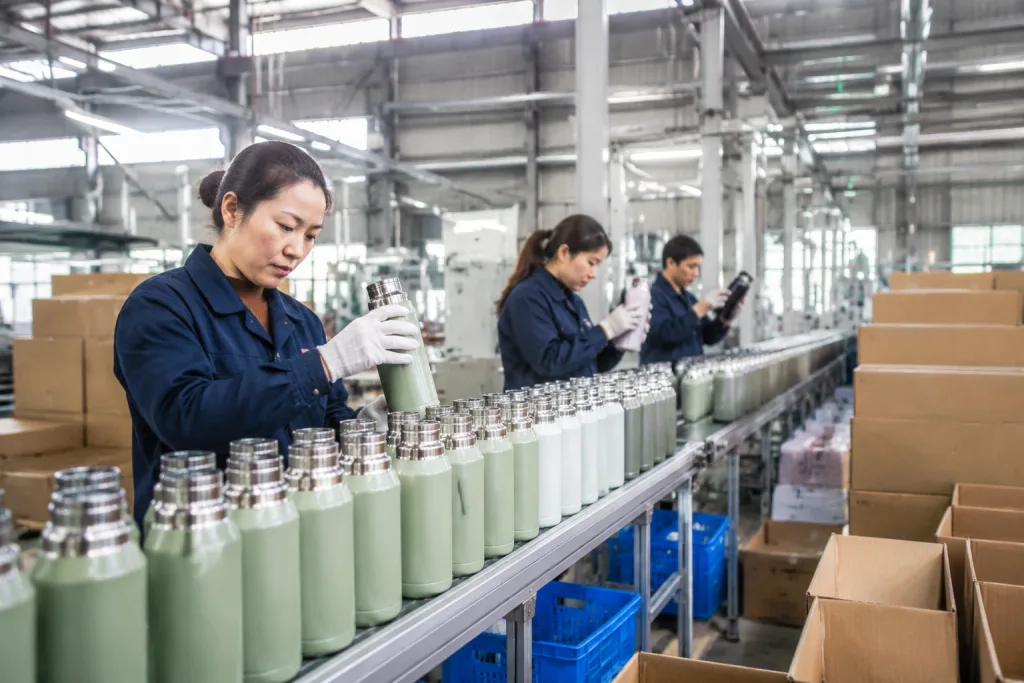
You do not buy a vendor thermos bottle like finished stock from a wholesaler. Once you add a logo, Pantone color, lid choice, retail box, barcode, and compliance file, it turns into a production job with real cost and timing risk. We run the first sample check with a caliper on the cup mouth, often 0.2 mm off is enough to make a lid feel loose.
Outdoor retailers and promotional brands usually ask first: “What is the unit price?” That is the wrong question to ask. The better one is, “What changes that price, and where can the schedule slip?” From our Hangzhou, Zhejiang production base, BottleForge Industrial quotes stainless thermos programs with MOQ tiers, material gauges, AQL inspection levels, and China export lead times before you place the PO. We have seen a 12-day sample plan become 18 days because the buyer flagged the powder-coat color, or because a PO typed “matte black” while the approved sample card said “sand black.”
Start with the real landed target
About 7 out of 10 failed vendor thermos bottle quotations start with “good quality, low price” in the RFQ. That is the wrong question to ask. Before we run a factory thermos program, we need the retail price, channel margin, freight assumption, and defect risk you can live with. Last month a buyer even typed “premium cheap” on PO line 6; our costing engineer circled it in red because no line chief can build to that spec.
For outdoor retail, a 500 ml to 750 ml stainless vacuum bottle often needs to land in Europe or North America at a cost that supports a 2.2x to 3.5x retail markup. If your retail shelf price is USD 24.99, your FOB China target may need to sit around USD 4.20-6.80, depending on ocean freight, duty, warehousing, and retailer margin. Promotional thermos orders are tighter because the bottle sits inside a campaign budget, not a normal retail margin. We ship a 500 ml powder-coated bottle at about 0.018 CBM per carton set; when the buyer forgets that number, the math breaks before production starts.
FOB pricing is not landed cost. On our quote sheet, we split these items before purchasing checks the 304 stainless coil price with a digital caliper on the sample wall thickness:
- FOB unit price: bottle body, lid, decoration, basic packaging, export carton, with the wall thickness and lid type stated.
- Tooling and setup: mold inserts, PMS color setup, laser jig, print screen, sample fees, including which cost is one-time and which repeats.
- Compliance: LFGB, FDA food-contact, REACH, Prop 65, or retailer-specific testing, with the test lab and sample quantity confirmed before bulk.
- Logistics: CBM, carton weight, palletization, FBA labels, delivery terms after port, plus carton size in mm so freight is not guessed.
A thermos manufacturer in China can make a cheap bottle look nice on a spreadsheet. The real test is whether the steel thickness, vacuum retention, coating adhesion, and packing method survive your channel. QC pulled the sample. On one distributor thermos program, 18 lids leaked after a 1.2 m drop test, and the buyer had been pushing us to save USD 0.18 per unit on the gasket. One container of leaking lids costs more than that saving.
MOQ tiers change the math
MOQ is not a punishment. It is the point where the line stops fighting the order. Setup, steel purchasing, logo fixtures, and QC checks start to make sense for both sides. For a custom thermos, MOQ is not one fixed number; it moves by model, Pantone color, logo method, and whether we run existing molds. Last month QC pulled the first 30 pcs from a 750 ml body run and found two laser logos sitting 1.5 mm off-center, which is exactly the kind of setup loss MOQ has to absorb.
At BottleForge Industrial in Zhejiang, a realistic starting point for a vendor thermos bottle is 1,000 pieces per model/color using existing molds. For thermos bulk programs with two colors, expect 2,000 pieces total. If the buyer wants a fully customized thermos with new lid tooling, special powder coat, and individual retail packaging, the MOQ usually moves to 3,000-5,000 pieces. The math doesn't work below that. A new lid mold needs trial shots, silicone ring checks, and 24-hour leak testing; we have seen lead time shift from 12 days to 18 days when a buyer added a custom flip cap after the PO was already signed.
Typical MOQ tiers look like this:
- 500 pieces: possible for laser logo on a stock color, but FOB price is usually 12-25% higher because the laser jig still needs alignment and first-piece approval.
- 1,000 pieces: practical entry tier for thermos custom orders using standard bottle bodies, with one logo position and one carton mark.
- 3,000 pieces: better coating efficiency and lower packaging cost; the powder coat line can run a full color batch without stopping for a 40-minute gun cleanout.
- 5,000-10,000 pieces: suitable for distributor thermos or outdoor retail rollouts across several stores, especially when the buyer needs barcode stickers and mixed master cartons.
The trap is mixing too many SKUs. If you request 1,000 units split across five colors and four lids, the thermos factory is not running a 1,000-piece order. It is running 20 tiny batches, each with setup loss, color-change waste, and extra AQL 2.5 inspection time. We had one PO where the buyer typed “matte sand” on line 3 and “sand beige” on line 7; the buyer flagged it only after the pre-production sample, and the line sat for half a shift. If budget matters, cut colors first. Do not cut wall thickness or lid sealing quality.
What drives unit cost up
Stainless thermos cost starts with the parts you can weigh on the line. Body steel, vacuum brazing, lid structure, coating, logo work, export carton, and QC level each add money. If a supplier thermos quote only says “750 ml, powder coated, packed,” the buyer is comparing fog. We usually ask for a BOM screenshot or at least body weight in grams, lid drawing, carton spec, and AQL 2.5 inspection scope before we treat the price as real.
For 304 stainless steel, common inner wall thickness is about 0.4 mm and outer wall thickness about 0.5 mm, depending on capacity and shape. Thinner steel cuts cost, but the math doesn't work if 3 cartons arrive with corner dents after a 1.2 m drop test. QC pulled a 500 ml sample last month with a 0.33 mm inner wall; it passed vacuum, then failed the hand-feel check because the shoulder flexed under thumb pressure. A 316 inner wall is possible for higher corrosion resistance, but it can add 10-18% to the metal cost portion and is not necessary for most coffee, tea, or water use.
Lids are the second big lever. Simple screw caps cost less and give fewer headaches. A push-button lid, straw lid, handle lid, or cup-cap set means extra molds, silicone seals, more assembly stations, and 100% leak testing on our water-pressure jig. On a 750 ml manufacturer thermos, lid complexity can move the FOB price by USD 0.35-1.20 per unit. The buyer flagged this twice in 2024: “same bottle, why higher price?” Because the lid had 9 parts instead of 3.
Surface finish changes both cost and schedule. Standard powder coating is still the best balance for outdoor retail because it gives grip and looks solid on shelf. Metallic paint, rubber paint, gradient color, or full-wrap print can look better in a campaign deck, but we’ve seen this go sideways when the Pantone chip, spray gun setting, and curved body do not agree. Expect extra setup cost, higher reject rate, and 3-7 more production days; our line often needs 2 trial panels and a cross-hatch tape test before mass production. For thermos promotional orders, laser engraving is clean and durable; silkscreen is cheaper for one-color logos but less forgiving on curved, textured surfaces.
Decoration and packaging costs
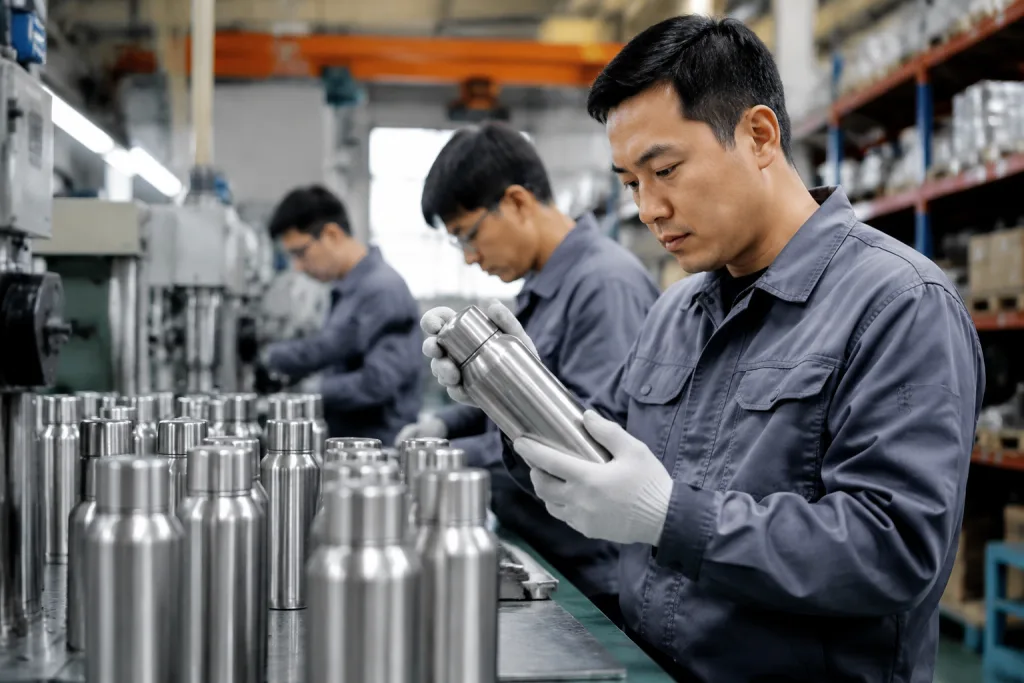
A custom stainless thermos gets expensive when branding lands after the PO is “almost final.” We see this a lot. Artwork is not just a logo file; our prepress desk needs Pantone C/U codes, placement in mm from the cup bottom or lid seam, print width, barcode size, carton mark layout, and the test target: 3M tape test, dishwasher claim, or a retailer abrasion spec. Last month QC pulled a sample where the buyer’s PDF said “black logo,” but the PO typed Pantone 426C; that mismatch stopped the line for 6 hours.
Logo cost ranges are usually predictable. Laser engraving on stainless or coated surfaces may add USD 0.15-0.45 per unit depending on size and run time; a 38 mm logo runs faster than a 92 mm vertical mark on a powder-coated bottle. One-color silkscreen can sit around USD 0.08-0.25 per position at volume, plus screen setup. Heat transfer or full-wrap graphics can add USD 0.45-1.50 per unit because the operator has to control seam alignment, film stretch, and rejects at the curing oven. For a customized thermos sold as a premium outdoor bottle, the cheapest print method is the wrong question to ask if it will be clipped to backpacks or washed daily.
Packaging is another quiet cost driver. A plain white box may add only USD 0.12-0.25. A printed retail box with corrugated insert can add USD 0.35-0.80, and we usually check the insert gap with a 1.5 mm feeler before carton approval. Gift tubes and molded pulp trays look better on shelf, but they can push a 24 pcs master carton from 14 kg to 17 kg and add empty space. Kraft sleeves, instruction leaflets, hang tags, and multilingual labels also raise labor time at the packing table. More volume means higher ocean freight per piece.
If you sell through online channels, lock FNSKU labels, suffocation warnings for polybags, master carton limits, and drop-test expectations before mass production. The math doesn’t work if 8,000 pcs arrive and Amazon prep needs relabeling at USD 0.35 per unit. For distributors thermos programs, we run one master carton plan for palletized wholesale and another for e-commerce replenishment, often with a 5-layer K=K carton and corner drop test at 76 cm. That planning adds a little work before production, but it prevents relabeling and repacking bills in the destination warehouse.
A realistic production timeline
Fast delivery only works when the thermos vendor locks the small details before the line starts. A normal stainless thermos custom order takes 35-60 days after deposit and approved pre-production sample. That range assumes existing tooling, standard 304 stainless coils, stock PP lid parts, and no failed FDA or LFGB check; last month QC pulled a sample because the silicone ring measured 0.4 mm under drawing.
A practical timeline looks like this:
- Quotation and specification: 2-4 working days if you send capacity, lid type, finish, logo size in mm, packaging style, and target quantity; we often lose 1 day when the PO says “matte black” but the artwork shows Pantone 433C.
- Artwork and sample confirmation: 7-12 days for a logo sample or 12-20 days for a color-matched pre-production sample, including laser position check on the rotary jig.
- Material preparation: 5-10 days for stainless coils, plastic parts, silicone seals, coating powder, and packaging board; for 5,000 pcs, one missing lid gasket can stop packing for a full shift.
- Mass production: 18-30 days depending on quantity, decoration steps, and line load; powder coating plus 2-position logo is not the same schedule as plain stainless.
- Inspection and booking: 3-7 days for AQL inspection, carton marking, vessel booking, and export documents; the buyer flagged a carton mark typo once, and reprinting labels cost us 2 days.
China holidays matter. Orders placed near Chinese New Year, National Day, or the July-August peak season need buffer. A thermos manufacturers quote that promises 20 days for a new custom color, new box, and 3 logo positions is usually counting on zero bottleneck and zero rework. We’ve seen this go sideways.
For outdoor seasonal programs, work backward from your warehouse delivery date. If you need goods in a North American DC by August 15, approve the pre-production sample by late May for ocean freight, because vessel space from Ningbo can slip 7 days in peak weeks. Air freight can rescue a launch, but a 750 ml stainless bottle is heavy; on bulk thermos orders, the math often doesn’t work.
Inspection protects your margin
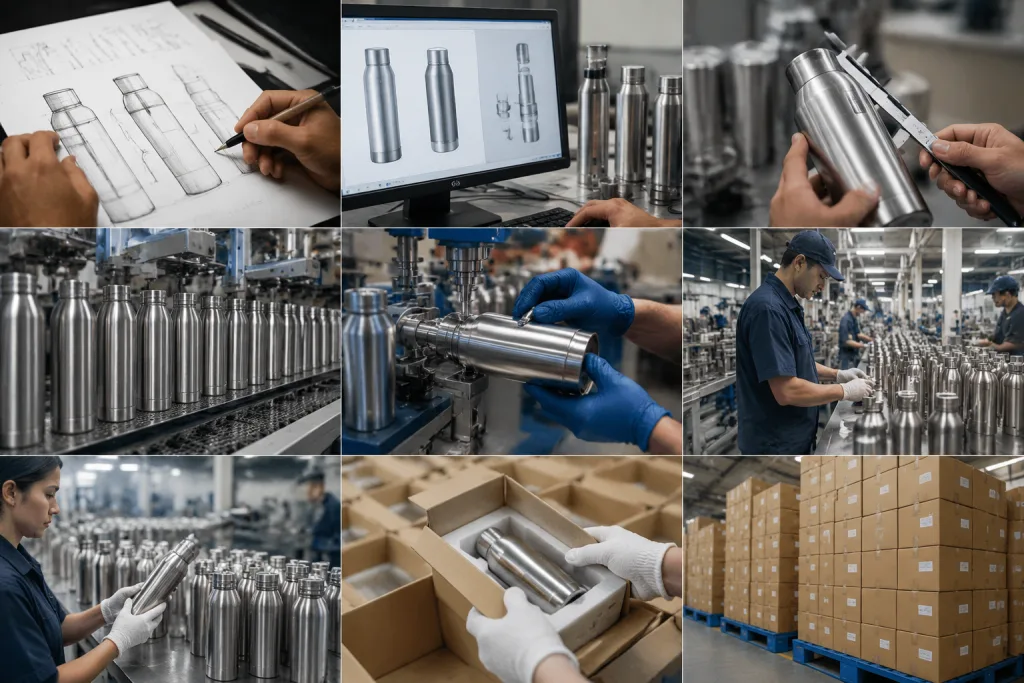
Quality control is not a final carton photo on WeChat. A stainless vacuum bottle has 8 common failure points: weak vacuum, missed welding, lid leakage, coating chips, rough rim finishing, print offset, seal odor, and crushed cartons. QC pulled a 500 ml sample last month with a 0.8 mm burr on the drinking rim; the buyer forgot the USD 0.06 price fight, but still remembered that return claim 14 months later.
For most thermos supplier orders, we run AQL 2.5 for major defects and AQL 4.0 for minor defects, with critical defects set at 0. Vacuum retention needs hot water testing, usually 95°C water with temperature logged after 6, 12, or 24 hours based on the claim printed on the color box. Leak testing should include inverted and shaking tests, especially for cup-cap and push-button lids; the line uses a simple 3-minute upside-down check before final packing, then QC repeats it from the inspection table.
For compliance, stainless drinkware sold into Europe often needs LFGB food-contact testing and REACH checks for coating or plastic parts. North American programs may require FDA food-contact conformity, ASTM-related packaging or child-use checks when relevant, and Prop 65 assessment for California distribution. If the bottle is for kids, treating it like an adult promotional thermos is the wrong call. We have seen this go sideways when a PO said “kids bottle” in one line but the artwork file and test request still used the adult SKU code.
BSCI or similar social audit documentation may be requested by larger retailers. ISO-style process control helps too, but the math does not work if you buy paperwork and skip records from the floor. Ask your thermos factory for incoming 304 stainless checks, vacuum test logs, coating adhesion results from the cross-hatch cutter, and final inspection photos tied to your PO. A good manufacturer thermos program is boring on inspection day because the risky work was controlled 12 days earlier, not argued about after cartons are sealed.
How to brief your supplier
A tight brief saves more money than hard price pushing. If you want thermos customized for retail or promotion, send one compact spec sheet, not 14 WeChat screenshots and a half-finished email thread. Include capacity, fixed dimensions in mm, lid type, inner and outer steel grade, finish, logo method, packaging, compliance market, order quantity, shipment term, and required delivery date. This matters on the line: our engineer checks the drawing with a digital caliper before tooling or sample work starts.
For example, a usable brief says: “750 ml double-wall vacuum stainless bottle, 304 inner and outer, powder-coated matte black, laser logo 45 x 30 mm on front, screw cap with carry handle, printed retail box, 3,000 pieces, FOB Ningbo, LFGB and REACH needed, warehouse deadline July 20.” Good brief. With that, a thermos manufacturer can quote within 2-3 working days because purchasing can price the 304 stainless, printing can confirm the laser area, and QC can check whether the lid gasket matches the compliance request.
A weak brief says: “Need best price for thermos bottle with logo.” This is the wrong question to ask. You will get a low supplier thermos price that probably excludes the carton drop test, color box, logo setup charge, or LFGB report you need later. We have seen this go sideways: QC pulled the sample after approval because the buyer flagged the logo at 38 mm wide, while the PO showed 45 mm.
At BottleForge Industrial in Hangzhou, Zhejiang, our monthly stainless drinkware output is about 450,000 units across thermos bottle, travel tumbler, and sports bottle lines. We are not the right China supplier for a 100-piece event giveaway. The math does not work once powder coating, laser setup, inner carton, export carton, and booking space are counted. We ship better when you need repeatable thermos bulk production, controlled decoration, export documents, and a production schedule your sales team can trust; our planner normally locks the line by SKU and carton mark before mass production starts.
Send your thermos specification for a costed quote
Share capacity, quantity, logo, packaging, and deadline. We will return MOQ, FOB price, sample timing, and production lead time.
Frequently asked questions
What is the lowest MOQ for a vendor thermos bottle with logo?
For an existing stainless thermos model, the practical MOQ is 1,000 pieces per model/color. We can sometimes support 500 pieces for laser engraving on a stock color, but the FOB unit price is usually 12-25% higher because setup, inspection, and packing labor are spread over fewer units. If you need custom powder coating, printed retail boxes, or a new lid color, plan around 1,000-3,000 pieces. For new mold work or a heavily customized thermos, 5,000 pieces is a more realistic starting point. Splitting 1,000 pieces into many colors is possible, but it often increases cost and adds 3-7 days.
How much does a custom thermos cost FOB China?
A standard 500 ml to 750 ml stainless vacuum thermos usually falls around USD 3.80-8.50 FOB China, depending on steel grade, lid design, coating, logo, packaging, and quantity. A simple screw-cap bottle with laser logo and white box sits near the lower end at 3,000 pieces. A premium outdoor bottle with powder coating, handle lid, retail box, and LFGB testing will be higher. New tooling, 316 stainless inner wall, full-wrap artwork, or gift packaging can push the quote up by 10-35%. Always compare quotes using the same specification, not just the same capacity.
How long should I allow for thermos bulk production?
For thermos bulk orders using existing tooling, allow 35-60 days after deposit and pre-production sample approval. The short end applies to standard colors, simple logos, and clear packaging files. Add 7-15 days for color matching, full-wrap decoration, new retail boxes, or peak-season line loading. Ocean freight to Europe or North America is separate and often adds 25-45 days port to port, plus customs and inland delivery. If your retailer has a fixed launch date, approve samples at least 90 days before the warehouse deadline. Air freight is possible, but stainless bottles are heavy and freight can erase margin quickly.
Which logo method is best for promotional thermos orders?
For promotional thermos programs, laser engraving is usually the safest choice when you want durability and a premium look. It normally adds about USD 0.15-0.45 per unit and works well on coated or stainless surfaces. Silkscreen is cheaper for simple one-color artwork, often USD 0.08-0.25 per position at volume, but it can wear faster on textured powder coating. Heat transfer or full-wrap printing gives stronger retail impact but may add USD 0.45-1.50 per unit and requires tighter artwork control. If the bottle will be used outdoors daily, choose durability before a slightly lower decoration cost.
What documents should a thermos supplier provide for retail buyers?
For Europe, ask for LFGB food-contact test reports and REACH documentation for coating, plastic, and silicone parts where applicable. For North America, request FDA food-contact conformity, Prop 65 assessment if selling into California, and any retailer-specific packaging or labeling files. For larger retailers, BSCI audit status, factory profile, QC flow, and AQL inspection reports may also be required. A proper thermos supplier should provide a specification sheet showing material grade, capacity, coating, lid components, carton size, gross weight, and country of origin. Get these before mass production, not after the shipment is waiting at port.