Key Takeaways
- Set vacuum retention targets at 6 hours and 12 hours, not just “keeps hot all day”
- Use 304 or 316 stainless steel specs with wall thickness and passivation requirements
- Approve decoration with a 20-50 pc pre-production sample run before bulk printing
- Set AQL 2.5 for major defects and AQL 4.0 for minor defects on export orders
A vendor thermal bottle order usually fails before the line even opens. We see it at the drawing stage: wall thickness missing, lid thread shown without tolerance, or the PO says “black logo” while the artwork file is Pantone 426C. Bad start. The buyer approves the sample in 2 days, then assumes every canteen manufacturer in China runs the same 304 stainless, vacuum furnace, and 0.6 MPa leak test. They do not. Two bottles can look identical in a catalog and still behave differently after 60 days in a warehouse or 500 cycles in a dishwasher.
From our factory in Hangzhou, Zhejiang, we see 5 problems repeat: weak insulation, lid seepage, scratched coatings, wrong logo placement, and cartons that fold during ocean freight. Last month QC pulled a 750 ml sample where the logo sat 4 mm off center; the buyer flagged it before we packed the master carton. BottleForge Industrial runs thermal bottle and custom drinkware programs from 3,000 pcs MOQ, with typical output around 450,000 units/month and normal lead time of 35-45 days after deposit and artwork approval. The cheap quote is not always the win. We’ve seen that go sideways.
The insulation claim is too loose
The costliest failure in a vendor thermal bottle program is not a dent or a crooked logo. It is a bottle that cannot hold temperature, because customer complaints start after the goods are already in cartons. Last quarter we saw 17 RFQs asking for “24 hours cold, 12 hours hot” with no starting temperature, room temperature, lid position, fill volume, or test method. QC cannot inspect that. It is a marketing line, not a spec, and the buyer flagged it only after the pre-shipment sample came back at 52°C after 6 hours.
For a serious B2B order, write the thermal requirement like an engineer. Use a test line like this: fill 500 ml bottle with 95°C water to 95% capacity, close lid within 30 seconds, test at 20-25°C ambient, temperature must remain above 60°C after 6 hours and above 45°C after 12 hours. That gives our lab tech a thermometer, a timer, and a pass/fail point. For cold testing, use 4°C water without ice unless your retail claim mentions ice; ice hides weak vacuum performance, and we have seen that go sideways in supermarket programs.
Vacuum failure usually starts with poor base welding, contamination before vacuum sealing, or thin inner walls deforming on the line. For most stainless thermal bottles, we recommend 0.4-0.5 mm inner wall and 0.5-0.6 mm outer wall depending on shape. The math does not work when a buyer asks us to cut 18 grams from a 500 ml bottle and still pass the same drop test. Light bottles look nice in a freight quote, but they dent faster, and QC pulled 32 samples last month where the base weld was fine yet the inner wall had already ovalized.
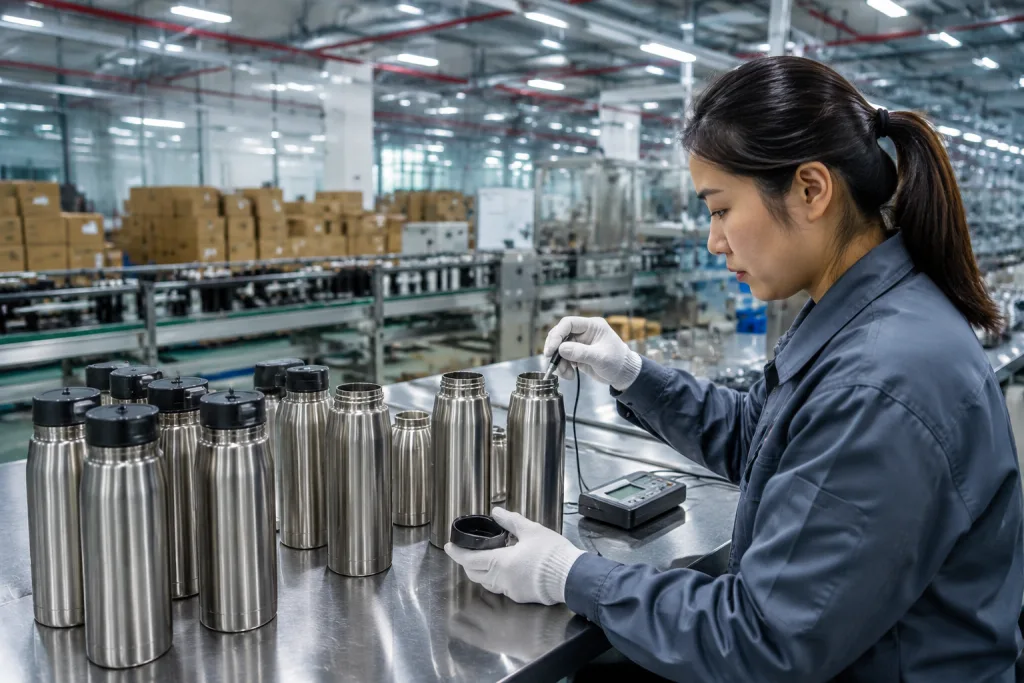
If you are a canteen distributor or distributor drinkware buyer, ask the canteen factory for actual test records from the last production lot, not just the catalog page. A solid canteen supplier in Zhejiang or elsewhere in China should show temperature curves, vacuum rejection rate, and sample quantities. At BottleForge, we pull thermal samples from each production batch and record 6-hour and 12-hour retention before packing approval. For a 3,000 pcs order, we normally run 12 thermal samples; if the PO has a typo like “12 hours above 60°C” instead of “6 hours above 60°C,” we stop and confirm before mass packing.
The lid passes once, then leaks
Leakage is the defect that drags a normal customized drinkware order into a claims meeting. Simple reason: one upright water test means almost nothing. A lid can sit dry on a buyer’s desk, then leak after carton vibration, hot-fill expansion, or 200 open-close cycles on the line. For a vendor thermal bottle, the lid is the risky part because plastic injection shrinkage, silicone gasket squeeze, thread tolerance at 0.15 mm, and real user torque all meet in one small assembly. We’ve seen this go sideways.
Do not approve a lid only because the golden sample stayed dry for 10 minutes. That is the wrong question to ask. Specify a leak protocol the factory can run every day, not a showroom trick. We run a 100% inline inverted leak test for screw-cap bottles: fill with room-temperature water, close to normal hand torque, invert for 3-5 minutes, then QC checks the tissue paper under the cap for seepage. For sports lids or straw lids, add a shake test and a 45°C warm-water test; warm air expansion finds weak gasket seats fast. Last month QC pulled 18 samples from a 3,000 pcs run after two caps showed wet threads.
The gasket matters more than most buyers think. Food-grade silicone should come out for cleaning, but it cannot sit so loose that it drops into the sink after the third wash. Shore A 50-60 is common for bottle gaskets, but the correct hardness depends on groove depth, gasket width, and how much compression the thread gives after tightening. If the gasket is too hard, it misses small tolerance gaps. If it is too soft, it rolls or mushrooms after repeated tightening. On our caliper check, a 0.3 mm shallow gasket groove is enough to make the math fail.
For canteen custom projects, ask your canteen manufacturer to define lid material clearly: PP, Tritan, ABS, or stainless outer shell, plus silicone gasket grade. If you sell in the EU, request LFGB or EU food contact declarations where relevant. For North America, specify FDA food contact compliance and, for kids or promotional programs, check CPSIA or ASTM requirements where applicable. Canteen vendors who cannot document lid material should not touch your retail or promotional order. We once had a PO say “plastic lid, food safe” with no resin code; the buyer flagged it, and the shipment waited 12 days for the supplier declaration.
The steel grade is assumed
“Stainless steel” is not a spec. A vendor thermal bottle for retail, corporate gifting, or distributor canteen programs should name the steel grade for the inner liner and the outer shell. We run 304 stainless steel on the inner wall as the normal export choice because it passes food-contact requirements, resists corrosion, and buyers know it. For salty drinks, outdoor retail, or a premium shelf position, 316 stainless steel works, but the math changes: coil cost goes up and MOQ planning often moves from 3,000 pcs to 5,000 pcs per color.
Some buyers push for the cheapest price and end up with 201 stainless on the outer shell without spotting it on the quote sheet. 201 cuts cost, but it has lower nickel content and weaker corrosion resistance than 304. If you spray powder coating over 201, rust can show early around scratches, weld seams, or the bottom edge where the bottle sits in a cup holder. We have seen QC pull a sample after 24 hours in a salt spray cabinet because orange dots appeared beside the laser-weld line. For most export custom canteen orders, we suggest 304 inner and 304 outer when the item is sold as premium. For entry-level canteen promotional work, 304 inner and 201 outer is only acceptable when the buyer signs off on the trade-off in writing.
Passivation gets missed. During welding and polishing, free iron can stay on the surface, especially near the neck thread and base weld. Without passivation or proper alkaline cleaning, rust spots can appear even on 304 steel, and the buyer will not care that the coil certificate looked fine. Your PO should state material grade, food-contact compliance, and surface treatment requirements. Be direct. If the factory claims 304, request an XRF material check on incoming steel coils and a random check on finished goods; on our line, QC scans 3 pcs per 1,000 pcs before packing when the buyer asks for it.
A practical FOB China price range for a 500-750 ml double-wall 304 thermal bottle is often USD 3.20-6.80 depending on cap structure, coating, carton packing, and order quantity. A custom growler or customized growler in 1.2-1.9 L capacity runs higher because of steel weight, handle tooling, and larger export cartons; a 1.9 L growler carton can jump from 9 kg to 14 kg gross weight per master carton. If a canteen vendor quotes 20-30% below the market, ask where the saving comes from before you approve it. This is the wrong place to chase a tiny unit-price win.

Decoration fails after real handling
Logo work causes 7 or 8 avoidable headaches in a normal customized canteen or customizable drinkware order. The buyer approves artwork on a flat PDF, then the line has to print it on a curved, tapered, powder-coated bottle at 900 pcs per hour. That changes everything. We have seen 1.2 mm text fill in, 0.3 mm hairlines break, and full-wrap art drift 4 mm at the overlap when the fixture is not locked tight.
Pick the decoration for the abuse it will take, not for the prettiest mockup. Laser engraving holds up well on 304 stainless or coated bottles, but the final mark can read silver, dark gray, or yellowish depending on the coating thickness and base steel. Silk screen works for one- or two-color logos on straight walls; on deep curves or wrap areas over 180 degrees, the math doesn't work. Heat transfer gives richer graphics, but QC needs to run abrasion checks with the rubber rub tester. UV print handles multi-color artwork, but adhesion has to match the coating system, or the buyer flags peeling after the first carton sample.
For canteen customizable programs, we ask for vector artwork, Pantone references, logo size in millimeters, print position measured from the base or centerline, and tolerance such as ±2 mm placement. Never write “logo same as sample” unless the sample is signed, sealed, and sitting on our QC desk with the PO number taped to it. We once had a PO typo that said 65 mm instead of 56 mm, and the logo landed too close to the bottom radius. For a 5,000 pc order, a 20-50 pc pre-production decoration run is cheap insurance. It lets you check color, registration, adhesion, and packing rub marks before the full line runs.
Test decoration the way the customer will abuse it. A 3M tape pull test catches weak adhesion, but it misses sleeve rub and wet-hand wear. We run 100 dry cloth rub cycles and 50 damp cloth cycles on coated promotional items, then QC pulls the sample under a 600 lux inspection lamp. For dishwasher-safe claims, push back early: most powder-coated bottles with printed logos should be sold as hand-wash only unless the ink and curing window have passed batch testing. A canteen suppliers list may all say “logo available,” but only 2 out of 10 factories we audit control curing temperature, ink compatibility, and operator setup well enough for repeat distributor growler and custom drinkware orders.
Coating looks good, then chips
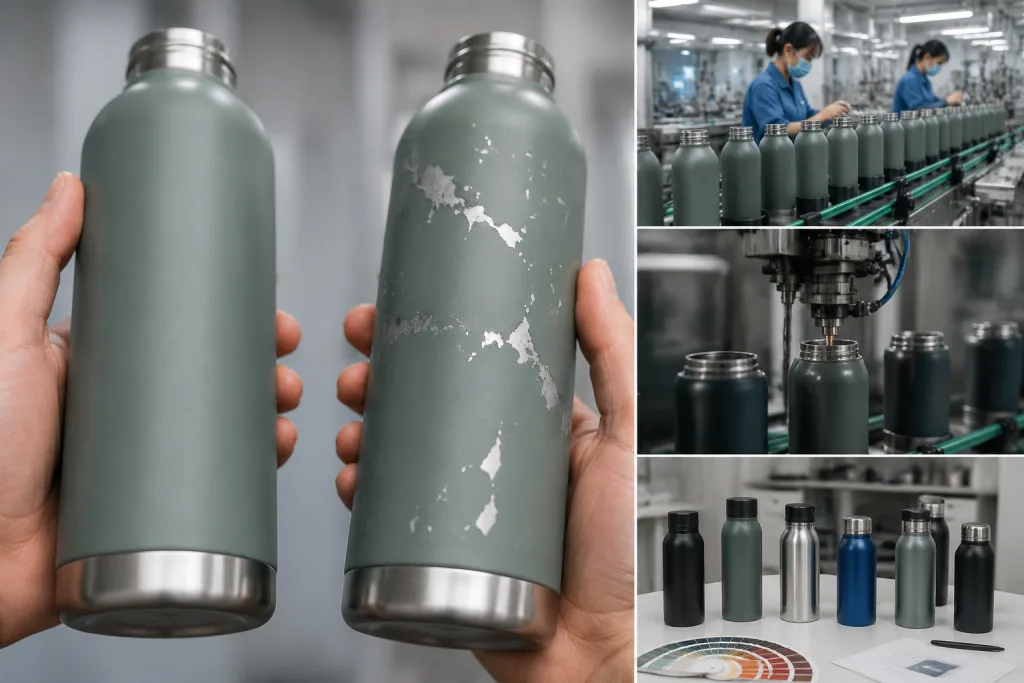
Powder coating sells bottles because buyers like the warmer hand feel and brand teams get tighter color control than bare steel. But coating fails in public. QC pulled 32 samples from a 3,000 pcs pilot run last month, and 7 showed base chips after the conveyor rail rubbed the radius before packing. Chipping at the base, peeling near the shoulder, and shiny spots in a matte finish usually trace back to weak degreasing, short oven time, uneven powder build, or rough handling before the carton is closed.
For a vendor thermal bottle, write the coating thickness and adhesion standard into the PO, not just “good powder coating.” We run most bottles at 60-90 microns, checked with an Elcometer gauge at the body, shoulder, and base. Too thin, and the shade looks cloudy or scratches during sleeve packing. Too thick, and the math doesn't work: threads tighten, lid fit changes, and a 73 mm cup-holder target can become 74.5 mm after coating. Cross-hatch adhesion testing is the right approval check for orders above 10,000 pcs. For outdoor retail items, add abrasion testing and 60-80 cm base-drop checks onto a fixed test board.
Color matching needs a real sample, not a nice PDF. Pantone on paper is not powder on 304 stainless, and we have seen buyers flag a “black” bottle that passed in the office but looked brown under D65 lighting. Ask for a coated metal chip or a physical bottle sample if the color carries the brand. For repeat canteen customized programs, keep one signed master sample in the factory sample room and one with your team; our shelf tags include item code, powder batch, and approval date. Six months later, that little tag saves a long argument.
Base design matters more than buyers expect. Sharp lower edges chip faster during filling, foam-bagging, and daily use, especially when the line runs 1,200 pcs per hour and bottles touch the stainless guide rail. A silicone boot cuts complaints, but it adds cost, hand labor, and odor risk if the silicone is cheap; we reject boots that smell after a 70°C hot-box check. A good canteen manufacturer will push back when your requested finish is risky. A weak canteen supplier will take the artwork, ship the goods, and leave your customer service team with the damage photos.
Packing is treated as decoration
Export packing is not decoration. It decides whether your canteen promotional order lands sellable after 30-40 days of ocean freight, warehouse transfers, and courier handling. Last month we had 3 buyers spend 2 days on logo height in mm, then approve the carton spec in 6 minutes. Wrong priority. If you ship to Europe or North America, carton crush, corner dents, and wet labels cost more than a slightly larger logo.
For standard thermal bottles, we run individual white boxes or kraft boxes most often. Retail color boxes need 350 gsm or stronger board, clean die-cut edges, and artwork checked against the printed proof, not just the PDF. For e-commerce or Amazon FBA programs, the box has to survive parcel drop handling, not only palletized freight. Specify carton ply, outer carton dimensions, gross weight limit, and drop test requirements. We prefer keeping master cartons under 15 kg when possible; once cartons hit 18 kg, the line sees more crushed corners and tape splits during loading.
If you are a distributor canteen or distributor drinkware buyer, barcode and label control matters. Confirm FNSKU labels, suffocation warnings for polybags, country of origin, item code, carton marks, and mixed-SKU rules before packing starts. QC pulled the sample carton on one order because the PO said “navy” but the carton mark typed “naby.” Small typo, big delay. Fixing label errors after cartons are sealed is slow and expensive. For FOB Ningbo or FOB Shanghai shipments from Zhejiang, relabeling usually adds 2-4 days and puts every carton through extra handling.
Moisture is another real issue in China export seasons. If bottles are packed before the inner cavity is dry, trapped moisture can create odor, spots, or carton softening. We check with a flashlight at the mouth and leave caps open on the rack when the line is moving too fast. Use dry inner cavities, clean caps, and desiccant when the route or season calls for it. A canteen distributors program with 4 colors should also use clear carton coding, because warehouse teams can mix matte black, navy, and charcoal under poor lighting.
Inspection happens after decisions are irreversible
Final inspection helps, but it is not magic. If you wait until 100% of a vendor thermal bottle order is packed, the math doesn't work: accept defects, rework 320 cartons under time pressure, or miss the vessel cut-off by 12 days vs 18 days. Better QC starts when the PO is written. We run incoming material checks on 304 stainless coil with a handheld thickness gauge, then catch line problems before the tape gun seals the master cartons.
Use AQL language clearly. For export drinkware orders, we usually see AQL 0 for critical defects, 2.5 for major defects, and 4.0 for minor defects as a workable starting point. Critical defects mean unsafe sharp edges found by the cotton-glove wipe, contamination inside the cup, wrong material, or leakage over 30 ml in a 3-minute inverted test. Major defects mean insulation failure after the hot-water station check, wrong logo against the approved artwork, poor lid fit with cross-threading, exposed rust, or coating damage larger than the signed limit sample. Minor defects are small cosmetic marks inside the agreed viewing distance and size limit.
Define what you will inspect. A normal checklist should cover capacity and weight with actual tolerance, dimensions in mm, wall finish under the light box, color against the Pantone chip, logo position from the rim, lid torque feel, leak test, thermal retention sampling, barcode scan, carton drop condition, and packing count. For customizable growler and custom canteen items, add handle strength with a 20 kg pull test, cap tether pull, and accessory checks against the BOM. If the order includes 6 SKUs, require a packing matrix and first-carton approval before mass packing; we have seen this go sideways when one PO had “matte black” in the email and “gloss black” in the attachment.
At BottleForge Industrial in Hangzhou, Zhejiang, we prefer staged approval: material confirmation, pre-production sample, inline inspection at 20-30% completion, and final inspection before shipment booking. Strict? Yes. Cheaper than arguing over 8,000 leaking lids after arrival. Last quarter, QC pulled the sample at 25% completion and found 14 lids with a silicone gasket seated 1.5 mm off-center, so the line stopped before the buyer's launch cartons were printed. Whether you work with one canteen factory or several canteen manufacturers in China, your spec should make failure visible early, not after your distributor customers have already scheduled launch dates.
Send your thermal bottle spec for factory review
We will check materials, lid risk, decoration method, MOQ, FOB price range, and QC points before you place a production order.
Frequently asked questions
What MOQ should I expect for a vendor thermal bottle order?
For most custom drinkware projects, 3,000 pcs per model is a practical MOQ when using standard molds and standard colors. If you need a new mold, custom lid, or special powder color, the MOQ may rise to 5,000-10,000 pcs because coating, injection, and setup losses increase. A canteen promotional order with one-color silk screen can sometimes start lower if the bottle body is in stock, but do not build your launch plan around that. For a canteen customized retail program, 3,000 pcs gives the factory enough volume to control decoration, packing, and QC without pricing every unit like a sample.
How long does production take after sample approval?
A normal vendor thermal bottle order takes about 35-45 days after deposit, artwork approval, and final sample confirmation. Add 7-12 days if you need a new powder color, complicated heat transfer artwork, or several SKUs packed into mixed cartons. New mold development can add 25-45 days before mass production even starts. From Zhejiang, FOB Ningbo is usually efficient, but label mistakes, late barcode files, or delayed third-party inspection can still push shipment by 3-7 days. The fastest orders are not rushed; they are the ones with complete specs at the beginning.
Should I choose 304 or 316 stainless steel?
For most customized drinkware and custom canteen orders, 304 stainless steel is the right default for the inner liner. It is food-safe, stable, and cost-effective. Choose 316 if your product is positioned for marine use, salty drinks, or a premium outdoor segment where corrosion resistance is a selling point. Expect 316 to increase material cost and sometimes MOQ because fewer factories keep it ready for bottle production. If a canteen supplier simply says “stainless steel,” ask for the grade in writing and request an XRF check. The inner wall grade matters more than the outer shell for food contact.
What logo method is best for distributor drinkware?
For distributor drinkware, laser engraving is the safest choice when durability matters and the design is simple. Silk screen is good for low-cost one-color branding on straight bottle walls. Heat transfer or UV print works better for multi-color designs, but you should approve a 20-50 pc pre-production run and run adhesion tests before bulk production. If the bottle is powder coated, decoration depends on coating chemistry and curing quality. A canteen vendor should tell you the printable area in millimeters, placement tolerance, Pantone limits, and whether the item should be sold as hand-wash only.
How do I compare quotes from canteen suppliers fairly?
Compare the same specification, not just the unit price. Ask every canteen manufacturer for capacity, steel grade, wall thickness, lid material, gasket material, coating type, logo method, packing, MOQ, lead time, AQL standard, and FOB port. A USD 3.40 bottle and a USD 4.10 bottle may not be equivalent if one uses 201 outer steel, thinner walls, weaker coating, or lighter cartons. For canteen distributors, freight damage and customer returns can erase a 5-8% unit price saving quickly. Put the spec table in your RFQ and require exceptions to be marked line by line.