Key Takeaways
- Plan 1,000-3,000 units MOQ for most custom logo infuser bottle projects
- Tritan bodies usually cost USD 1.85-3.40 FOB depending on lid, basket, and packaging
- Tea-focused models need 304 stainless infusers with 0.4-0.6 mm perforation holes
- Confirm REACH, LFGB, FDA food-contact, and AQL 2.5/4.0 before bulk production
A vendor tea infuser bottle looks simple until samples hit the bench. One supplier quotes Tritan, another switches to PP, one infuser basket picked up brown tea marks after 2 brew tests, and the cheapest FOB offer removed the spare silicone gasket from the carton spec. We see this often. For a wellness brand or hydration startup, those “small” choices turn into chargebacks, launch delays, and 1-star reviews that are hard to clean up.
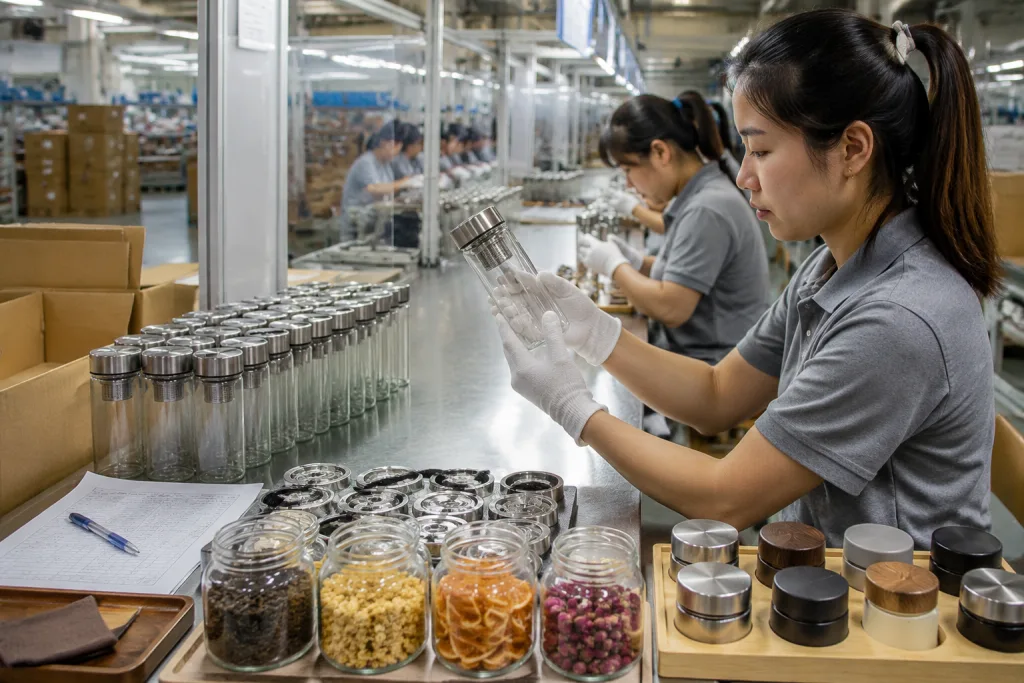
You need a buying checklist, not a pretty catalog. At BottleForge Industrial in Hangzhou, Zhejiang, we run custom infuser bottle programs for buyers who care about taste, leakage, packaging, compliance, and repeat orders. A typical factory infuser bottle project starts at 1,000 units per color, with 25-35 day production after sample approval in China; QC pulled one recent sample because the tea basket rim was 0.4 mm out and the cap would not seat cleanly on the leak tester.
Start with the drinking use case
The first decision is not color or logo. Ask what the buyer will brew or soak. A vendor tea infuser bottle for loose-leaf tea needs a different build from a bulk fruit infuser bottle sold for lemon water or gym hydration. We saw this go sideways on a 3,000 pcs trial order when the PO said “tea bottle,” but the buyer’s Amazon photos showed cucumber slices. QC pulled the sample, and the basket was wrong for both jobs.
For tea, the infuser basket carries the product. We run 304 stainless steel mesh or a perforated tube with 0.4-0.6 mm holes for green tea tips and cut herbal blends because small leaves escape through bigger holes. A cheaper PP basket saves around USD 0.08-0.12 per unit and passes basic food-contact tests, but it picks up tea stain and mint smell after 5-7 wash cycles. For fruit water, bigger openings are fine, but the chamber needs volume. A narrow 30 mm fruit rod looks clean in a render; on the line, it barely takes three strawberry slices.
Capacity is the trade-off buyers underestimate. Wellness brands usually choose 500 ml or 650 ml because those sizes fit office bags and most 72 mm cup holders. Gym and hydration accounts often ask for 700-800 ml, then push back when the carton CBM lands on the quote sheet. The math does not work in every market. A 700 ml bottle can take 18-22% more carton space than a 500 ml model, even when the FOB price difference is only USD 0.20, and our carton test uses a 5-layer K=A box at 12 kg gross weight.
If your range includes both a custom tea infuser bottle and a custom fruit infuser bottle, do not force one mold to do every job. A shared body with interchangeable baskets can work, but the lid seal, neck diameter, and basket depth need to be drawn together on the same 2D file. We check this with a 0.3 mm feeler gauge around the silicone ring before pilot run, because one loose lid ruins the whole set. Factory direct infuser bottle sourcing in Zhejiang, China gives you control here, instead of picking random open-stock units from trading catalogs.
Choose material before decoration
Your material choice sets the taste, test report path, breakage rate, and shelf price. We usually quote 4 body options for vendor tea infuser bottle projects: Tritan, borosilicate glass, stainless steel, and food-grade PP. None wins every order. Last month QC pulled the sample from line 3 because the buyer wrote “glass look” on the PO, but the artwork file showed a Tritan bottle.
Tritan is the safe pick when you need startup volume. It looks clear, takes drops better than glass, is BPA-free, and works for fruit water or cold-brew tea. For a 650 ml factory tea infuser bottle with Tritan body, 304 stainless basket, flip lid, and color box, a realistic FOB Ningbo or Shanghai range is USD 2.10-3.20 at 3,000 units. Wall thickness is usually 1.8-2.3 mm. Go to 1.6 mm and the bottle feels thin in the hand; go to 2.5 mm and the math changes on resin cost and carton weight. We check this with a digital caliper before the buyer sees the pre-production sample.
Borosilicate glass gives cleaner tea flavor and shoots well for wellness listings. It also breaks. We recommend 2.0-2.5 mm glass wall thickness, silicone sleeve coverage of at least 70% of the body, and drop testing from 80 cm in retail packaging. For one German order, 6 bottles cracked at the bottom radius during the first carton drop, so we changed the inner tray from 250 g white card to molded pulp. Glass is a strong choice for a customized tea infuser bottle. It is the wrong question to ask if the customer expects gym-bag durability and Amazon-style returns.
Stainless steel usually fits insulated tea infuser bottles. A double-wall 304 stainless body with copper coating can hold hot tea for 6-8 hours, but the buyer loses the visual fruit infusion that sells well in photos. We run vacuum testing after welding, then check for pinhole leaks in the water tank. This product sits closer to thermos sourcing than a clear tea bottle, so decoration choices also change: laser logo, powder coating, or one-color silk screen.
PP is the low-cost route for a bulk infuser bottle promotion. It works for a 5,000-20,000 piece short campaign, especially when the target is a giveaway rather than repeat retail. Wellness brands should be careful. If you are building a premium custom made infuser bottle line, PP can fight the brand message before the customer even opens the lid. Europe buyers flag odor, dishwasher performance, and REACH documentation fast; we have seen a project go sideways over a 0.3 mm sink mark near the handle gate.
Decide the infuser architecture
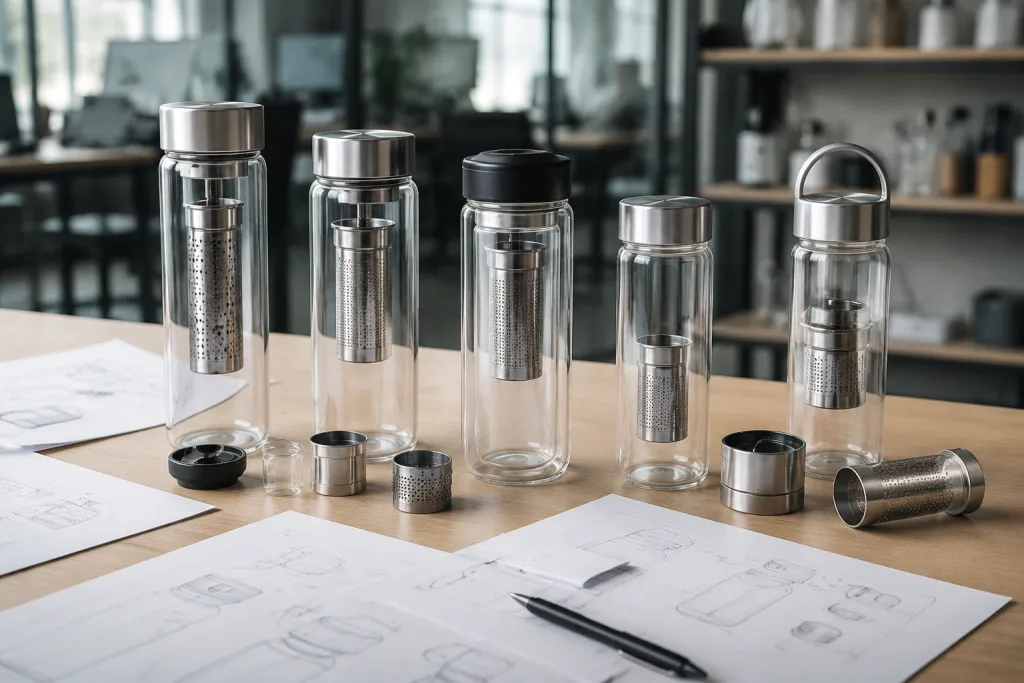
The third decision is how the infuser locks into the bottle. This changes cleaning time, leak risk, brew strength, line assembly speed, and spare-part planning. We usually see 3 structures on buyer POs: top basket, bottom fruit rod, and full-length removable chamber. QC checks this at the tilt test station with 60°C water, because a nice drawing means nothing if the basket drops into the tea.
A top basket works best for tea. The user opens the lid, loads tea, and pulls the basket when the brew is strong enough. For a bulk tea infuser bottle, do not accept a basket that only sits loose in the neck. We run threaded or bayonet-lock baskets on better models, with a 0.3 mm fit tolerance on the lid mold. A press-fit basket saves about USD 0.06-0.10 per unit, but we have seen this go sideways when a buyer’s Amazon review photo showed hot tea leaves floating in the bottle.
A bottom fruit rod looks clean and keeps fruit below the drinking spout. It fits customized fruit infuser bottle programs and distributor infuser bottle assortments where shelf photos matter. The weak point is cleaning. If the bottom cap has a deep thread channel, pulp sits there after 2 washes. Ask for a 1.5-2.0 mm thread radius and removable silicone gasket. Also write the gasket into the spare-parts list, not just the BOM for first assembly, or the math does not work when 200 replacement requests arrive after shipment.
A full-length chamber gives the strongest display effect for a customizable fruit infuser bottle. It also adds plastic weight and slows water flow, especially when the chamber wall uses small 1.2 mm slots instead of larger oval cuts. For fruit infuser bottle bulk orders aimed at retail shelves, the look can pay for itself. For subscription wellness kits, this is the wrong question to ask; a simpler top basket usually cuts customer support emails because users clean it faster with a normal bottle brush.
One practical detail: confirm the mouth opening on the sample, not only on the PDF. Anything under 45 mm is annoying for fruit loading and bottle brushing; our caliper check has caught 43.6 mm mouths marked as 45 mm on a PO before. For tea-only use, 38-42 mm is acceptable. For a combined custom infuser bottle, we usually recommend 50-55 mm because it handles ice cubes and fruit slices without making the lid look bulky.
Price the real finished product
FOB price is not a price until the quotation locks the parts. For a vendor tea infuser bottle quote, we ask the merchandiser to spell out body material and thickness in mm, lid resin or metal spec, tea basket grade, gasket material, logo method, inner packing, master carton size, AQL 2.5 inspection level, and spare parts ratio. If a supplier writes only “infuser bottle, logo included,” the math doesn’t work. Last month our sales desk caught a PO typo that changed “Tritan body” to “AS body,” which would have saved USD 0.18 per unit and caused a rejected shipment.
From our China production floor, a 500-650 ml Tritan factory infuser bottle usually lands around USD 1.85-2.60 FOB for simple one-color printing and polybag packaging at 5,000 units. Add a 304 stainless tea basket, matte lid finish, silicone carry loop, and kraft color box, and the range moves to USD 2.45-3.40. Borosilicate glass with sleeve and stainless basket commonly sits at USD 2.80-4.20 depending on sleeve coverage and packaging protection. We run the Tritan line with a 0.02 mm caliper check on mouth diameter because one loose lid thread can turn a cheap quote into a leak claim.
Logo method changes cost and risk. Silk screen is cheap and clean for one or two colors on a flat area. Laser engraving works on stainless lids or metal sleeves, not clear plastic bodies. Heat transfer gives stronger retail artwork, but we’ve seen this go sideways when buyers skip abrasion testing. For a custom logo infuser bottle, ask for 3M tape test, 300-cycle rub test, and dishwasher guidance before approving mass production. QC pulled the sample on one 8,000-piece order after the black logo lost edges at 180 rub cycles.
Packaging changes the landed cost faster than some buyers expect. A plain white box may cost USD 0.12-0.18. A 350 gsm printed color box with insert can cost USD 0.28-0.45. If you sell through distributors tea infuser bottle channels, retail packaging earns its space. If you sell B2B wellness kits, a recyclable kraft box is usually enough. BottleForge Industrial in Zhejiang currently handles up to 450,000 drinkware units per month across bottle and tumbler lines, but packaging lead time can still add 5-7 days if artwork changes late. The buyer flagged a barcode size once, and the box vendor needed 6 extra days to remake plates.
Set compliance and inspection rules
Set compliance before sampling, not after your distributor chases documents 3 days before shipment. For North America, we normally prepare FDA food-contact documentation; for children’s use, check CPSIA and ASTM points before the mold drawing is approved. For Europe, ask for LFGB or EU 10/2011 where applicable, REACH restricted-substance screening, and packaging heavy metals limits. If the bottle uses silicone, confirm the silicone grade and migration test scope; QC pulled one sample last year where the supplier wrote “food grade” on the spec sheet, but the gasket batch had no test report tied to the lot number.
Factory audit rules depend on where you sell. Some wellness brands accept basic ISO 9001-style process control, with incoming material records and 2-hour line patrol sheets. Larger retailers often ask for BSCI, Sedex, or a customer-specific social audit. If you plan to sell a distributor tea infuser bottle line into European retail, ask about audit support before the purchase order. Audit scheduling can take 2-4 weeks, and we have seen this go sideways when the buyer flagged it after cartons were already printed.
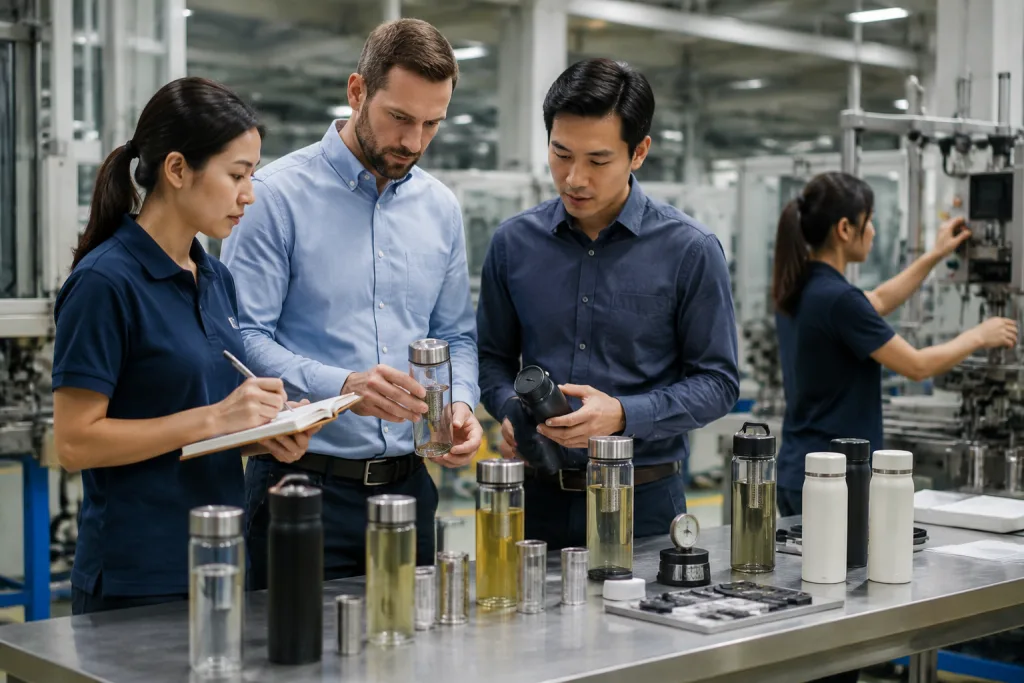
Write inspection terms into the purchase order. No shortcut here. For most bulk infuser bottle projects, we suggest AQL 2.5 for major defects and AQL 4.0 for minor defects, using general inspection level II. Critical defects should be zero tolerance. Our usual checklist covers leakage after 30 minutes inverted, lid torque checked with a torque meter, gasket placement, logo position within ±1.5 mm, color difference against the approved sample, carton drop test, and barcode scan. The buyer may push back on inspection cost, but the math does not work if 3,000 bottles arrive with loose tea baskets.
For Amazon or DTC fulfillment, add FNSKU or UPC scan checks to the PO. For wholesale cartons, confirm inner pack quantity and master carton gross weight. A carton above 15 kg may be acceptable for sea freight, but warehouse teams hate lifting it all day. We ship plenty of China export production, and these details are normal when they are locked early; if not, the line will pack for speed, not your downstream process. One PO typo, “24 pcs/ctn” instead of “12 pcs/ctn,” can change pallet height by 180 mm.
Plan samples, MOQ, and launch timing
A realistic launch calendar keeps the buyer from forcing bad choices. For a factory direct infuser bottle, we run open-mold samples in 3-7 days when you accept stock colors and a blank body. Custom color matching normally takes 7-10 days after Pantone confirmation; our color tech checks the chip under a D65 light box before the line releases resin. Logo samples need another 5-8 days, depending on silk screen, pad print, or heat transfer. New mold work is a different job: plan 30-45 days for tooling and first shots, then leave room for revisions if QC pulls sink marks around the lid thread.
MOQ is not just a sales policy. It comes from resin color batching, lid injection setup, printing screens, packaging minimums, and assembly speed on the line. For a custom infuser bottle using existing molds, 1,000 units per color works on about 8 of our regular models. For custom Pantone colors, 3,000 units per color is the cleaner number because the color mixer and injection barrel need a stable run. For a customized infuser bottle with new lid tooling, the first order may need 5,000-10,000 units, or the mold cost per bottle makes the math look ugly.
If you are testing a wellness concept, start with one body, two colors, and one packaging format. Keep it tight. Too many SKUs turn into slow cartons in the warehouse, and we have seen this go sideways when a buyer pushed 6 colors before they had sell-through data. A distributor infuser bottle buyer may ask for six colors, but the first PO should prove repeat demand. Add a custom tea infuser bottle or a custom fruit infuser bottle variant after you see which color actually moves.
Lead time after deposit and final sample approval is commonly 25-35 days for standard production, plus 25-35 days ocean freight to the U.S. West Coast or 30-45 days to Rotterdam, Hamburg, or Felixstowe. Air freight saves time, but bulky bottles punish the budget. A 5,000-unit order can easily exceed 45-60 cartons; on one recent quote, the buyer flagged freight because the carton size was 58 cm x 42 cm x 39 cm. Do the freight math before you promise a launch date.
Pick a vendor you can scale
The lowest unit price is usually the wrong question to ask. For a vendor tea infuser bottle program, you need a supplier who can explain trade-offs, hold repeat color within a Delta E 1.5 target, keep 5,000 spare silicone gaskets on hand, and warn you when a narrow mouth design will trap tea leaves in the thread. We’ve seen this go sideways. One buyer pushed for a USD 0.08 saving on the first PO, then paid for 1,200 replacement lids after QC pulled the sample and found the gasket groove was 0.4 mm too shallow.
Ask direct questions. What is the monthly capacity for this model: 30,000 pcs or 120,000 pcs? Who owns the mold? Can the same line support both bulk fruit infuser bottle and bulk tea infuser bottle versions, or does the strainer length need a separate tool? What defect rate did the last similar order have under AQL 2.5? Can you provide pre-production samples from mass-production materials, not hand-polished showroom pieces? A serious factory tea infuser bottle supplier should answer with numbers. Not nice words. We run calipers on thread height and lid torque before quoting repeat orders, because a 0.2 mm drift can make the cap feel cheap.
For wellness brands, check whether the vendor can support the next retail step. Today you may need a simple customized tea infuser bottle for online sales. Six months later, distributors infuser bottle buyers may ask for shelf trays, multilingual manuals, FSC paper packaging, pallet labels with GS1 codes, and carton drop-test reports. Changing suppliers at that point costs time and creates batch mismatch; the math doesn’t work if the second factory’s powder coat shade is off and the buyer flagged it under store lighting. We had one PO where “matte sage” was typed as “matte salge,” and that typo still had to be caught before film output.
BottleForge Industrial works from Hangzhou, Zhejiang with production partners and in-house export engineering support across China drinkware supply chains. We are picky about details because small bottle decisions become large operational issues: lid insert weight, infuser mesh hole size, carton compression, and whether the line can hold a 3,000 pcs color MOQ without slowing other jobs. If your product brief is still rough, send capacity, target retail price, market, logo artwork, and expected first order quantity. A good vendor turns that into a clean quotation and sample plan without forcing you into the wrong model.
Send your infuser bottle brief for costing
Share capacity, material, logo artwork, market, and target quantity. We will return a practical China sourcing plan with MOQ and FOB ranges.
Frequently asked questions
What MOQ should I expect for a vendor tea infuser bottle?
For existing molds, expect 1,000 units per color for a basic vendor tea infuser bottle with standard colors and simple logo printing. If you need Pantone-matched plastic, plan closer to 3,000 units per color because resin batching and injection setup become less efficient below that. For a custom made infuser bottle with new lid tooling, special basket structure, or proprietary body shape, 5,000-10,000 units is more realistic. Packaging can also drive MOQ; printed color boxes often start at 1,000-3,000 pieces depending on the box supplier. If you are a startup, it is usually smarter to launch one 500 ml or 650 ml model in two colors instead of five weak SKUs.
Is Tritan or glass better for a custom tea infuser bottle?
Tritan is better when you need durability, lower breakage risk, and lighter shipping weight. A 650 ml Tritan custom tea infuser bottle with stainless basket usually weighs around 160-220 g before packaging. Borosilicate glass feels more premium and has excellent taste neutrality, but a 500-600 ml glass version with silicone sleeve may weigh 330-450 g. That affects freight and warehouse handling. For wellness brands selling calm, home-office tea rituals, glass can be worth it. For gyms, outdoor hydration, or distributor programs with higher handling risk, Tritan is usually safer. Either way, confirm food-contact testing and run leakage and drop checks before bulk production.
How much does a custom logo infuser bottle cost FOB China?
A practical FOB China range is USD 1.85-2.60 for a simple Tritan custom logo infuser bottle at 5,000 units with one-color silk screen and basic packaging. If you add a 304 stainless tea basket, silicone carry loop, matte lid, and printed color box, expect USD 2.45-3.40. Borosilicate glass with sleeve and stainless infuser usually starts around USD 2.80 and can reach USD 4.20 depending on sleeve design and box protection. Prices move with resin, steel, exchange rate, and packaging. Always compare quotations line by line: body material, basket grade, logo method, carton quantity, inspection terms, and FOB port.
Can one model work for both tea and fruit infusion?
Yes, but only if the bottle is designed around both use cases. For tea, you need a fine 304 stainless basket with roughly 0.4-0.6 mm perforations so loose leaves do not escape. For fruit, users need a wider mouth, usually 50-55 mm, and a chamber large enough for citrus, berries, or cucumber. A narrow tea-only bottle can frustrate fruit users. A fruit-only rod can be poor for small tea leaves. The best compromise is a shared body with two interchangeable inserts: one tea basket and one fruit chamber. It costs more in tooling and parts, but it lets you sell a customizable tea infuser bottle and a customizable fruit infuser bottle from one platform.
What quality checks should I require before shipment?
Use AQL inspection, typically AQL 2.5 for major defects and AQL 4.0 for minor defects under general inspection level II. Critical defects should be zero tolerance. For infuser bottles, require leakage testing for 30 minutes inverted, lid open-close cycle checks, gasket placement, basket fit, odor check, logo adhesion, barcode scan, and carton drop testing. Logo position should stay within about ±1.5 mm from the approved sample. For retail or Amazon orders, check FNSKU or UPC readability on at least the sampled cartons and units. Also confirm carton gross weight, inner pack quantity, and spare gasket availability before balance payment. Inspection is cheaper than replacing 3,000 leaking bottles.