Key Takeaways
- A realistic vendor tea bottle MOQ starts around 1,000 pcs per color for most stainless designs
- Ask for 304 stainless steel, LFGB or FDA contact material reports, and an AQL 2.5/4.0 inspection plan
- Laser engraving works best for long-life branding; silk screen is cheaper for 1-3 color promotional runs
- Normal production lead time is 25-35 days after sample approval, packaging file approval, and deposit
A vendor tea bottle looks simple until your team has to sign off the lid seal, tea infuser mesh, logo position, carton drop test, and retail barcode before launch. We’ve had QC pull a 500 ml sample because the silicone ring sat 0.6 mm proud in the groove. For retail, corporate gifts, Amazon, or distributor programs, those small misses decide whether 3,000 bottles sell cleanly or turn into a claims file.
We manufacture in Hangzhou, Zhejiang, and we run these questions every week with buyers in Europe and North America. Clear specs make China sourcing workable. The math doesn’t work when a buyer asks for a canteen customized by looks alone, then flags capacity tolerance, coating rub after 50 cycles on the alcohol abrasion tester, or missing import compliance after the PO is already cut.
What Are You Really Buying?
If a buyer asks for a vendor tea bottle, our sales desk still has to pin down the real item. Is it a loose-leaf tea infuser bottle with a 120 mm basket, a vacuum flask for hot drinks, a canteen promotional giveaway, or a retail-grade customizable canteen packed in a 350 gsm gift box? Same-looking photos can mean different BOMs. QC pulled one sample last month where the buyer wanted “tea bottle,” but the PO photo showed a sports canteen lid with no strainer.
A clean RFQ should state capacity, material, insulation target, lid type, infuser type, coating, logo method, packaging, destination port, and certification needs. For stainless steel tea bottles, common sizes are 350 ml, 500 ml, 600 ml, and 750 ml. If you want vacuum insulation, the body is usually double-wall 304 stainless steel inside, 201 or 304 outside, with wall thickness around 0.4-0.5 mm per layer. We run the caliper check at incoming material, because 0.38 mm sheet quoted as 0.5 mm makes the math look good only on paper. A single-wall custom canteen costs less, but it will sweat with cold drinks and will not hold tea temperature.
For B2B buying, the word “custom” needs control. This is where orders go sideways. A canteen custom order may mean logo printing on a stock mold, with the pad-printing jig already on the line. A canteen customizable project may cover lid color, powder coating, or packaging changes, each with its own sample approval. A fully customized canteen or customized growler may require a new mold, 3D drawing, tooling fee, and validation closer to 18 days than 12 days. If you are a distributor canteen buyer, stock mold customization is usually the safer first order.
- Stock mold with logo: fastest and lowest risk, usually 1,000-3,000 pcs MOQ; we ship this from existing tooling once the logo film is approved.
- Color and packaging change: moderate risk, usually 2,000-5,000 pcs MOQ; the buyer often flags coating shade, barcode size, or a typo on the carton mark.
- New shape or lid tooling: higher cost, often 8,000-20,000 pcs commitment; the mold shop needs drawing sign-off before steel cutting.
Factory Questions Worth Asking
You do not need a 40-question audit form for every canteen supplier. You do need straight answers. A serious canteen manufacturer should state monthly capacity, how rejected goods are handled, sample timing, and which tests are run on the line versus sent to SGS, Intertek, or a local CNAS lab. At BottleForge Industrial in Zhejiang, we run about 600,000 units/month across tumblers, bottles, tea bottles, and growlers, depending on powder-coat ratio and Q4 loading; last November, our vacuum test bench was the choke point, not welding.
Ask the canteen factory whether forming, welding, vacuuming, polishing, coating, printing, and packing stay inside its own plant. We see about 6 out of 10 new “China canteen vendor” inquiries coming through traders who borrow photos from outside workshops. That is not automatically a deal breaker, but accountability changes. If the same canteen vendor cannot explain a vacuum failure rate below 0.8%, a 3M tape coating adhesion test, or a 5-layer K=A carton spec, you are probably not speaking with the production side. We have seen this go sideways when the buyer flagged peeling logo ink after carton drop testing.
For vendor tea bottle projects, ask these before paying for samples; QC pulled one sample last month because the PO said “tea infuser 0.4 mm mesh,” while the drawing showed 0.5 mm:
- What is the MOQ per color, and does a new Pantone color change it?
- Is the inner wall 304 stainless steel, 316 stainless steel, glass, or Tritan?
- Can you provide FDA, LFGB, REACH, or CA Prop 65 documents for the exact material batch?
- What AQL level do you use for final inspection, and is it AQL 2.5 for major defects?
- What is the sample lead time with laser logo or 1-color silk print?
- Can you pack with FNSKU labels, carton marks, or retailer routing labels without rework at the warehouse?
A reliable answer is specific. “MOQ 1,000 pcs per color, 7 days for plain sample, 10-12 days for logo sample, 30 days mass production after deposit” gives purchasing something to plan against. “No problem, we can do everything” does not. The math does not work if a vendor promises logo samples in 3 days but still needs a copper mold, ink matching, and a 24-hour adhesion check.
Material And Compliance Checklist
For tea bottles, material choice is not just a price decision. Tea goes in hot, sits acidic for hours, and shows weak passivation fast; QC pulled one sample last month with tea stains around the weld line after a 24-hour soak. For European buyers, LFGB food-contact testing matters. For North America, FDA food-contact compliance, CPSIA for children’s use, and sometimes California Proposition 65 documentation get requested on the PO. If you sell outdoor or school canteen products, expect ASTM or retailer drop tests, plus migration reports tied to the exact material batch.
Use this checklist when comparing canteen manufacturers and canteen suppliers:
- Inner body: 304 stainless steel is the normal spec for a stainless vendor tea bottle; we run 0.5 mm inner wall on most 500 ml bottles. 316 makes sense for salty tea drinks or lemon use, but the math does not work for every promotion order.
- Outer body: 201 stainless steel can cut cost by about 6-9% on body material; 304 outside is the safer call for premium customized drinkware where buyers check rust after dishwasher or salt-spray tests.
- Infuser: 304 stainless mesh, about 0.3-0.5 mm hole size, with smooth edges and no loose wires. Check it with a cotton swab; if fibers catch, the buyer will flag it.
- Lid seal: food-grade silicone, odor checked after hot water soak at 95°C for 30 minutes. We also weigh random seals on the line because a 0.2 g short seal can leak after assembly.
- Coating: powder coating should pass cross-hatch adhesion, 3M tape pull, and basic abrasion testing. Ask for the real test panel, not just a clean studio photo.
- Plastic parts: PP or Tritan should be BPA-free with documentation from the resin supplier. Match the resin grade on the report to the BOM; one typo on a PO can turn into a week of document chasing.
Do not approve a sample only because it looks good in photos. This is where we have seen programs go sideways. Fill it with boiling water, invert it for 30 minutes, leave it in a bag, and check for odor after opening. For a customized canteen program, test the actual logo process too. Laser engraving and silk screen usually hold cleaner on daily-use bottles; heat transfer and UV print need rubbing checks, especially near the grip area. A canteen promotional order may accept shorter cosmetic life, but retail customizable drinkware cannot.
Logo Choices And Real Costs
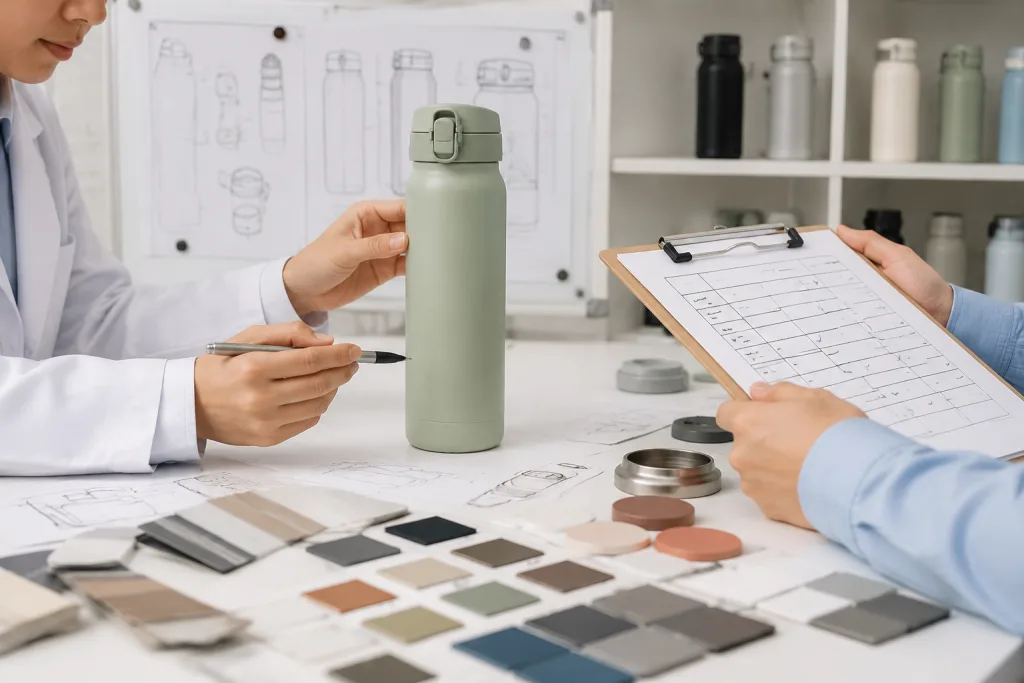
Logo work is where we see 6 out of 10 custom drinkware quotes lose margin. Buyers ask for “premium logo,” but that is the wrong question to ask until the use case is clear. A vendor tea bottle for corporate gifting usually needs a sharp laser mark, and QC will check the edge under a 10x loupe after coating. A canteen promotional giveaway may only need one-color silk screen. A retail customized canteen needs a full-color wrap, locked artwork files, and a 3M tape pull plus rub test before the line runs.
China factory pricing changes by artwork, but these ranges work for planning. One-color silk screen may add USD 0.05-0.12 per unit at 1,000 pcs. Laser engraving may add USD 0.10-0.25 per unit depending on logo size and coating; a 45 mm logo on powder coat costs less pain than a 90 mm logo around a curve. Full-color heat transfer may add USD 0.30-0.80 per unit and needs tighter setup discipline, including film alignment within 1.5 mm. A custom gift box can add USD 0.20-0.60, while a thicker export carton may add USD 0.03-0.06 but cuts crushed-corner claims. We ship enough cartons to know the math works there.
If you are a canteen distributor or distributor drinkware buyer, keep SKU complexity under control. Four bottle colors, three logo versions, and two packaging types already create 24 SKU combinations. That hits MOQ, AQL 2.5 sampling, carton marking, warehouse receiving, and reorder planning. We’ve seen this go sideways when the PO says “blue” but the approved sample tag says Pantone 7690C.
For a first order, choose one bottle body, two safe colors, one logo method, and one packaging structure. Build variety after you see 60-day sell-through and actual claim rates.
The same logic applies to a custom growler, customizable growler, customized growler, or distributor growler project. Bigger body means a bigger logo panel, heavier carton, and more risk if artwork and packaging are rushed. QC pulled one 1.9 L growler sample last month because the logo sat 4 mm off center after shrink film heating. Small miss. Big complaint.
MOQ, Lead Time, And Pricing
For a stock mold vendor tea bottle, we usually quote MOQ at 1,000 pcs per color. Some canteen suppliers will take 500 pcs in black, white, or brushed steel, but the math gets ugly: logo setup may stay around USD 60-120, and the unit price can jump USD 0.25-0.45 because the line still washes the spray gun and masks the same fixtures. For a powder-coated custom canteen color, 2,000 pcs is the cleaner starting point; our coating line runs better when one color fills a full hanging rack batch. For a new lid or body shape, expect tooling plus 10,000 pcs or more across the first production schedule. We had one buyer push for 3,000 pcs on a new flip lid last March. The tooling quote killed it.
FOB Ningbo or FOB Shanghai is common for Zhejiang factories. From Hangzhou, we truck to Ningbo in about 3.5 hours when the G92 is clear, so both ports work for normal export routing. A typical 500 ml stainless tea bottle might land in the USD 3.20-5.80 FOB range depending on steel grade, lid complexity, coating, infuser, logo, and packaging. A premium retail version with 304 inner and outer walls, powder coating, laser logo, tea strainer, and color box may cost more. A basic canteen promotional bottle can cost less. Expect trade-offs: thinner carton, simpler lid, lighter body, or no spare gasket. QC pulled a 500 ml sample last week at 276 g body weight, and the buyer flagged it as too light for shelf retail.
Lead time is usually:
- Plain sample: 5-7 days
- Logo sample: 10-14 days
- Pre-production sample: 7-10 days after artwork lock
- Mass production: 25-35 days after deposit and approvals
- Sea freight to Europe or North America: often 25-45 days port to port
Do not build your launch calendar from factory production days only. Wrong question. Add 3-5 days for sample review, 2-4 days for artwork corrections, 1 day for the third-party inspector to book AQL 2.5, 3-7 days for vessel space, and another 1-2 days if the PO has a typo in the consignee name. We ship smoother when the buyer gives us 12 days of buffer vs 3 days of panic. China export is predictable with buffer. It gets painful when you ask for retail-ready customized drinkware in 21 days during peak season, especially when the color box dieline is still not signed off.

Inspection Before Shipment
Final inspection is not optional for B2B drinkware. AQL gives the canteen factory, your QC team, and our line inspector the same defect language. For most custom drinkware, buyers use AQL 2.5 for major defects and AQL 4.0 for minor defects. Critical defects should be zero. For kids’ bottles, hot-liquid use, or Costco-style retail chains, we run tighter sampling; last month QC pulled 200 pcs from a 5,000 pcs order because the silicone gasket gap measured 0.6 mm over spec.
For a vendor tea bottle, the inspection needs capacity check, leak test, vacuum performance, coating defects, logo position, lid fit, infuser fit, odor, sharp edges, carton drop condition, barcode scan, and carton mark verification. Don’t make this a paper exercise. The inspector should use a 500 ml measuring beaker, torque the lid by hand like a consumer, and scan every FNSKU or SKU label if the goods go to Amazon or retailer warehouses. One wrong barcode can block a shipment faster than a small scratch; we saw a PO typo change “VTB-750-BK” to “VTB-750-BL,” and the buyer flagged it before the truck left Hangzhou.
A useful inspection sample size depends on order quantity, but even a 1,000 pcs order should not be checked by opening one carton. Pull cartons across the pallet stack, top, middle, and back row, because the front row is usually the cleanest. For vacuum bottles, we run hot water testing on a defined sample set: fill with water at 95°C, close the lid, measure after 6 hours, and compare against the agreed insulation claim. If your sales copy promises 12 hours hot, write the test standard before production. Asking “will it keep tea hot?” is the wrong question; the pass line needs a thermometer reading, not a feeling.
Good canteen vendors welcome a clear inspection checklist. Weak canteen vendors argue after defects appear. Send the checklist with the purchase order, not after the goods are packed. We’ve seen this go sideways: cartons sealed with 48 mm tape, warehouse booked, then the buyer asks for a 1.2 m carton drop test that nobody priced or planned.
Buying Decision Checklist
Before you choose a canteen supplier, force the decision onto one A4 sheet. Good procurement is boring on purpose. We run into trouble when buyers chase the lowest FOB line and skip the checks that decide whether the bottle passes FDA/LFGB, whether the silk-screen logo survives 50 dishwasher cycles, and whether the 5-layer export carton keeps retail boxes square after a 12 kg drop-stack test. The math does not work if a USD 0.03 saving turns into 8% crushed color boxes at incoming inspection.
Use this short buyer checklist before issuing a PO. QC pulled the sample last week because the PO said “matte black,” but the approved sample tag read “powder black 18#”; that one typo would have changed the coating line.
- Product drawing or spec sheet includes capacity, dimensions, weight tolerance, material, coating, and lid structure, with key sizes shown in mm.
- Approved sample matches the quoted material and finish, not only the sales photo; weigh it on a digital scale and record the gram weight.
- MOQ is confirmed by color, logo version, and packaging version, because 1,000 pcs in one color is not the same as 250 pcs x 4 colors.
- FOB port, payment term, carton size, gross weight, and lead time are written in the proforma invoice, not buried in a WeChat message.
- Compliance documents match your market: FDA, LFGB, REACH, Prop 65, or retailer-specific testing.
- Inspection standard uses AQL levels and lists functional tests for leakage, vacuum, logo, and packaging; for tea bottles, we usually add a 30-minute upside-down leak test.
- Artwork files are vector format, with Pantone color and logo placement tolerance stated in millimeters, such as ±1.5 mm from the center line.
If you are comparing canteen suppliers in China, ask who owns the mold, who makes the lid, and where coating is done. Simple questions. We have seen this go sideways when the body factory outsourced the lid to a small shop 40 km away, then the buyer flagged loose threads during AQL 2.5 inspection. If you are comparing canteen distributors in your own market, ask whether they control production or only resell from a catalog. Both models can work, but the risk profile is different.
A vendor tea bottle is a small item, but the PO is not small once you order 5,000 or 20,000 pcs with custom cartons. Treat it like engineered packaging plus food-contact hardware, not like a generic giveaway. This is the wrong place to save pennies blindly. A clean spec, a signed golden sample, and a clear inspection checklist usually save more money than negotiating another USD 0.03 off the unit price.
Send Your Tea Bottle RFQ For Review
Share capacity, logo, target market, MOQ, and launch date. We will respond with practical specs, pricing, and sample timing.
Frequently asked questions
What MOQ should I expect for a vendor tea bottle order?
For a stock stainless steel vendor tea bottle, expect around 1,000 pcs per color when using an existing mold and standard coating. If you want a custom Pantone powder coating, many factories prefer 2,000 pcs per color because coating lines and paint preparation need volume. For a canteen customized with a new lid, new infuser basket, or special body shape, the factory may require tooling fees plus 8,000-20,000 pcs forecast volume. You can sometimes negotiate a 500 pcs trial order, but the price may increase by USD 0.30-0.80 per unit and sample charges are less likely to be refunded.
Can I use the same supplier for tea bottles, canteens, and growlers?
Yes, if the canteen manufacturer has the right production range. Tea bottles, custom canteen projects, and custom growler orders share processes like stainless forming, welding, vacuuming, polishing, coating, and logo application. The difference is tooling size, leak testing, insulation targets, and carton strength. A 64 oz distributor growler needs heavier packaging and more strict handle or lid testing than a 500 ml tea bottle. Ask for production photos, current capacity, and at least 2 similar export case references. A canteen factory that only makes lightweight promotional bottles may not be the right choice for premium customized growler retail programs.
Which logo method is best for customized drinkware?
Laser engraving is the safest choice for long-life customized drinkware because it removes the coating surface and does not peel like ink. It works especially well on powder-coated stainless steel bottles and growlers. Silk screen is cheaper for simple one-color canteen promotional orders, often adding about USD 0.05-0.12 per unit at 1,000 pcs. UV print and heat transfer are better for multi-color artwork, but they need abrasion testing and careful curing control. For retail, ask for a logo sample and run a tape test, 50-rub abrasion check, and dishwasher discussion before approval. Do not assume “dishwasher safe” unless the factory has tested that exact finish.
What certifications do European and North American buyers usually request?
For Europe, LFGB food-contact testing is commonly requested, along with REACH for restricted substances when coatings, plastics, or silicone parts are involved. For North America, FDA food-contact compliance is the baseline, and some buyers ask for California Proposition 65 assessment. If the product is marketed for children, CPSIA and additional small-parts or coating tests may apply. Large retailers may add their own protocols, including drop testing, barcode verification, and packaging requirements. Ask your canteen supplier for current reports on the same material system, not a random old report for another bottle. Reports should show material, model, test date, and laboratory name clearly.
How do I compare quotes from different canteen vendors?
Put every quote into the same format: capacity, steel grade, wall thickness, lid material, infuser material, coating type, logo method, packaging, MOQ, FOB port, lead time, and inspection standard. A USD 3.60 quote and a USD 4.10 quote may not be comparable if one uses 201 outer steel, a thin gift box, and no coating test. Ask each canteen vendor to confirm net weight and carton size, because freight cost can change the landed price by 5-12%. For distributor drinkware orders, also compare reorder MOQ and spare lid availability. A cheap first order is not cheap if replacement parts are impossible six months later.