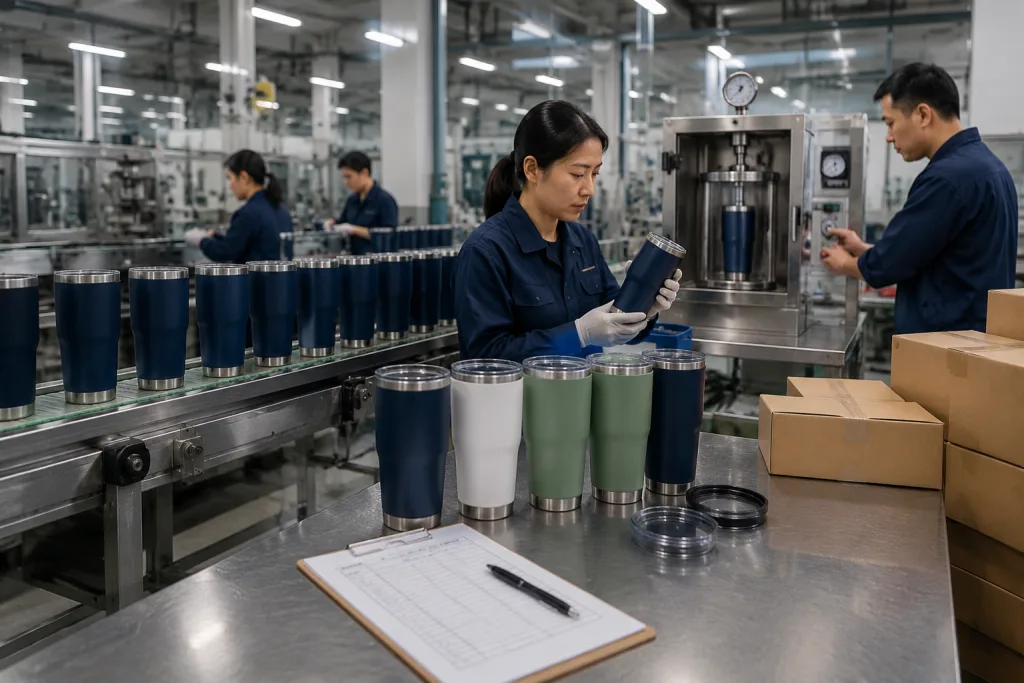
Key Takeaways
- Specify 304 stainless steel, 0.45-0.55 mm inner wall, and vacuum loss below 3% after heat testing
- For BottleForge Zhejiang production, common MOQ starts at 1,000 pcs per color with 25-35 day lead time after PP sample approval
- Use AQL 2.5 for major defects and AQL 4.0 for minor defects on distributor canteen and tumbler orders
- FOB Ningbo pricing for a 20 oz custom tumbler often lands around USD 3.20-5.80 depending on lid, coating, and logo
A vendor stainless steel tumbler order usually goes wrong before the line starts. The drawing says 20 oz, the hand sample feels OK, and the quote has no red flags. Then 5,000 pcs in mass production show the gaps: 0.38 mm inner wall instead of 0.45 mm, powder coating that fails the 3M tape test, lids with 0.4 mm too much play, Pantone drift under the light box, or K=A cartons that collapse before a 30-day ocean shipment.
If you buy custom drinkware for retail, corporate gifts, distributor drinkware programs, or online channels, spec the failure points first. Asking “what is your best price?” is the wrong question to ask. Our Hangzhou, Zhejiang team sees the same issues across custom canteen, customized drinkware, and travel tumbler projects; last month QC pulled the sample because the PO said matte black, but the approved sample label had “BK gloss” typed on it. The fix is simple: put wall thickness, coating test, lid tolerance, carton drop test, and AQL inspection terms into the RFQ and sample approval sheet before a China factory starts cutting steel.
Steel grade claims can drift
The first failure we see is material substitution. A quote says 304 stainless steel, then the PO leaves out one key point: does 304 mean the inner wall only, the outer wall too, or every food-contact part? For a vendor stainless steel tumbler, the liquid-contact inner wall matters most. We write it line by line: SUS304 inner cup, SUS201 or SUS304 outer shell based on the price target, PP or Tritan lid parts. QC pulled 12 samples last April where the buyer’s PO only said “304 cup,” and the line had used 201 on the outside because the sales sheet was unclear. That is where arguments start.
Do not accept “food grade stainless steel” as your only material spec. It sounds safe, but it is the wrong wording to buy against. Food grade is a use claim, not a steel grade. If you are buying for Europe, ask the canteen manufacturer to confirm LFGB or EU food-contact compliance where required. For North America, request FDA food-contact material declarations. For children’s lines, check whether CPSIA or ASTM-related testing applies before tooling starts. We have had a buyer flag this at pre-shipment inspection on day 18, after cartons were sealed with a 75 mm tape gun, and the math does not work at that stage.
Wall thickness is another quiet problem. A 20 oz tumbler can look good in a sample with a 0.50 mm inner wall, then feel soft in mass production if the factory switches to 0.38 mm steel to protect margin. You feel it at the rim. It also changes dent resistance and polish quality after the automatic buffing wheel. Your RFQ should state target thickness, tolerance, and net weight range. For example, “inner wall 0.45-0.55 mm, outer wall 0.40-0.50 mm, finished body weight 250-285 g excluding lid.” On our line, QC checks cut pieces with a Mitutoyo caliper before forming; if the coil is thin, the problem is already baked in.
For a canteen custom project or customized growler, ask for incoming material inspection records. A serious canteen factory in China should keep coil batch records, basic thickness checks, and supplier certificates. You do not need a 40-page lab file for every shipment. You do need enough traceability to stop a material dispute from landing on your desk. We run coil tags against the job card at receiving, and one PO typo, “SUS340” instead of “SUS304,” once held a 3,000 pcs order for two days until the buyer corrected it.
Vacuum performance fails quietly
Vacuum failure costs money because you usually cannot see it at the carton check. A tumbler with a weak vacuum can look clean under a 600-lux inspection lamp, pass the logo and scratch check, then drop heat retention after 14 days in a Hangzhou warehouse. For custom drinkware, the vacuum result comes from the weld bead, the evacuation station, the sealing plug, and the thermal test record. Miss one step and the buyer paid for a premium tumbler but received a dressed-up cup.
Do not print “keeps hot for 12 hours” unless the test method is written on the spec sheet. This is the wrong question to ask without a test. We run a simple B2B check: fill with water at 95°C, close the lid, hold at 20-25°C room temperature, then record the water temperature after 6 hours with a calibrated probe thermometer. For a typical 20 oz double-wall stainless tumbler, 55-65°C after 6 hours is a fair target, depending on lid design and mouth diameter. A 78 mm wide-mouth customizable growler will lose heat faster than a narrow custom canteen; the math does not work the same.
Factories usually run a thermal scan or hot-water test after vacuuming. At BottleForge in Zhejiang, our inspection line checks vacuum performance before packing, with production capacity around 480,000 stainless units per month across tumbler and custom growler lines. For large distributor growler or canteen promotional orders, we recommend a retained sample set: 5 pcs from pre-production, 10 pcs from mid-production, and 10 pcs from final packing. QC pulled the sample for one EU buyer last year after the buyer flagged “only 42°C after 6 hours,” and those retained pcs told us whether the issue came from the line or from how the customer tested it.
Watch copper lining claims. Copper plating can improve insulation performance, but it adds cost and the coating must be even inside the shell. If your canteen supplier quotes a low FOB price while claiming copper lining, ask for cut-section photos or sample testing; we have seen this go sideways when a PO said “copper coated” but the sample showed only standard vacuum construction. A USD 0.10 hidden saving at the vacuum stage can create a USD 10.00 retail return.
Lids leak for boring reasons
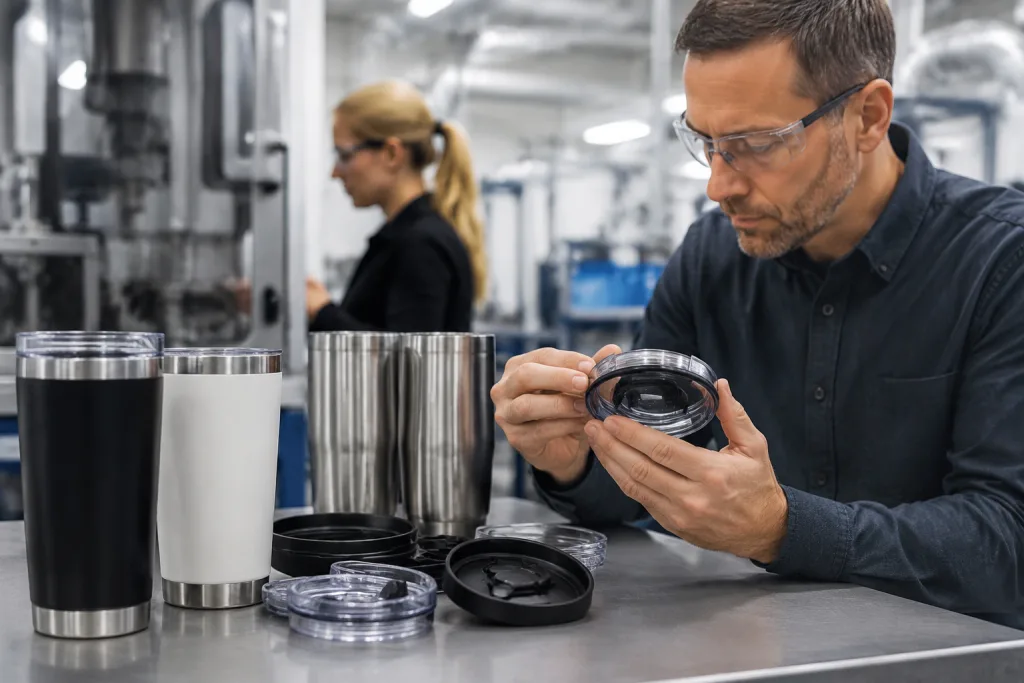
Most leak complaints are not dramatic engineering failures. We see them come from 0.2 mm tolerance stack-ups: silicone ring hardness, thread fit, straw-hole diameter, flip-cap preload, or one gasket sitting upside down after assembly. QC pulled the sample last month and the “leak” was a 58 Shore A ring squeezed into a groove cut for 55 Shore A. If you are sourcing from canteen vendors or a canteen supplier for branded programs, lid details need the same attention as the 304 stainless body.
Define the use case before asking for price. A travel tumbler with a sip lid is splash-resistant, not leakproof, and this is where buyers get angry after the first backpack claim. A custom canteen for hiking or school bags should pass an inverted test with no wet tissue after 30 minutes. A customized canteen with a straw lid is the wrong choice for carbonated drinks. A custom growler needs stronger sealing because beer, kombucha, and sparkling beverages build pressure; we run a thicker gasket and a deeper thread bite on those. Put this into the product brief so your canteen manufacturer does not quote the cheapest lid that technically fits the mouth.
For QC, use two bench tests and one abuse check. First, fill to 90% capacity, close the lid, invert for 30 minutes, and check leakage on white tissue paper. Second, shake horizontally for 60 seconds. Third, run 3 opening and closing cycles before the leak test, because a gasket can pass when untouched and fail after normal use. For threaded lids, specify thread engagement in mm and reject cross-threading; we use a go/no-go gauge on the line when the PO calls for it. For flip lids, inspect hinge stress whitening and latch retention after the buyer’s logo sample, not after mass packing.
Silicone quality also matters. Ask for food-grade silicone, usually 50-60 Shore A hardness for common tumbler gaskets, and request the hardness reading on the inspection report. Too soft and it deforms. Too hard and it will not seal well. We have seen this go sideways when a distributor approved the cup body but skipped the spare gasket plan, then got 312 return claims from school-channel orders. Replacement gasket availability deserves a line item for distributor canteen programs, especially when canteen distributors sell into outdoor and hospitality channels where spare parts cut returns.
Coating defects hurt retail margins
Powder coating, spray painting, and plating decide whether a stainless tumbler looks like a retail item or a giveaway. The defects we reject most often are color drift, orange peel, weak adhesion, rim chips, and rub marks after carton vibration. QC sees them fast. Last month QC pulled the sample under a D65 light box and found 7 scratched lids in a 200 pcs pilot run, all before anyone filled the cup with water.
For powder coating, lock the finish with a physical color standard. Pantone helps on email, but it does not control matte black, metallic champagne, or gradient blue-purple well enough. Approve a production color chip or a signed pre-production sample, then make the factory keep it beside the coating line. If the order is 5,000 pcs for a canteen distributor, we run the first 30 pcs against that sample before full spraying. A Delta E tolerance of 1.5-2.0 is reasonable for solid colors, but metallic and translucent finishes need buyer sign-off by photo and courier sample. Otherwise the math does not work: one shade complaint can eat the margin on the whole PO.
Adhesion testing belongs in the QC checklist, not in a late email after goods are packed. A cross-hatch tape test is common: cut a 1 mm grid through the coating with a blade, apply 3M tape, pull at the same angle, then check flaking. For outdoor canteen customized products, add a 500-cycle rub test and dishwasher warning review. Be straight with your marketing team here. Many powder-coated stainless items are hand-wash recommended. If you print “dishwasher safe” without testing the coating, logo, and lid parts together, the buyer will be right to push back on returns.
Packaging can ruin a good finish. A perfect tumbler still arrives scratched if each unit sits loose in a thin white box with no wrap. For North America and Europe, we usually recommend an individual box with a polybag or tissue wrap, EPE protection for premium finishes, and export cartons at 5-ply K=A or similar strength. We also check carton shake on the packing table because a 0.3 mm scuff near the rim shows up in retail photos. If you ship Amazon FBA, carton weight, drop resistance, FNSKU labels, and master carton barcodes need approval before packing starts in China. We have seen this go sideways over one barcode typo on a PO.
Logo methods create hidden rejects
Logo application is where custom drinkware gets risky. A cup can look fine in a WhatsApp photo and still fail when the buyer rubs the print with a thumbnail. We run silkscreen, laser engraving, heat transfer, UV print, water transfer, and embossing on separate stations, and each one has a hard limit. If your canteen vendor says every logo is “no problem,” push back. Last month QC pulled 32 samples from the line because a white logo passed the photo check but showed grey edges under the 3M tape test.
Silkscreen keeps the math clean for simple one- or two-color artwork. It works on straight walls; it fights you on tapered tumblers and curved canteen customizable bodies. Fine text below 6 pt, thin lines under 0.2 mm, and large wraparound logos need real checking, not a pretty PDF. We use a 120T mesh screen for most small logos, and pinholes show fast if the ink is too thin or the fixture does not hold the cup square. Laser engraving lasts better for corporate orders, but the final color depends on coating and base metal. On powder-coated cups, engraving usually exposes 304 stainless; on plated finishes, the contrast can look weak, and the buyer flagged it twice on champagne gold samples.
For customized drinkware with retail packaging, approve a logo strike-off before the pre-production sample. Digital mockups are not enough. Ask for logo size in millimeters, distance from rim or bottom, print tolerance, and accepted registration shift. A practical tolerance is ±1.5 mm for many tumbler logos, but wrap prints need tighter fixtures or a slower line speed, maybe 18 seconds per cup instead of 12. We’ve seen this go sideways when a PO said “logo center” but the artwork file named the position “30 mm from bottom.”
For canteen promotional projects, budget decides the method faster than design taste. A one-color silkscreen logo may add USD 0.08-0.18 per unit. Laser engraving often adds USD 0.15-0.35 depending on size and production speed. Full-wrap heat transfer can add USD 0.60-1.20 and raises reject risk if the artwork crosses seams or curves. The wrong question is “which logo looks best?” Ask which logo survives mass production at your target price. When comparing canteen suppliers, make sure the same FOB quotation includes logo cost, setup charge, sample charge, and extra reject allowance; we usually hold 2%-3% extra blanks for heavy logo jobs.
Cartons and compliance get ignored
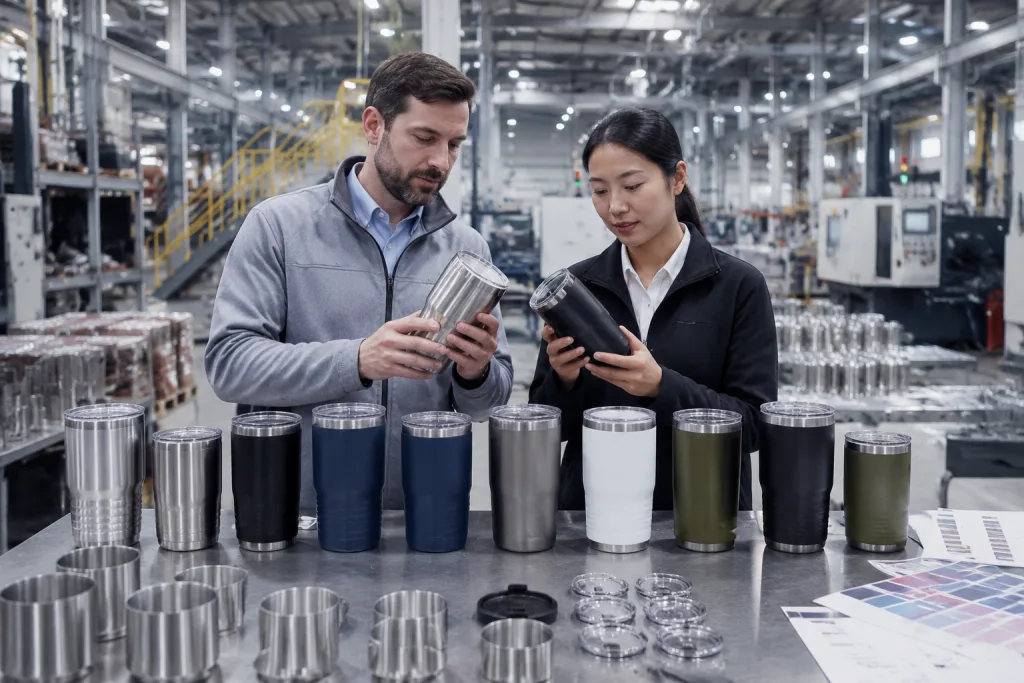
We’ve watched 8 buyers spend two weeks arguing over 304 stainless thickness, then approve packaging in 2 emails. That is backwards. For a vendor stainless steel tumbler shipped from Zhejiang or another China manufacturing base, the carton protects the margin. A 0.6 mm body can pass QC, then arrive with lid scratches because the insert tray was 3 mm too loose. Ocean freight, warehouse stacking, courier drops, and retail shelf handling each hit the product in a different way.
Start with the sales channel. A distributor drinkware order for wholesale cartons may only need plain white boxes and carton marks printed with a 60 mm stencil. A retail gift set needs barcode placement, multilingual warnings, recycling marks, and sometimes REACH-related declarations for coatings or packaging materials in Europe. An Amazon FBA order needs FNSKU labels, suffocation warnings on polybags where applicable, carton dimensions under platform limits, and scannable outer labels. If you ask for these after production, the math doesn’t work; we’ve seen a buyer flagged by FBA over a missing outer label and lose 12 days to relabeling at the warehouse.
Carton testing does not need to be fancy for every order. For standard tumblers, we run a 1.0 m drop test on a full export carton: one corner, three edges, and six faces. QC pulled the sample last month and found coating rub on 4 lids because the divider height was short by 5 mm. Check dents, cracked lids, coating rub, and crushed retail boxes. For heavier customized growler sets, reduce carton quantity or increase board strength. A 12 pcs carton may work for 20 oz tumblers, while a 64 oz growler may need 6 pcs per carton to stay below 15-18 kg gross weight.
Compliance paperwork should be mapped by market before the PO is signed. Europe may require LFGB, REACH screening for coatings, and packaging waste documentation depending on customer requirements. North America may require FDA food-contact declarations, Prop 65 review for California, and CPSIA if the item is intended for children. A reliable canteen manufacturer will not guess your legal obligations, but they should collect material declarations, test reports, and factory audit documents such as BSCI or ISO 9001 when requested. Small detail, big mess: we once saw “LFGB” typed as “LFGD” on a PO, and the lab booked the wrong report name until our merchandiser caught it before sample sealing.
The purchase order must control risk
The purchase order is not just a price sheet. It is the job file the line follows. If your PO only says “20 oz stainless tumbler, black, logo printed,” the factory has to guess the coating, lid fit, logo position, carton mark, and even the black shade. We saw one buyer’s PO list matte black, while the approved sample card was Pantone Black 6 C; QC pulled the sample under a D65 light box and the buyer flagged the difference at final inspection. Good canteen manufacturers can still build a solid cup, but loose paperwork makes claims messy and pushes your order behind POs that a merchandiser can release without 12 back-and-forth emails.
A strong PO for customizable canteen or tumbler production should lock the model number, capacity tolerance, steel grade, wall thickness, lid type, coating method, Pantone or approved sample reference, logo file version, packaging structure, carton marks, inspection standard, and shipping term. Spell it out. For FOB Ningbo or FOB Shanghai, define whether inner cartons, pallets, FNSKU labeling, and export documentation are included; a 1,000 pcs Amazon order can stall for 2 days if the PO says “label as usual” but the FNSKU PDF is missing. If you need DDP quoting, separate product cost from freight and duty assumptions, because mixing them into one unit price makes the math ugly when the carton weight changes from 13.5 kg to 15.2 kg after adding gift boxes.
For inspection, use AQL instead of soft phrases like “good quality.” This is the wrong question to ask. A typical standard is AQL 0 for critical defects, 2.5 for major defects, and 4.0 for minor defects under ANSI/ASQ Z1.4 or ISO 2859-1 sampling. Critical defects include unsafe sharp edges, foreign material inside the cup, or wrong material; our inspector once found polishing compound inside 3 cups during a pre-shipment check, and that lot stayed on the bench. Major defects include leakage, severe dents, wrong logo, failed coating adhesion, and non-functioning lids. Minor defects include small cosmetic marks within agreed limits, such as one 0.5 mm speck outside the logo area instead of scratches across the front face.
MOQ and timing should match the real factory queue. For BottleForge Industrial in Hangzhou, Zhejiang, common MOQ for a vendor stainless steel tumbler is 1,000 pcs per color, with 7-10 days for custom sample work and 25-35 days for mass production after deposit and PP sample approval. We run laser engraving, powder coating, and packing on separate schedules, so one late lid mold can hold the whole order. Complex customized canteen orders, full-wrap printing, or custom growler tooling can need 45-60 days, not 18 days because someone wants a trade-show date. If a canteen vendor promises half that time during peak season without explaining capacity, ask what step they plan to skip.
Send your tumbler spec before you quote
BottleForge will review steel, lid, coating, logo, packaging, MOQ, and compliance risks before your next China production run.
Frequently asked questions
What should I ask a vendor stainless steel tumbler factory before quoting?
Ask for steel grade by component, wall thickness, capacity tolerance, lid material, coating method, logo process, MOQ, sample lead time, mass production lead time, and FOB port. For a normal 20 oz tumbler, expect 304 stainless inner wall, 0.45-0.55 mm inner thickness, MOQ around 1,000 pcs per color, and 25-35 days production after PP sample approval. Also ask whether the canteen factory can support AQL inspection, food-contact test reports, BSCI or ISO 9001 documents, and carton drop testing. A clean quotation should separate unit price, mold or setup cost, sample cost, packaging cost, and freight assumptions.
Is 201 stainless acceptable for custom drinkware?
201 stainless can be acceptable for non-food-contact outer shells when the product is positioned at a lower price point, but we do not recommend it for the inner wall that touches beverages. For most Europe and North America programs, specify SUS304 for the inner cup. Some buyers also request SUS316 for salty or acidic use cases, but it raises cost and is not needed for most tumblers. If a canteen supplier quotes far below market, confirm whether both inner and outer walls are 304. A 20 oz tumbler with 304 inner and 201 outer can be valid if disclosed, tested, and priced honestly.
How much does a customized canteen or tumbler cost from China?
FOB China pricing depends on capacity, lid, coating, logo, and packaging. A 20 oz stainless tumbler with powder coating and one-color logo often runs about USD 3.20-5.80 FOB Ningbo. A custom canteen with leakproof screw lid may fall in a similar range, while a 32 oz or 40 oz item can move to USD 5.50-8.50. A customized growler is heavier and may range from USD 8.00-15.00 depending on capacity and cap system. Treat unusually cheap quotes carefully; they may hide thinner steel, weak packaging, or missing compliance support.
Can canteen distributors mix colors under one MOQ?
Usually yes, but it depends on coating changeover and material availability. A practical MOQ is 1,000 pcs per color for many powder-coated stainless items. For a 3,000 pcs distributor canteen order, mixing 3 colors at 1,000 pcs each is realistic. Mixing 10 colors at 300 pcs each is harder because coating line setup, powder loss, and QC time increase. Some canteen manufacturers will accept lower color splits with a surcharge of USD 0.15-0.50 per unit. Confirm carton labeling by color if your warehouse or retail customer needs SKU-level separation.
What inspection standard should I use for canteen promotional orders?
Use AQL sampling and define defects before production. For most canteen promotional orders, AQL 0 for critical, 2.5 for major, and 4.0 for minor is practical. Critical defects include unsafe edges, contamination, or wrong material. Major defects include leakage, failed vacuum, cracked lids, wrong logo, severe coating chips, or barcode errors. Minor defects include small scratches outside the agreed viewing distance. For orders above 5,000 pcs, consider inline inspection at 20-30% completion plus final random inspection after 80-100% packed. This catches process drift before all units are boxed.