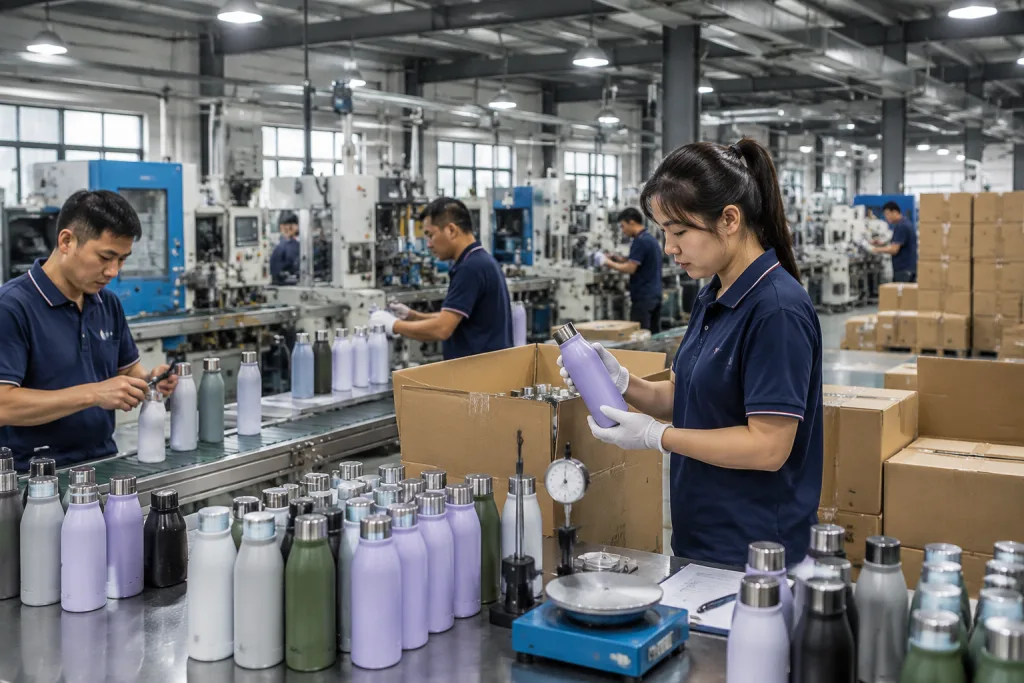
Key Takeaways
- A 304 stainless steel flask with 0.45-0.50 mm outer wall is the safest B2B baseline
- Our typical MOQ is 1,000 units per SKU/color with 25-35 day production after PP sample approval
- Powder coating costs about USD 0.25-0.55 more than basic spray paint but performs better in handling
- Use AQL 2.5/4.0 inspection for most distributor drinkware orders before final balance payment
A vendor stainless steel flask looks simple on a quote sheet: 750 ml capacity, Pantone color, logo size, carton size, FOB price. Trouble shows up later. QC pulled the sample from the drop-test table at 1.2 m and found water around the lid thread; another batch passed vacuum, then the powder coat picked up 3 mm scratches after warehouse handling. We’ve also had buyers flag a logo that looked fine on a PDF but disappeared in retail photos, and a 5-ply carton that collapsed after a 40-day ocean shipment.
If you buy custom drinkware for retail, promotion, distributor programs, or Amazon-style fulfillment, the wrong question is “which flask is cheapest?” Compare the flask like an engineer on the line: 0.5 mm vs 0.6 mm wall thickness, 12-hour heat retention target, MOQ by color, 28 days vs 45 days lead time, FDA or LFGB paperwork, and what a canteen manufacturer in China can lock before mass production. BottleForge Industrial in Hangzhou, Zhejiang works with B2B buyers on these trade-offs every week; we run pre-production samples, check thread fit with go/no-go gauges, and push back when the math on a logo, coating, or carton spec doesn’t work.
Spec table before price talk
Price first is the wrong question. A vendor stainless steel flask can be USD 2.80 or USD 7.90 FOB China, and both quotes can be clean. We see it on the line every week: one sample measures 0.36 mm on the digital caliper, another runs 0.48 mm with a heavier lid set and better powder coat. That gap is not magic margin. It comes from steel grade, wall gauge, lid parts, coating yield, AQL target, export carton spec, and the order volume you put on the PO.
Use this head-to-head table before asking a canteen supplier for a formal quote. It saves time. Last month a buyer flagged a USD 1.10 spread between 3 factories; QC pulled the samples and found 2 were single-wall flasks while 1 had real vacuum insulation under the same 500 ml name.
| Spec point | Budget promotional flask | Retail-grade insulated flask | Outdoor canteen or growler |
|---|---|---|---|
| Typical capacity | 350-500 ml | 500-750 ml | 900 ml-1.9 L |
| Steel | 201 or 304 body | 304 inner and outer | 304 body, sometimes 316 inner |
| Wall thickness | 0.35-0.40 mm | 0.45-0.50 mm | 0.50-0.60 mm |
| Insulation | Single wall or basic vacuum | 6-12 hours hot, 12-24 hours cold | 12-24 hours hot, 24-36 hours cold |
| Best fit | Canteen promotional programs | Customized drinkware retail | Custom growler and outdoor kits |
| Typical MOQ | 1,000-3,000 units | 1,000 units per color | 500-1,000 units depending on tooling |
For European and North American buyers, we run 304 stainless steel as the safe default. 201 works for a low-cost canteen customized project, but we have seen this go sideways after a 48-hour salt spray check or when an end customer spots rust near the seam. If you want fewer after-sales arguments, spend the extra USD 0.20-0.45 per unit.
Match flask type to channel
A canteen distributor buying for schools carries a different risk than a growler buyer selling into outdoor retail. The school order usually needs safe colors, simple lids, and cartons that pass a 76 cm drop test. The outdoor buyer asks for 0.6 mm steel, welded handles that do not twist, and heat retention we can defend on a test sheet. We run these jobs on different specs for a reason. Putting both into one PO is lazy sourcing, and we have seen it go sideways when QC pulled the sample and the handle gap was 2 mm off.
For promotional buyers, the safe choice is usually a 500 ml stainless flask, powder coated, with one-color silkscreen logo or laser engraving. The carton has to survive bulk handling, and the unit price still needs 18% to 25% room for agency margin. A canteen promotional order normally does not need retail packaging with inserts, hangtags, and window boxes. Skip it. A white box, polybag, and 24 pieces per master carton is often enough, as long as the outer carton uses 5-ply K=A paper and the PO does not miss the logo Pantone code.
For retail brand owners, the flask needs cleaner finishing. Check coating adhesion with a cross-cut test, ask for a PP sample in the final color, and photograph the logo under warehouse LED light plus daylight near the loading door. If you are building customizable drinkware for 6 SKUs, keep the bottle body shared and change the lids or sleeves. The math works better: one body mold, fewer spare parts, fewer packing mistakes on the line. We once had a buyer flag three cap colors mixed in one carton because the lid BOM was written too loose.
For outdoor or food-service programs, a custom growler or customizable growler needs tighter control around cap torque, handle welds, and mouth diameter. A 64 oz growler with a weak carry handle is a return waiting to happen. For beer, coffee, or cold brew, ask for inner electropolishing and a smooth thread area, then have QC check the mouth with a go/no-go gauge before mass packing. A customized growler with a 58 mm wide mouth cleans better after syrup or milk residue, which matters more than a polished catalog photo. This is the wrong question to ask if the buyer only talks about color.
Good sourcing is not finding one perfect flask. It is matching one controlled spec to one sales channel, then making sure the factory can repeat it for 3,000 pieces without drama.
China factory numbers that matter
Comparing canteen manufacturers in China? Ask for operating numbers before you ask for another certificate PDF. A real canteen factory should be able to give daily output, vacuum test method, scrap rate range, and the number of lines booked for powder coating or printing. We run into this often: the buyer asks for FDA or LFGB first, then later finds the supplier cannot explain whether vacuum testing is done by water bath, pressure decay, or a 24-hour temperature hold. If the answers stay soft, there is a good chance the “factory” is buying from 2 or 3 small workshops and repacking the goods.
BottleForge Industrial is based in Hangzhou, Zhejiang, with partner production capacity of about 450,000 stainless drinkware units per month across flasks, tumblers, sports bottles, and growlers. For a standard vendor stainless steel flask, our practical MOQ is 1,000 units per SKU/color. For existing molds with simple laser logo, we can sometimes support 500 units for sampling-market tests, but the unit cost climbs because the fiber laser jig, carton plate, and line changeover still take the same setup time. The math doesn’t work if a buyer expects 500 units to price like 5,000 units.
Normal timing from Zhejiang looks like this: 5-7 days for artwork and digital mockup, 7-10 days for pre-production sample, 25-35 days for mass production after PP sample approval, and 3-7 days for final inspection and export paperwork. Ocean freight to Europe or North America may add 28-45 days depending on port and season. Air freight is faster, but a stainless flask is not a light product; on a 1,000-unit carton load, the freight can pass the goods value fast. QC pulled one flask sample last month at 312 g without packaging, and the buyer flagged the air quote the same day.
Ask every canteen manufacturer to quote using the same Incoterm. FOB Ningbo or FOB Shanghai is common for Zhejiang factories. EXW can look cheaper, but you then pay local trucking, export customs, and handling; we have seen a PO typo list “EXW Ningbo port,” which is the wrong question to ask because EXW starts at the factory gate. DDP works for some small distributor drinkware orders, but confirm the importer of record and the person responsible for compliance if customs asks for test reports.
Finishes, logos, and real durability
Decoration is where 7 out of 20 custom canteen projects lose margin. A logo can pass the first sample, then fail on the line if the body curve, coating cure window, or artwork stroke width is loose. We ask buyers to lock the decoration method and the pass/fail standard on the PO; last month one PO had “black logo” typed twice, but the approved AI file showed white.
Laser engraving is clean and hard to kill on 304 stainless steel and powder coating. We run it on the fiber laser with a rotary jig, and QC checks the mark at 30 cm under the light box before packing. It fits premium customized canteen orders where the logo needs to survive dishwashing-like abuse, even though the care card still says hand wash. Color is the catch. Laser usually cuts back to stainless steel or leaves a tonal mark, so the math does not work for a strict Pantone logo.
Silkscreen costs less for one-color or two-color logos and works well on canteen promotional runs above 1,000 pcs. For curved bodies, keep fine lines above 0.25 mm; our screen room uses a 300-mesh screen, and thin strokes disappear fast near the shoulder radius. Big wraparound logos look nice in mockups, but we have seen this go sideways with ghosting at the overlap. Heat-transfer and UV printing give more color, but abrasion performance depends on the coating underneath, not just the ink quote.
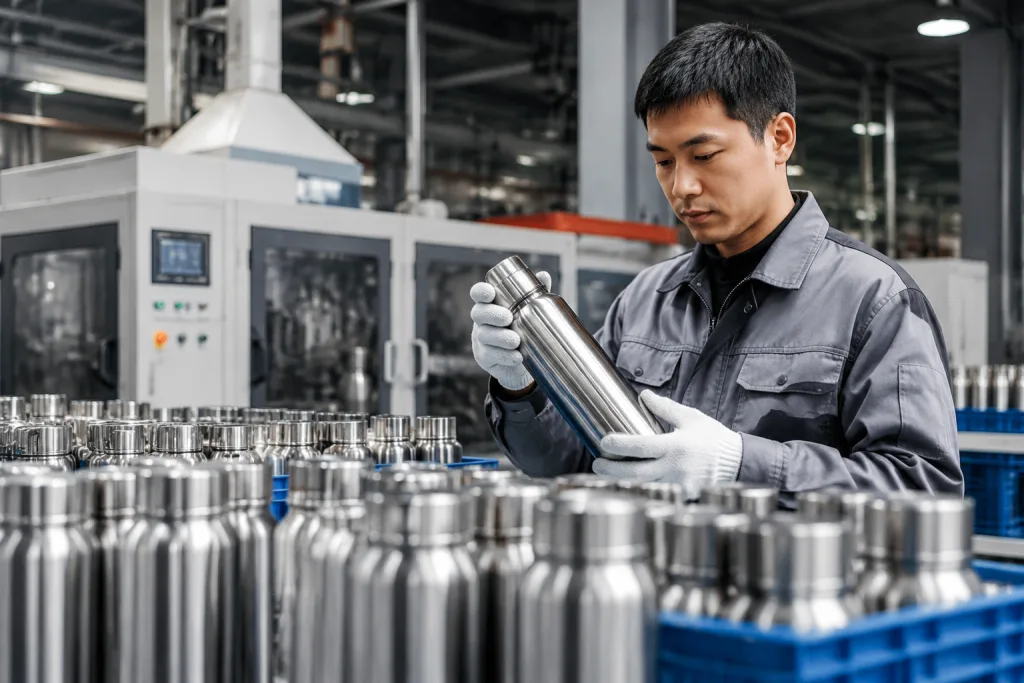
Powder coating is the default finish for retail-grade customizable canteen and customized drinkware projects. It typically adds USD 0.25-0.55 per unit compared with basic spray paint, and it holds up better when cartons rub for 12 days on the water instead of sitting clean in a sample room. Gloss paint photographs well, then fingerprints show up during packing. Matte coating feels better in hand, but if the texture is too soft, QC will flag oil marks after one worker handles 50 pcs without gloves.
For a serious order, request these tests: 3M tape test after logo printing, 100-grid cross-cut coating test, 24-hour salt spray for exposed stainless parts if relevant, leak test at 100 percent of units, and random drop test from 80-100 cm with filled bottles. We use a BYK cross-cut knife and a simple water tank on the line; QC pulled the sample only after the cap thread passed the leak check. These are not fancy lab tricks. They are the basic discipline a canteen supplier needs if they want the second order.
Compliance is not optional paperwork
For Europe and North America, stainless drinkware compliance is part of the product, not a folder someone builds after the container leaves Ningbo. A canteen vendor should know which tests fit the destination market and the food-contact parts on the BOM. If you hear only “FDA approved” with no lab report, ask for the report number, test items, tested material, and issue date. We had one buyer flag this after QC pulled the sample and the lid PP grade on the report did not match the PO.
For the United States, buyers often ask for FDA food-contact relevant testing, and some channels ask for California Proposition 65 screening. For children’s bottles, CPSIA and ASTM-related requirements can enter the discussion fast. For the EU, common requests include LFGB, EU food-contact migration testing, REACH for coatings or components, and packaging-related requirements. If your flask includes plastic lids, silicone seals, straws, paint, or printed ink, treat them as separate materials. The lab will. Last month, a 0.8 mm silicone ring held up a shipment because the buyer’s checklist listed the gasket as “rubber.” Wrong word, real delay.
Factory social audits also matter. BSCI, Sedex, or ISO 9001 does not guarantee a clean weld line or a perfect powder coat, but it shows the canteen factory passed a basic management check. For large canteen distributors and retail chains, audit status can block a supplier before anyone talks about USD 0.12 savings on a lid. We have seen this go sideways: price approved, sample approved, then vendor onboarding stopped because the audit certificate expired 18 days before the buyer’s system review.
Do not rely on old reports blindly. A 2021 report for a black tumbler coating does not automatically cover your 2026 matte green flask with a different lid gasket. Good canteen suppliers in China will tell you when a new test is needed. Bad ones send whatever PDF is sitting on the desktop. QC pulled one sample from the line where the coating looked the same under a D65 light box, but the supplier had changed paint batch from supplier A to supplier B. The math does not work if the report covers only the old coating.
The practical move is simple: define destination market, user age group, materials, and packaging before quotation. Then the canteen manufacturer can build real testing cost and timing into the quote instead of adding it after PI approval. A typical third-party food-contact test may take 5-10 working days, or 12 working days vs 18 working days when 4 colors and 6 components go in together. We run the test list against the BOM before sampling, down to 304 stainless body, PP lid, silicone seal, ink logo, and color box paper.
Inspection beats warranty arguments
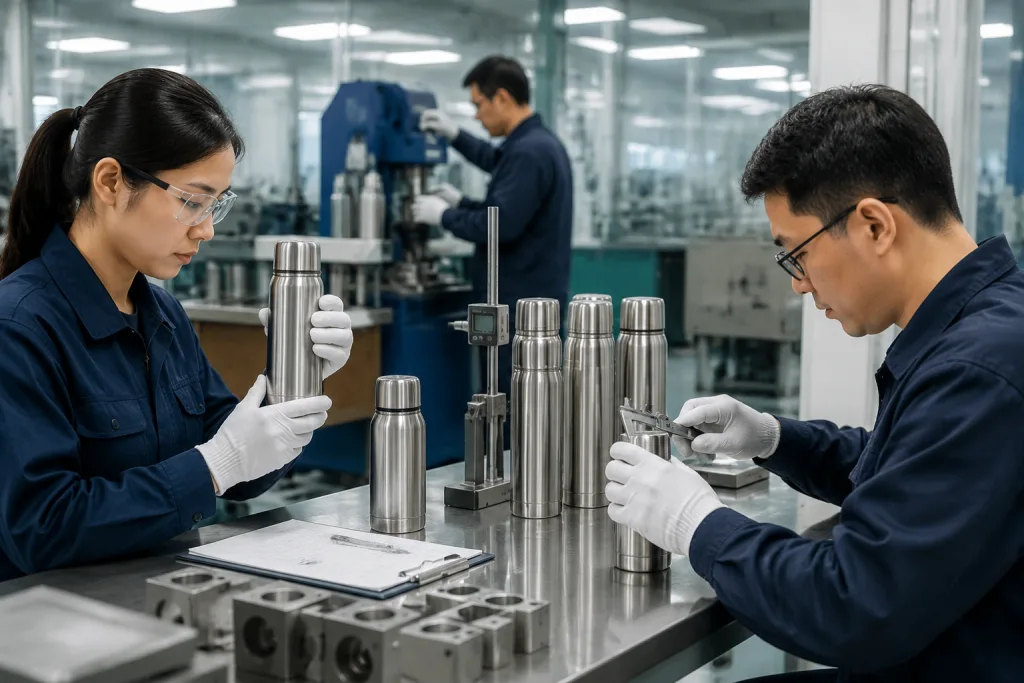
Warranty wording feels safe on a PO, but inspection stops the fight before it starts. For B2B flask orders, we run AQL instead of loose phrases like “good quality.” A common setting is AQL 2.5 for major defects and 4.0 for minor defects, with critical defects rejected at zero tolerance. If your retail channel wants tighter limits, tell the factory before the first sheet of 304 stainless goes to the hydraulic press, not after QC pulled the sample from packed cartons.
Major defects mean leaking lids, unstable standing, wrong capacity, sharp burrs, coating peeling, unreadable logos, wrong barcode, or carton damage that hurts saleability. Minor defects are small dust marks, slight color shift inside the signed tolerance, or tiny cosmetic points away from the main viewing face. Critical defects cover food-safety contamination, broken metal fragments, mold, dangerous sharp edges, or material substitution. We have seen one buyer flag a 500 ml flask because the test fill read 472 ml on the measuring cylinder. Fair call.
For distributor drinkware and distributor canteen shipments, carton checks are not boring details. The math doesn't work if a soft master carton sits under 6 layers in a mixed container. Use 5-ply export cartons for heavy growlers, keep gross weight preferably under 15-18 kg per carton, and add dividers for powder-coated bottles when the rub test shows contact marks after 30 shakes. If you ship to fulfillment centers, confirm carton dimensions, FNSKU or barcode placement, suffocation warning on polybags where needed, and whether the outer carton needs country-of-origin marking.
One practical rule: approve a golden sample and keep one at the factory, one at your office, and one with the inspection company. When the inspector checks mass production in Zhejiang, everyone compares against the same reference under the same light box, not someone’s phone photo. This avoids the classic fight where the sales sample was glossy, the mass order is satin, and the PO had “black finish” typed with no finish code.
Choosing the right supplier model
You can buy from a canteen factory, a trading company, or a hybrid canteen supplier. None is automatically good or bad. The better question is which risk sits on your desk: tooling control, mixed-item sourcing, or shipment paperwork. Last month a buyer sent us a PO with “750ML” in the title and “500ML” in the spec line, and that tiny mismatch stopped the line for 6 hours.
A direct canteen manufacturer gives tighter control over tooling, production schedule, and defect analysis. It fits repeated customized drinkware programs, private-label flasks, or a customizable canteen line with 4 colorways running on the same body. The tradeoff is simple: factories like focused SKUs and predictable volume. If you ask for 12 unrelated products at 300 units each, the math doesn't work, so the factory rejects it or prices it like a headache. We run wall-thickness checks with a digital micrometer, and a 0.05 mm change can affect both cost and vacuum performance.
A trading company makes sense when you need a mixed shipment, such as flask, glass bottle, lunch box, and 2 accessory sets in one container. The weak point is process control if they do not audit the workshops with real photos, AQL records, and packing-line checks. A hybrid supplier, like 20 to 30 export-focused drinkware companies in Zhejiang, manages factory production while handling artwork, testing, packaging, and shipment documents. That model works for canteen distributors who want fewer handoffs. We’ve seen this go sideways when the buyer flagged a logo color after mass production because nobody matched the Pantone chip under a D65 light box.
When you compare canteen vendors, ask for a quote sheet that includes material grade, capacity tolerance, unit weight, coating method, logo method, packaging, MOQ, sample cost, mold cost if any, lead time, Incoterm, payment term, and inspection standard. If one supplier gives only a single FOB price with no spec detail, do not compare it against a full quote. It is not the same offer. On our side, QC pulled the sample and found one lid gasket 0.8 mm thinner than approved, which looked small on paper but failed the leak test after 30 shakes.
For most B2B buyers, the safest starting point is not the cheapest flask. Start with a 304 stainless steel vacuum flask, 0.45-0.50 mm wall, powder coating, leak-tested lid, approved PP sample, AQL inspection, and FOB China pricing from a canteen vendor that can explain every line of the quote. Ask them what happens if 3 cartons fail inspection or if the powder coating shop is backed up by 12 days vs 18 days. A supplier who answers that clearly is usually easier to ship with.
Send your flask spec for a practical quote
Share capacity, logo, market, MOQ, and target FOB price. We will return a realistic China production option, not a mystery catalog quote.
Frequently asked questions
What MOQ should I expect for a vendor stainless steel flask order?
For an existing mold, expect 1,000 units per SKU/color as a normal MOQ from a China canteen manufacturer. Some factories accept 500 units for laser engraving on stock colors, but the FOB price may rise by USD 0.40-1.20 per unit because setup costs are spread over fewer bottles. For custom colors, custom lids, printed cartons, or retail packaging, 1,000-3,000 units is more realistic. If you need a canteen customized project with a new mold, the MOQ may move to 3,000-5,000 units, plus tooling cost. For first orders, I usually recommend one body mold, two colors, and one logo method rather than six weak SKUs.
Is 304 stainless steel always necessary for custom drinkware?
For most B2B custom drinkware sold in Europe and North America, 304 stainless steel is the practical baseline. It gives better corrosion resistance than 201 and is easier to explain to retail buyers, canteen distributors, and compliance teams. A 201 outer wall may be acceptable for a low-cost canteen promotional order, especially if the inner food-contact wall is 304, but you should declare it clearly. For coffee, acidic drinks, or long-term outdoor use, stay with 304 or consider 316 inner steel for premium programs. The price difference between 201 and 304 is often only USD 0.20-0.45 per unit, which is cheap insurance against complaints.
How long does sampling and production take from Zhejiang, China?
A normal stainless flask project from Zhejiang, China takes about 7-10 days for a pre-production sample after artwork approval, then 25-35 days for mass production after you approve the PP sample. Add 3-7 days for final inspection, packing corrections if needed, and export paperwork. If third-party food-contact testing is required, budget another 5-10 working days, sometimes more for multiple colors or lid materials. Ocean freight to North America or Europe usually adds 28-45 days port to port. For seasonal launches, count backward from your warehouse deadline and leave at least 10 days of buffer. Flask production is predictable; shipping schedules are less polite.
Which logo method is best for a customized canteen?
For a customized canteen that must last, laser engraving is the safest choice. It has a higher perceived value, does not peel like ink, and works well on stainless steel or powder coating. For large canteen promotional orders, one-color silkscreen is cheaper and can look sharp if the artwork is simple. Keep fine lines above 0.25 mm and avoid tiny reversed text. UV printing and heat transfer are better for full-color artwork, but you should test abrasion and adhesion before mass production. If your order is for retail shelves, approve a physical logo sample, not only a digital mockup. Curved bodies can distort artwork more than new buyers expect.
How do I compare quotes from different canteen suppliers fairly?
Force every canteen supplier to quote the same written specification. Include capacity, steel grade, wall thickness, unit weight, lid material, gasket material, coating type, logo method, packaging, carton strength, MOQ, Incoterm, lead time, and inspection standard. A USD 3.20 flask and a USD 4.10 flask may not be comparable if one uses 0.35 mm 201 steel and the other uses 0.50 mm 304 steel with powder coating. Ask for FOB Ningbo or FOB Shanghai if you are comparing Zhejiang or nearby China factories. Also ask whether testing, sample cost, and carton printing are included. Cheap quotes often move cost into later line items.