Key Takeaways
- A realistic custom thermos MOQ starts at 1,000 pieces per color for existing molds
- FOB Ningbo or Shanghai pricing usually ranges from USD 3.20 to USD 8.50 depending on capacity, steel, lid, and finish
- Standard bulk thermos lead time is 25-35 days after artwork and deposit approval
- New mold or lid tooling can add 18-35 days and USD 800-4,500 before mass production
If you are buying a vendor stainless steel bottle for an outdoor retail line or a promo drop, the bottle shape is not the hard part. The real fight is the quote sheet: why one factory offers USD 3.20 FOB Ningbo and another writes USD 6.80, then whether the cheap one survives a 1.2 m drop test, 40 days on the water, retail returns, and your launch window. We have seen this go sideways. QC pulled 24 samples from a 3,000 pcs pilot run last year, and 5 lids had a 0.4 mm sealing gap the buyer never saw in the photo sample.
Our factory in Hangzhou, Zhejiang, China produces stainless vacuum bottles for export buyers who want working numbers before they open a PO. A normal factory thermos program is not “pick a bottle and add a logo.” The cost moves when we run 304 stainless at 0.5 mm instead of 0.4 mm, change from stock lid to private tooling, switch laser logo to 2-color silk print, or pack each bottle in a 350 gsm color box instead of a white box. MOQ matters too: 1,000 pcs and 5,000 pcs do not sit on the line the same way, and the math does not work if the buyer asks for custom Pantone coating, spare straws, and AQL 2.5 inspection at sample-order volume.
Start with the bottle specification
A serious vendor stainless steel bottle quote starts with a specification sheet, not a product photo. Photos hide the cost drivers: inner steel grade, outer wall gauge, vacuum hold, lid stack-up, coating type, carton pack, and test standard. Ask 5 thermos suppliers for “500 ml stainless bottle with logo” and you will get 5 prices that look close on email but fail side-by-side once QC pulls the sample and checks the wall with a 0-25 mm micrometer. Wrong starting point. The spec sheet comes first.
For outdoor retail, we normally suggest 18/8 stainless steel, also written as SUS304, for the inner wall. For promotional thermos orders under hard price pressure, some buyers accept SUS201 on the outer shell, but the inner wall should stay SUS304 if the bottle touches drinks. Typical wall thickness is 0.4-0.5 mm for the inner shell and 0.5-0.6 mm for the outer shell. Thinner steel can cut FOB cost by USD 0.15-0.35 per unit, but the math often breaks after the first dent claim. We have seen this go sideways on club-store pallets where the buyer flagged 23 dented bottles from 2 cartons after a drop on the packing bench.
Capacity changes more than steel weight. A 350 ml promotional thermos also packs better, often 48 pcs per carton instead of 24 pcs for a 1,000 ml outdoor bottle, so the container math moves fast. A 1,000 ml outdoor bottle uses more steel, needs a stronger lid, and takes more time on the polishing wheel and powder coating line. As a rough FOB China range for existing molds, 350-500 ml bottles usually sit at USD 3.20-5.20, 600-750 ml at USD 4.20-6.80, and 900-1,200 ml at USD 5.80-8.50. These are realistic manufacturer thermos numbers we ship, not catalog fantasy prices.
FOB cost drivers buyers miss
The biggest cost driver is not always stainless steel. For a customized thermos, the lid often costs more than the body change. We run this quotation fight every month. A simple screw lid with PP inner parts may add USD 0.45-0.80. A leakproof carry-loop lid with silicone grip, spring button, or dual drinking mode can add USD 0.90-1.80. If the lid needs a new mold, tooling may cost USD 1,200-4,500 and require 20-30 days before sampling. Last week the buyer flagged a USD 0.62 lid increase, then QC pulled the sample and found the 0.8 mm silicone gasket was the part doing the real work.
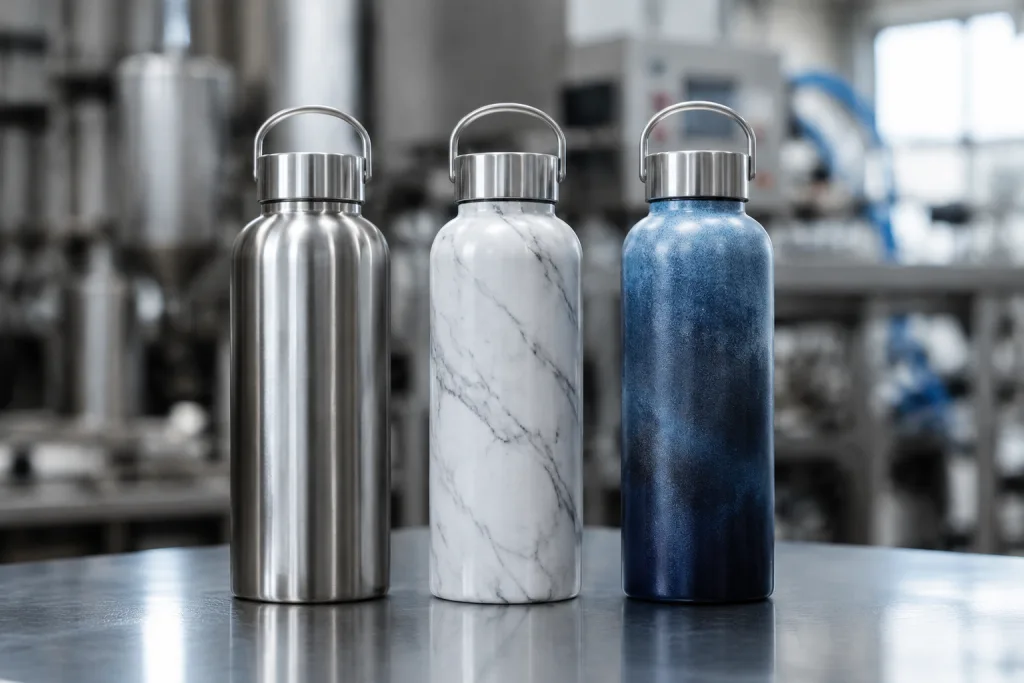
Surface finish is the next cost driver. Plain brushed stainless is the safest low-cost option. Powder coating adds about USD 0.35-0.75 per bottle, depending on color, coating thickness, and defect tolerance. On the line, we check coating with a cross-hatch cutter and 3M tape before packing; weak adhesion shows up fast. Soft-touch coating looks good for a promotional thermos, but scratches more easily and needs stricter carton protection. A glitter, gradient, rubberized, or ceramic-look finish can push decoration and rejection cost higher by another USD 0.40-1.20. The math doesn't work if the buyer asks for premium finish and then wants supermarket-level carton specs.
Logo work looks small on a purchase order but changes production flow. One-color silk screen is usually USD 0.08-0.18 per position at volume. Laser engraving is around USD 0.12-0.35 depending on logo size and machine time. Full-wrap heat transfer can add USD 0.60-1.50 and requires more testing for adhesion. We had one PO typo last season: logo size written as 45 mm instead of 35 mm, and that pushed the laser station from 9 seconds to 14 seconds per bottle. If you need a thermos custom program with retail packaging, barcodes, hangtags, and color boxes, expect USD 0.25-0.90 for packaging before freight.
Testing and compliance also belong in the cost model. For Europe, you may need LFGB, REACH, and food-contact migration reports. For North America, 7 out of 10 retail buyers we ship for ask for FDA food-contact documentation, CPSIA for kids items, or ASTM-related checks depending on channel. A practical thermos manufacturer will tell you which reports already exist and which require paid lab testing. Ask this before the deposit. We've seen this go sideways when a buyer confirms artwork first, then learns the black mouth-contact PP part needs a fresh migration test.
MOQ tiers and pricing behavior
MOQ is not a punishment; it is how a thermos factory avoids wasting line setup, coating powder, packaging print, and inspection time. At BottleForge Industrial in Zhejiang, China, our standard MOQ for an existing stainless thermos mold is 1,000 pieces per color, with a workable export order starting around 3,000 pieces mixed across capacities or colors. We run about 600,000 drinkware units per month across stainless bottles, travel tumblers, and sports bottles, so a 3,000-piece thermos PO does not get buried behind a 120,000-piece chain-store order. The line still needs a 2-hour mold check, sample weigh-in on the digital scale, and one signed color card before mass production starts.
For 1,000-2,999 pieces, expect the highest unit price. No surprise there. The factory still has to set up polishing wheels, powder coating guns, laser or silk-screen logo fixtures, inner carton packing, AQL inspection, and export paperwork. At this tier, a 500 ml customizable thermos may cost USD 4.20-5.80 FOB depending on lid and finish. It fits pilot retail orders, regional distributor thermos programs, and corporate gifts where the buyer cares more about finish than shaving USD 0.18. Last month QC pulled the sample after the logo jig was 1.5 mm off center; on 1,000 pieces, that kind of reset hurts the math.
At 3,000-9,999 pieces, pricing works better. Logo plates, color setup, and carton printing get spread over more units. The same 500 ml customized thermos may fall to USD 3.75-5.20 FOB. This is the normal band for outdoor retailers launching a private-label bottle or promotional brands buying for a national event. We ship a lot of 5,000-piece runs in this bracket because the carton factory can print without a surcharge, and the coating room can finish one color in a full shift instead of stopping after half a pallet.
At 10,000 pieces and above, the savings are real but not unlimited. Steel, lids, coating, and cartons still have hard costs. You may see 5-12% reduction versus the 3,000-piece level, especially if you keep one lid, one body mold, and limited colors. Buyers sometimes expect 25% savings at thermos bulk volume; the math doesn't work unless the supplier thermos quote quietly changed the specification. We have seen this go sideways when a buyer flagged a lower price, then found the wall thickness had moved from 0.50 mm to 0.42 mm and the carton paper was downgraded. Ask what changed before you celebrate.
Lead time from sample to shipment
A clean lead-time plan starts before sampling. For an existing mold with your logo, pre-production samples normally take 5-10 days after artwork confirmation. If the buyer asks for a custom powder color matched to Pantone, we run 2 coated color panels on the spray line and add 3-5 days for approval. New lid, silicone plug, bottle shoulder, or special bottom shape is not “just a small change”; CNC prototype, 2D drawing check, and trial mold fitting can add 18-35 days before you even approve a sample. QC pulled one sample last month because the lid gap measured 0.6 mm over spec. That stopped the clock.
Once the purchase order, deposit, artwork, and packaging files are approved, mass production for a manufacturer thermos order usually takes 25-35 days for 1,000-10,000 pieces. Orders above 30,000 pieces may need 40-55 days, especially during March-May and August-October when 7 out of 10 China drinkware factories we talk with are packed with summer outdoor and Q4 promotional orders. The buyer often pushes for “30 days including inspection.” The math does not work if coating, vacuum testing, and carton printing all sit on the same week. A realistic timeline beats a heroic promise that fails one week before your vessel closing date.
Here is the schedule we use with new buyers: artwork check in 1-2 days, sample production in 5-10 days, sample courier in 3-6 days, final approval in 1-3 days, raw material and component preparation in 7-12 days, forming and welding in 5-8 days, vacuuming and temperature testing in 3-5 days, coating and curing in 4-7 days, logo and packing in 3-6 days, final inspection in 1-2 days, and truck delivery to Ningbo or Shanghai port in 1-2 days. On the line, the vacuum tester holds each bottle for the set reading, then QC checks heat retention again after 6 hours. Slow work. We have seen this go sideways when a PO says matte black but the carton mark file says “black glossy.”
If you sell through Amazon FBA, retail chains, or distributor thermos channels, add time for FNSKU labels, carton drop-test checks, pallet configuration, and booking. Sea freight to the US West Coast may take 18-28 days port to port; to Europe, often 28-40 days. Air freight can rescue a launch, but it can add USD 1.20-3.80 per unit on drinkware. For one 12 oz bottle order, the buyer flagged a 9 kg master carton because their warehouse limit was 8.5 kg, so we changed the inner quantity and lost 2 days before booking.
Decoration choices change risk
Decoration is where 7 out of 10 thermos vendor complaints start. A logo can look clean on a pre-production sample, then lift after 3,000 pcs if the ink spec is wrong or the curing tunnel is set at 145°C instead of 165°C. For outdoor retail, laser engraving is the safest bet. It does not peel. The catch: it only looks right when the stainless, powder coat, or paint gives enough contrast, and QC needs to check the first 20 pcs under the same light box before the line keeps running.
Silk screen works well for a promotional thermos with one or two colors. Use it for event logos or simple brand marks with text above 1.2 mm stroke width. The weak spots are tiny copy, curved shoulders, and abrasion after shipping. We run a 3M tape test and alcohol rub test on printed samples before bulk thermos production, and QC pulled one batch last month because the white ink smeared after 25 rubs. If your logo has a gradient, full-color illustration, or a wraparound mountain scene, heat transfer or water transfer is the better route, but build in a higher rejection allowance. The math does not work if the buyer expects silk-screen pricing with photo-grade artwork.
For a thermos customizable project with multiple SKUs, keep the decoration plan simple. One bottle body, two colors, one lid, and one logo method will move faster than six colors with artwork on four positions. Every variation needs its own setup, golden sample, and carton mark check. We have seen this go sideways when a PO typo listed “matte black” on page 1 and “satin black” on page 3, then the buyer flagged mixed cartons at AQL 2.5 inspection. This matters for distributors thermos orders because the end customer usually rejects shade variation between branches or event locations.
Color matching needs a blunt warning. Pantone on paper is not powder coating on stainless steel. Lighting changes it, coating thickness changes it, and the oven profile changes it again. For brand-critical colors, approve a physical color panel, not only a PDF. We keep the signed panel at the coating line, then compare every batch with a D65 light box and a 60° gloss meter reading before packing starts.
Quality checks before balance payment
Do not treat QC as a checkbox at the end. A stainless vacuum bottle has failure points you will not spot in a carton photo. We have seen a 0.3 mm weld pinhole, a weak vacuum, a deformed lid gasket, chipped coating, and a crushed outer carton after a rough truck ride. Put the inspection standard, defect definition, and AQL level into the PO before the line starts.
For export orders, AQL 2.5 for major defects and AQL 4.0 for minor defects is a workable baseline. Critical defects stay at zero. For retail-grade stainless thermos orders, we run hot-water retention tests with 95°C water at fill, then check again at 6 hours and 12 hours by model. A 500 ml double-wall bottle should usually stay above 55-65°C after 6 hours, but wide-mouth cups and straw lids do not behave the same. One buyer once asked for “all lids same result”; that math does not work.
Leak testing should cover inverted bottles, shake tests, and 50 open-close cycles on the lid. For powder coating, check cross-hatch adhesion, tape pull, rub resistance, and visible marks under normal light from 60 cm away. For packaging, a 76 cm carton drop test is common for export cartons under many retailer rules, though some channels ask for ISTA instead. We had one carton fail because the bottom tuck flap was 3 mm short, and QC pulled the sample right away.
When you work with thermos manufacturers in China, ask for production photos, but do not rely on them alone. For first orders, arrange pre-shipment inspection by your own QC team, our internal QC report, or a third-party inspector. Balance payment should wait for inspection approval, not just “goods finished.” That is the cleaner move, and it keeps pressure on both sides without starting a fight. One typo on a PO can cost a week, so we check the spec line by line before we ship.
How to brief a supplier
The quickest way to get a usable quote from thermos suppliers is a tight brief. Put in capacity, lid type, stainless grade, finish, logo method, color count, packaging, market for compliance, order quantity, target ship date, and trade term. If you have an FOB target, write it down. On our line, we can price a 500 ml bottle in minutes when the brief is clean, but a vague PO usually sends the sales desk back to QC for a sample check. A solid supplier will tell you straight away if the target works or which spec is blowing up the cost.
A good brief sounds like this: “We need a 600 ml double-wall vacuum stainless bottle for outdoor retail, SUS304 inner, powder-coated body, leakproof carry lid, laser logo, color box, REACH and LFGB support, 5,000 pieces across two colors, FOB Ningbo, goods ready by June 20.” That is enough for a thermos manufacturer to quote with real numbers and spot risk. The buyer once flagged a cap typo on a PO, and that small mismatch turned into a new mold check, so the math starts with the details.
A weak brief says: “Send best price for custom bottle.” That question is wrong. Some thermos factories will quote the thinnest wall, cheapest lid, plain carton, and no testing just to win the email. Then every real requirement lands as an extra charge. We have seen this go sideways more than once, and two weeks disappear while nobody can pin down the true landed cost.
If you are comparing a thermos distributor, a trading company, and a direct manufacturer, compare service scope and FOB price together. A distributor may have local stock but limited customization. A direct thermos factory can control molding, coating, and QC, but it needs clearer planning and MOQ. For private-label outdoor retail and repeat promo runs, direct sourcing from Zhejiang or another China production base usually gives better control once the spec is stable. We run that way every day.
Send your thermos brief for a firm quote
Share capacity, logo, quantity, market, and delivery date. We will reply with MOQ, FOB pricing, sample timing, and production risks.
Frequently asked questions
What MOQ should I expect for a custom stainless thermos?
For an existing mold, a realistic MOQ is 1,000 pieces per color and about 3,000 pieces for an efficient export order. If you need a customized thermos with a new lid, private mold, exclusive body shape, or special coating, the MOQ often moves to 3,000-5,000 pieces because tooling, testing, and line setup need volume. For simple laser logo work on a current model, 500 pieces may be possible for sampling or a paid pilot, but the FOB unit price will be noticeably higher. Outdoor retailers should plan 3,000-10,000 pieces for a serious first run.
How much does a vendor stainless steel bottle cost FOB China?
For standard double-wall stainless models, expect roughly USD 3.20-5.20 FOB for 350-500 ml, USD 4.20-6.80 for 600-750 ml, and USD 5.80-8.50 for 900-1,200 ml. These ranges assume existing molds, SUS304 inner steel, normal vacuum construction, and export cartons. Powder coating, special lids, retail color boxes, full-wrap printing, or stricter testing can add USD 0.30-2.50 per unit. If a quote is 20-30% below this range, check steel grade, wall thickness, lid material, carton strength, and whether compliance documents are included.
Can I get my own Pantone color and logo?
Yes, a customizable thermos can use your Pantone color and logo, but you should approve physical samples. Powder coating on stainless steel does not match paper Pantone chips perfectly. We normally prepare color panels in 3-5 days, then produce a pre-production sample after approval. Logo options include silk screen, laser engraving, pad printing, heat transfer, and embossed parts if tooling is justified. Laser engraving is the most durable; silk screen is cheaper for one or two colors. For brand-critical retail programs, approve the bottle finish, logo size, and carton artwork before deposit-driven mass production starts.
How long does bulk thermos production take?
For existing molds, bulk thermos production normally takes 25-35 days after deposit, artwork approval, and sample confirmation. Add 5-10 days for samples and 3-6 days for courier delivery if you need physical approval. New lid or body tooling can add 18-35 days before mass production. Large orders above 30,000 pieces may need 40-55 days, depending on coating capacity and component availability. You should also add freight time: about 18-28 days to the US West Coast by sea and 28-40 days to many European ports.
What quality standard should I put on the purchase order?
Use AQL terms and clear defect definitions. A common baseline is AQL 2.5 for major defects, AQL 4.0 for minor defects, and zero critical defects. List required checks: vacuum retention, leak test, lid fit, coating adhesion, logo position, carton drop performance, barcode scan, and packaging accuracy. For retail or Amazon FBA, also specify FNSKU label placement, master carton weight, and pallet requirements. For Europe, ask about LFGB and REACH support; for North America, request food-contact documentation. Do this before production, not after the goods are packed.