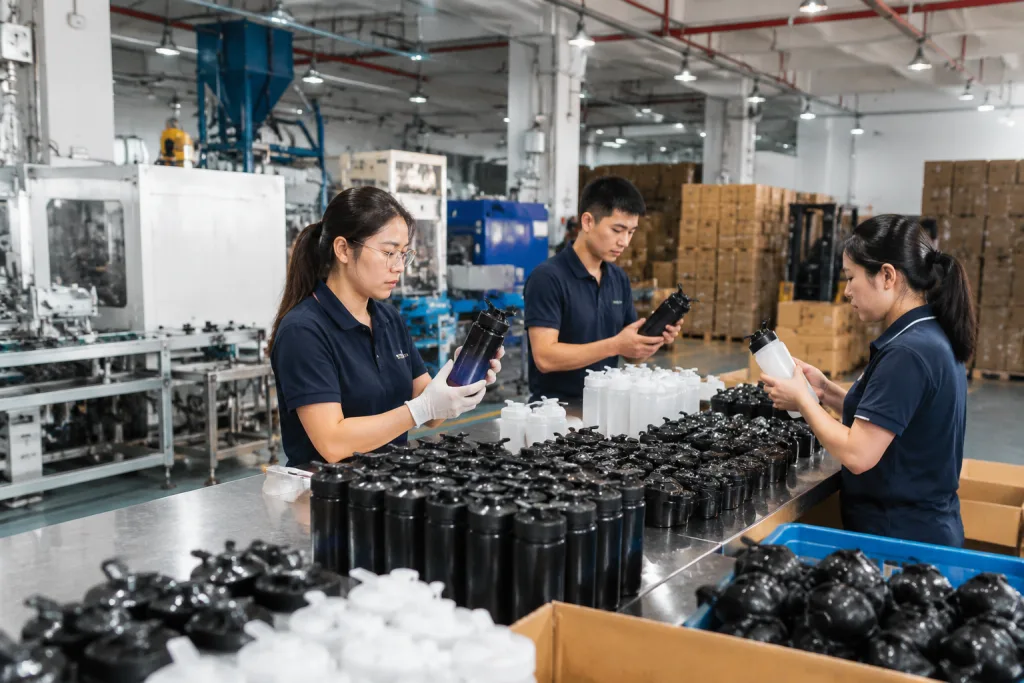
Key Takeaways
- Typical MOQ for custom logo sports bottles starts at 1,000 units per color and 3,000 units for molded custom colors
- A reliable gym bottle lid needs a leak test at 100% production or at least AQL 2.5 for major defects
- FOB China pricing usually ranges from USD 1.20 to USD 4.80 depending on Tritan, PP, stainless steel, and shaker parts
- Plan 25-35 days for repeat orders and 40-55 days when new tooling, color matching, or retail packaging is required
If you are buying a vendor sports water bottle for a 24-club gym chain, race event, supplement brand, or fitness retail program, finding a bottle is the easy part. China has thousands. The hard part is choosing one that survives 1.2 m drop tests, 65°C dishwasher cycles, sweat-covered hands, and members who expect the logo to still look sharp after six months. QC pulled a 750 ml sample last month with a loose flip lid after 300 open-close cycles; the buyer flagged it before we even talked about color.
Start with four calls: material, lid system, branding process, and inspection standard. Then the numbers fall into place: MOQ, tooling cost, carton size, FOB price, and lead time. We’ve seen this go sideways when buyers treat a custom sports water bottle like a cheap giveaway instead of a product with leak points, scratch risk, and real daily abuse. On the line in Hangzhou, Zhejiang, a 0.3 mm wall-thickness change or one wrong logo Pantone on the PO can turn a clean reorder into 12 days of back-and-forth emails.
Choose the bottle job first
Before you ask for a quote on a bulk sports water bottle, decide what the bottle has to survive in the member’s hand. A gym check-in gift is not built like a retail shaker sitting beside protein powder. A cycling studio bottle gets squeezed 80-120 times in one class. A strength-training bottle gets dropped on 15 mm rubber flooring, usually with the cap hitting first. For a distributor sports water bottle covering 6-10 accounts, broad appeal and stable repeat stock beat a fashionable shape; we have seen this go sideways when a buyer loved the sample, then the line could not keep the color cap in stock for the second PO.
Use a blunt filter. For high-volume member onboarding, we run the numbers around low unit cost, 18-22 day lead time, and a lid that passes a 30-minute upside-down leak test in a PE gym bag. For merchandise, focus on finish, hand feel, and packaging that does not crush at the corners; QC pulled the sample last month because the color box gap was 3 mm too wide after drop testing. For supplement use, choose a bulk shaker bottle with a mixing ball, strainer, or agitator insert. For youth programs, add bite-valve safety, smaller capacity, and ASTM or CPSIA checks where applicable. Cheap is the wrong first question here.
Capacity is not just a marketing number. A 500 ml bottle works for boutique studios and class packs. A 650-750 ml customizable sports water bottle is the safe middle for most gym chains. A 1,000 ml bottle looks strong but raises freight cost and carton volume; you may ship 30-40% more air if the shape nests badly. We check this with a carton mock-up, tape measure, and gross weight sheet before quoting, because the math does not work when a 12 kg carton becomes 15 kg just to hold a taller shoulder design. For distributor gym water bottle programs, we normally suggest one 700 ml main SKU and one 900-1,000 ml premium SKU instead of five weak variants.
Good sourcing starts when you stop asking “what is cheapest?” and start asking “what failure can my customer not forgive?”
Match material to selling channel
Material sets the landed cost, the food-contact paperwork, the mold plan, and the hand feel on shelf. For most fitness brands, we run four workable materials: PP, PE, Tritan, and stainless steel, but we quote them against different channels. A 12,000 pcs gym promo order is not the same job as a 3,000 pcs retail insulated launch. Wrong question to ask: “Which material is best?” Ask where it sells and what complaint you cannot afford. We have seen buyers push a USD 1.20 PP squeeze bottle spec toward a USD 4.50 insulated stainless feel, and the math does not work.
PP fits a bulk gym water bottle where the buyer cares about unit price and the body shape stays simple. It is light, survives normal promo use, and works well for shaker cups with a basic injection lid; our line usually checks cap fit with a 0.20 mm feeler gauge before packing. Food-grade PP should be BPA-free and tested to LFGB, FDA, or EU food contact requirements based on your selling market. PE squeeze bottles suit cycling-style sports programs, but they read more like event giveaway than premium retail.
Tritan is the safer middle lane for a custom fitness water bottle. It is clear, tough, and easier to sell through retail because the buyer can see the water line and logo print. You can add a flip straw lid, time marker, silicone sleeve, or carry handle, but do not stack every feature unless the target price allows it. A 700 ml Tritan custom gym water bottle typically lands around USD 2.10-3.60 FOB China depending on lid complexity and logo process. QC pulled the sample last month because a time-marker screen print shifted 1.5 mm after heat transfer, and scratches show faster on clear Tritan than on opaque PP.
Stainless steel makes sense when your fitness brand wants a premium retail product, not a throw-in gift. For single-wall bottles, 0.5-0.6 mm wall thickness is common. For vacuum insulated bottles, 304 stainless steel inside and outside is the normal specification, with 201 sometimes used outside for budget programs. Be careful here. If your bottle touches sweat, salt, and dishwasher habits, cheap outside steel creates after-sales noise; we have seen this go sideways after 18 days of warehouse dampness versus a clean 12-day inland transit. Zhejiang factories can make strong stainless bottles, but the grade must be written on the PI and test report, not buried in a WeChat message.
Lid design is the risk area
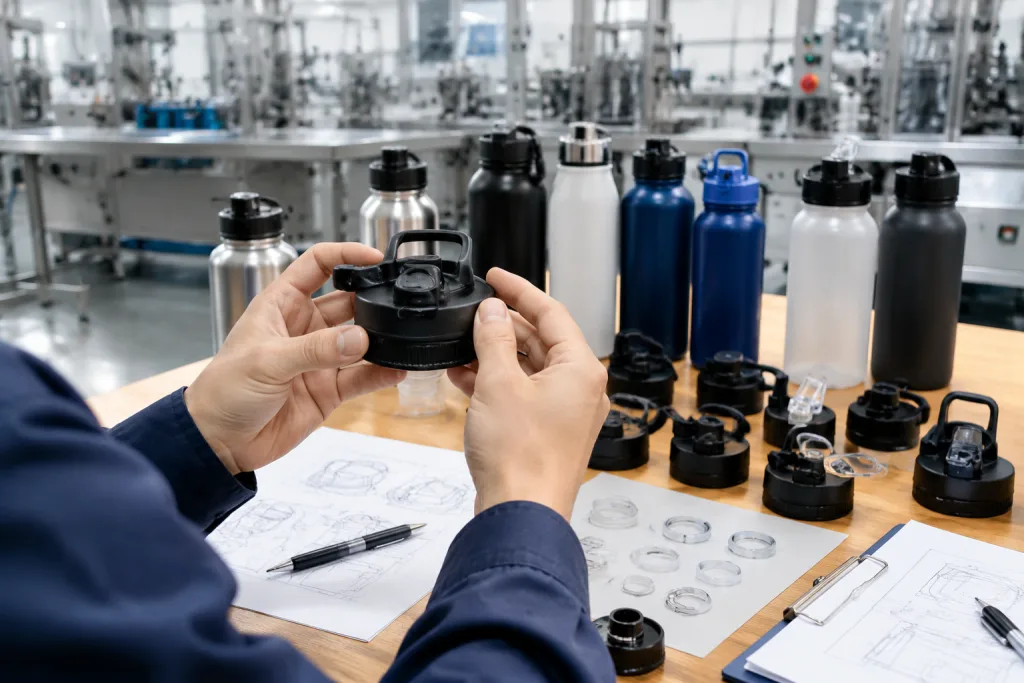
Most bottle complaints start at the lid, not the body. We see this on the line every month: hinge pins under 2.0 mm, gaskets sitting 0.3 mm proud, or threads that feel soft after 30 open-close cycles. A customized sports water bottle can pass drop testing and still come back if the lid leaks in a gym bag. For gym chains, the lid decides the use case: one-hand drinking during class, straw sipping on a treadmill, protein shaking after training, or clipped carry from locker to studio.
For a custom shaker bottle, check thread engagement with a torque meter, then pull the gasket and look for flashing under a 10x loupe. Mixing insert stability matters too; QC pulled one sample last quarter where the ball rattled loose after 8 minutes on our test shaker. A custom logo shaker bottle may look simple, but the cap has to survive repeated twisting when powder residue sits in the thread. We run torque testing, upside-down leak testing, and 24-hour water retention checks before mass production approval. For a custom made shaker bottle with new mold parts, add a pilot run of 100-300 units before the full order.
For a customizable gym water bottle with straw lid, check the straw seal and button spring first. Then check the vent hole with water inside, not on an empty sample. One-click lids sell well in buyer meetings, but every extra part adds one more place to fail. This is where the math can go sideways. A simple screw cap with silicone gasket may look less sporty, but for distributors gym water bottle programs where one SKU ships to 40 clubs, it is often the safer choice.
Do not approve lid samples by photo. Ask for 3-5 physical samples from the exact mold, filled with water, capped at normal hand torque, and shipped by courier. If one sample leaks after air shipment, mass production will not fix itself. We had a PO once with “black lid” typed as “back lid,” and the buyer flagged it only after the courier samples arrived. BottleForge Industrial in Hangzhou, Zhejiang runs monthly output of about 420,000 drinkware units across sports bottles, tumblers, and shakers, and lid QC is where we spend more inspection time than buyers expect.
Branding should fit usage abuse
Logo decoration is where about 6 out of 10 custom sports water bottle projects get overbuilt. The right print method depends on the bottle material, logo colors, order quantity, and wash method written on the buyer’s spec sheet. For one-color gym chain branding, we still run silkscreen most weeks. It works. A one-color logo on PP or Tritan often adds USD 0.08-0.18 per unit at 1,000-3,000 units, and QC checks it with 3M tape plus a 30-cycle rub test before the line packs cartons.
Heat transfer fits full-color graphics, gradients, or retail wrap artwork, but the math does not work if the buyer only needs a small chest logo. It costs more and needs adhesion testing on curved walls or textured grip zones; we have seen wrap edges lift by 1.5 mm near the parting line after hot-water washing. UV printing is clean for smaller graphics and multi-color logos, but some powder-coated surfaces reject it unless the coating surface tension is right. Laser engraving is excellent on stainless steel because it cannot peel, though it is usually one-color by nature because it exposes the metal or underlayer.
If you need a customized shaker bottle for supplement retail, think about the logo and the measurement marks at the same time. Buyers often forget that ml/oz marks, protein scoop guides, and compliance icons eat printable area, especially on a 600 ml body with a tapered waist. QC pulled the sample last month because the 400 ml mark sat 4 mm too low after the artwork was stretched. On a bulk shaker bottle, the logo may share the same print plate with measurement marks to control cost, but that locks you in when marketing asks for a later logo change.
Color matching is another trade-off. Standard factory colors ship faster and cost less. Pantone-matched plastic or powder coating usually requires MOQ around 3,000 units per color, sometimes 5,000 for special resin. Expect a color sample approval loop of 5-7 days, not 2 days, because the mixing room still needs trial chips and a light box check. For China production, put the Pantone code, gloss level, and acceptable Delta E tolerance in writing. “Navy blue” is not a spec. It is an argument waiting to happen.
Build the quote around landed cost
A low FOB quote can still be the wrong buy. For a bulk fitness water bottle, we price landed cost from day one: unit price, logo charge, mold charge, inner box, carton volume, freight, duty, inspection, and warehouse handling. This is the wrong question to ask: “What is your cheapest FOB?” Last month QC pulled a 1,000 ml curved-handle sample; it looked fine on the bench, but the carton jumped to 0.086 cbm for 24 pcs, so the sea freight ate the USD 0.18 factory-gate saving before it reached the distribution center.
Typical FOB China ranges are steady enough for planning. A basic PP sports bottle may sit around USD 1.20-1.90. A PP custom shaker bottle is often USD 1.50-2.80 depending on mixing parts and cap style; a 3-piece agitator adds cost and slows the line during assembly. A Tritan customized fitness water bottle usually ranges from USD 2.10-3.80. Single-wall stainless steel can be USD 2.60-4.20, while vacuum insulated sports bottles run higher based on capacity and finish. These are planning ranges, not promises. Resin price, exchange rate, and carton design can move them in 7 days; we have seen a 2 mm thicker insert tray add USD 0.11 per set after the buyer flagged drop-test dents.
For North American gym chains selling through ecommerce or club stores, ask whether the supplier can support FNSKU labeling, barcode stickers, polybag warnings, carton marks, and master carton weight under your warehouse limit. We run this on the packing table with a Zebra printer and a 30 kg bench scale, not in a sales deck. For European distributors fitness water bottle programs, confirm REACH, LFGB, and packaging waste requirements early. If you need BSCI audit documentation for your retail customer, ask before sampling, not after deposit; we have seen this go sideways when the PO had “LFGB” typed in the remarks but the approved sample request only said “food grade.”
Payment terms change the real cost. Standard terms are often 30% deposit and 70% before shipment. For repeat distributor shaker bottle orders, some factories discuss credit terms after 3-5 clean shipments, but new buyers should not build their cash plan around that. The math doesn't work. A serious quote should state MOQ, lead time, FOB port, packaging, logo method, sample fee, and validity period, usually 15-30 days; our merchandiser also checks the PO for small traps like “Ningbo” written on page 1 and “Shanghai” on the carton mark page.

Set inspection rules before deposit
Quality control should not sit as a polite note at the bottom of a purchase order. Put it into the sourcing decision before you pay the deposit. For a custom sports water bottle, we set the inspection plan across incoming material, pre-production sample approval, in-line checks, and final random inspection. On our line, QC uses a 0.02 mm caliper on lid thread fit before assembly starts. Inspect only after cartons are sealed, and you can still reject defects, but the math doesn't work: rework can turn a 12-day shipment window into 18 days.
For mass production, AQL is the common language. AQL 0 for critical defects, 2.5 for major defects, and 4.0 for minor defects is a practical starting point for drinkware. Critical defects include sharp edges, contamination, wrong material, severe leakage, and unsafe small parts. Major defects include logo misplacement, functional lid failure, heavy scratches, wrong capacity, or poor thread fit. Minor defects are small cosmetic marks that do not affect use. Last month QC pulled 32 samples from a 3,000 pcs run and found 2 lids with rough mouth edges after trimming; that stayed in major until the blade was changed.
Ask for functional tests that match gym use. Be specific. Drop test the filled bottle from 1.0 meter onto a hard surface. Run a 24-hour leakage test upside down and horizontal. Check dishwasher claims only if the material and print process support it; on decorated bottles, we often push back and mark hand-wash recommended, even when the buyer wants a dishwasher icon on the insert. For stainless steel vacuum bottles, test insulation with hot water over 6-12 hours and check vacuum failure rate. We use a water bath gauge and record the starting temperature, not a “looks warm enough” note.
For a customizable fitness water bottle order, keep a signed golden sample at the factory and one in your office. The golden sample should include final logo, color, lid, packaging, barcode, and instruction insert. We prefer buyers to approve by couriered sample, not just video. We've seen this go sideways when a PO typed “Pantone 299C” while the approved cap was 293C, and the buyer flagged it only after 40 cartons were packed. In Zhejiang and wider China manufacturing, most of these problems are preventable when the factory has a physical target to match.
Plan ordering like a program
One launch order is simple. A full-year fitness bottle program needs SKU control. We’ve seen this go sideways when a 40-gym chain approved 9 body colors, 4 lids, and 3 carton marks, then found the reorder MOQ did not match club-level demand. Decide which bottles are core runners, which ones are seasonal, and which ones only belong to events. A distributor fitness water bottle program usually works better with 2-3 neutral stock colors and fast logo swaps on the pad-printing jig. A brand-owned custom gym water bottle program can push tighter Pantone control, dedicated inserts, and retail packaging, but the math has to support it.
Normal timing is 7-10 days for sampling, 25-35 days for repeat mass production, and 40-55 days for new molds or custom colors. Add ocean freight time of roughly 25-40 days to North America or Europe depending on port and season. Air freight works for 500 emergency top-ups, not for 8,000 bulky bottles; the freight bill can eat the whole margin. If the gym opening date is fixed, work backward from that date and add a 10-day buffer. QC pulled one launch sample last year because the silicone ring sat 0.6 mm proud, and that tiny gap became a leak after the drop test.
For distributors shaker bottle and distributors fitness water bottle buyers, we usually run a base model with interchangeable decoration: same bottle, same lid, same carton, different logo panels on the print film. That keeps MOQ under control and cuts spare-lid confusion in the warehouse. For brand owners, a custom handle, lid texture, or molded grip starts to make sense when annual volume exceeds 20,000-30,000 units. Below that level, this is the wrong question to ask. Use existing molds, then spend the budget on better material, AQL 2.5 inspection, stronger logo adhesion, and a carton that survives a 16 kg stack test.
A vendor sports water bottle is not just a product line item. It carries your gym’s name into lockers, cars, offices, and social posts. Treat sourcing like a program, not a one-time PO. The line needs clean specs: cap torque, logo size in mm, carton mark, spare gasket ratio, and ship date. Do that, and you avoid the usual mess we see buyers flag: leaking caps, vague quotes, weak logos, missed launch dates, and cartons that cost too much to move.
Source your gym bottle program with fewer surprises
Send your target capacity, logo file, quantity, and market. BottleForge will return practical options with MOQ, FOB China pricing, and lead time.
Frequently asked questions
What MOQ should a gym chain expect for custom sports water bottles?
For existing molds, a realistic MOQ is 1,000 units per color for most PP, Tritan, and stainless models. If you need Pantone-matched plastic, custom powder coating, or a new molded lid, MOQ usually moves to 3,000-5,000 units. A custom shaker bottle with standard colors can often start at 1,000 units, but a custom made shaker bottle with new tooling may need 5,000 units to make the mold cost sensible. For multi-location gym chains, we recommend consolidating club orders into one production run, then splitting cartons by location with clear labels.
Which material is best for a bulk gym water bottle?
There is no universal best material. PP is the lowest-cost option for a bulk gym water bottle or bulk shaker bottle and works well for member welcome kits. Tritan is better for a custom fitness water bottle that needs a clear retail look and better perceived value. Stainless steel is the right choice when you want a premium product, especially for retail sales or loyalty gifts. For most gym chains, a 700 ml Tritan bottle or a 600-700 ml PP shaker gives the best balance of cost, durability, and member acceptance.
How long does production take after sample approval?
For repeat orders using existing molds and standard colors, production normally takes 25-35 days after deposit and artwork confirmation. A new customizable sports water bottle with Pantone color matching, retail box, or new lid tooling usually needs 40-55 days. Sampling adds 7-10 days, plus courier time. If you ship by sea, add about 25-40 days to Europe or North America depending on port congestion. For fixed gym openings, approve samples at least 75-90 days before the required delivery date.
Can we use one bottle design for multiple gym locations?
Yes, and it is often the smartest setup. Use one bottle mold, one lid, one packaging structure, and change only the logo, location name, or barcode. This keeps MOQ lower, reduces QC variation, and makes reordering easier. For example, you can run 5,000 units total across five gym locations if each location uses the same bottle color and only changes the print. If each location wants a different bottle color, the factory may treat each as a separate 1,000-unit MOQ color batch.
What quality tests should we require before shipment?
Require a final random inspection using AQL, normally 0 for critical defects, 2.5 for major defects, and 4.0 for minor defects. For a custom logo shaker bottle or customized gym water bottle, include leak testing, thread fit checks, logo adhesion, capacity verification, carton drop testing, and barcode scanning if retail packaging is used. For stainless steel bottles, add insulation testing and rust-resistance review. Ask for photos and short videos from the inspection, but do not rely only on factory self-checks for orders above 3,000 units.